

Close Menu
Bodybuilding Wizard

    Subscribe to Updates

    Join our mailing list to receive the latest updates from our team.

    Facebook X (Twitter) Instagram
    Trending
    • Decline Machine Press (Hammer Strength Decline Press): How To, Muscles Worked, Benefits & Alternatives
    • Ring Dips: How To, Muscles Worked, Benefits & Alternatives
    • Reverse-Grip Incline Dumbbell Press: How To, Muscles Worked, Benefits & Alternatives
    • Landmine Chest Press: How To, Muscles Worked, Benefits & Alternatives
    • Reverse-Grip Bench Press: How-To, Muscles Worked, Benefits & Alternatives
    • Dumbbell Squeeze Press (Hex Press): How To, Muscles Worked, Benefits & Alternatives
    • Muscle-Tendon Unit: How Muscles Transfer Force to Bones
    • Anatomical Position and Directional Terms: A Guide for Lifters
    RSS Facebook X (Twitter) LinkedIn YouTube Pinterest Instagram
    Bodybuilding Wizard
    Subscribe Login
    • Home
    • Tools
      • Interactive Muscle Anatomy
      • Interactive Human Skeleton
      • Bodybuilding & Fitness Calculators
      • Dietary & Nutrition Calculators
      • Body Measurement Calculators
      • Fitness Tests
      • Bodybuilding Glossary
      • DIY Projects
    • Training
      • Weight training basics
      • Advanced bodybuilding
      • Strength training for women
      • Workout programs
      • Home weight training programs
      • Cardio workout
      • Exercise equipment
      • Weight training accessories
      • Weight lifting injuries
      • Weight training for sports
    • Exercises
      • Chest exercises
        • Middle chest exercises
        • Upper chest exercises
        • Lower chest exercises
      • Back exercises
        • Middle back (latissimus dorsi)
        • Upper back (trapezius)
        • Lower back (erector spinae)
      • Arm exercises
        • Bicep exercises
        • Tricep exercises
        • Forearm exercises
        • Grip-strengthening exercises
      • Shoulder exercises
        • Front deltoid
        • Side deltoid
        • Rear deltoid
        • Rotator Cuff
        • Scapular & Shoulder Stability
        • Neck strengthening exercises
      • Leg and glute exercises
        • Quadricep exercises
        • Hamstring exercises
        • Calf exercises
        • Glute & Hip exercises
        • Shin exercises
      • Abdominal exercises
        • Upper abdominal exercises
        • Lower abdominal exercise
        • Oblique exercises
      • Core exercises
      • Kettlebell exercises
      • Foam rolling & Stretching
      • Explosive (dynamic) lifts
    • Motivation
      • Greatest physiques
      • Motivation techniques & tips
      • Events and competitions
      • Latest fitness news
      • Videos
        • Funny gym reels
        • Motivational videos
        • Funny workout videos
      • Pictures
      • Quotes
      • Funny Fitness
      • Transformations
    • Diet
      • Nutrition Fundamentals
      • Diet Types & Strategies
      • Foods & Superfoods for Athletes
      • Muscle Building & Performance Nutrition
      • Weight Loss & Fat Management
      • Food Psychology & Myths
      • Recipes & Meal Ideas
    • Supplements
      • Supplements Review
      • Muscle Building Supplements
      • Anabolic Steroids
      • Fat Burners & Weight Loss
      • Pre-Workout & Energy Boosters
      • Recovery & Sleep Aids
      • Cognitive & Nootropic Support
      • General Supplement Advice
      • Health Supplements
        • Joint & Bone Support
        • Gut Health & Digestion
        • Vitamins & Minerals
        • Superfoods & Greens
      • Steroid Alternatives
    • Anatomy
      • Upper-Body Muscles
      • Lower-Body Muscles
      • Bones & Skeletal Anatomy
      • Muscle Growth & Genetics
      • Joints, Tendons & Connective Tissue
      • Hormones & Endocrine System
      • Physiology & Body Systems
      • Body Composition & Fat
      • General Anatomy & Basics
    • Health
    Bodybuilding Wizard
    You are at:Home»Exercises»Shoulder exercises»Scapular & Shoulder Stability»Overhead Carry Exercise Guide
    Scapular & Shoulder Stability

    Overhead Carry Exercise Guide

    No Comments5 Mins ReadkrunoslavBy krunoslavFebruary 1, 2026
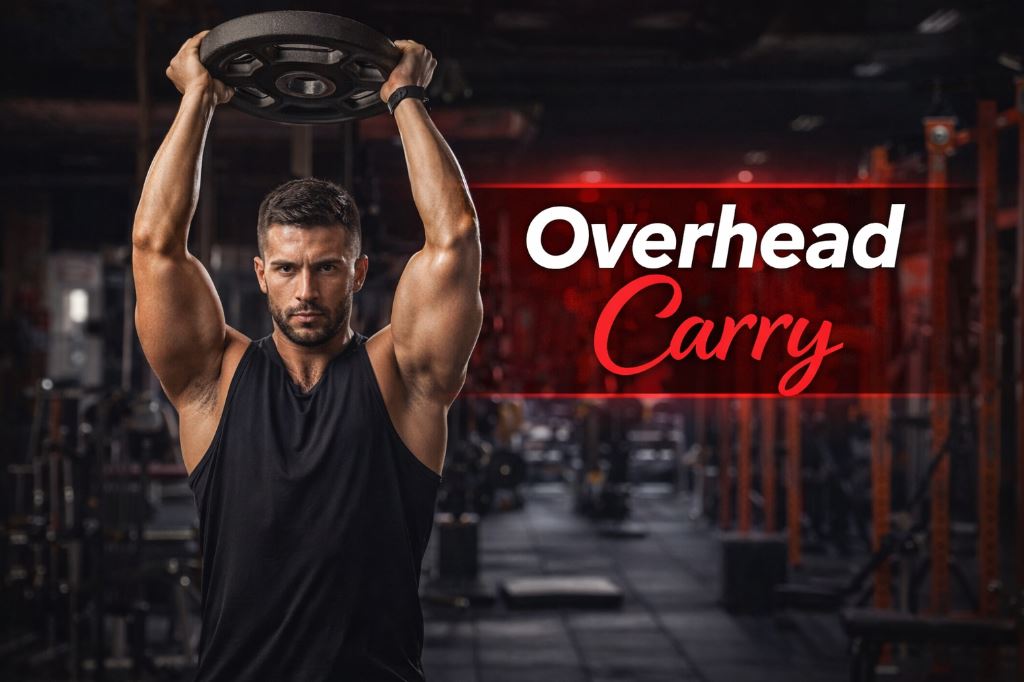
    Muscular man performing overhead carry exercise in a gym, holding a weight plate overhead with stable posture
    Share
    Facebook Twitter Pinterest LinkedIn Email Tumblr WhatsApp Telegram

    The overhead carry is a highly effective full-body stability exercise that challenges the shoulders, core, and upper back while reinforcing proper posture under load. Unlike traditional carry variations, this movement places the load overhead, forcing the body to maintain alignment, balance, and scapular control throughout locomotion.

    This exercise is widely used in athletic training, shoulder rehabilitation progressions, and functional strength programs for its ability to integrate mobility, stability, and strength into a single movement.

    Equipment Needed

    The overhead carry can be performed with minimal equipment, making it versatile across training environments.

    • Dumbbells
    • Weight plate
    • Kettlebells
    • Barbell (advanced)
    • Open a training space for walking

    Step-by-Step Instructions for the Overhead Carry Exercise

    Starting Position (Setup)

    Proper setup is essential for shoulder safety and overall effectiveness. Before moving, the body must be stacked and stable.

    • Press the weight overhead using a strict press or push press
    • Lock the elbows fully without hyperextension
    • Keep the wrists neutral and directly above the elbows
    • Stack the shoulders over the rib cage and pelvis
    • Brace the core as if preparing for a plank
    • Feet should be hip-width apart before initiating movement
    Side view of overhead carry exercise demonstrating shoulder stability and vertical alignment.

    Movement (Execution)

    Once the overhead position is established, the carry itself reinforces stability under dynamic conditions.

    • Begin walking forward with controlled, deliberate steps
    • Keep the rib cage down and avoid excessive lower-back arching
    • Maintain vertical alignment from wrist → shoulder → hip → ankle
    • Walk for the prescribed distance or time while maintaining posture
    • Stop the set immediately if the overhead position or spinal control degrades

    Overhead Carry with Weight Plate — Video Demonstration

    This video demonstrates proper overhead carry technique using a weight plate, with a strong focus on shoulder stacking, core bracing, and controlled walking mechanics. Pay close attention to the locked-out elbow position, neutral wrist alignment, and rib cage positioning throughout the movement. The demonstration highlights how to maintain stability under overhead load while moving without compromising posture or shoulder control.

    Muscles Worked

    The overhead carry is a total-body stability exercise with a strong emphasis on the shoulder girdle and trunk.

    • Deltoids (especially anterior and lateral heads)
    • Rotator cuff muscles
    • Upper and lower trapezius
    • Serratus anterior
    • Core musculature (transverse abdominis, obliques)
    • Glutes and lower-body stabilizers

    Benefits of the Overhead Carry

    The overhead carry offers benefits that extend beyond simple strength development.

    • Improves shoulder stability and endurance
      Sustained overhead loading reinforces joint integrity and scapular control.
    • Enhances core anti-extension strength
      The overhead load increases demand on trunk stabilization to prevent lumbar overextension.
    • Develops postural awareness under load
      Carrying overhead exposes compensations that are often hidden in static lifts.
    • Transfers well to athletic and overhead sports
      Particularly valuable for throwers, swimmers, and overhead athletes.
    • Builds integrated full-body coordination
      The exercise links upper-body stability with lower-body movement.

    Coach’s Note — Overhead Carries in Handball Training

    In my coaching work with handball players, overhead carries proved to be an extremely valuable tool for improving shoulder stability and trunk control under dynamic conditions. Handball involves repeated overhead throwing, physical contact, and rapid changes of direction — all of which place significant stress on the shoulder complex.

    By programming overhead carries with moderate loads and strict technical standards, we consistently improved overhead control, postural alignment, and tolerance to repeated throwing demands. Athletes also reported better shoulder “feel” during matches, especially in late-game situations when fatigue usually compromises mechanics.

    I use overhead carries primarily as a quality-focused accessory rather than a conditioning tool. When executed with proper alignment and controlled walking tempo, they reinforce exactly what overhead athletes need most: stable shoulders, a strong core, and efficient force transfer from the ground up.

    Common Mistakes

    • Excessive lower-back arching
    • Bent elbows or unstable overhead lockout
    • Rushed walking speed
    • Loss of rib cage and pelvis alignment
    • Using a load that exceeds the shoulder control capacity

    Programming Guidelines (Sets, Reps, Tempo)

    The overhead carry should be programmed for quality, not maximal load.

    • Sets: 2–4
    • Distance: 15–40 meters per set
    • Alternative: 20–45 seconds per set
    • Tempo: Controlled walking pace, no rushing
    • Rest: 60–90 seconds between sets
    • Frequency: 1–3 times per week

    Replacement Exercises

    If overhead carries are not currently appropriate, consider these alternatives:

    • Bottoms-up kettlebell carry
    • Single-arm overhead hold (static)
    • Tall-kneeling overhead hold
    • Wall-supported overhead carries
    • Half-kneeling kettlebell press holds

    Overhead Carry vs. Farmer’s Carry

    Although both exercises are loaded carries, their demands and adaptations differ significantly.

    The farmer’s carry places the load on the sides of the body, allowing heavier weights and a stronger emphasis on grip strength, traps, and overall work capacity. It is ideal for building brute strength and conditioning.

    The overhead carry, on the other hand, shifts the priority to shoulder stability, core control, and postural integrity. The overhead position significantly increases the demand on the rotator cuff and trunk, making it more technical and less load-focused.

    In practice:
    Farmer’s carries are better for load tolerance and conditioning, while overhead carries excel in shoulder health, stability, and movement quality.

    Overhead Carry vs. Suitcase Carry

    The suitcase carry involves holding the load on one side of the body, creating an asymmetrical load.

    Compared to the overhead carry, the suitcase carry places greater emphasis on lateral core stability and anti-lateral flexion. It is especially useful for correcting side-to-side imbalances and reinforcing oblique strength.

    The overhead carry remains more demanding for the shoulder complex and upper back musculature, while still challenging the core in an anti-extension role rather than primarily in lateral control.

    In practice:
    Suitcase carries are excellent for unilateral core stability, whereas overhead carries prioritize shoulder integrity and vertical alignment.

    Conclusion

    The overhead carry is one of the most effective exercises for developing shoulder stability, core control, and postural strength under dynamic conditions. While it may not allow for maximal loading like farmer’s carries, it still reinforces high-quality movement and joint integrity.

    When programmed intelligently, the overhead carry becomes a cornerstone exercise for athletes, lifters, and anyone aiming to build resilient shoulders and a strong, stable trunk.

    Is the overhead carry safe for the shoulders?

    Yes, when performed with proper technique and appropriate load, the overhead carry can improve shoulder stability and endurance rather than increase injury risk.

    Should the elbows be fully locked during the overhead carry?

    Yes, the elbows should be fully extended without hyperextension to create a stable overhead position and reduce unnecessary strain on the shoulder joint.

    What is the biggest mistake people make with the overhead carry?

    The most common mistake is excessive lower-back arching, which shifts the load away from the shoulders and compromises core stability.

    The most common mistake is excessive lower-back arching, which shifts the load away from the shoulders and compromises core stability.

    Beginners can perform the overhead carry using light loads or static overhead holds before progressing to walking variations.

    Is it better to use a weight plate, dumbbell, or kettlebell?

    All options are effective. Weight plates encourage symmetrical shoulder engagement, while dumbbells and kettlebells allow for unilateral or asymmetrical variations.

    How long should each overhead carry set last?

    Most sets last between 20–45 seconds or 15–40 meters, depending on training goals and the athlete’s ability to maintain perfect overhead alignment.

    Share. Facebook Twitter Pinterest LinkedIn Tumblr Email WhatsApp
    krunoslav
    • X (Twitter)

    Hey! My name is Kruno, and I'm the owner and author of Bodybuilding Wizard. I am a licensed fitness trainer with a Ph.D. in kinesiology. Throughout my career, I have dedicated myself to helping individuals achieve their health and fitness goals through personalized training programs. In addition to my academic qualifications, I have completed various specialized courses, including certifications in nutrition and strength training, which have further enhanced my ability to provide comprehensive fitness guidance. I started this website back in late 2014, and it has been my pet project ever since. My goal is to help you learn proper weight training and nutrition principles so that you can get strong and build the physique of your dreams!

    Related Posts

    Cable Y-Raise – Complete Guide to Technique, Benefits & Shoulder Stability

    Scapular Pull-Ups Exercise Guide

    Dead Hang (Scapular Decompression) Exercise Guide

    Leave A Reply Cancel Reply

    You must be logged in to post a comment.

    WE ARE SOCIAL
    • Facebook 3.6K
    • Twitter
    • YouTube 134
    • Instagram
    RECENT POSTS
    October 10, 2026

    Decline Machine Press (Hammer Strength Decline Press): How To, Muscles Worked, Benefits & Alternatives

    October 10, 2026

    Ring Dips: How To, Muscles Worked, Benefits & Alternatives

    October 6, 2026

    Reverse-Grip Incline Dumbbell Press: How To, Muscles Worked, Benefits & Alternatives

    October 4, 2026

    Landmine Chest Press: How To, Muscles Worked, Benefits & Alternatives

    October 3, 2026

    Reverse-Grip Bench Press: How-To, Muscles Worked, Benefits & Alternatives

    RECENT COMMENTS
    • Justin Dew on Designing your own home gym
    • krunoslav on How Skeletal Muscles Are Named: A Simple Guide to Muscle Names
    • Christina on How Skeletal Muscles Are Named: A Simple Guide to Muscle Names
    • igtropin on Stiff-Leg Deadlift: Proper Form, Muscles Worked & Hamstring Growth Guide
    • teragon labs on Barbell Back Squat: Proper Form, Benefits, Muscles Worked & Expert Tips
    LATEST GALLERIES

    Subscribe to Updates

    Join our mailing list to receive the latest updates from our team.

    ABOUT
    ABOUT

    We are a group of bodybuilding enthusiasts and this is our effort to have all the details about bodybuilding on a single website. We strive to educate and inform our visitors so that they can make the correct training, nutrition, and supplement decisions on their own. Bodybuilding Wizard will make your dream body your reality and take you to a whole new level!

    POPULAR POSTS
    April 2, 2014

    Lying Leg Curl: Complete Guide to Hamstring Isolation, Strength & Muscle Growth

    February 18, 2019

    How Skeletal Muscles Are Named: A Simple Guide to Muscle Names

    March 28, 2014

    Free weights: The main tool for building muscles

    BODYBUILDING WIZARD
    Bodybuilding Wizard Footer Logo
    Facebook X (Twitter) Instagram Pinterest YouTube
    • About
    • Authors
    • Editorial Policy
    • Write for us
    • Privacy
    • Contact
    • Terms of Use
    • Advertising
    • FAQ
    Copyright © 2014-2026 BodybuildingWizard. All rights reserved. Powered by WordPress. Made with love and lots of caffeine.

    Type above and press Enter to search. Press Esc to cancel.

    Sign In or Register

    Welcome Back!

    Login to your account below.

    Lost password?