



Overview (Why This Exercise Exists)
Band external rotation is one of the most effective and accessible exercises for strengthening the rotator cuff, particularly the external rotators of the shoulder. Unlike dumbbell or cable variations, resistance bands provide constant tension throughout the movement, making it easier to control and ideal for both beginners and rehabilitation settings.
This exercise primarily targets the infraspinatus and teres minor—two key muscles responsible for external rotation and shoulder stability. Because these muscles play a crucial role in maintaining proper alignment of the shoulder joint, strengthening them can help reduce the risk of injury and improve overall movement quality.
One of the biggest advantages of band external rotation is its simplicity. It can be performed anywhere, requires minimal equipment, and allows for precise control of resistance. This makes it a staple in physical therapy programs and a foundational exercise for anyone looking to build healthy, resilient shoulders.
As a coach working with lifters and athletes, I almost always start rotator cuff training with band external rotations. It’s the safest and most effective way to build a strong foundation before progressing to more advanced exercises.
Equipment Needed
Band external rotation is one of the simplest and most accessible shoulder exercises, requiring minimal equipment while still delivering excellent results.
Required equipment:
Optional (recommended):
Resistance bands come in different tension levels, so choosing the right one is important. The goal is to maintain control throughout the entire movement—not to use maximum resistance.
Key insight: Bands provide increasing resistance as they stretch, which makes the end range of the movement more challenging—perfect for strengthening the external rotators where they are most needed.
Step-by-Step Instructions for Band External Rotation
Proper execution of band external rotation is essential for effectively targeting the rotator cuff. The goal is to isolate the external rotators while keeping the rest of the body stable and free of compensation.
A. Starting Position (Setup)
The setup ensures correct alignment and optimal activation of the rotator cuff muscles.
Key cue: Keep your elbow fixed against your body throughout the movement.
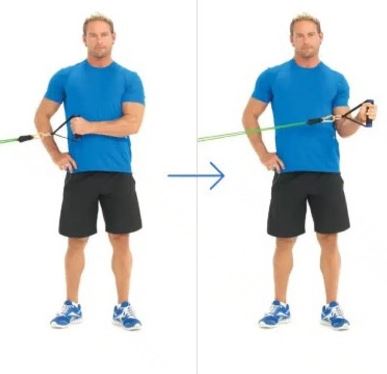
B. Movement (Execution)
The movement should be slow, controlled, and driven entirely by shoulder rotation.
Tempo recommendation: 2 seconds out, 2–3 seconds controlled return
Movement analogy: Imagine your elbow is a hinge fixed to your body, while your forearm swings outward like a door.
Resistance Curve Insight
Band external rotation uses elastic resistance, which creates a progressively increasing load as the band stretches. This makes the resistance profile different from both dumbbells and cables.
At the starting position—when the band is slack or only slightly stretched—there is relatively low tension on the external rotators. As you rotate your forearm outward, the band lengthens, increasing resistance throughout the movement.
The highest tension occurs at the end range, when the band is most stretched. This is where the infraspinatus and teres minor must work hardest to control the movement and stabilize the shoulder.
This resistance profile is particularly beneficial because the external rotators are often weakest in the fully rotated position. Training in this range helps improve shoulder stability and joint control.
Practical takeaway: Band external rotation becomes more challenging as you rotate outward—focus on controlling the end range, where the exercise is most effective.
Muscles Worked in Band External Rotation
Band external rotation primarily targets the shoulder’s external rotators, making it one of the most effective exercises for improving rotator cuff strength and stability.
Primary Muscles
Secondary Muscles
These muscles support the movement and assist with control.
Stabilizers
These muscles maintain the proper positioning of the shoulder and torso.
Antagonists
These muscles perform the opposite movement (internal rotation).
Key insight: Band external rotation directly targets the muscles that stabilize the shoulder joint, making it a foundational exercise for both performance and injury prevention.
Performance Tips (Coach’s Cues)
Band external rotation is all about control, precision, and quality of movement. Since this is a foundational rotator cuff exercise, mastering these cues will carry over to all other shoulder work.
Coach’s insight: As a coach working with lifters and athletes, I treat this exercise as the foundation of all shoulder training. If you can’t control band external rotation perfectly, progressing to more advanced exercises like dumbbell or cable variations is usually a mistake.
Common Mistakes
Band external rotation is simple in appearance, but it’s very easy to perform incorrectly. Small mistakes can reduce effectiveness or shift the load away from the rotator cuff.
Key takeaway: If your body is moving more than your shoulder joint, you’re likely using poor technique or too much resistance.
Video Demonstration — Proper Band External Rotation Technique
Watching a proper demonstration is especially helpful for band external rotation, because even though the movement looks simple, small technical details make a big difference in effectiveness.
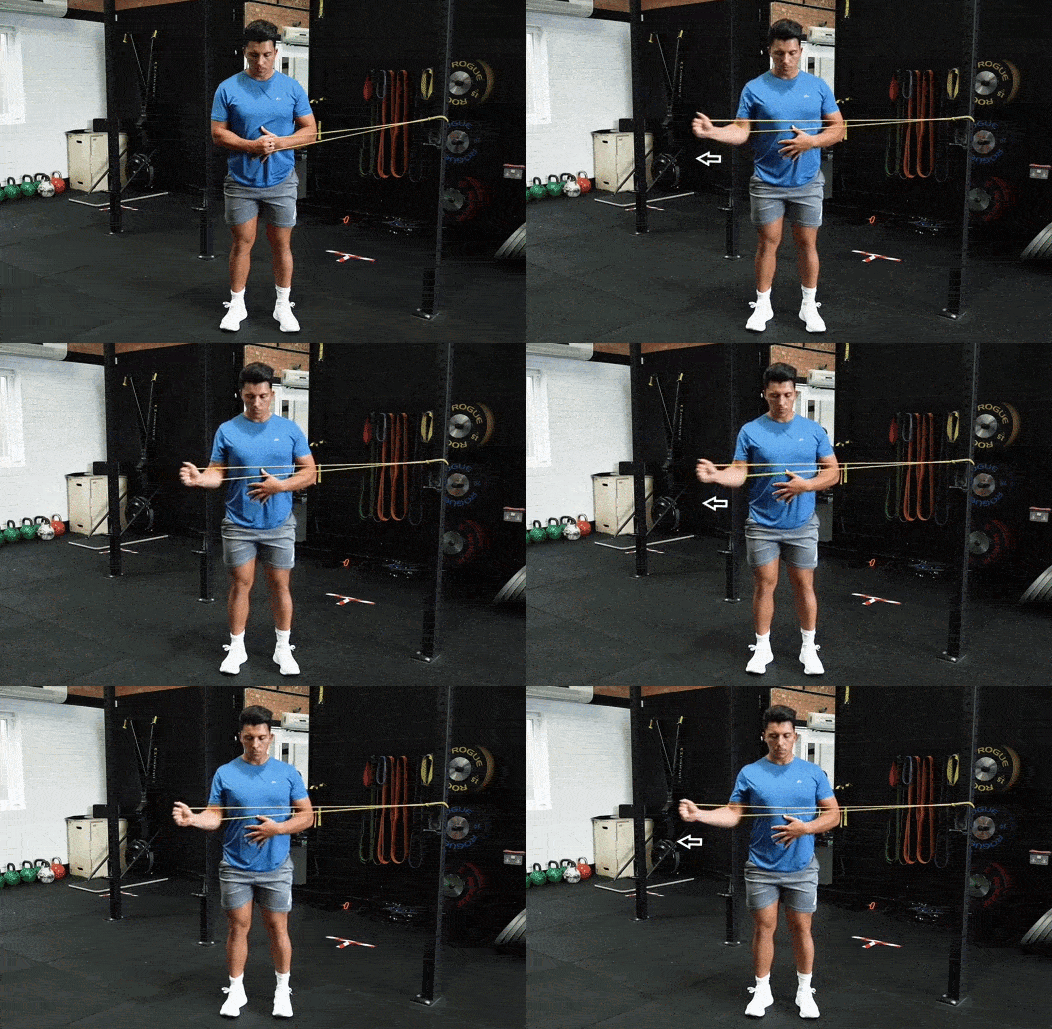
In a correct execution, you should notice:
Pay close attention to the end position, where the band is stretched the most. This is where the rotator cuff must work hardest, so control and stability are critical.
What to look for: If the elbow moves away from the body or the torso starts rotating, the exercise is being performed incorrectly. The movement should be isolated strictly to the shoulder joint.
Exercise Variations & Alternatives for Band External Rotation
Band external rotation is highly versatile and can be adjusted based on your level, available equipment, or specific training goals. Each variation slightly changes the movement’s mechanics and difficulty.
1) Seated Band External Rotation

How to perform:
Why it works:
Reduces body movement, making it easier to focus on proper technique.
2) Band External Rotation with Towel

How to perform:
Why it works:
Improves rotator cuff isolation and reduces compensation.
3) 90/90 Band External Rotation

How to perform:
Why it works:
A more advanced variation that mimics overhead movements.
4) Cable External Rotation

How to perform:
Why it works:
Provides consistent resistance throughout the entire range.
5) Dumbbell External Rotation (Side-Lying)

How to perform:
Why it works:
Uses gravity instead of elastic resistance and is great for control.
Key insight: Band external rotation is the foundation. Once mastered, you can progress to more advanced variations such as 90/90 rotations or cable-based movements.
Key Benefits of Band External Rotation
Band external rotation is one of the most effective exercises for building a strong, stable, and injury-resistant shoulder. Despite its simplicity, it delivers powerful benefits when performed correctly.
Key insight: Band external rotation is not just a warm-up—it’s a foundational exercise that supports every upper-body movement you perform.
Who Should Use This Exercise?
Band external rotation is one of the most versatile shoulder exercises, making it suitable for almost everyone—from complete beginners to advanced athletes.
Who should be cautious:
Key takeaway: Band external rotation is a foundational exercise that belongs in almost every training program—whether for performance, rehabilitation, or long-term shoulder health.
Band vs Dumbbell vs Cable External Rotation
External rotation can be performed using bands, dumbbells, or cables—each offering a slightly different resistance profile and training effect. Understanding these differences helps you choose the right variation for your goals.
| Criteria | Band External Rotation | Dumbbell External Rotation | Cable External Rotation |
|---|---|---|---|
| Resistance type | Elastic | Gravity-based | Constant |
| Resistance curve | Increasing (hardest at the end) | Peak in mid-range | Consistent throughout |
| Best for | End-range strength, rehab | Control and isolation | Balanced strength development |
| Difficulty | Beginner-friendly | Beginner to intermediate | Intermediate |
| Stability demand | Low | Moderate | Moderate |
| Equipment | Minimal (portable) | Dumbbell + bench | Cable machine |
| Control | Easy to adjust | Requires positioning | Smooth and consistent |
Conclusion: Each variation has its place in a well-rounded shoulder training program. Band external rotation is ideal for beginners and rehabilitation, as it provides increasing resistance that strengthens the shoulder at the end range, where stability is often weakest.
Dumbbell external rotation is excellent for improving control and isolation, particularly in side-lying positions. Cable external rotation offers the most consistent resistance throughout the movement, making it useful for more advanced training.
Practical takeaway: Use band external rotation as your foundation, then incorporate dumbbell and cable variations to build complete strength and control across the full range of motion.
As a coach working with lifters and athletes, band external rotation is one exercise I rarely skip. It may look simple, but it builds the foundation for everything else you do in the gym—especially when it comes to shoulder health and longevity.
I’ve seen many lifters struggle with shoulder pain simply because they ignored these small stabilizing muscles. Master this movement first, keep it controlled, and you’ll notice improvements not just in your shoulders—but in your pressing strength and overall performance as well.
Where This Exercise Fits in a Workout
Band external rotation is a foundational movement that can be incorporated into multiple parts of a workout, depending on your goal. Its versatility makes it one of the most useful exercises for both preparation and long-term shoulder health.
As a Warm-Up (Most Common Use)
This is the most popular placement. It prepares the rotator cuff before heavier upper-body exercises.
Best used before: pressing, pulling, and overhead movements
As a Prehab / Corrective Exercise
Ideal for improving shoulder stability and addressing imbalances.
Useful for injury prevention and rehabilitation
Between Sets of Upper-Body Exercises
Can be used between heavier sets to reinforce shoulder positioning.
Helps maintain shoulder stability during workouts
As a Finisher
Can be used at the end of a session to reinforce rotator cuff activation.
Important Guidelines
Practical takeaway: Band external rotation is best used consistently rather than intensely—it’s a foundational movement that supports all upper-body training.
To get the most out of this movement, it should be combined with a full range of rotator cuff exercises that target stability, control, and balanced shoulder development.
Conclusion
Band external rotation is one of the most effective and essential exercises for building strong, stable, and injury-resistant shoulders. Its simplicity makes it accessible to everyone, while its effectiveness makes it a cornerstone of both rehabilitation and performance training.
By strengthening the external rotators—especially the infraspinatus and teres minor—this exercise helps improve shoulder alignment, enhance control, and reduce the risk of injury. The progressive resistance provided by the band makes it particularly effective for training the end range of motion, where stability is often weakest.
Whether you are a beginner learning proper shoulder mechanics, an athlete preparing for overhead movements, or an experienced lifter aiming to stay injury-free, band external rotation has a place in your program.
Final takeaway: Master this exercise first. A strong rotator cuff built through band external rotation creates the foundation for safer, stronger, and more effective upper-body training.
