


Introduction
If your chest isn’t developing the way you expected, the problem might not be effort—it might be exercise selection. One of the most common questions I hear from lifters is: incline vs flat bench press — which one actually builds more chest? At first glance, both look almost identical. You’re pressing weight, working your upper body, and aiming for the same goal. But that small change in bench angle can completely shift how your chest develops.
Some lifters swear by the flat bench for overall mass, while others prioritize incline pressing to build that upper chest “shelf” that gives the physique a more complete look. The confusion usually comes from not fully understanding what each variation actually does—and how it affects muscle activation, strength, and long-term progress.
As a coach working with lifters and athletes, I’ve seen people get stuck for months simply because they relied too heavily on one variation while neglecting the other. The result is often an imbalanced chest—either lacking upper fullness or missing overall thickness.
This isn’t just a matter of preference. Choosing the right variation—or combination—can significantly impact how your chest looks and performs.
In this article, we’ll break down the real differences between incline and flat bench press, explain how each one affects chest development, and help you decide which one you should focus on based on your goal.
Incline vs Flat Bench Press (Quick Answer)
If you’re comparing incline vs flat bench press, the difference comes down to which part of the chest is emphasized.
Flat bench press:
- Targets the middle and overall chest
- Allows heavier loads
- Best for building overall chest mass
Incline bench press:
- Emphasizes the upper chest (clavicular head)
- Uses slightly lighter weights
- Best for improving upper chest development
So, which builds more chest?
- For total chest size → flat bench press
- For upper chest focus and aesthetics → incline bench press
The key point is this: both are effective, but they shape your chest differently.
Key Differences Between Incline and Flat Bench Press
At first glance, both movements look nearly identical. You lower the bar, press it back up, and train your chest. But changing the bench angle significantly alters movement mechanics, muscle emphasis, and overall training outcomes.
Bench Angle and Setup
The primary difference is the bench’s angle.
- Flat bench press: performed on a horizontal bench
- Incline bench press: typically performed at a 15–30° angle
Even a small incline is enough to shift the emphasis toward the upper portion of the chest.
Bar Path and Pressing Mechanics
The angle changes how the bar moves and where it touches your body.
- Flat bench: bar is lowered to the mid-chest
- Incline bench: bar is lowered higher, toward the upper chest
This changes the pressing path and how force is produced throughout the movement.
Elbow Position
Elbow position also shifts slightly:
- Flat bench: elbows move in a natural arc, balancing chest and triceps
- Incline bench: elbows tend to stay slightly lower relative to the shoulders, increasing upper chest involvement
Range of Motion
- Flat bench: typically allows a more stable and efficient range of motion
- Incline bench: can feel slightly longer and more demanding due to the angle
This often results in better control but lower potential weight on the incline.
Load Potential
Most lifters can lift more weight on the flat bench.
- Flat bench: higher load potential
- Incline bench: slightly reduced load due to increased difficulty
This difference is important for strength progression and total training volume.
Muscle Emphasis
Both exercises train the chest, shoulders, and triceps, but the emphasis shifts:
- Flat bench press: more overall chest development
- Incline bench press: more upper chest focus
This is the key difference that affects how your chest develops visually.
Coach’s Takeaway — Incline vs Flat Bench Press
The difference between incline and flat bench press is not about one being better overall—it’s about how the angle changes muscle recruitment, movement mechanics, and the overall training outcome.
It’s also important to understand that both variations train the entire chest. You cannot completely isolate only the upper or lower portion of the pectoral muscle with a single exercise.
What the incline bench press does is shift more emphasis toward the upper chest, while the flat bench press distributes the load more evenly across the chest. Understanding this allows you to use both variations with purpose instead of relying on guesswork.
Muscles Worked (Detailed Breakdown)
To understand the real difference between incline vs flat bench press, you need to look at how each variation shifts the workload across the same muscle groups.
Both exercises train the chest, shoulders, and triceps—but the distribution of tension varies with the angle.
Flat Bench Press — Primary Muscles
The flat bench press is the most balanced upper-body pressing movement.
Main muscles involved:
- Pectoralis major (chest) — primary driver
- Anterior deltoids (front shoulders)
- Triceps
Because of the horizontal position, the chest can generate force efficiently across a stable range of motion.
In practice, this leads to:
- Strong overall chest activation
- Higher load potential
- Efficient strength progression
This is why the flat bench press is often considered the foundation for building chest mass.
Incline Bench Press — Primary Muscles
The incline bench press shifts more of the workload toward the upper chest.
Main muscles involved:
- Upper chest (clavicular head of the pectoralis major) — emphasized
- Anterior deltoids — increased involvement
- Triceps
Because of the upward pressing angle, the upper chest fibers are placed in a more favorable position to contribute.
In practice, this leads to:
- Greater upper chest emphasis
- Increased shoulder involvement
- Slightly reduced total load compared to the flat bench
Key Difference in Muscle Contribution
The key difference is not which muscles are used, but which part of the chest is doing more of the work.
- Flat bench press → more evenly distributed chest activation
- Incline bench press → greater emphasis on the upper chest
Both variations still recruit the entire pectoral muscle, but the angle at which the tension is most effective changes.
Which One “Activates the Chest More”?
This is a common misconception.
Incline bench press does not “activate more chest”—it simply shifts the emphasis toward a specific region.
Flat bench press, on the other hand, often allows:
- Heavier loading
- More total volume
Both factors are critical for muscle growth.
Coach’s Takeaway — Best Approach for Chest Development
If your goal is overall chest development, the flat bench press is more efficient.
If your goal is to bring up your upper chest, the incline bench press becomes essential.
The best results come from understanding how each variation works and using both strategically in your training.
Next, we’ll answer the key question: which one actually builds more chest.
Which Builds More Chest?
Now to the key question: incline vs flat bench press — which one actually builds more chest?
The answer depends on what you mean by “more chest.”
For Overall Chest Size
If your goal is to build as much chest mass as possible:
The flat bench press has the advantage.
Because it allows:
- Heavier weights
- More total volume
- A stable pressing position
These factors make it highly effective for overall hypertrophy.
In practice, the flat bench press is the foundation for:
- Building chest thickness
- Increasing total muscle mass
- Progressing in strength
For Upper Chest Development
If your goal is to develop the upper portion of your chest:
The incline bench press is essential.
The angled position shifts more tension toward the upper chest, which helps:
- Improve upper chest fullness
- Create a more balanced chest appearance
- Build that “upper chest shelf”
Without incline work, many lifters end up with a chest that lacks upper development.
The Real Verdict
If you want a clear, practical answer:
- For overall chest size → flat bench press
- For upper chest emphasis → incline bench press
Neither variation is superior on its own.
Each one contributes to a different aspect of chest development.
Coach’s Takeaway — Best Strategy for Chest Growth
If your goal is maximum chest growth, the most effective approach is not choosing one variation, but using both strategically.
- Use flat bench press to build overall mass and strength
- Use incline bench press to develop the upper chest
The flat bench press allows heavier weights and more total training volume because of its stable position, shorter and more efficient pressing path, and better mechanical leverage. This makes it ideal for progressive overload, which is a key driver of muscle growth.
Combining both variations ensures balanced development and prevents weak points, leading to better long-term chest growth.
Next, we’ll compare both variations side by side in a clear table.
Incline vs Flat Bench Press — Comparison Table
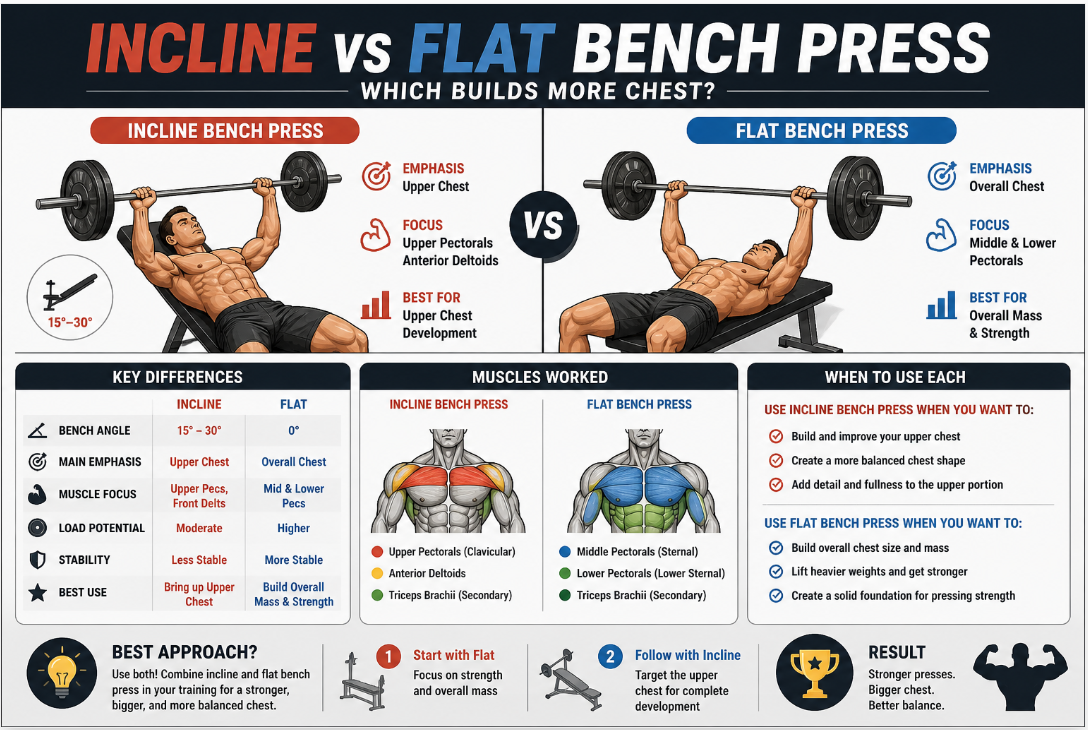
To make the differences clear at a glance, here’s a side-by-side comparison:
| Feature | Flat Bench Press | Incline Bench Press |
|---|---|---|
| Bench Angle | Horizontal (0°) | Inclined (15–30°) |
| Primary Focus | Overall chest (mid + lower emphasis) | Upper chest (clavicular head) |
| Range of Motion | Moderate, stable | Slightly longer, more demanding |
| Load Potential | Higher | Moderate |
| Shoulder Involvement | Moderate | Higher |
| Triceps Involvement | Moderate | Moderate–High |
| Best For | Overall chest size and strength | Upper chest development and balance |
The table highlights a simple but important principle:
Flat and incline bench press are not competing exercises—they complement each other.
- Flat bench builds overall chest mass and strength
- Incline bench fills in the upper chest and improves overall shape
Using both variations allows for more complete chest development instead of relying on a single angle.
Master Your Bench Press Technique
Want to go beyond this comparison and truly master each variation? These complete guides break down proper setup, execution, muscles worked, benefits, and the most common mistakes—so you can train with perfect technique and get maximum results.
When to Use Incline vs Flat Bench Press
Now that you understand the differences, the next step is knowing when to use each variation in your training.
The goal is not to choose one and ignore the other, but to use each strategically based on your goal and current development.
Use the Flat Bench Press for Overall Mass and Strength
The flat bench press should be your primary movement if your goal is to build overall chest size and pressing strength.
Use it when you want to:
- Build total chest mass
- Lift heavier weights
- Progress in strength
- Create a solid foundation
Because of its stability and greater load capacity, it works best as your primary pressing exercise.
Use the Incline Bench Press for Upper Chest Development
The incline bench press becomes essential when your goal is to improve upper chest development.
Use it when you want to:
- Bring up the upper chest
- Improve overall chest shape and balance
- Add detail and fullness to the upper portion
This variation is especially important if your chest lacks upper development.
Best Approach: Use Both
The most effective strategy is to combine both variations.
Option 1 — Same workout
- Start with the flat bench press
- Follow with incline bench press
Option 2 — Different training days
- Day 1: Flat bench (mass and strength)
- Day 2: Incline bench (upper chest focus)
Option 3 — Priority-based approach
- If the upper chest is lagging, start with the incline
- If overall mass is the goal, start with flat
Where They Fit in Your Program
A simple structure:
- Main lift: flat bench press
- Secondary lift: incline bench press
This allows you to:
- Maximize strength and volume
- Target different areas of the chest
- Create a balanced stimulus
Next, we’ll cover the most common mistakes that limit chest development.
Common Mistakes That Limit Chest Growth
Even if you’re using both incline and flat bench press, your results can stall if your technique or approach is off. Most lifters don’t have a chest growth problem—they have an execution problem.
Setting the Incline Too High
One of the biggest mistakes is turning the incline bench into a shoulder exercise.
- Too steep → more front delts, less chest
- Less effective upper chest stimulation
Fix:
Use a moderate incline (around 15–30°) to keep the emphasis on the upper chest.
Relying Only on Flat Bench Press
Many lifters focus only on the flat bench, expecting complete chest development.
- Leads to an underdeveloped upper chest
- Creates an imbalanced look
Fix:
Include incline work consistently, even if the flat bench is your main lift.
Treating Incline as a “Secondary” Movement Only
Incline bench press is often treated as an afterthought.
- Performed with less focus and effort
- Limits upper chest development
Fix:
Periodically prioritize the incline bench by placing it first in your workout.
Using Too Much Weight
Going too heavy reduces control and shifts tension away from the chest.
- More shoulder and triceps involvement
- Less effective chest activation
Fix:
Use a weight you can control through a full range of motion and focus on muscle tension.
Poor Bar Path
Incorrect bar positioning reduces efficiency and chest activation.
- Too high → more shoulders
- Too low → inefficient pressing
Fix:
- Flat bench: lower to mid-chest
- Incline bench: lower to upper chest
- Press in a controlled, slightly curved path
Not Controlling the Eccentric Phase
Letting the bar drop too quickly reduces time under tension.
Fix:
Lower the bar under control (2–3 seconds) and maintain tension throughout the movement.
No Focus on Muscle Engagement
Simply moving the weight is not enough.
- Limits the mind-muscle connection
- Reduces hypertrophy stimulus
Fix:
Focus on chest contraction during every rep, especially at the top.
Coach’s Takeaway — Technique and Programming Matter
Most chest development issues come from technique and programming, not exercise selection.
Fixing these mistakes will immediately improve how both incline and flat bench press feel and perform.
Final Thoughts
The difference between incline and flat bench press is not about choosing one over the other—it’s about understanding how each variation contributes to chest development.
The flat bench press remains the foundation for building overall chest size and strength, while the incline bench press plays a critical role in developing the upper chest and creating a more balanced, complete look.
If you rely on only one variation, you limit your results. Using both allows you to train the chest more effectively, improve symmetry, and continue progressing over time.
Understanding how to apply each variation gives you a clear advantage—because progress in training comes from intention, not just effort.
Bench pressing is not just about moving weight — small changes in grip, equipment choice, and shoulder mechanics can completely change which muscles dominate the lift.
Can I build a complete chest using only incline bench press?
You can build muscle, but it’s not optimal for complete development. Incline emphasizes the upper chest, but without flat pressing, overall thickness and lower chest contribution are often limited.
Why does flat bench press usually feel stronger than incline?
Flat bench allows better mechanical leverage, a more stable position, and less shoulder involvement. This makes it easier to generate force and lift heavier weights.
Does incline bench press reduce lower chest development?
Not directly, but if you rely only on incline work, the lower portion of the chest may receive less effective stimulus over time.
What’s the biggest mistake people make with incline bench press?
Setting the bench angle too high. This shifts the load toward the shoulders and reduces the involvement of the upper chest.
Is a steeper incline better for upper chest growth?
No. A moderate incline (15–30°) is more effective. Steeper angles turn the movement into more of a shoulder press.
Should I use the same weight for incline and flat bench press?
No. Most lifters will naturally use less weight on incline due to the increased difficulty and different mechanics.
Which variation is better for aesthetics?
Both are important. Flat bench builds overall size, while incline creates upper chest fullness, which is key for a balanced, aesthetic look.
Can changing the order of exercises affect chest development?
Yes. Doing incline first can prioritize upper chest growth, while starting with flat bench focuses more on overall mass.
Why do I feel incline bench more in my shoulders than chest?
This usually happens due to a steep bench angle, poor setup, or incorrect bar path. Adjusting these can shift tension back to the chest.
How should I combine incline and flat bench press in one workout?
A common approach is to start with flat bench for strength and follow with incline for upper chest focus. You can also reverse the order if your upper chest is lagging.
