



Introduction
If you’re trying to build a bigger chest, one question comes up again and again: barbell vs dumbbell bench press — which actually builds more muscle? At first glance, the difference seems simple. Both are pressing movements, both target the chest, and both are staples in nearly every training program. But in practice, they feel completely different—and more importantly, they produce different results.
Some lifters prefer the barbell because it allows them to lift heavier weights and track progress easily. Others swear by dumbbells for the increased range of motion and better muscle activation. The problem is that most people choose one over the other based on preference rather than understanding.
As a coach working with lifters and athletes, I’ve seen both approaches work—and I’ve also seen both limit progress when used incorrectly. The truth is, each variation has clear advantages, and knowing when to use them can make a significant difference in how your chest develops.
This isn’t just about comfort or convenience. The choice between barbell and dumbbell bench press affects stability, muscle recruitment, strength development, and long-term hypertrophy.
In this article, we’ll break down the real differences between the barbell vs dumbbell bench press, explain how each one impacts muscle growth, and help you decide which option is better for your specific goal.
Barbell vs Dumbbell Bench Press (Quick Answer)
If you’re comparing the barbell vs. dumbbell bench press, the main differences come down to load, stability, and range of motion.
Barbell bench press:
- Allows heavier weights and easier progression
- Provides more stability
- Best for building overall strength and mass
Dumbbell bench press:
- Offers a greater range of motion
- Improves muscle activation and balance
- Best for hypertrophy, control, and symmetry
So which builds more muscle?
- For maximum load and strength progression → barbell bench press
- For better stretch, contraction, and muscle development → dumbbell bench press
The key point is this: both are highly effective, but they stimulate muscle growth in different ways.
Key Differences Between Barbell and Dumbbell Bench Press
At a glance, both movements look similar—you’re pressing the weight away from your chest. But the type of equipment you use changes stability, range of motion, muscle recruitment, and how force is produced.
Stability and Control
The biggest difference is how much stability each variation requires.
- Barbell bench press: more stable because both hands are fixed on the same bar
- Dumbbell bench press: requires independent control of each arm
With a barbell, the path is guided and balanced automatically. With dumbbells, each side must stabilize the weight independently.
This makes dumbbells:
- More demanding for coordination
- Better for identifying imbalances
- Harder to control, especially at heavier loads
Range of Motion
Dumbbells allow a greater range of motion compared to a barbell.
- Barbell: the bar stops at your chest
- Dumbbells: can go deeper, increasing the stretch
This extended range can improve:
- Muscle tension
- Stretch under load
- Overall contraction
Load Potential
Most lifters can lift more weight with a barbell.
- Barbell: higher load potential
- Dumbbells: typically lower due to stability demands
This matters because heavier loads contribute to strength and overall muscle growth.
Muscle Balance and Symmetry
Dumbbells force each side of your body to work independently.
- Reduce strength imbalances
- Improve coordination
- Promote symmetrical development
With a barbell, the stronger side can compensate for the weaker one without you noticing.
Joint Position and Comfort
Dumbbells allow more natural movement.
- Barbell: fixed hand position
- Dumbbells: adjustable wrist and elbow angles
This can make dumbbells more comfortable, especially for lifters with shoulder discomfort.
Coach’s Takeaway — Barbell vs Dumbbell Bench Press
The difference between barbell and dumbbell bench press is not about one being better overall.
It’s about how each variation changes stability, range of motion, load potential, and muscle contribution.
Understanding these differences allows you to use both more effectively instead of relying on just one.
Next, we’ll break down exactly which muscles are doing the work in each variation.
Muscles Worked (Detailed Breakdown)
To understand the real difference between the barbell and dumbbell bench press, you need to look at how each variation distributes the workload across the same muscle groups.
Both exercises target the chest, shoulders, and triceps—but the way those muscles are recruited changes depending on the equipment.
Barbell Bench Press — Primary Muscles
The barbell bench press is a highly efficient compound movement.
Main muscles involved:
- Pectoralis major (chest) — primary driver
- Anterior deltoids (front shoulders)
- Triceps
Because the bar path is fixed and stable, the body can focus more on generating force than on stabilizing the load.
In practice, this leads to:
- Higher load potential
- Efficient strength development
- Strong overall chest activation
This is why the barbell bench press is often the foundation for building pressing strength.
Dumbbell Bench Press — Primary Muscles
The dumbbell bench press recruits the same primary muscles but adds a significant stabilization component.
Main muscles involved:
- Pectoralis major (chest) — primary driver
- Anterior deltoids
- Triceps
- Stabilizer muscles (shoulders, core, and smaller supporting muscles)
Because each arm moves independently, the body must stabilize and control the weight throughout the entire movement.
In practice, this leads to:
- Greater muscle activation overall
- Improved coordination and control
- Increased demand on stabilizing muscles
Key Difference in Muscle Contribution
The key difference is not which muscles are used, but how they are used.
- Barbell bench press → more force production with less stabilization
- Dumbbell bench press → more stabilization and control with slightly less load
Both exercises train the same major muscle groups, but the emphasis shifts between strength output and control.
Which One “Activates More Muscle”?
Dumbbells often feel like they “activate more muscle” because of:
- Increased range of motion
- Need for stabilization
- Deeper stretch and contraction
However, barbell training allows for:
- Heavier loading
- More total volume
Both factors are critical for muscle growth.
Coach’s Takeaway — Strength vs Control
If your goal is maximum strength and efficient overload, the barbell bench press is the more effective option.
If your goal is improved muscle activation, control, and balanced development, the dumbbell bench press becomes essential.
The best results come from understanding how each variation works and using both strategically.
Next, we’ll answer the key question: which one actually builds more muscle?
Which Builds More Muscle?
Now to the key question: barbell vs dumbbell bench press — which actually builds more muscle?
The honest answer is that both can build muscle very effectively—but they do it in different ways.
For Maximum Muscle Growth (Hypertrophy)
If your goal is pure hypertrophy:
Dumbbell bench press often has a slight advantage.
Why?
- Greater range of motion
- Better stretch at the bottom
- Stronger contraction at the top
- More muscle fiber recruitment due to stabilization
These factors increase time under tension and improve the overall quality of each rep.
For Overall Mass and Progression
If your goal is building size through progressive overload:
Barbell bench press has the advantage.
Because it allows:
- Heavier weights
- Easier load progression
- More consistent performance
This makes it ideal for:
- Increasing total training volume
- Building foundational strength
- Driving long-term muscle growth
The Real Verdict
If you want a clear, practical answer:
- For muscle activation and hypertrophy quality → dumbbell bench press
- For overall mass and strength progression → barbell bench press
Neither variation is universally superior.
Each one contributes to muscle growth in a different way.
Practical Takeaway
If your goal is maximum muscle growth, the best approach is to use both.
- Use the barbell bench press to build strength and overload
- Use the dumbbell bench press to improve muscle activation and balance
Combining both creates a more complete stimulus and leads to better long-term results.
Next, we’ll compare both variations side by side in a clear table.
Coach’s Takeaway — Why You Lift Less With Dumbbells
Most lifters cannot use the same total weight with dumbbells as they can with a barbell because dumbbells require much more stabilization and control.
With a barbell, both hands are fixed on one stable implement, which creates a more predictable pressing path and allows you to produce more force. With dumbbells, each arm must control its own weight independently, which increases the demand on the shoulders, stabilizers, and coordination.
This is why dumbbell bench press usually feels harder even with lighter loads. You may lift less weight, but the extra control, range of motion, and stabilization can still create a powerful hypertrophy stimulus.
Barbell vs Dumbbell Bench Press — Comparison Table
To make the differences clear at a glance, here’s a direct side-by-side comparison:
| Feature | Barbell Bench Press | Dumbbell Bench Press |
|---|---|---|
| Stability | Higher | Lower (requires more control) |
| Range of Motion | Limited by bar | Greater stretch and contraction |
| Load Potential | Higher | Moderate |
| Muscle Activation | Efficient force production | Greater activation and control |
| Muscle Balance | Can mask imbalances | Improves symmetry |
| Joint Comfort | Fixed movement path | More natural movement |
| Best For | Strength and overall mass | Hypertrophy and control |
Barbell and dumbbell bench press are not competing exercises—they complement each other.
- Barbell allows you to build strength and lift heavier weights
- Dumbbells improve muscle activation, control, and balance
Using both variations gives you a more complete stimulus and leads to better overall results.
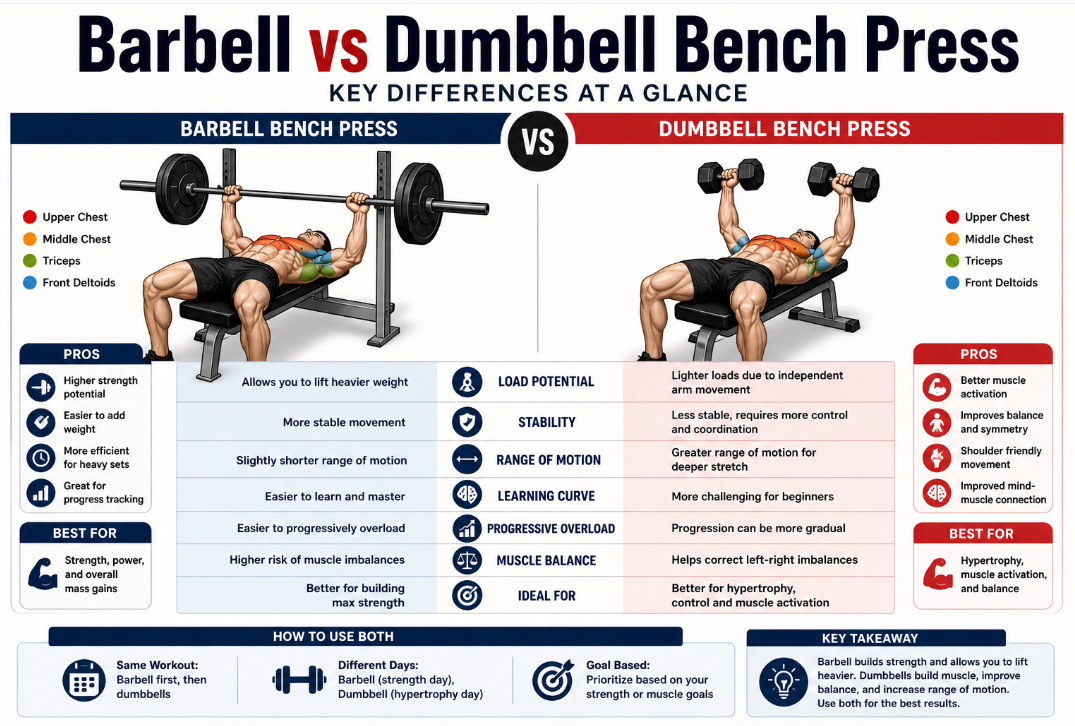
This infographic highlights the key differences between barbell and dumbbell bench press, including how each affects strength, muscle activation, and overall development.
When to Use Barbell vs Dumbbell Bench Press
Now that you understand the differences, the next step is knowing when to use each variation in your training.
The goal is not to pick one and stick with it forever, but to use each strategically based on your goal, experience level, and current needs.
Use Barbell Bench Press for Strength and Overload
The barbell bench press should be your primary choice when your goal is to build strength and maximize load.
Use it when you want to:
- Lift heavier weights
- Track progression easily
- Build overall pressing strength
- Increase total training volume
Because of its stability and efficiency, it works best as your main compound lift.
Use Dumbbell Bench Press for Hypertrophy and Balance
The dumbbell bench press is ideal when your focus is on muscle development and control.
Use it when you want to:
- Improve range of motion
- Increase muscle activation
- Correct strength imbalances
- Enhance mind-muscle connection
It is especially useful as a secondary movement after heavy barbell work.
Best Approach: Use Both
The most effective strategy is to combine both variations.
Option 1 — Same workout
- Start with the barbell bench press
- Follow with dumbbell bench press
Option 2 — Different training days
- Day 1: Barbell (strength focus)
- Day 2: Dumbbell (hypertrophy focus)
Option 3 — Priority-based approach
- If strength is your goal, prioritize the barbell
- If muscle development is your goal, emphasize dumbbells
Where They Fit in Your Program
A simple structure:
- Main lift: barbell bench press
- Secondary lift: dumbbell bench press
This allows you to:
- Maximize strength and load
- Improve muscle activation and balance
- Create a more complete training stimulus
Practical Takeaway
Barbell and dumbbell bench press are tools, not competitors.
Use a barbell to build strength and overload.
Use dumbbells to improve control, activation, and symmetry.
Using both together yields better long-term results than relying on a single variation.
Next, we’ll cover the most common mistakes that limit your results.
Common Mistakes That Limit Results
Even if you’re using both barbell and dumbbell bench press, your progress can stall if your technique or approach is off. Most issues come from execution, not exercise selection.
Using Dumbbells That Are Too Heavy
A common mistake is choosing dumbbells that are too heavy to control properly.
- Leads to unstable reps
- Reduces range of motion
- Shifts tension away from the chest
Fix:
Use a weight you can control through the full movement, especially at the bottom.
Cutting the Range of Motion Short
Many lifters don’t take advantage of the full range that dumbbells offer.
- Limits of stretch and contraction
- Reduces hypertrophy stimulus
Fix:
Lower the dumbbells deep enough to feel a stretch in the chest, then press fully without locking out aggressively.
Relying Only on Barbell Bench Press
Barbell training alone can lead to imbalances.
- The stronger side compensates for the weaker side
- Limits balanced development
Fix:
Include dumbbell work to improve symmetry and control.
Poor Setup with Dumbbells
Getting into position incorrectly wastes energy and affects performance.
- Leads to early fatigue
- Reduces stability
Fix:
Use a controlled setup (kick dumbbells into position) and maintain tightness before starting the set.
Letting the Dumbbells Drift
Uncontrolled movement reduces efficiency and increases injury risk.
Fix:
Keep the dumbbells on a consistent path and maintain control throughout the set.
Using Momentum Instead of Control
Swinging the weights or rushing reps reduces muscle tension.
Fix:
Control both the lowering and pressing phases, focusing on the chest doing the work.
Ignoring Progressive Overload
Some lifters treat dumbbells as a “lighter” alternative and don’t track progression.
Fix:
Progress weights, reps, or control over time just as you would with a barbell.
Coach’s Takeaway — Technique and Consistency Matter
Most limitations in muscle growth come from technique and consistency, not from the choice between barbell and dumbbell.
Fixing these mistakes will improve performance, muscle activation, and long-term results with both variations.
Master Every Bench Press Variation
Want to go beyond comparisons and truly master each variation? These complete guides break down proper technique, muscles worked, benefits, and common mistakes—so you can train smarter and get better results from every workout.
- 🔗 Flat Barbell Bench Press – Complete Guide to Technique, Benefits & Maximum Chest Strength
- 🔗 Flat Bench Dumbbell Press – Complete Guide to Technique, Benefits & Chest Muscle Activation
- 🔗 Incline Barbell Bench Press: Proper Technique, Muscles Worked, Benefits & Expert Tips
- 🔗 Incline Dumbbell Bench Press: Step-by-Step Technique and Training Benefits
- 🔗 Decline Barbell Bench Press: Technique, Benefits, Expert Tips, Variations, Pros & Cons
- 🔗 Decline Dumbbell Bench Press Exercise Guide
Final Thoughts
The difference between the barbell and dumbbell bench press is not about choosing one over the other—it’s about understanding how each variation contributes to muscle growth.
The barbell bench press allows you to lift heavier weights, making it ideal for building strength and driving progressive overload. The dumbbell bench press, on the other hand, offers a greater range of motion and improved muscle activation, which can enhance hypertrophy and balance.
If you rely on only one variation, you limit your results. Using both allows you to train more effectively, correct imbalances, and continue progressing over time.
Understanding how to apply each variation gives you a clear advantage—because real progress comes from using the right tool at the right time.
Your choice of equipment is only one piece of the puzzle — bench angle, grip width, and technique all play a crucial role in chest development.
Do dumbbells actually build more muscle than barbells?
Not automatically. Dumbbells can improve stretch and contraction, but barbells allow heavier loading. Muscle growth depends on how you use each, not just the tool itself.
Why do some lifters grow better with dumbbells?
Because dumbbells increase range of motion and force each side to work independently, which can improve muscle recruitment and reduce imbalances.
Is barbell bench press overrated for hypertrophy?
No. It remains one of the best tools for progressive overload, which is a key driver of muscle growth. The limitation comes only when it’s used alone without variation.
Can dumbbell bench press fix strength imbalances?
Yes. Since each arm works independently, dumbbells expose and help correct left-to-right strength differences.
Which variation is better for long-term joint health?
Dumbbells are often more joint-friendly because they allow natural wrist and elbow positioning, reducing stress on the shoulders.
Should I prioritize dumbbells if I don’t feel my chest during barbell bench press?
Yes. Dumbbells can help improve mind-muscle connection and teach you how to properly engage your chest.
Why is it harder to stabilize dumbbells?
Because each arm must control the weight independently without the support of a fixed bar path, increasing demand on stabilizing muscles.
Can I build maximum strength using only dumbbells?
You can build significant strength, but barbell training is generally more effective for reaching maximal strength levels due to higher load potential.
How do I know if I rely too much on the barbell?
If you struggle with dumbbells, have imbalances, or lack control during pressing, it’s a sign you need more dumbbell work.
What is the best ratio of barbell to dumbbell training?
There is no fixed rule, but a common and effective approach is to use barbell work for main lifts and dumbbells for accessory work within the same program.
