



Introduction
For many beginners, the most significant barrier to starting a workout routine isn’t motivation — it’s access to equipment. Not everyone has a gym membership, a rack of dumbbells, or space for bulky machines. That’s where resistance bands become a powerful and often underestimated training tool.
This Resistance Band Workout for Beginners is designed specifically for those who want to train at home using minimal equipment while still building strength, muscle control, and confidence. Resistance bands are affordable, portable, joint-friendly, and surprisingly effective when used correctly. They provide constant tension throughout the movement, which makes them ideal for learning proper muscle engagement and movement patterns.
To ensure progression and long-term results, this program assumes access to multiple resistance bands with different tension levels (commonly color-coded). This allows you to increase resistance as your strength improves gradually — a key principle for muscle growth and adaptation, even in home-based training.
In this article, I’ll guide you through a structured 4-week full-body resistance-band training plan performed three times per week (Monday, Wednesday, Friday). Each workout targets all major muscle groups using beginner-friendly exercises that are easy to learn and widely documented — meaning you’ll have no trouble finding visual references or exercise demonstrations online.
The goal of this program is simple: build a solid strength foundation, improve coordination and joint stability, and prove that you don’t need heavy weights to start getting stronger.
About the Program
Before diving into the workouts, here’s a quick snapshot of what you can expect from this 4-week resistance band program.
| Parameter | Details |
|---|---|
| Training Type | Full Body Training System |
| Level | Beginners |
| Frequency | 3 Times per Week (Monday, Wednesday, Friday) |
| Program Duration | 4 Weeks |
| Workout Duration | 45–65 Minutes |
| Primary Goal | Muscle Gain (Hypertrophy), Strength Foundation, Movement Control |
| Training Location | Home |
| Required Equipment | Resistance Bands (Multiple Tension Levels), Door Anchor or Stable Attachment Point |
| Exercise Selection | Resistance Band–Based Compound and Isolation Exercises |
| Progression Model | Stronger bands, increased reps, improved tempo control |
| Fatigue Management | Non-consecutive training days; controlled RPE |
| Beginner-Friendly | Low joint stress, adjustable resistance, simple movement patterns |
| Rest Between Sets | 45–75 seconds (depending on exercise complexity) |
| Warm-Up Included | Yes – light band mobility and activation sets |
| Cool Down | Optional stretching and band-assisted mobility work |
Equipment Required
To follow this Resistance Band Workout for Beginners program effectively, you’ll need:
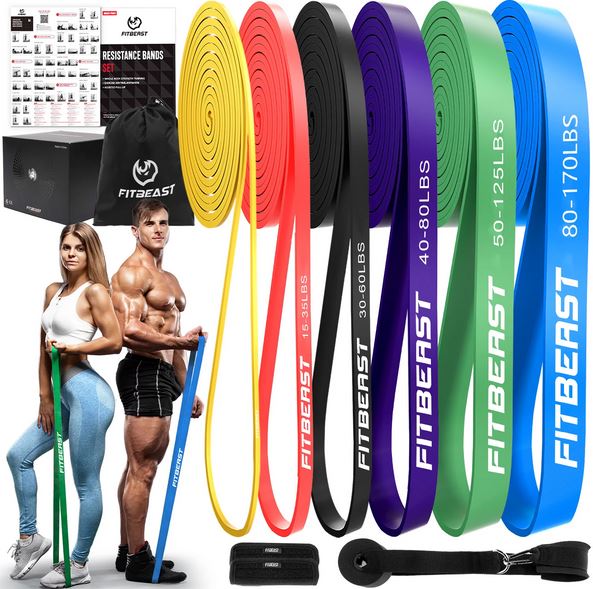
- A set of resistance bands with varying resistance levels — usually color-coded (e.g., yellow = light, green = medium, blue = heavy).
- Handles or loops (some bands come with detachable handles, others are loop-style — both are usable).
- A door anchor (optional but helpful for adding variety and stability to pulling exercises).
- A yoga mat or padded surface for floor-based exercises.
- A sturdy object to wrap the band around (like a heavy table leg, railing, or a closed door).
💡 Investing in a high-quality band set ensures safety and progression, as resistance can be scaled up gradually as you get stronger.
Weekly Training Overview
To help beginners ease into strength training with resistance bands, this 4-week program follows a structured full-body split, performed three times per week (Monday, Wednesday, and Friday). Each session is carefully balanced to target all major muscle groups, with an emphasis on proper form, controlled movement, and gradual progression by adjusting band tension or reps.
| Day | Activity |
|---|---|
| Monday | Full Body Resistance Band Workout (Day 1) |
| Tuesday | Rest or Light Activity |
| Wednesday | Full Body Resistance Band Workout (Day 2) |
| Thursday | Rest or Light Activity |
| Friday | Full Body Resistance Band Workout (Day 3) |
| Saturday | Optional Mobility or Light Cardio |
| Sunday | Rest |
You can also download this complete Full-Body Resistance Band Workout Plan for Beginners (Home Edition) as a beautifully formatted PDF to keep on your device and follow anytime, anywhere.
Week 1 – Laying the Foundation
In the first week of this Resistance Band Workout for Beginners, the main goal is to become familiar with resistance band tension, anchoring positions, and basic movement patterns. Unlike machines or free weights, bands challenge you differently — resistance increases as the band stretches, which requires controlled movement and constant tension.
This week is all about technique, control, and consistency. Choose a band that allows you to complete all reps with good form while staying around an RPE of 7 — challenging, but not exhausting. Focus on slow, controlled reps and proper body positioning.
Each workout targets the entire body, ensuring balanced muscle activation and steady adaptation.
Day 1 – Monday (Week 1)
| Exercise | Sets | Reps | RPE | Muscles Worked |
|---|---|---|---|---|
| Resistance Band Squat | 4 | 12–15 | 7 | Quads, glutes, hamstrings |
| Resistance Band Chest Press (Standing or Floor) | 3 | 12–14 | 7 | Chest, triceps, anterior deltoids |
| Resistance Band Seated Row | 3 | 12–14 | 7 | Upper back, lats, biceps |
| Resistance Band Shoulder Press | 3 | 12–14 | 7 | Deltoids, triceps |
| Resistance Band Romanian Deadlift | 3 | 14–16 | 7 | Hamstrings, glutes, lower back |
| Resistance Band Biceps Curl | 3 | 14–16 | 7 | Biceps |
| Standing Resistance Band Crunch | 3 | 15–20 | 7 | Abdominals |
Day 2 – Wednesday (Week 2)
| Exercise | Sets | Reps | RPE | Muscles Worked |
|---|---|---|---|---|
| Resistance Band Reverse Lunge | 4 | 12 / leg | 7 | Quads, glutes, hamstrings |
| Resistance Band Lat Pulldown (Door Anchor) | 3 | 12–14 | 7 | Lats, biceps, upper back |
| Resistance Band Chest Fly | 3 | 12–14 | 7 | Chest (pectorals) |
| Resistance Band Face Pull | 3 | 14–16 | 7 | Rear delts, upper back, rotator cuff |
| Resistance Band Hip Thrust / Glute Bridge | 3 | 14–16 | 7 | Glutes, hamstrings |
| Resistance Band Triceps Pushdown | 3 | 14–16 | 7 | Triceps |
| Resistance Band Russian Twist | 3 | 20 total | 7 | Obliques, core |
Day 3 – Friday (Week 3)
| Exercise | Sets | Reps / Time | RPE | Muscles Worked |
|---|---|---|---|---|
| Resistance Band Deadlift | 4 | 12–15 | 7 | Glutes, hamstrings, lower back |
| Resistance Band One-Arm Row | 3 | 12–14 / arm | 7 | Lats, mid-back, biceps |
| Resistance Band Push-Up (Band Across Back) | 3 | 10–12 | 7 | Chest, triceps, shoulders |
| Resistance Band Lateral Raise | 3 | 14–16 | 7 | Lateral deltoids |
| Resistance Band Hamstring Curl (Lying) | 3 | 14–16 | 7 | Hamstrings |
| Resistance Band Hammer Curl | 2–3 | 14 | 7 | Biceps, forearms |
| Plank with Resistance Band Row | 3 | 20–30 sec | 7 | Core, shoulders, upper back |
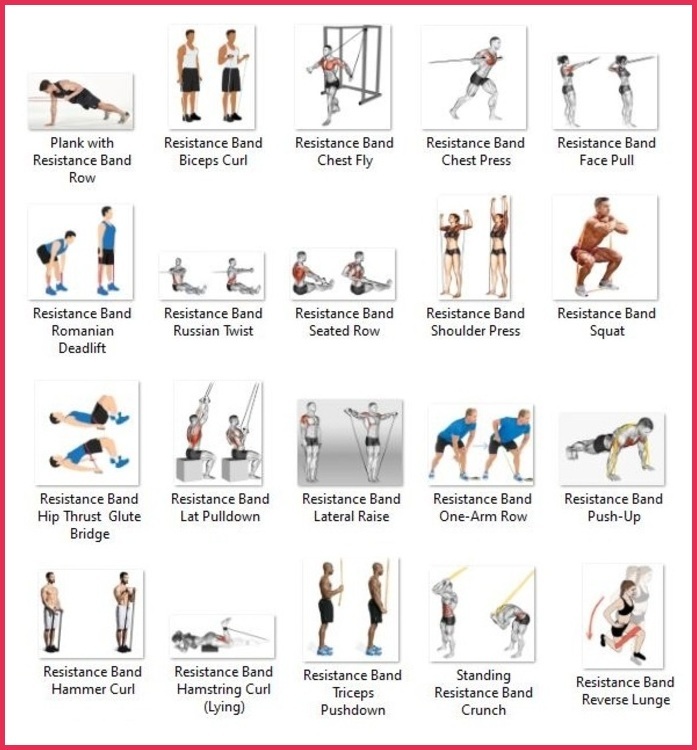
Exercise Instructions
| Exercise | Setup & Position | Execution (How to Perform) | Key Coaching Cues & Common Mistakes |
|---|---|---|---|
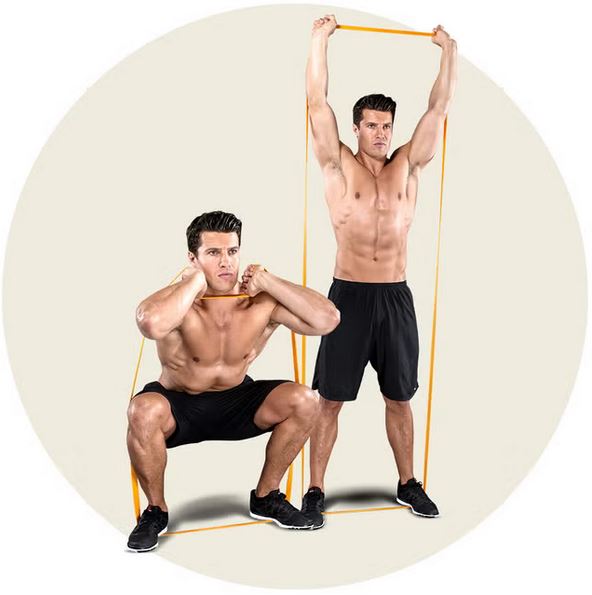
| Resistance Band Squat | Stand on the band with feet shoulder-width apart, holding handles at chest or shoulder height. | Sit hips back and down, then push through heels to return to standing. | Chest tall, knees track over toes. Avoid rounding lower back. |
| Resistance Band Chest Press | Band anchored behind body or looped across upper back. | Press arms forward until fully extended, return slowly. | Brace core. Do not flare elbows excessively. |
| Resistance Band Seated Row | Sit tall, legs extended, band looped around feet. | Pull elbows toward torso, squeeze shoulder blades. | No rounding. Lead with elbows. |
| Resistance Band Shoulder Press | Stand on band, handles at shoulder height. | Press overhead, then lower under control. | Avoid arching lower back. Core tight. |
| Resistance Band Romanian Deadlift | Stand on band, slight knee bend, handles in front of thighs. | Hinge at hips, push hips back, then extend. | Flat spine. Hips drive the movement. |
| Resistance Band Biceps Curl | Stand on band, arms extended, palms forward. | Curl handles upward, squeeze biceps. | No swinging. Elbows fixed. |
| Standing Resistance Band Crunch | Band anchored overhead, hands behind head. | Crunch torso downward using abs. | Do not pull with arms. |
| Resistance Band Reverse Lunge | Stand on band, handles at sides or shoulders. | Step back into lunge, return to start. | Front knee stable. Upright torso. |
| Resistance Band Lat Pulldown | Band anchored overhead, arms fully extended. | Pull elbows down toward ribs. | Avoid shrugging shoulders. |
| Resistance Band Chest Fly | Band anchored behind body, arms slightly bent. | Bring hands together in front of chest. | Control movement. No jerking. |
| Resistance Band Face Pull | Band anchored at face height. | Pull band toward face, separate hands. | Focus on rear delts. |
| Resistance Band Hip Thrust / Glute Bridge | Band across hips, anchored or held down. | Drive hips up until body is straight. | Squeeze glutes. No lower-back arch. |
| Resistance Band Triceps Pushdown | Band anchored overhead, elbows bent. | Extend elbows downward. | Elbows stay fixed. |
| Resistance Band Russian Twist | Band anchored to side, seated position. | Rotate torso away from anchor. | Movement from core, not arms. |
| Resistance Band Deadlift | Stand on band, handles at sides. | Hinge hips back, then stand tall. | Neutral spine. No squatting. |
| Resistance Band One-Arm Row | Band anchored in front, staggered stance. | Pull elbow toward hip. | Avoid torso rotation. |
| Resistance Band Push-Up | Band across upper back, hands on floor. | Lower chest, press up. | Body straight. No sagging hips. |
| Resistance Band Lateral Raise | Stand on band, arms at sides. | Raise arms to shoulder height. | Control tempo. No swinging. |
| Resistance Band Hamstring Curl (Lying) | Band anchored low, lying face down. | Curl heels toward glutes. | Hips stay down. |
| Resistance Band Hammer Curl | Stand on band, palms facing inward. | Curl upward maintaining neutral grip. | No shoulder movement. |
| Plank with Resistance Band Row | Plank position, band anchored in front. | Row band while holding plank. | Hips level. Core braced. |
Week 2 – Improving Control & Band Tension Progression
After completing Week 1, your body should already feel more comfortable with resistance bands and basic movement patterns. In Week 2 of this Resistance Band Workout for Beginners, the focus shifts toward improving control, stability, and gradually increasing training demand.
At this stage, you should either:
- switch to a slightly stronger resistance band, or
- increase repetitions within the prescribed range, while maintaining proper form and control.
Training intensity remains moderate, targeting an RPE of around 7, allowing you to progress without excessive fatigue.
Day 1 – Monday (Week 2)
| Exercise | Sets | Reps | RPE | Muscles Worked |
|---|---|---|---|---|
| Resistance Band Squat | 4 | 12–14 | 7 | Quads, glutes, hamstrings |
| Resistance Band Chest Press | 3 | 10–12 | 7 | Chest, triceps, anterior deltoids |
| Resistance Band Seated Row | 3 | 12–14 | 7 | Upper back, lats, biceps |
| Resistance Band Shoulder Press | 3 | 12–14 | 7 | Deltoids, triceps |
| Resistance Band Romanian Deadlift | 3 | 14–16 | 7 | Hamstrings, glutes |
| Resistance Band Biceps Curl | 2–3 | 14–16 | 7 | Biceps |
| Standing Resistance Band Crunch | 3 | 15–20 | 7 | Abdominals |
Day 2 – Wednesday (Week 2)
| Exercise | Sets | Reps | RPE | Muscles Worked |
|---|---|---|---|---|
| Resistance Band Reverse Lunge | 4 | 12 / leg | 7 | Quads, glutes, hamstrings |
| Resistance Band Lat Pulldown (Door Anchor) | 3 | 12–14 | 7 | Lats, biceps, upper back |
| Resistance Band Chest Fly | 3 | 12–14 | 7 | Chest |
| Resistance Band Face Pull | 3 | 14–16 | 7 | Rear delts, upper back |
| Resistance Band Hip Thrust / Glute Bridge | 3 | 14–16 | 7 | Glutes, hamstrings |
| Resistance Band Triceps Pushdown | 2–3 | 14–16 | 7 | Triceps |
| Resistance Band Russian Twist | 3 | 20–24 total | 7 | Obliques, core |
Day 3 – Friday (Week 2)
| Exercise | Sets | Reps / Time | RPE | Muscles Worked |
|---|---|---|---|---|
| Resistance Band Deadlift | 4 | 12–14 | 7 | Glutes, hamstrings, lower back |
| Resistance Band One-Arm Row | 3 | 12–14 / arm | 7 | Lats, mid-back, biceps |
| Resistance Band Push-Up | 3 | 10–12 | 7 | Chest, triceps, shoulders |
| Resistance Band Lateral Raise | 3 | 14–16 | 7 | Lateral deltoids |
| Resistance Band Hamstring Curl (Lying) | 3 | 14–16 | 7 | Hamstrings |
| Resistance Band Hammer Curl | 2–3 | 14 | 7 | Biceps, forearms |
| Plank with Resistance Band Row | 3 | 25–35 sec | 7 | Core, shoulders, upper back |
Week 3 – Progressive Overload with Resistance Bands
By Week 3 of this Resistance Band Workout for Beginners, your technique should feel more natural and controlled. This is the point where we begin applying progressive overload more deliberately — still safely, but with a slightly higher training demand.
At this stage, you should:
- use a stronger resistance band whenever possible;
- push closer to the upper end of the rep ranges;
- slow down the eccentric (lowering) phase of each movement;
Intensity increases slightly to an RPE of around 7.5, meaning the last few reps should feel challenging but still technically clean.
Day 1 – Monday (Week 3)
| Exercise | Sets | Reps | RPE | Muscles Worked |
|---|---|---|---|---|
| Resistance Band Squat | 4 | 10–12 | 7.5 | Quads, glutes, hamstrings |
| Resistance Band Chest Press | 3 | 10–12 | 7.5 | Chest, triceps, anterior deltoids |
| Resistance Band Seated Row | 3 | 12 | 7.5 | Upper back, lats, biceps |
| Resistance Band Shoulder Press | 3 | 12 | 7.5 | Deltoids, triceps |
| Resistance Band Romanian Deadlift | 3 | 12–14 | 7.5 | Hamstrings, glutes |
| Resistance Band Biceps Curl | 2–3 | 14 | 7.5 | Biceps |
| Standing Resistance Band Crunch | 3 | 15–20 | 7.5 | Abdominals |
Day 2 – Wednesday (Week 3)
| Exercise | Sets | Reps | RPE | Muscles Worked |
|---|---|---|---|---|
| Resistance Band Reverse Lunge | 4 | 10–12 / leg | 7.5 | Quads, glutes, hamstrings |
| Resistance Band Lat Pulldown (Door Anchor) | 3 | 10–12 | 7.5 | Lats, biceps, upper back |
| Resistance Band Chest Fly | 3 | 10–12 | 7.5 | Chest |
| Resistance Band Face Pull | 3 | 14–16 | 7.5 | Rear delts, upper back |
| Resistance Band Hip Thrust / Glute Bridge | 3 | 12–14 | 7.5 | Glutes, hamstrings |
| Resistance Band Triceps Pushdown | 2–3 | 12–14 | 7.5 | Triceps |
| Resistance Band Russian Twist | 3 | 24–28 total | 7.5 | Obliques, core |
Day 3 – Friday (Week 3)
| Exercise | Sets | Reps / Time | RPE | Muscles Worked |
|---|---|---|---|---|
| Resistance Band Deadlift | 4 | 10–12 | 7.5 | Glutes, hamstrings, lower back |
| Resistance Band One-Arm Row | 3 | 12 / arm | 7.5 | Lats, mid-back, biceps |
| Resistance Band Push-Up | 3 | 10–12 | 7.5 | Chest, triceps, shoulders |
| Resistance Band Lateral Raise | 3 | 14–16 | 7.5 | Lateral deltoids |
| Resistance Band Hamstring Curl (Lying) | 3 | 12–14 | 7.5 | Hamstrings |
| Resistance Band Hammer Curl | 2–3 | 12–14 | 7.5 | Biceps, forearms |
| Plank with Resistance Band Row | 3 | 30–40 sec | 7.5 | Core, shoulders, upper back |
Week 4 – Final Push & Mastery Phase
Welcome to the final week of your Resistance Band Workout for Beginners. By now, your movement patterns should feel natural, your control should be significantly improved, and your confidence with resistance bands should be noticeably higher.
This week is about cementing everything you’ve learned. The exercises remain the same to reinforce mastery, but training intensity increases slightly to an RPE of around 8. Focus on intense, controlled repetitions, steady breathing, and maintaining tension throughout each movement.
Finish strong — this week sets the foundation for your next training phase.
Day 1 – Monday (Week 4)
| Exercise | Sets | Reps | RPE | Muscles Worked |
|---|---|---|---|---|
| Resistance Band Squat | 4 | 10–12 | 8 | Quads, glutes, hamstrings |
| Resistance Band Chest Press | 3 | 10–12 | 8 | Chest, triceps, anterior deltoids |
| Resistance Band Seated Row | 3 | 10–12 | 8 | Upper back, lats, biceps |
| Resistance Band Shoulder Press | 3 | 10–12 | 8 | Deltoids, triceps |
| Resistance Band Romanian Deadlift | 3 | 12–14 | 8 | Hamstrings, glutes |
| Resistance Band Biceps Curl | 2–3 | 12–14 | 8 | Biceps |
| Standing Resistance Band Crunch | 3 | 15–20 | 8 | Abdominals |
Day 2 – Wednesday (Week 4)
| Exercise | Sets | Reps | RPE | Muscles Worked |
|---|---|---|---|---|
| Resistance Band Reverse Lunge | 4 | 10–12 / leg | 8 | Quads, glutes, hamstrings |
| Resistance Band Lat Pulldown (Door Anchor) | 3 | 10–12 | 8 | Lats, biceps, upper back |
| Resistance Band Chest Fly | 3 | 10–12 | 8 | Chest |
| Resistance Band Face Pull | 3 | 14–16 | 8 | Rear delts, upper back |
| Resistance Band Hip Thrust / Glute Bridge | 3 | 12–14 | 8 | Glutes, hamstrings |
| Resistance Band Triceps Pushdown | 2–3 | 12–14 | 8 | Triceps |
| Resistance Band Russian Twist | 3 | 28–32 total | 8 | Obliques, core |
Day 3 – Friday (Week 4)
| Exercise | Sets | Reps / Time | RPE | Muscles Worked |
|---|---|---|---|---|
| Resistance Band Deadlift | 4 | 10–12 | 8 | Glutes, hamstrings, lower back |
| Resistance Band One-Arm Row | 3 | 10–12 / arm | 8 | Lats, mid-back, biceps |
| Resistance Band Push-Up | 3 | 10–12 | 8 | Chest, triceps, shoulders |
| Resistance Band Lateral Raise | 3 | 14–16 | 8 | Lateral deltoids |
| Resistance Band Hamstring Curl (Lying) | 3 | 12–14 | 8 | Hamstrings |
| Resistance Band Hammer Curl | 2–3 | 12–14 | 8 | Biceps, forearms |
| Plank with Resistance Band Row | 3 | 40–45 sec | 8 | Core, shoulders, upper back |
Understanding RPE in This Program
Throughout this program, you’ll often see the term RPE. RPE stands for Rate of Perceived Exertion and is a simple way to measure how hard a set feels, based on your own perception of effort rather than exact weight or resistance.
This system is helpful for resistance-band training, where exact load numbers are difficult to standardize. By using RPE, you can adjust band tension, repetitions, and tempo to match your current strength level while still progressing safely and effectively.
| RPE Level | What It Feels Like | Reps Left in Reserve |
|---|---|---|
| RPE 6 | Comfortable effort, very controlled | 4–5 reps left |
| RPE 7 | Challenging but sustainable | 3 reps left |
| RPE 7.5 | Hard, strong focus required | 2 reps left |
| RPE 8 | Very challenging, near your limit | 1–2 reps left |
In simple terms, RPE 7 means you finish the set feeling challenged but confident that you could still perform about three more quality repetitions if needed.
Coach’s Note — Final Thoughts After 4 Weeks
As an experienced coach, one of the most important lessons I’ve learned is that beginners don’t need constant exercise variety — they need consistency, repetition, and gradual challenge. That’s exactly why I intentionally kept the exercise selection the same throughout all four weeks of this program.
By repeating the same movements week after week, your body had the time it needed to truly learn the patterns, improve coordination, and build a solid mind–muscle connection. Real progress doesn’t come from constantly changing exercises — it comes from doing the basics well, over and over again.
Instead of adding complexity, I made the program more challenging through smarter variables: stronger resistance bands, higher reps near the top of each range, slower tempo, longer time under tension, and gradually increasing RPE. This approach keeps the program safe, effective, and scalable — especially for home training.
If you’ve completed these four weeks with good form and consistency, you’ve built far more than just strength. You’ve built confidence, movement awareness, and a foundation that will carry over into any future training style — whether that’s heavier resistance bands, free weights, or gym-based workouts.
Remember: simple programs, executed well, will always outperform complicated ones done inconsistently. This 4-week phase is not the end — it’s the starting point.
Evaluating the Program: Pros & Cons
Before committing to any training program, it’s important to understand both its strengths and its limitations. From a coaching perspective, no program is perfect for everyone — but the right program, used at the right time, can be extremely effective.
This Resistance Band Workout for Beginners was intentionally designed with simplicity, safety, and progression in mind. Below is an honest breakdown of where this program excels and where it has natural limitations, especially when compared to gym-based or free-weight training.
| Pros | Cons |
|---|---|
| Extremely beginner-friendly with a low learning curve | Limited maximum resistance compared to barbells or machines |
| Minimal equipment required — ideal for home training | Long-term muscle growth may plateau without stronger bands |
| Joint-friendly and low-impact, suitable for most beginners | Less absolute loading compared to free-weight training |
| Easy to scale intensity using different band tensions | Band quality and durability can vary between brands |
| Excellent for learning movement patterns and muscle control | Requires proper anchoring for certain exercises |
| Portable and travel-friendly training solution | Not ideal for advanced strength or power development |
| Encourages consistency and routine adherence | Some trainees may find band training less motivating |
| Safe option for beginners training alone at home | Progression relies more on tempo and control than load |
Coach’s Note — Perspective on This Program
From my experience working with beginners, the biggest strength of this program is accessibility. It removes most of the common barriers that stop people from starting resistance training, such as lack of equipment, limited space, and intimidation. For someone training at home, that alone greatly increases the chances of staying consistent.
The limitations of resistance band training are not weaknesses of the program itself, but a matter of context. Bands are not meant to replace heavy free weights indefinitely. They serve as a preparatory tool that helps build coordination, joint stability, and basic strength without unnecessary risk.
When used as a structured four-week phase, this program does exactly what it is designed to do. It builds a foundation, reinforces proper movement patterns, and prepares the body and mind for more demanding forms of resistance training in the future.
Beginner Training Alternatives Worth Exploring
While this Resistance Band Workout for Beginners is an excellent starting point for home-based training with minimal equipment, it’s not the only effective option available to beginners. Depending on your access to equipment, training environment, and personal preferences, you may find one of the following alternatives more suitable — either now or as your next step after completing this program.
Each of these beginner-friendly programs follows the same core principles: full-body training, structured progression, and a strong emphasis on proper technique.
- Beginner Machine-Only Full Body Workout Program (Gym Edition)
A great option for those training in a commercial gym who prefer guided movements. Machine-based training minimizes coordination demands and injury risk while helping beginners build strength and confidence in a gym environment. - Beginner Full Body Training Program for Maximum Muscle Gains (Gym-Based)
Designed for beginners with full gym access, this program combines free weights and machines to introduce compound movements while still maintaining a beginner-friendly structure. - Dumbbell-Only Full Body Workout for Beginners (Home Edition)
Ideal for home trainees who own a pair of adjustable dumbbells and a bench. This program offers more loading potential than bands while still remaining accessible and flexible. - Barbell-Only Full Body Workout for Beginners (Home Edition)
A structured approach for those who have a barbell, weight plates, and basic equipment at home. This program focuses on foundational lifts and long-term strength development. - Kettlebell-Only Full Body Workout for Beginners (Home Edition)
A dynamic alternative centered around kettlebell movements. Excellent for improving strength, coordination, and conditioning with minimal equipment. - 4-Week Beginner Free-Weights Workout Program (Home or Gym)
A balanced introduction to both barbells and dumbbells, aimed at building muscle, flexibility, and overall strength through classic resistance training. - 4-Week Bodyweight-Only Full Body Workout Program (Home Edition)
A no-equipment solution that relies entirely on bodyweight exercises. Perfect for beginners training at home, traveling, or working with very limited resources.
No matter which path you choose, the most important factors remain the same: consistency, gradual progression, and patience. The best program is always the one you can follow consistently and execute with proper form.
Beginners progress best when following the right order — see the recommended progression in our beginner training overview .
Coach’s Note
When beginners ask me which program is best, my answer is almost always the same: the best program is the one you can follow consistently. That’s why I view resistance band training as a powerful entry point rather than a limitation.
This program was designed to remove common barriers such as lack of space, equipment, or gym confidence. By keeping the structure simple and the exercises consistent, the focus stays where it matters most — on learning how to move well and training regularly.
Once that foundation is built, transitioning to machines, dumbbells, barbells, or kettlebells becomes significantly easier. In that sense, this program doesn’t compete with other beginner routines — it complements them.
Final Thoughts: Resistance Band Workout for Beginners
This Resistance Band Workout for Beginners proves that practical strength training doesn’t require expensive equipment or a fully equipped gym. With a structured plan, innovative progression, and consistent effort, resistance bands can deliver meaningful improvements in strength, muscle control, and confidence — especially for those just getting started.
By keeping the exercise selection consistent across all four weeks, this program allows beginners to focus on mastering movement patterns rather than constantly learning new exercises. Progress is achieved through better control, increased resistance, improved tempo, and higher training intensity — the same principles used in advanced strength training.
If you’ve completed these four weeks with commitment and good form, you’ve built a solid foundation that can support any future training path you choose. Whether you move on to machines, free weights, kettlebells, or continue progressing with resistance bands, the habits and skills developed here will carry over.
This is not the finish line — it’s the starting point for long-term, sustainable training success.
Is a resistance band workout effective for beginners?
Yes, resistance band workouts are highly effective for beginners because they allow controlled resistance, low joint stress, and gradual progression.
How many days per week should beginners train with resistance bands?
Beginners should train with resistance bands three times per week to allow proper recovery and consistent strength gains.
Can resistance bands build muscle without weights?
Resistance bands can build muscle, especially in beginners, by creating constant tension and supporting progressive overload.
What resistance band strength should a beginner use?
Beginners should start with lighter bands that allow proper form and gradually progress to stronger bands over time.
Is a full-body resistance band workout better than split training for beginners?
Yes, full-body workouts are ideal for beginners because they train all major muscle groups multiple times per week.
How long should a resistance band workout last?
Most beginner resistance band workouts last between 45 and 65 minutes, including warm-up and cool-down.
What does RPE mean in resistance band training?
RPE refers to Rate of Perceived Exertion and helps beginners gauge how hard a set feels based on effort.
Is RPE 7 good for beginners?
RPE 7 is ideal for beginners because it is challenging while still allowing perfect form and recovery.
Can resistance band workouts replace gym training?
Resistance band workouts can replace gym training temporarily and are excellent for building a foundation before moving to heavier loads.
What should beginners do after completing a 4-week resistance band program?
After completing the program, beginners can progress to heavier bands, free weights, or machine-based workouts.
