



For many newcomers stepping into a gym for the first time, the free weights section can feel intimidating. The array of barbells, dumbbells, and complex movements often requires a solid foundation in form, coordination, and confidence. That’s where machine-based training shines.
I created this Machine-Only Full Body Workout for Beginners specifically to help you build that foundation — safely and effectively. By using resistance machines, you can train your entire body while minimizing injury risk, ensuring proper form, and developing the strength and control needed to transition to free weights, if desired, eventually.
In this article, I’ll walk you through a complete 4-week training plan, with three full-body sessions per week (Monday, Wednesday, Friday). Each workout is designed to target all major muscle groups using machines only. You’ll find a structured progression model to help you improve over time, with guidance on reps, sets, and tips for proper execution.
Let’s start with an overview of the program parameters.
About the Program
Before we dive into the workouts, here’s a quick overview of the program structure and key parameters to help you understand what to expect.
| Parameter | Details |
|---|---|
| Training Type | Full Body Training System |
| Level | Beginners |
| Frequency | 3 Times per Week (Monday, Wednesday, Friday) |
| Program Duration | 4 Weeks |
| Workout Duration | 60–75 Minutes |
| Primary Goal | Muscle Gain (Hypertrophy), Skill Acquisition |
| Training Location | Gym |
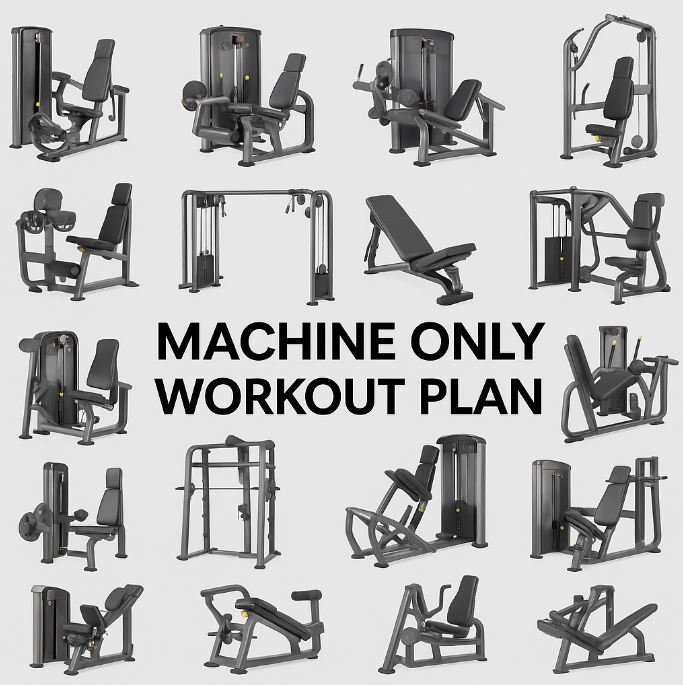
| Required Equipment | Resistance Machines (Leg Press, Chest Press, Lat Pulldown, etc.), Cable Station |
| Exercise Selection | Machine-Based Compound and Isolation Exercises |
| Progression Model | Gradual increase in reps, weight, or reduced rest across weeks |
| Fatigue Management | Alternating rest days between sessions; Controlled RPE |
| Beginner-Friendly | Fixed movement patterns minimize injury risk and improve form |
| Rest Between Sets | 60–90 seconds for compound lifts, 45–60 seconds for isolation exercises |
| Warm-Up Included | Yes – Light cardio and machine-specific warm-up sets |
| Cool Down | Optional static stretching post-workout |
Weekly Training Overview
To ensure optimal recovery and muscle stimulation, the program is structured across three non-consecutive training days each week. Here’s a simple breakdown of your weekly schedule:
| Day | Activity |
|---|---|
| Monday | Full Body Workout (Day 1) |
| Tuesday | Rest or Light Activity |
| Wednesday | Full Body Workout (Day 2) |
| Thursday | Rest or Light Activity |
| Friday | Full Body Workout (Day 3) |
| Saturday | Active Recovery or Optional Cardio |
| Sunday | Rest |
🧠 RPE Scale – How Hard Should You Train?
Throughout this program, you’ll notice that each exercise is paired with an RPE value. RPE stands for Rate of Perceived Exertion, which is a scale used to subjectively measure how hard you’re working during an exercise.
Instead of focusing solely on weight or reps, RPE helps you listen to your body and train with the right intensity for your current fitness level. An RPE of 7, for example, means the set felt challenging but you could still perform 2–3 more reps with good form.
| RPE | Description | Effort Level |
|---|---|---|
| 10 | Max effort – couldn’t do another rep | Absolute limit |
| 9 | Extremely hard – maybe 1 more rep left | Near max effort |
| 8 | Very hard – 2 reps left in the tank | Strong, controlled intensity |
| 7 | Hard but manageable – 3 reps left | Ideal for hypertrophy training |
| 6 | Moderate – 4 or more reps left | Light effort |
| 5 | Warm-up level – easy effort | Minimal challenge |
You can also download this complete Beginner Machine-Only Full Body Workout Program as a beautifully formatted PDF to keep on your device and follow anytime, anywhere.
Week 1 – Learning the Machines & Building the Base
In the first week of this machine-based workout program, the primary focus is to familiarize yourself with the equipment, learn proper movement patterns, and establish a strong foundation.
As a beginner, machines offer you the perfect balance of safety and support, allowing you to train major muscle groups without the complexity and coordination required for free weights. This week, we’ll introduce you to a structured full-body routine performed three times, ensuring you hit all major muscle groups evenly.
Start with a moderate weight, focus on form and control, and train consistently at an RPE of 7 — challenging, but not exhausting. This approach will help build confidence, activate dormant muscles, and prepare your body for steady, structured progression in the coming weeks.
Day 1 – Monday (Week 1)
- Leg Press (Machine) – 4 sets | 12–15 reps | RPE 7
🔹 Muscles worked: Quads, glutes, hamstrings - Lat Pulldown (Wide Grip) – 3 sets | 12–14 reps | RPE 7
🔹 Muscles worked: Lats, biceps, upper back - Chest Press (Machine) – 3 sets | 12–14 reps | RPE 7
🔹 Muscles worked: Chest, triceps, anterior deltoids - Seated Row (Cable Machine) – 3 sets | 12–14 reps | RPE 7
🔹 Muscles worked: Mid-back, rhomboids, biceps - Shoulder Press (Machine) – 3 sets | 12–14 reps | RPE 7
🔹 Muscles worked: Delts, triceps - Leg Curl (Lying or Seated Machine) – 3 sets | 14–16 reps | RPE 7
🔹 Muscles worked: Hamstrings - Leg Extension (Machine) – 3 sets | 14–16 reps | RPE 7
🔹 Muscles worked: Quads - Cable Crunch (Rope Attachment) – 3 sets | 15–20 reps | RPE 7
🔹 Muscles worked: Abdominals
Day 2 – Wednesday (Week 1)
- Leg Curl (Seated Machine) – 4 sets | 12–15 reps | RPE 7
🔹 Muscles worked: Hamstrings - Assisted Pull-Ups (Machine) – 3 sets | 10–12 reps | RPE 7
🔹 Muscles worked: Lats, biceps, upper back - Incline Chest Press (Machine) – 3 sets | 12–14 reps | RPE 7
🔹 Muscles worked: Upper chest, triceps, delts - Seated Cable Row (Neutral Grip) – 3 sets | 12–14 reps | RPE 7
🔹 Muscles worked: Mid-back, rhomboids, biceps - Lateral Raise (Cable or Machine) – 3 sets | 14–16 reps | RPE 7
🔹 Muscles worked: Lateral deltoids - Leg Press (Machine) – 3 sets | 14–16 reps | RPE 7
🔹 Muscles worked: Quads, glutes, hamstrings - Triceps Pushdown (Cable) – 3 sets | 14 reps | RPE 7
🔹 Muscles worked: Triceps - Reverse Crunch (Bodyweight) – 3 sets | 15–20 reps | RPE 7
🔹 Muscles worked: Lower abdominals
Day 3 – Friday (Week 1)
- Leg Press (Feet High on Platform) – 4 sets | 10–12 reps | RPE 7
🔹 Muscles worked: Glutes, hamstrings, quads - Lat Pulldown (Wide Grip) – 3 sets | 12–14 reps | RPE 7
🔹 Muscles worked: Lats, biceps, rear delts - Chest Press (Machine) – 3 sets | 12–14 reps | RPE 7
🔹 Muscles worked: Chest, triceps, delts - Cable Row (Close Grip, Seated) – 3 sets | 12–14 reps | RPE 7
🔹 Muscles worked: Mid-back, lats, biceps - Shoulder Press (Machine) – 3 sets | 12–14 reps | RPE 7
🔹 Muscles worked: Deltoids, triceps - Leg Curl (Lying Machine) – 3 sets | 14–16 reps | RPE 7
🔹 Muscles worked: Hamstrings - Cable Biceps Curl (Bar or Rope) – 3 sets | 14 reps | RPE 7
🔹 Muscles worked: Biceps - Machine Crunch (Ab Machine) – 3 sets | 15–20 reps | RPE 7
🔹 Muscles worked: Abdominals
Week 2 – Improving Confidence & Control
After a successful first week of building the foundation and familiarizing yourself with machine movements, Week 2 focuses on improving confidence and control and slightly increasing the training challenge.
By now, the exercises should feel more natural, and your neuromuscular coordination is beginning to adapt. This week, you’ll repeat many of the same exercises, but now you’re encouraged to increase either the weight slightly or the number of reps per set — as long as your form remains perfect and you stay within an RPE of around 7.
Consistency and precision are the keys. Let your body gradually adapt to the workload while ensuring recovery between sessions.
Day 1 – Monday (Week 2)
- Leg Press Machine – 4 sets | 12–14 reps | RPE 7
🔹 Muscles worked: Quads, glutes, hamstrings - Chest Press Machine – 3 sets | 10–12 reps | RPE 7
🔹 Muscles worked: Chest, triceps, front deltoids - Lat Pulldown Machine – 3 sets | 12–14 reps | RPE 7
🔹 Muscles worked: Lats, upper back, biceps - Seated Row Machine – 3 sets | 12 reps | RPE 7
🔹 Muscles worked: Rhomboids, lats, rear delts, biceps - Shoulder Press Machine – 2 sets | 12–14 reps | RPE 7
🔹 Muscles worked: Deltoids, triceps - Leg Curl Machine – 3 sets | 14 reps | RPE 7
🔹 Muscles worked: Hamstrings - Cable Rope Triceps Pushdown – 2 sets | 14–16 reps | RPE 7
🔹 Muscles worked: Triceps - Seated Ab Crunch Machine – 3 sets | 15–20 reps | RPE 7
🔹 Muscles worked: Abdominals
Day 2 – Wednesday (Week 2)
- Leg Extension Machine – 4 sets | 12–14 reps | RPE 7
🔹 Muscles worked: Quadriceps - Incline Chest Press Machine – 3 sets | 10–12 reps | RPE 7
🔹 Muscles worked: Upper chest, triceps, shoulders - Assisted Pull-Up Machine – 3 sets | 10–12 reps | RPE 7
🔹 Muscles worked: Lats, biceps, upper back - Chest Fly (Pec Deck Machine) – 3 sets | 12–14 reps | RPE 7
🔹 Muscles worked: Chest (pectorals) - Lateral Raise Machine – 2 sets | 12–14 reps | RPE 7
🔹 Muscles worked: Lateral deltoids - Leg Curl Machine – 3 sets | 14 reps | RPE 7
🔹 Muscles worked: Hamstrings - Cable Biceps Curl (EZ Bar Attachment) – 2 sets | 14–16 reps | RPE 7
🔹 Muscles worked: Biceps - Cable Woodchoppers (High to Low) – 3 sets | 15 reps each side | RPE 7
🔹 Muscles worked: Obliques, core
Day 3 – Friday (Week 2)
- Hack Squat Machine – 4 sets | 10–12 reps | RPE 7
🔹 Muscles worked: Quads, glutes - Flat Chest Press Machine – 3 sets | 10–12 reps | RPE 7
🔹 Muscles worked: Chest, triceps, shoulders - Seated Row Machine (Close Grip) – 3 sets | 12 reps | RPE 7
🔹 Muscles worked: Back, biceps, rear delts - Cable Lateral Raises (Single Arm) – 2 sets | 14 reps each arm | RPE 7
🔹 Muscles worked: Lateral deltoids - Seated Leg Curl Machine – 3 sets | 14–16 reps | RPE 7
🔹 Muscles worked: Hamstrings - Cable Triceps Overhead Extensions (Rope Attachment) – 2 sets | 14 reps | RPE 7
🔹 Muscles worked: Triceps - Cable Rope Crunches – 3 sets | 15–20 reps | RPE 7
🔹 Muscles worked: Abdominals
Week 3 – Progressive Overload in Action
By Week 3, you’ve developed solid familiarity with the machines and movement patterns, which sets the stage for implementing progressive overload more deliberately. This means slightly increasing the training intensity — either by adding more weight, increasing reps, or reducing rest periods — to continue challenging your muscles and stimulating growth.
You may notice improved control and a better range of motion compared to Week 1. This is an excellent sign that you’re adapting and becoming more efficient. Maintain good form, focus on mind-muscle connection, and aim to push yourself just a little more — while still staying within a manageable RPE of around 7.
Day 1 – Monday (Week 3)
- Leg Press Machine – 4 sets | 10–12 reps | RPE 7.5
🔹 Muscles worked: Quads, glutes, hamstrings - Incline Chest Press Machine – 3 sets | 10–12 reps | RPE 7.5
🔹 Muscles worked: Upper chest, shoulders, triceps - Lat Pulldown Machine (Wide Grip) – 3 sets | 12 reps | RPE 7.5
🔹 Muscles worked: Lats, biceps, upper back - Cable Lateral Raises (Double Arm) – 2 sets | 14 reps | RPE 7.5
🔹 Muscles worked: Lateral deltoids - Leg Extension Machine – 3 sets | 14–16 reps | RPE 7.5
🔹 Muscles worked: Quadriceps - EZ-Bar Preacher Curl Machine – 2 sets | 14 reps | RPE 7.5
🔹 Muscles worked: Biceps - Hanging Leg Raises (or Roman Chair Leg Lifts) – 3 sets | 15–20 reps | RPE 7.5
🔹 Muscles worked: Lower abs, hip flexors
Day 2 – Wednesday (Week 3)
- Hack Squat Machine – 4 sets | 10–12 reps | RPE 7.5
🔹 Muscles worked: Quads, glutes, hamstrings - Chest Press Machine (Flat) – 3 sets | 10–12 reps | RPE 7.5
🔹 Muscles worked: Chest, triceps, anterior deltoids - Seated Cable Row (Close Grip) – 3 sets | 12 reps | RPE 7.5
🔹 Muscles worked: Middle back, lats, biceps - Shoulder Press Machine – 3 sets | 12 reps | RPE 7.5
🔹 Muscles worked: Deltoids, triceps - Seated Leg Curl Machine – 3 sets | 14–16 reps | RPE 7.5
🔹 Muscles worked: Hamstrings, glutes - Rope Cable Triceps Pushdown – 2 sets | 14 reps | RPE 7.5
🔹 Muscles worked: Triceps - Cable Crunches – 3 sets | 15–20 reps | RPE 7.5
🔹 Muscles worked: Upper abs
Day 3 – Friday (Week 3)
- Romanian Deadlift (Smith Machine) – 4 sets | 10–12 reps | RPE 7.5
🔹 Muscles worked: Hamstrings, glutes, lower back - Incline Chest Press Machine – 3 sets | 10–12 reps | RPE 7.5
🔹 Muscles worked: Upper chest, triceps, shoulders - Assisted Chin-Ups (Machine or Band) – 3 sets | 8–10 reps | RPE 7.5
🔹 Muscles worked: Lats, biceps, forearms - Cable Lateral Raises – 2 sets | 14–16 reps | RPE 7.5
🔹 Muscles worked: Lateral deltoids - Standing Calf Raise Machine – 3 sets | 14–16 reps | RPE 7.5
🔹 Muscles worked: Calves (gastrocnemius, soleus) - EZ Bar Cable Curls – 2 sets | 14 reps | RPE 7.5
🔹 Muscles worked: Biceps - Hanging Knee Raises (Roman Chair) – 3 sets | 15–20 reps | RPE 7.5
🔹 Muscles worked: Lower abs, hip flexors
Week 4 – Final Push and Mastery
Welcome to the final week of your 4-week machine-based journey. At this point, you should feel more confident with each exercise, your form should be more refined, and your overall strength and endurance should have improved. This week is all about cementing those gains. We’re keeping the same exercises for consistency, but bumping the RPE up slightly to encourage peak performance before transitioning into more advanced training. Finish strong!
Day 1 – Monday
- Leg Press Machine – 4 sets | 10–12 reps | RPE 8
🔹 Muscles worked: Quads, glutes, hamstrings - Lat Pulldown Machine – 3 sets | 10–12 reps | RPE 8
🔹 Muscles worked: Lats, biceps, upper back - Chest Press Machine (Incline) – 3 sets | 10–12 reps | RPE 8
🔹 Muscles worked: Chest (upper), triceps, delts - Leg Curl Machine (Lying) – 3 sets | 12–14 reps | RPE 8
🔹 Muscles worked: Hamstrings, glutes - Machine Shoulder Lateral Raise – 3 sets | 14 reps | RPE 8
🔹 Muscles worked: Lateral deltoids - Preacher Curl Machine – 2 sets | 14 reps | RPE 8
🔹 Muscles worked: Biceps - Hanging Leg Raises – 3 sets | 15–20 reps | RPE 8
🔹 Muscles worked: Lower abs, hip flexors
Day 2 – Wednesday
- Hack Squat Machine – 4 sets | 10–12 reps | RPE 8
🔹 Muscles worked: Quads, glutes, hamstrings - Seated Row Machine – 3 sets | 10–12 reps | RPE 8
🔹 Muscles worked: Lats, rhomboids, biceps - Chest Fly Machine (Pec Deck) – 3 sets | 12–14 reps | RPE 8
🔹 Muscles worked: Chest (inner), anterior deltoids - Leg Extension Machine – 3 sets | 14 reps | RPE 8
🔹 Muscles worked: Quadriceps - Cable Shoulder Front Raise – 3 sets | 14 reps | RPE 8
🔹 Muscles worked: Anterior deltoids - Cable Rope Triceps Pushdown – 2 sets | 14 reps | RPE 8
🔹 Muscles worked: Triceps - Crunches (on mat or machine) – 3 sets | 15–20 reps | RPE 8
🔹 Muscles worked: Upper abs
Day 3 – Friday
- Leg Press Machine – 4 sets | 10–12 reps | RPE 8
🔹 Muscles worked: Quads, glutes, hamstrings - Lat Pulldown Machine (Wide Grip) – 3 sets | 10–12 reps | RPE 8
🔹 Muscles worked: Lats, biceps, upper back - Chest Press Machine – 3 sets | 12–14 reps | RPE 8
🔹 Muscles worked: Chest, triceps, anterior deltoids - Leg Curl Machine (Seated or Lying) – 3 sets | 14 reps | RPE 8
🔹 Muscles worked: Hamstrings - Cable Lateral Raises – 3 sets | 14 reps | RPE 8
🔹 Muscles worked: Lateral deltoids - EZ Bar Bicep Curl (Cable Attachment) – 2 sets | 14 reps | RPE 8
🔹 Muscles worked: Biceps - Hanging Leg Raises – 3 sets | 15–20 reps | RPE 8
🔹 Muscles worked: Lower abs, hip flexors
🏋️ Coach’s Corner – Client Progress Review
Client: Luka Petrović, 20 years old, University Student
When Luka started this Beginner Machine-Only Workout Program, he had very limited experience with strength training and lacked confidence in the gym. Machines offered him the perfect entry point — they guided his movements, minimized injury risk, and allowed him to focus on form and consistency.
During Week 1, Luka was a bit hesitant, especially with upper-body machines. But by Week 2, he started increasing weights gradually and reported more energy and better sleep. In Week 3, we pushed RPE slightly, and his form held up great. The only challenge he mentioned was occasional soreness in his quads after leg press days — which we solved with added stretching and foam rolling.
By Week 4, Luka was not only stronger but visibly more confident. He increased his training loads by an average of 15–20%, gained around 1.5 kg of lean muscle, and his posture and gym presence dramatically improved.
Programs like this are excellent for beginners like Luka — they establish a strong base, reduce intimidation, and build momentum for future strength development using free weights or more complex movement patterns.
Evaluating the Program: Strengths and Limitations
Before jumping into any workout routine, it’s essential to understand both its advantages and potential drawbacks. As your coach, I always want you to make informed choices that align with your goals and training preferences. Here’s a detailed look at the pros and cons of the Beginner Machine-Only Full-Body Workout Program:
| Pros | Cons |
|---|---|
| Ideal for complete beginners – minimal learning curve for correct form. | Limited functional movement – doesn’t fully transfer to real-life strength patterns. |
| Reduced risk of injury due to fixed movement paths and guided mechanics. | Less muscle engagement of stabilizers compared to free weights. |
| Allows for consistent progressive overload with clear weight increments. | Some gyms may not have all the machines used in this program. |
| Efficient for building a foundational level of strength and coordination. | Can become repetitive or boring over time without variety or progression into free weights. |
| Excellent for learning muscle–mind connection and isolating target groups. | May not maximize neuromuscular adaptations compared to compound free-weight lifts. |
Beginner Training Alternatives Worth Exploring
While this machine-only program is a fantastic starting point, it’s far from the only beginner-friendly workout plan available. Depending on your equipment access, personal preferences, and training environment, you might find these alternatives just as effective — or even better suited to your lifestyle:
- Beginner Full Body Training Program for Maximum Muscle Gains (Gym-Based): A well-rounded introduction to training with free weights and machines, ideal for those with full gym access.
- Dumbbell-Only Full Body Workout for Beginners (Home Edition): Perfect for home setups equipped with just a pair of adjustable dumbbells and a bench.
- Barbell-Only Full Body Workout for Beginners (Home Edition): Tailored for those who own a barbell, weight plates, and a bench — providing structure and progression.
- Kettlebell-Only Full Body Workout for Beginners (Home Edition): A dynamic routine for individuals with one or two kettlebells, great for strength and conditioning.
- 4-Week Beginner Free-Weights Workout Program (Home or Gym): Combines barbells and dumbbells to maximize hypertrophy, flexibility, and foundational strength.
- 4-Week Bodyweight-Only Full Body Workout Program (Home Edition): An equipment-free approach using your own bodyweight — ideal for budget-friendly or travel scenarios.
- Full-Body Resistance Band Workout Plan for Beginners (Home Edition)
Resistance bands offer scalable tension, joint-friendly loading, and an excellent transition point toward more advanced training methods.
No matter which path you choose, consistency and progression will always be the most critical factors for success.
This workout is one of several proven beginner routines — compare all options inside our Best Workout Routines for Beginners guide .
Final Thoughts from Your Coach
As a fitness coach who’s worked with countless beginners, I can confidently say that this Machine-Only Full Body Workout Program for Beginners provides one of the safest and most efficient ways to ease into resistance training. Machines offer unmatched support and guidance for mastering exercise form, especially when you’re just getting started. They help minimize injury risk while still delivering meaningful muscular stimulation.
If you’re nervous about jumping straight into free weights or want to build confidence first, this program is an ideal launchpad. My advice? Focus on perfect form, follow the progression week to week, and take note of how your strength, control, and confidence grow. Once you complete this program, you’ll be better prepared—both mentally and physically—to transition into more advanced routines with dumbbells, barbells, or even bodyweight-based training. Keep pushing forward—this is just the beginning of your fitness journey!
What is the benefit of using machines for a beginner workout program?
Machines provide controlled, guided movements that reduce the risk of injury while allowing beginners to focus on proper form and muscle activation.
Can I build muscle with only machine exercises?
Yes, you can build significant muscle using machines, especially as a beginner. Machines effectively isolate muscle groups and provide consistent resistance.
How often should beginners use gym machines for full body workouts?
Three times per week is optimal for beginners following a full body routine using machines. It balances recovery with enough training stimulus.
Are machines safer than free weights for beginners?
Machines are generally safer for beginners because they guide the movement path, reducing the likelihood of incorrect form and strain.
What machines are best for a full body workout?
The best machines include leg press, chest press, lat pulldown, cable rows, shoulder press, leg curl, leg extension, and abdominal crunch machines.
How do I ensure progress using only machines?
To make progress, increase resistance over time, perform more reps or sets, or reduce rest periods between sets — a principle called progressive overload.
Can I follow this workout program at home?
This program is designed for gym use, but if you have access to a home gym with resistance machines, you can follow it from home as well.
Will this program help me transition to free weights later?
Yes. This machine-only program builds foundational strength and confidence, making it easier to transition to free weights in the future.
What should I do after completing this 4-week machine workout?
After finishing the 4-week program, consider progressing to a beginner free weights program or a hybrid plan combining machines and free weights.
Do I need a personal trainer to follow this program?
Not necessarily. The structured plan, combined with the safe nature of machines, allows beginners to follow it independently with proper gym etiquette.
