



Have you ever wondered how your waist size could tell more about your health than a traditional scale? This concept revolves around the waist-to-hight ratio (WHtR), a handy tool for evaluating your health beyond just numbers and calories. Unlike other measurements, WHtR provides a more insightful picture of your risk for health issues related to obesity.
In this article, we’ll deeply analyze the waist-to-height ratio, answering questions like what it is, how to calculate it, interpret it, and why it’s an essential metric. We’ll also compare it to other well-known metrics such as BMI and waist-to-hip ratio.
We’re delighted to offer you a user-friendly waist-to-hight ratio calculator designed to provide ease and precision in your health assessments.

What is the waist-height ratio?
The waist-to-height ratio (WHtR) is a simple and effective health metric for assessing body fat distribution and the potential risk of obesity-related health issues. By dividing your waist circumference by your height, this ratio clearly indicates whether your waist size is in a healthy proportion to your height. This makes it a valuable tool for adults and children to gauge lifestyle risks. Additionally, it serves as an early indicator of obesity risks, with the ability to adjust parameters based on factors like race and ethnicity.
What does waist-to-height ratio mean?
The waist-to-height ratio (WHtR) is an easy-to-understand yet practical gauge of how body fat is distributed.
As someone’s waist-height ratio increases, so does their risk of obesity-related cardiovascular conditions, making it a useful measure of obesity.
Research indicates that waist-height ratio is a reliable predictor of heart attack, stroke, or mortality risk, although its association with diabetes hasn’t been conclusively determined yet. Other measures of abdominal obesity include body mass index (BMI) and waist-hip ratio.
How do you calculate waist-to-height ratio?
Calculating your waist-to-hight ratio (WHtR) is straightforward and requires two measurements: your waist circumference and height. First, measure your waist circumference at the navel – keeping the tape measure snug but not compressing your skin.
Next, take your height measurement. Make sure both measurements are in either centimeters or inches for consistency. Once you have these measurements, divide your waist circumference by your height.
For example, if your waist measures 80 cm and your height is 175 cm, your WHtR would be 80 ÷ 175 = 0.457.
Remember, this ratio helps assess body fat distribution and potential health risks, offering a more targeted approach than BMI alone.
How do you interpret your WHtR?
Once you’ve calculated your WHtR, interpreting the results is straightforward:
- Less than 0.40: indicates that you may be underweight, which could lead to other health issues. It might be beneficial to consult with a healthcare professional.
- 0.40 to 0.50: This range suggests a healthy waist-to-height ratio, reflecting an ideal balance and lower risk of obesity-related health concerns.
- 0.50 to 0.60: Falling into this range indicates you are overweight, signaling a potential risk for health issues related to excessive fat distribution around the waist.
- Greater than 0.60: This ratio suggests obesity and a higher risk for cardiovascular and other obesity-related diseases. It’s advisable to seek medical guidance.
Maintaining a WHtR of less than 0.50 for adults is generally recommended as it is associated with a lower risk of heart disease and diabetes. While WHtR is a helpful tool, it should be considered alongside other measures and professional advice for a comprehensive health assessment.
If we plot these values on a chart, it looks something like this:
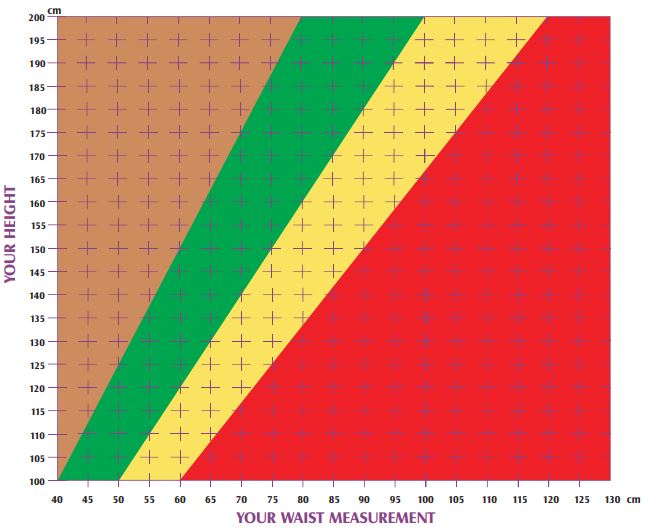
Diagram description:
- The x-axis represents waist circumference, while height is displayed on the y-axis.
- This chart is ideal for adults and children aged five and up.
- The waist-to-height ratio cut-off points are set at WHtR 0.4 (brown to green), 0.5 (green to yellow), and 0.6 (yellow to red).
- The brown zone suggests Take Care – you might be underweight; no reduction in waist circumference is needed.
- The green zone signifies OK.
- The yellow zone indicates Consider Action for Adults and Take Action for Children.
- The red zone calls for Take Action.
How to use a waist-to-height ratio calculator?
Using a waist-to-height ratio calculator is simple. First, you’ll need to measure your waist circumference. Ensure you measure at a horizontal line, around one inch above your belly button, to get the most accurate number. Next, note your height, which can be in inches or centimeters, depending on your preference or the calculator you’re using.
Enter your waist circumference and height into the calculator with these two measurements. This tool will compute your WHtR by dividing your waist measurement by height. Once you input the figures, the calculator will provide your waist-to-height ratio, offering an insight into your body fat distribution and potential health risks. It’s an efficient way to self-assess and monitor your health over time.
Waist-to-Height Ratio vs. BMI
When it comes to monitoring your health and assessing obesity-related risks, both the waist-to-hight ratio (WHtR) and Body Mass Index (BMI) are valuable tools, yet they serve slightly different purposes. While BMI calculates a number based solely on your height and weight, WHtR considers body fat distribution by comparing your waist circumference to your height. This makes WHtR an excellent predictor of visceral fat—the fat surrounding your organs that is linked to various health concerns, such as cardiovascular diseases and type 2 diabetes.
Moreover, WHtR is particularly appreciated for its sensitivity in identifying potential health risks early on. It provides insight into whether your waist size is appropriate for your height. This means it can be more effective than BMI in highlighting health risks, even if your general body weight is normal. Research suggests that maintaining a WHtR below 0.5 is optimal for health. In contrast, BMI can sometimes underestimate or overestimate body fat, especially in those who are muscular or have a smaller frame.
In summary, while both metrics offer their own benefits, you may often prefer WHtR because it provides a clearer picture of body fat distribution. This helps you understand your personal health better and make informed lifestyle choices.
Waist-to-Height Ratio vs. Waist-to-Hip Ratio
The Waist-to-Height Ratio (WHtR) and the Waist-to-Hip Ratio (WHR) serve distinct but complementary roles in assessing body fat distribution and health risks. The WHtR is a straightforward calculation that divides your waist circumference by height, offering a valuable gauge for identifying potential lifestyle-related health risks early on. This metric is particularly valuable because it directly compares your waist – an indicator of visceral fat levels – to your height, providing an easy-to-interpret indicator that correlates well with obesity-related health risks.
On the other hand, the Waist-to-Hip Ratio looks at the proportion of your waist circumference compared to your hip circumference. This ratio provides insight into fat distribution around your midsection versus your hips, with some studies suggesting this measurement can help indicate the likelihood of cardiovascular diseases. Generally, a high WHR might suggest a greater risk of health issues associated with central obesity.

Use both ratios together for insights into different health aspects. Combine them with other metrics to create a complete view of body composition and related health risks. WHtR is more about overall body shape and height, while WHR provides insights into where your body stores fat. These tools can offer a clearer picture of your health and help tailor personal health and fitness goals.
Related Calculators
Conclusion
A simple guideline to remember is that your waist-to-height ratio should ideally be under half your height. By maintaining your waist circumference at less than half your height, you can minimize the risks associated with stroke, heart disease, and diabetes. For the most precise waist measurement, consider doing it right after you wake up from 7-8 hours of restful sleep.
