


In the world of fitness and health, understanding body measurements plays a crucial role in tracking progress and ensuring one’s well-being. One often overlooked but significant measure is the waist-to-hip ratio (WHR). This simple tool provides insights into your body’s fat distribution, helping to assess your risk for various health conditions. If you aim to improve your health or are simply curious about your body’s stats, grasping the WHR is a valuable step.
You can calculate this ratio with just a few measurements and understand where you stand. In this article, we’ll guide you through using the hip ratio calculator, including what inputs you’ll need and how to measure your waist and hips accurately.


What is Waist to Hip Ratio (WHR)?
The waist-to-hip ratio (WHR) is a valuable measure for assessing body fat distribution. Calculated by dividing the circumference of your waist by that of your hips, it gives insight into potential health risks related to obesity. Unlike other measures, such as BMI, WHR specifically highlights how weight is distributed across these key areas, which can be significant in evaluating your risk for conditions like heart disease, diabetes, and certain cancers.
Why is WHR Important?
- Health Risk Assessment: A high WHR can suggest a higher likelihood of conditions such as diabetes, hypertension, and heart disease. It helps categorize health risks into low, moderate, and high, allowing for targeted medical attention when necessary.
- Body Composition Insight: Unlike Body Mass Index (BMI), WHR focuses on fat distribution (a good indicator of visceral fat) rather than overall body weight, offering a more nuanced view of health.
- Identifying Underlying Illnesses: A high WHR can prompt healthcare professionals to investigate potential health issues, enabling early intervention and management.
- Tailored Fitness Goals: By understanding their WHR, individuals can tailor their fitness and nutritional strategies to target fat loss more effectively.
- Holistic Health Monitoring: WHR serves as a quick measure of fat distribution, offering insights into an individual’s overall health status and progress tracking over time.
How to Use Waist to Hip Ratio Calculator
- Select your gender: Many calculators may ask for this input as WHR can vary across genders.
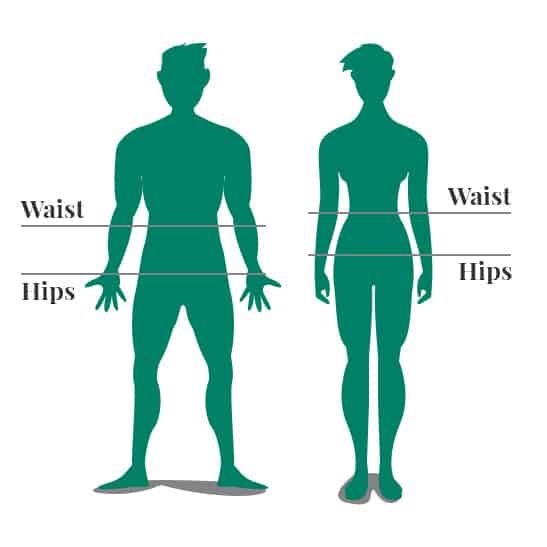
- Measure your waist circumference: Use a flexible tape measure to find the circumference of your waist at the narrowest point, typically above the belly button but below the ribs. Make sure the tape is snug but not too tight.
- Record your waist measurement: Note the measurement in either inches or centimeters, depending on the calculator’s requirement.
- Measure your hip circumference: Use the tape measure to wrap around the widest part of your hips and buttocks. Ensure the tape is leveled around the body and is not twisted.
- Record your hip measurement: Again, measure in inches or centimeters as needed.
- Input your measurements into the calculator: Enter waist and hip measurements into their respective fields.
- Click calculate: Press the calculate button to see your waist-to-hip ratio.
- Analyze the result: Check the resulting WHR against guidelines to determine your health risk category.
Waist-Hip Ratio Formula
The waist-hip ratio (WHR) is determined using the following formula:
WHR = Waist Circumference / Hip Circumference
Let’s see how this works with examples:
Example for a male:
- Waist Circumference: 34 inches
- Hip Circumference: 40 inches
- WHR = 34 / 40 = 0.85
Example for a female:
- Waist Circumference: 28 inches
- Hip Circumference: 36 inches
- WHR = 28 / 36 = 0.78
Healthy Waist-to-Hip Ratio According to the World Health Organization
| Female | Male | Health Risk |
|---|---|---|
| 0.80 or lower | 0.95 or lower | Low health risk |
| 0.81 to 0.84 | 0.96 to 1.0 | Moderate risk |
| 0.85 or higher | 1.0 or higher | High risk |
The World Health Organization (WHO) has established guidelines for what constitutes a healthy waist-to-hip ratio (WHR). For men, a WHR of 0.95 or less is considered healthy. For women, the benchmark is a WHR of 0.80 or less. These measurements help assess body fat distribution, providing insight into potential health risks such as heart disease. Maintaining a WHR within these ranges is associated with a lower risk of various health conditions, further highlighting the importance of monitoring your body’s fat distribution rather than focusing solely on weight or Body Mass Index (BMI).
Body Mass Index (BMI) versus Waist-Hip Ratio (WHR)
When assessing your health, both Body Mass Index (BMI) and Waist-Hip Ratio (WHR) are valuable tools, yet they measure different aspects. BMI is calculated by dividing your weight by your height squared and is often used to categorize individuals into weight categories such as underweight, normal weight, overweight, and obese. However, BMI does not consider how your weight is distributed across your body, which can lead to inaccurate health assessments. For example, someone with a lot of muscle mass could be incorrectly classified as overweight or obese.
On the other hand, WHR provides insight into your body’s fat distribution. It’s the ratio of the circumference of your waist to that of your hips. This measurement helps evaluate the risk for health conditions associated with fat distribution (how much fat is stored on your waist, hips, and buttocks), such as cardiovascular diseases and diabetes. Research suggests that WHR might be more effective than BMI in predicting serious health outcomes, mainly because it reflects central obesity—a critical factor for assessing health risks.
While BMI has been a longstanding tool in clinical practice, switching to WHR can be beneficial for a more comprehensive understanding of your health. Understanding both metrics and how they apply can offer a clearer picture of your health risks and guide you in making informed lifestyle choices.
Waist-to-Hip Ratio vs. Waist-to-Height Ratio
While both the waist-to-hip ratio (WHR) and the waist-to-height ratio (WHtR) are measures used to assess body fat distribution and health risk, they focus on different aspects of body composition. The WHR compares the waist circumference to that of your hips, highlighting body fat distribution around the abdomen. This is particularly important as central obesity is a marker for health risks like heart disease and diabetes.
On the other hand, the WHtR emphasizes the proportion of your waist circumference to your height, offering a straightforward measure of whether your waist size is healthy in relation to your overall body size. This ratio helps indicate abdominal obesity issues regardless of overall weight or body structure, providing a general guideline across different body types and racial variances.
Essentially, both ratios complement each other by providing a more comprehensive understanding of potential health risks and helping you design health and fitness strategies that target both abdominal fat and overall body proportions.
Ways to Improve Waist-to-Hip Ratio
- Increase Physical Activity: Engage in regular workouts such as cardio, strength training, and flexibility exercises to help reduce waist size.
- Maintain a Balanced Diet: Incorporate more vegetables, fruits, lean proteins, and whole grains while limiting processed foods high in sugar and unhealthy fats.
- Monitor Portion Sizes: Being mindful of the amount you eat can prevent overeating, aiding in better weight control.
- Stay Hydrated: Drinking plenty of water can help manage cravings and maintain a healthy metabolic rate.
- Consistent Sleep Schedule: Ensure you get adequate rest each night, as poor sleep can lead to weight gain and a higher waist-to-hip ratio.
- Stress Management: Practice relaxation techniques like meditation or yoga to reduce stress, which can contribute to abdominal fat.
Related Calculators
Conclusion
The waist-to-hip ratio calculator is a critical tool for anyone serious about fitness and body health. By accurately measuring waist and hip circumference and utilizing a WHR calculator, individuals can gain valuable insights into their body composition and associated health risks. As a part of a holistic approach to fitness, monitoring WHR can guide individuals towards healthier lifestyles, tailored fitness routines, and improved overall well-being.
For those interested in further enhancing their fitness journey, exploring various fitness calculators can provide additional perspectives on body measurements and health metrics. Whether it’s tracking body fat percentage, BMI, or WHR, these calculators serve as essential allies in pursuing fitness excellence.
