



The Body Mass Index (BMI) calculator is a popular tool used by fitness enthusiasts, athletes, and health professionals. It indicates an individual’s health relative to their height and weight, offering a quantitative measurement used ubiquitously to assess whether one’s body weight is in a healthy range.
BMI is a simple calculation using a person’s weight and height that can help determine whether they’re in a healthy weight range.
We’re here to assist you with a user-friendly BMI calculator. This tool offers a quick and straightforward way to compute your BMI at your fingertips, giving you an immediate snapshot of your weight status.
In this article, we shall go deep into the essence of BMI: defining what it is, elucidating its calculation method through a standardized formula, and exploring the classification categories associated with BMI values. Additionally, we shall examine the graphical representation of BMI values through a BMI chart for adults.
Beyond the mechanical aspects, this article will juxtapose the pros and cons of utilizing the BMI index to determine health risks. A historical overview of the BMI’s origin will provide context and discuss how BMI integrates with broader fitness and health paradigms. This will include insights into complementary fitness calculators, the critical role of professional health guidance, and holistic health perspectives. Finally, we will discuss the health risks associated with overweight and underweight conditions, underscoring the relevance of BMI within contemporary health discourse.


What is BMI (body mass index)?
BMI, or body mass index, is a widely used metric that uses height and weight to gauge whether you are underweight, normal, overweight, or obese. It’s a simple formula used globally to provide a quick snapshot of an individual’s health status. Healthcare providers often use BMI to identify potential health risks associated with weight issues.
How is BMI calculated using the standard formula?
Tag: BMI formula, body mass index formula
To calculate BMI using the standard formula, you need to use either the metric or imperial system, depending on your preference:
- Metric System: BMI = weight in kilograms ÷ (height in meters × height in meters)
- Imperial System: BMI = (weight in pounds × 703) ÷ (height in inches × height in inches)
This calculation helps quickly and easily assess whether you are within a healthy weight range by considering your weight and height together.
Here’s a step-by-step guide:
- Measure Your Weight: Weigh yourself using a reliable scale. Note your weight in kilograms (kg) or pounds (lbs).
- Measure Your Height: Use a stadiometer or a measuring tape. Note your height in meters (m) or inches (in).
- Plug the Numbers into the Formula: Use the appropriate formula based on the units you are using.
- Interpret Your Results: Compare your BMI value with the categories below to understand your weight status.
For convenience, use the fitness calculator in this article, which automates this process and provides instant results.
The BMI Categories
Understanding BMI categories can guide you on your health journey. Here’s a handy breakdown:
| Category | BMI Range |
|---|---|
| Underweight | Less than 18.5 |
| Normal weight | 18.5 to 24.9 |
| Overweight | 25 to 29.9 |
| Class I Obesity | 30 to 34.9 |
| Class II Obesity | 35 to 39.9 |
| Class III Obesity | 40 or more |
Regarding understanding obesity as classified by BMI, there are three classes: Class 1, Class 2, and Class 3. Each class represents a different level of health risk associated with increasing BMI numbers.
Class 1 Obesity: Also known as mild obesity, this category is defined by a BMI ranging from 30 to 34.9. Individuals in this range face a moderate increase in health risks, and it often marks the starting point for obesity-related complications.
Class 2 Obesity: Known as moderate obesity, Class 2 is characterized by a BMI between 35 and 39.9. The health risks are more significant at this stage, requiring more direct intervention and lifestyle adjustments to mitigate potential health issues.
Class 3 Obesity: Referred to as severe or morbid obesity, Class 3 obesity includes those with a BMI of 40 or higher. This is a serious condition with critical health risks, often necessitating comprehensive medical treatment and management.
These categories are based on World Health Organization guidelines and provide a standard approach to interpreting your BMI score.
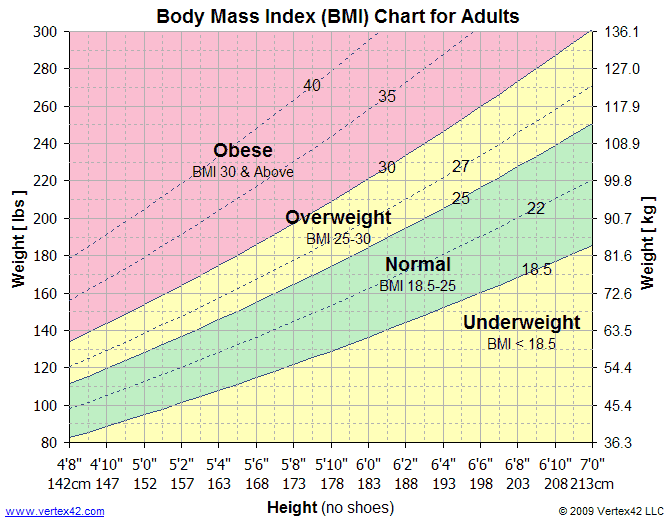
BMI chart for adults
This is a graph of BMI categories based on the World Health Organization data. The dashed lines represent subdivisions within a significant categorization.
The pros and cons of using the BMI index
Understanding the pros and cons of using the BMI index is crucial for utilizing it effectively as a health assessment tool. While it offers an uncomplicated method to gauge healthy body weight ranges, it’s essential to recognize its limitations in providing a comprehensive view of an individual’s overall health. Let’s explore both sides of the equation.
The Pros of Using a BMI Calculator
1. Simplicity and Accessibility
One of the primary advantages of the BMI calculator is its simplicity. It requires only two measurements: weight and height. This makes it accessible to the general public and easy to use without requiring specialized equipment.
2. Quick Assessment of Weight Status
The BMI calculator provides a quick snapshot of an individual’s weight status. This can be useful for those looking to maintain or change their weight, offering a baseline for further health assessments.
3. Standardized Measurement
BMI is a standardized measurement used globally. It offers a common language across different populations, making it easier for health professionals to communicate and compare data.
4. Useful for Large Populations
BMI is particularly beneficial for assessing weight trends in large populations. Researchers and public health officials often utilize BMI data to study health trends and community obesity rates.
5. Encouragement for Healthy Lifestyle Changes
For individuals aiming to improve their fitness levels, knowing their BMI can motivate them to adopt healthier lifestyle choices, including exercise and nutrition adjustments.
The Cons (Limitations) of Using a BMI Calculator
1. Does Not Differentiate Between Muscle and Fat
One of the significant limitations of BMI is that it does not differentiate between body fat and lean muscle mass. For athletes or individuals with higher muscle mass, a high BMI may inaccurately classify them as overweight or obese despite being extra fit with clearly visible six-pack-abs. Conversely, someone with low muscle mass might be classified as normal weight, even with a higher body fat percentage.
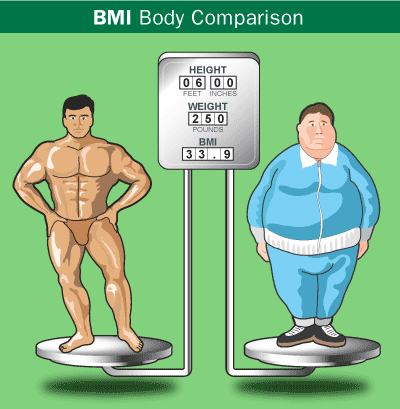
It’s surprisingly common for two people with vastly different body structures to have identical BMI scores. This is because BMI doesn’t consider the composition of your weight. It doesn’t distinguish between fat and lean mass, including bones, organs, and muscle.
Given BMI’s inability to separate muscle from fat, having more muscle can lead to a higher BMI. That’s why our bodybuilder friend, pictured above, might have a BMI of 33.9—placing him in the ‘obese’ category on the chart referenced earlier!
2. Lack of Consideration for Distribution of Fat
BMI does not account for fat distribution in the body. Two individuals with the same BMI may have different health risks based on where their body fat is located, such as abdominal versus peripheral fat.
3. Age and Gender Variability
BMI does not take age and gender differences into consideration. Body composition varies significantly across different demographics, and BMI may not accurately reflect health status in older adults or children.
4. Cultural and Ethnic Differences
Different cultures and ethnic groups may have varying definitions of a healthy body mass. BMI does not account for these differences, leading to misinterpretation of health risks.
5. Potential for Misleading Interpretations
Individuals may misinterpret their BMI results, leading to unnecessary stress or unhealthy behaviors. Using BMI in conjunction with other health indicators is crucial for a comprehensive assessment.
The history and origin of BMI
In the 1830s, the concept of BMI was introduced by Lambert Adolphe Jacques Quetelet, a Belgian mathematician and statistician. His goal was to establish a formula that could aid in defining the “average” man within a population. Originally termed the “Quetelet Index,” it sought to provide a simple numerical measure of a person’s thickness or thinness based on their weight and height, which is why it was referred to as a “weight for height” measurement. Although initially devised for statistical purposes in social physics, it wasn’t until the late 20th century—namely the 1990s—that BMI gained widespread traction in the medical field. It became a standard tool for evaluating body weight and its potential health implications, playing a significant role in medical assessments, especially concerning weight-related conditions such as obesity.
How BMI Fits into the Bigger Picture of Fitness and Health
While the BMI calculator is a valuable tool, it is essential to use it as part of a broader health and fitness strategy. Incorporating additional body measurement calculators, such as waist-to-hip ratio, body fat percentage, and overall fitness assessments, can provide a more complete picture of an individual’s health.
1. Complementary Fitness Calculators
Fitness calculators encompass a range of tools designed to help individuals track their progress and achieve their fitness goals. These can include:
- Body Fat Calculators: Measure body fat percentage for a more accurate body composition assessment.
- Caloric Needs Calculators: Help determine daily caloric intake based on activity level and fitness goals.
- Fitness Assessment Tools: Evaluate strength, flexibility, and endurance levels to gain insight into overall fitness.
2. The Role of Professional Guidance
Consulting with a fitness professional or dietitian can provide personalized insights and recommendations for those serious about fitness and bodybuilding. They can help interpret BMI results and suggest tailored fitness plans considering individual goals, body composition, and health status.
3. Holistic Health Approaches
A holistic approach to health considers body measurements, nutrition, mental well-being, and lifestyle factors. Regular physical activity, a balanced diet, and managing stress are all integral to achieving overall health and fitness.
Risks associated with being overweight
- Increased risk of cardiovascular diseases, including heart attacks and strokes.
- Higher likelihood of developing type 2 diabetes due to increased insulin resistance.
- Greater chances of experiencing high blood pressure and cholesterol, impacting heart health.
- Elevated risk of certain types of cancer, such as breast, colon, and kidney cancer.
- Higher probability of experiencing joint and musculoskeletal issues, such as osteoarthritis.
- Increased risk of sleep apnea and respiratory issues, leading to disturbed sleep patterns.
- Potential for developing fatty liver disease, including nonalcoholic steatohepatitis (NASH).
- Higher risk of gallbladder disease, including gallstones.
Risks associated with being underweight
- Increased vulnerability to infections due to a potentially weakened immune system.
- Higher risk of osteoporosis and fractures because of lower bone density.
- Potential for nutritional deficiencies affecting overall health and well-being.
- Lower energy levels, leading to fatigue and reduced physical performance.
- Possible disruption of normal growth and development in children and teenagers.
- Greater likelihood of fertility issues in women, including irregular menstrual cycles.
More reliable calculators than BMI
- Lean Body Mass (LBM) Calculator
- U.S. Navy Body Fat Calculator
- Waist-to-Height Ratio Calculator
- Waist-to-Hip Ratio Calculator (WHR)
- Body Shape Calculator
Conclusion
The BMI calculator is a convenient and accessible tool for assessing body mass in relation to height. While it has its benefits, it is essential to acknowledge its limitations and use it with other health metrics for a more comprehensive understanding of fitness and well-being.
Understanding their body composition and overall health is crucial for those passionate about fitness. By using BMI alongside other body measurement calculators and seeking professional guidance, individuals can work towards achieving their health and fitness goals more effectively.
