



Two people finish the same workout. One walks out with a shirt completely soaked through. The other barely broke a visible sweat. Did the first person train harder? Burn more calories? Lose more fat? Is the second person just not fit enough?
Not necessarily — and in most cases, probably not at all. Sweat is one of the most visible physiological responses to exercise, which is exactly why people attach meanings to it that it doesn’t actually carry. This guide covers what sweat really tells you, what it doesn’t, and why how much you sweat tells you far more about your body’s need to dissipate heat than about how much fat you burned, how many calories you used, or how effective your workout was.
QUICK ANSWER: Sweating during exercise is primarily a thermoregulatory response. Working muscles produce metabolic heat, and sweating allows that heat to be removed once sweat evaporates from the skin. How much you sweat is influenced by exercise intensity, environmental conditions, body size, genetics, heat acclimation, clothing, and individual physiology. More sweat does not automatically mean more calories burned, more fat lost, or a better workout — it mainly reflects how much heat your body needs to get rid of at that moment.
Why Do We Sweat During Exercise?
Exercise Produces Metabolic Heat
Muscle contraction isn’t 100% efficient — a large share of the metabolic energy your muscles use during exercise ends up as heat rather than movement, a byproduct of how skeletal muscle actually converts chemical energy into mechanical force.
How Sweating Helps Cool the Body
Sweat glands produce fluid that reaches the skin surface, and evaporation of that fluid removes heat from the body. This bears repeating because it’s the single most important physiological fact in this entire article: sweating itself doesn’t cool you—evaporation does.
Sweating Is Only One Part of Thermoregulation
Skin blood flow, evaporation, convection, radiation, and conduction all work together to manage body heat during exercise. For the full physiology of heat production and heat loss, see our companion pillar, Thermoregulation During Exercise: How Your Body Produces and Loses Heat — this article focuses specifically on sweat, not the full thermoregulatory picture.
What Determines How Much You Sweat During a Workout?
This framework matters before diving into the myths below, because understanding these factors debunks almost every myth on this list.
Exercise Intensity and Metabolic Heat Production
More metabolic heat generally means a greater need for heat dissipation — but intensity and sweat rate aren’t related in a simple, linear way across every individual and condition.
Temperature and Humidity
Hot environments increase thermal strain directly. Humidity matters because it reduces how effectively sweat evaporates, regardless of how much is produced.
Airflow and Clothing
Ventilation, fans, outdoor wind, and breathable versus heavy clothing all affect how efficiently sweat evaporates once it reaches the skin.
Body Size and Composition
Greater body mass can mean greater absolute heat production, and the ratio of surface area to mass is genuinely relevant to heat exchange — but this is a long way from the old, oversimplified claim that heavier individuals simply “sweat more” as a fixed rule.
Genetics and Individual Sweat Rate
Some people have a substantially higher sweat rate than others even under identical conditions, for reasons that come down to individual physiology as much as anything else.
Fitness and Heat Acclimation
A review of individual factors affecting the sweating response found that improved aerobic fitness and heat acclimation both promote a more responsive sweating pattern, generally meaning earlier onset and greater capacity when needed. This sets up the very first myth below.
Sex and Other Individual Differences
Real average differences exist between men and women, but as covered in Myth #8 below, other factors heavily confound them rather than creating a simple, isolated sex effect.
| Factor | Potential Effect on Sweating |
|---|---|
| Higher metabolic heat production | Usually increases cooling demand |
| Hot environment | Increases thermal strain |
| High humidity | Reduces evaporative efficiency |
| Greater airflow | Improves evaporation and convection |
| Heavy clothing | Can impair heat loss |
| Heat acclimation | Alters and typically improves the sweating response |
| Genetics | Large individual variation |

10 Myths About Sweating During Exercise
Myth #1: Unfit People Always Sweat More Than Fit People
The reality is more complicated than either claim. Trained and heat-acclimated individuals can develop an earlier onset of sweating and greater sweating capacity when it’s needed—the opposite of what this myth assumes. But fitness alone doesn’t determine who sweats more; exercise intensity, body size, environment, acclimation status, and individual physiology all factor in together. Bottom line: you cannot reliably judge someone’s fitness level by how much they sweat.
Myth #2: Sweating More Means You’re Burning More Fat
Sweat loss and fat loss are entirely different processes. Sweating produces water loss and a temporary reduction in body mass. Fat loss requires a sustained energy deficit over time, causing the body to mobilize and oxidize stored energy — a completely separate mechanism operating on a completely different timescale. If the scale shows a kilogram less immediately after a hard session, that’s not a kilogram of body fat gone; it’s fluid, and it comes back as you rehydrate. Bottom line: you can sweat off water. You cannot sweat off body fat.

Myth #3: Sweating More Means You’re Burning More Calories
There’s a loose correlation in some situations, since hard exercise tends to raise both energy expenditure and heat production, but sweat itself isn’t a calorie meter. Thirty minutes of easy cycling in 35°C heat can produce far more visible sweat than a strength session in an air-conditioned gym, even when the difference in sweat production doesn’t reflect the difference in energy expenditure between the two sessions. Bottom line: sweat rate is a poor proxy for calorie expenditure.
Myth #4: Sweat Suits and Extra Clothing Help You Lose Body Fat
Heavy clothing reduces heat loss, which increases sweating, which increases fluid loss, which lowers the number on the scale — a chain of events that has nothing to do with actual fat loss. This comes up specifically in combat sports “making weight” contexts, and a comprehensive review of rapid weight loss practices in combat sports found that dehydration-based methods, including sauna and sweat-suit use, primarily manipulate body water and carry real physiological and performance risks rather than producing genuine fat loss.
It’s worth being clear that manipulating water weight for a specific weigh-in is a different goal entirely from losing body fat, and carries real dehydration and heat-illness risk when taken to an extreme. If actual fat loss is the goal, see our complete guide, Cutting in Bodybuilding: The Complete Guide to Losing Fat While Preserving Muscle, for an approach that works. Bottom line: sweat suits manipulate water weight, not body-fat loss.
Myth #5: Sweating Detoxifies Your Body
Sweat is predominantly water, along with sodium, chloride, potassium, and smaller amounts of various other compounds. A comprehensive review of sweat composition found that sweat electrolyte and metabolite concentrations are not reliable biomarkers of hydration status or broader physiological function, and correlations between sweat and blood composition haven’t been established for most substances people associate with “toxins.” The body’s primary elimination pathways run through the liver and kidneys, with additional roles for the gastrointestinal and respiratory systems depending on the substance involved — sweat glands are not a meaningful general-purpose elimination route. This doesn’t mean sweat contains literally zero trace compounds; it means treating sweating as a serious detox strategy isn’t supported by how the body’s actual elimination systems work. Bottom line: your sweat glands are primarily part of your cooling system, not your body’s main detoxification system.
Myth #6: If You’re Not Sweating, You’re Not Training Hard Enough
This one deserves a genuinely bodybuilding-specific answer. Compare five sets of three heavy deadlifts with four-minute rest periods in a cool, air-conditioned gym to a 20-minute moderate-intensity circuit in a hot room. The circuit will almost certainly produce more visible sweat — but more sweat doesn’t mean a better hypertrophy stimulus. Sweat doesn’t measure mechanical tension, proximity to failure, training volume, progressive overload, motor-unit recruitment, or the actual hypertrophy stimulus a session provided. Bottom line: judge your workout by the training variables that actually matter — not by how wet your shirt is.
Myth #7: More Sweat Means Better Cooling
Sweat that drips off the skin without evaporating provides far less cooling benefit than sweat that actually evaporates — a direct consequence of the core physiology covered above. This is exactly why a humid environment can produce the counterintuitive combination of more visible sweat and worse cooling at the same time, since evaporation is limited even as sweat production stays high. Bottom line: effective evaporation matters more than simply producing more sweat.
Myth #8: Men Always Sweat More Than Women
Research reviewing sex differences in sweating found that men tend to sweat more than women specifically at higher levels of metabolic heat production, with no clear sex difference apparent when heat production is low — and a large share of the commonly cited male-female gap is confounded by differences in body size, absolute exercise intensity, fitness, and acclimation status between the groups typically compared. When these factors are matched, the gap narrows substantially. Individual variation within each sex can easily exceed the average difference between sexes. Bottom line: sex can influence sweating, but it does not determine an individual’s sweat rate by itself.
Myth #9: You Need an Electrolyte Drink Every Time You Sweat
For a typical, shorter gym workout, most people don’t automatically need a sports drink just because they’re sweating. Official sports medicine guidance notes that because sweat rate and sweat electrolyte content vary considerably between individuals, customized fluid and electrolyte replacement is more useful than a one-size-fits-all rule. Electrolyte replacement becomes increasingly relevant as exercise duration and sweat losses increase, particularly during prolonged training in hot conditions or in athletes with high sweat or sodium losses — not at some fixed universal cutoff. The picture changes with prolonged exercise, heavy sweating, hot environments, multiple sessions in a day, or unusually high individual sodium losses. For the full picture of when electrolyte replacement matters, see our guide, Hydration and Electrolytes in Sports Nutrition. Bottom line: sweating doesn’t automatically mean you need a sports drink — context matters.
Myth #10: Heavy Sweating Always Means You’re Dehydrated
Sweating causes fluid loss, but a high sweat rate by itself isn’t proof of current dehydration. Hydration status depends on the balance between fluid loss and fluid replacement — someone can sweat heavily while adequately replacing fluids throughout a session and remain reasonably well hydrated. Bottom line: sweat rate tells you how quickly you’re losing fluid — not your hydration status by itself.
What Is Actually in Your Sweat?
Water
By far the largest component of sweat.
Sodium and Chloride
The most relevant electrolytes for sports nutrition context, and the main reason sweat tastes salty and can leave visible marks on clothing.
Other Electrolytes and Compounds
Sweat also contains potassium, calcium, magnesium, lactate, urea, and a range of other compounds in smaller, more variable concentrations, though the mechanisms determining exact levels of most of these are still incompletely understood and vary considerably between individuals.
Why Does Sweat Taste Salty?
Sweat glands reabsorb some sodium and chloride as sweat travels through the duct toward the skin, but a meaningful concentration remains in the final fluid that reaches the surface — enough to taste distinctly salty, especially as sweat rate rises and less reabsorption time is available.
Why Do Some Athletes Leave White Salt Marks on Their Clothes?
As sweat evaporates from clothing, the dissolved sodium and other minerals it carried are left behind as a visible residue. White salt marks on clothing suggest substantial salt loss through sweat, though they don’t provide a precise measure of sweat sodium concentration, since total sweat volume, evaporation conditions, and the fabric itself all affect how visible the residue becomes.
How Much Can You Sweat During Exercise?
Individual variation here is large enough that a single universal “normal sweat rate” isn’t especially useful without context. How much you sweat depends on the exercise itself, ambient heat, humidity, your body size, your acclimation status, and how long the session lasts. Published sweat rates for exercising adults span an enormous range — from a few hundred milliliters per hour during light activity in cool conditions, to well over two liters per hour during intense exercise in heat for some individuals — which is exactly why the practical estimation method below is more useful than any generic number.
How to Estimate Your Sweat Rate
You can estimate your own sweat rate directly:
Estimated sweat loss (L) ≈ pre-exercise body mass (kg) − post-exercise body mass (kg) + fluid consumed (L) − urine produced (L)
Then convert that to a rate:
Estimated sweat rate (L/h) = estimated sweat loss (L) ÷ exercise duration (hours)
Both formulas assume roughly 1 kg of body mass change corresponds to about 1 liter of water. As a worked example: a lifter who weighs 80.0 kg before training and 79.2 kg after, having consumed 0.5 L of fluid during a 90-minute session, has lost roughly 1.3 L of fluid — a sweat rate of about 0.87 L per hour for that particular session and conditions. Tracking this over a few representative sessions gives a genuinely useful, individualized number for planning fluid intake — far more useful than a generic “drink X liters” rule that ignores your actual sweat rate, body size, and training conditions.
It’s worth noting this is a practical field estimate rather than a laboratory measurement, since respiratory water loss and substrate-related mass changes can introduce small errors — accurate enough for everyday training decisions, not a precise clinical figure. If you want a starting point for your daily fluid needs beyond just training sessions, our Water Intake Calculator is a useful complement to the sweat-rate method above.
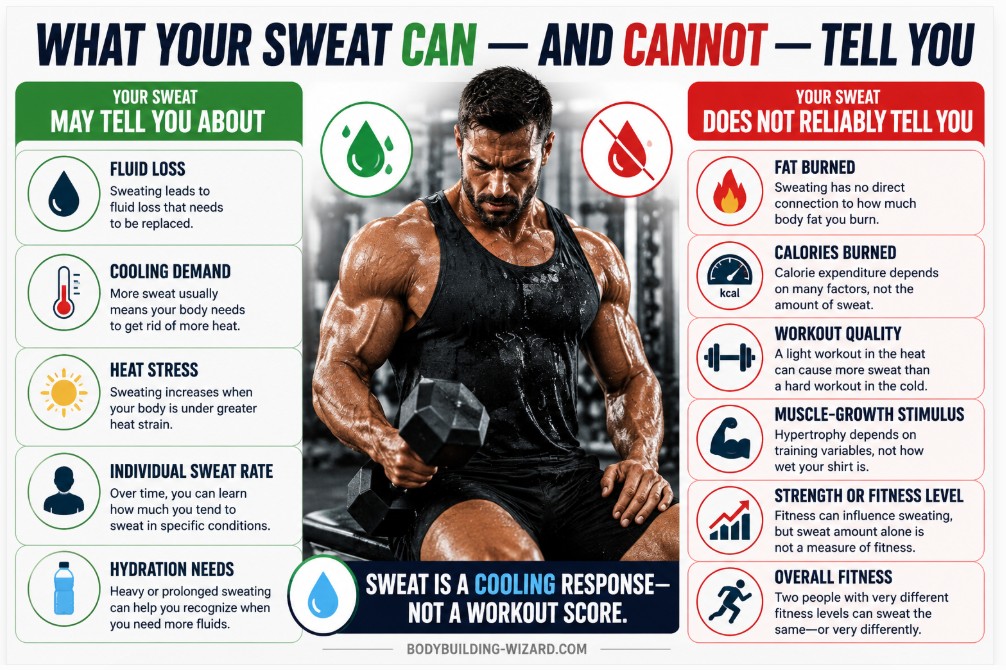
What Can Your Sweat Actually Tell You About Your Workout?
| Sweat MAY Help Tell You About | Sweat Does NOT Reliably Tell You |
|---|---|
| Fluid loss | Fat burned |
| Cooling demand | Calories burned |
| Heat stress | Workout quality |
| Individual sweat rate | Muscle-growth stimulus |
| Possible hydration needs | Strength gains |
| Response to environmental heat | Fitness level by itself |
Does Sweating More Mean You’re More Fit?
Not necessarily. Training and heat acclimation can genuinely change your sweating response—typically with earlier onset and greater capacity when the situation calls for it—but the raw amount of sweat you produce in any single session isn’t a fitness test. Environmental conditions, exercise selection, individual physiology, and acclimation status all shape how much you sweat on a given day, independent of your actual fitness level. Two equally fit lifters training the same program in the same gym can show visibly different sweat patterns simply because of individual differences in sweat gland density and sensitivity — differences that exist regardless of how many years either one has been training.
When Can Sweating During Exercise Become a Problem?
Heavy Sweating and Fluid Loss
Sustained heavy sweating without adequate fluid replacement can lead to meaningful fluid deficits over a session, especially in heat.
When Sweating Is Accompanied by Dizziness, Nausea, or Weakness
These symptoms alongside heavy sweating are worth taking seriously rather than pushing through, since they can signal developing heat exhaustion.
Sweating and Heat Illness
This deserves only a brief mention here since our thermoregulation pillar covers it in full — but one important, potentially dangerous point is worth repeating: don’t rely on “stopped sweating” as a sign of exertional heat stroke. A person experiencing exertional heat stroke can still be sweating heavily; the defining features are severe hyperthermia combined with central nervous system dysfunction like confusion or altered behavior, not the absence of sweat. For the complete safety picture, see Thermoregulation During Exercise.
Practical Sweat and Hydration Tips for Lifters
- Don’t judge workout quality by how much you sweat.
- Wear clothing that allows heat loss rather than trapping moisture against the skin.
- Improve gym airflow when possible — a fan is a genuinely useful, low-effort tool.
- Start training reasonably hydrated rather than trying to catch up mid-session.
- Replace fluids according to your actual measured sweat rate, not a generic assumption.
- Consider tracking sweat rate specifically during long or hot sessions where it matters most.
- Don’t deliberately overdress to try to “sweat off” body fat.
- Don’t assume every workout automatically requires an electrolyte drink.
- Pay attention to unusual symptoms — dizziness, nausea, weakness — rather than sweat quantity alone.
Coach’s Note: One of the easiest mistakes to make is judging training quality by how exhausted, sore, or sweaty a workout makes you feel. I’ve watched two lifters train on the same day, in the same gym: one doing heavy compound work with full rest periods between sets, the other moving quickly through a circuit in a warmer corner of the room. The second lifter often looks like they “did more” — dripping, breathing hard, shirt soaked. But the amount of sweat on the floor doesn’t tell you which session actually provided a better stimulus for the goal each of them was training for. I’ve learned to evaluate the work itself — load, effort, technique, proximity to failure — and treat how wet someone’s shirt is as background noise, not a training metric.
Bodybuilder’s Take
Sweat is your body’s cooling response — not your workout score. For a bodybuilder, what actually matters is training performance, progressive overload, proximity to failure, sufficient volume, nutrition, and recovery — not how soaked your shirt is at the end of a session.
Key Takeaways
- ✓Sweating is primarily a thermoregulatory response, not a performance or effort metric.
- ✓Evaporation — not sweating itself — is what actually removes substantial heat from the body.
- ✓Sweat rate varies enormously between individuals, even under identical conditions.
- ✓More sweat does not mean more fat loss — temporary post-workout weight loss is fluid, not fat.
- ✓Sweat is a poor proxy for calories burned and doesn’t measure hypertrophy stimulus or training quality.
- ✓Sweat is not a meaningful detox mechanism — the liver and kidneys handle the body’s primary elimination pathways.
- ✓Fitness and heat acclimation can modify your sweating response, but sweat quantity alone doesn’t measure fitness level.
- ✓Hydration and electrolyte needs depend on fluid losses, session duration, and environmental conditions — not a fixed rule for every workout.
Frequently Asked Questions
Is sweating a lot during exercise good?
Sweating heavily isn’t inherently good or bad — it simply reflects your body’s cooling demand at that moment, shaped by exercise intensity, heat, humidity, and your individual physiology. It’s not itself a marker of a superior or inferior workout.
Does sweating mean you’re burning fat?
No. Sweating causes water loss, not fat loss. Fat loss requires a sustained caloric deficit over time, an entirely separate process from the fluid you lose through sweat during a single workout.
Do you burn more calories when you sweat more?
Not reliably. Sweat rate reflects thermoregulatory demand, which is influenced by heat and humidity as much as by exercise intensity, so it’s a poor proxy for how many calories a session actually burned.
Why do I sweat more than other people at the gym?
Individual sweat rate depends on genetics, body size, fitness level, heat acclimation status, and the specific conditions of your training environment. Large individual differences are completely normal, even among people doing the exact same workout.
Do fit people sweat more than unfit people?
Fitness and heat acclimation can lead to an earlier onset of sweating and a greater sweating capacity when needed, but this doesn’t translate into a simple rule that fitter people always sweat more in any given session — too many other factors are involved.
Why do I sweat so much during weight training?
Resistance training, especially high-volume or compound-exercise sessions, produces substantial metabolic heat in bursts, which can trigger significant sweating even though the effort pattern is intermittent rather than continuous like endurance exercise.
Should I drink electrolytes if I sweat a lot?
It depends on session duration, your individual sweat rate, the heat of your environment, and your overall diet. Electrolyte replacement matters more for prolonged, heavy-sweat sessions than for a typical shorter workout.
Is it normal not to sweat much during exercise?
Yes, for many people and conditions — cooler environments, lower exercise intensity, and individual physiology can all result in comparatively little visible sweat without indicating a problem. Persistently unusual patterns are worth discussing with a healthcare provider, but modest sweating on its own isn’t a red flag.
References
- Betts, J. G., et al. (2023). Anatomy and Physiology 2e. OpenStax. openstax.org/details/books/anatomy-and-physiology-2e
- Baker, L. B. (2019). Physiological mechanisms determining eccrine sweat composition. European Journal of Applied Physiology. pmc.ncbi.nlm.nih.gov/articles/PMC7125257
- (2024). Effects of individual characteristics and local body functions on sweating response: a review. Journal of Physiological Anthropology. pmc.ncbi.nlm.nih.gov/articles/PMC11519300
- American College of Sports Medicine; Sawka, M. N., Burke, L. M., Eichner, E. R., Maughan, R. J., Montain, S. J., & Stachenfeld, N. S. (2007). American College of Sports Medicine position stand: exercise and fluid replacement. Medicine & Science in Sports & Exercise. pubmed.ncbi.nlm.nih.gov/17277604
- Franchini, E., Brito, C. J., & Artioli, G. G. (2012). Weight loss in combat sports: physiological, psychological and performance effects. Journal of the International Society of Sports Nutrition. pubmed.ncbi.nlm.nih.gov/23237303
- Kenney, W. L., Wilmore, J. H., & Costill, D. L. (2021). Physiology of Sport and Exercise (8th ed.). Human Kinetics.
- Powers, S. K., & Howley, E. T. (2021). Exercise Physiology: Theory and Application to Fitness and Performance (11th ed.). McGraw Hill.
