



Introduction
If you’ve ever dieted hard, you know that eating less doesn’t just burn fat — it also drains energy, messes with hormones, and crushes motivation. That’s where “refeed days” and “cheat meals” come in. Both promise to relieve dietary stress, but they’re not the same thing.
Despite how casually they’re thrown around in fitness circles, refeeds and cheat meals operate on very different principles. One is rooted in science and controlled nutrition, while the other leans heavily on psychology and reward-based behavior.
This article will break down the differences, the science behind each, and how to use them correctly in your cutting phase — so you can get leaner, stay sane, and keep your hard-earned muscle.
The Science Behind Refeed Days
A refeed day is a short, planned period (usually 1–2 days) during which you temporarily increase your caloric intake — mainly through carbohydrates — to counteract the adverse effects of prolonged dieting.
During long caloric restriction, your body adapts: metabolism slows, leptin (the “satiety hormone”) drops, and energy levels fall. Refeeds temporarily reverse this by replenishing glycogen and boosting your metabolism.
How Refeed Days Work
- Leptin Restoration: Carbohydrates raise insulin, which triggers leptin release — a signal that food is available again. This helps stabilize metabolism.
- Thyroid Function Support: Low calories suppress T3 (active thyroid hormone). Short refeed periods can improve its conversion from T4.
- Performance Boost: Extra carbs refill muscle glycogen, enhancing training intensity and recovery.
- Psychological Reset: Refeeds reduce the mental fatigue of constant restriction without derailing progress.
Coach’s Note
In my years coaching athletes, I’ve found that strategic refeeds often save a fat-loss phase from burnout. They aren’t “cheats” — they’re calculated performance resets. When used correctly, they restore focus, strength, and consistency — the three pillars of a successful cut.
The Science Behind Cheat Meals
A cheat meal, on the other hand, is a spontaneous, untracked, often indulgent meal where rules are relaxed. It’s not primarily about hormones — it’s about psychological relief.
The Problem
While an occasional cheat meal can reduce feelings of restriction, it can also spiral into binge-like behavior if not managed. The “I earned this” mindset can quickly undo a week’s deficit if calories explode beyond maintenance.
What Happens Physiologically
- Blood sugar spikes sharply, followed by insulin surges.
- Digestive load increases dramatically (especially from fat and sugar).
- Water retention may rise temporarily.
- Fat storage may increase if the surplus exceeds glycogen capacity.
Psychological Side
Cheat meals can reduce diet fatigue — but they also reinforce emotional eating patterns if used as “rewards.” The difference between a helpful indulgence and a harmful binge is intention.
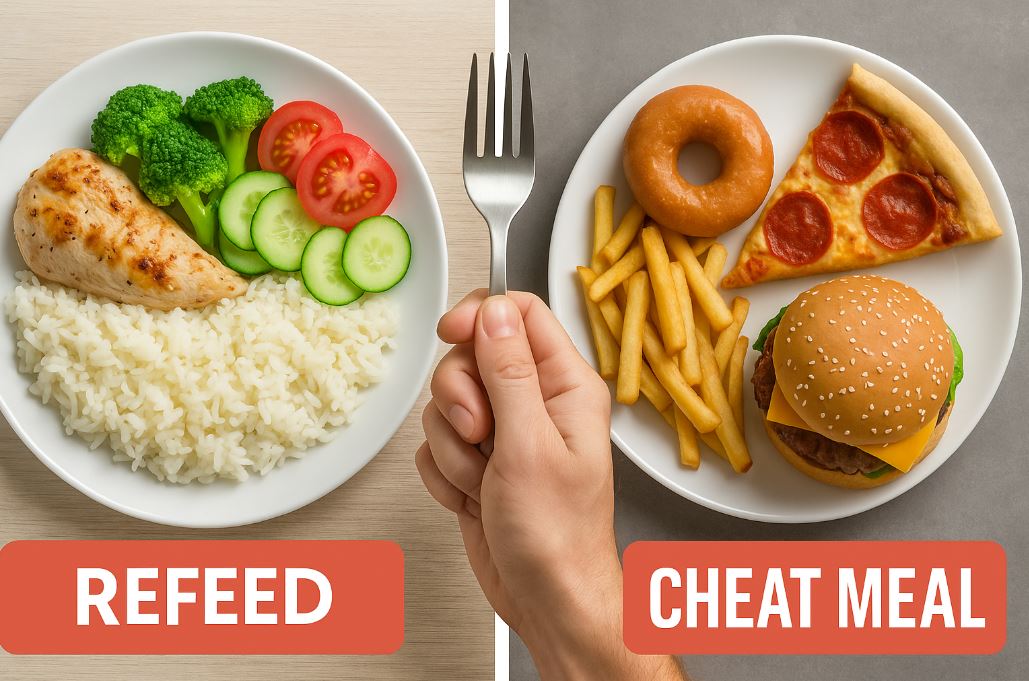
Refeed Days vs Cheat Meals — The Key Differences
While both refeed days and cheat meals involve eating more food during a diet, their goals, structure, and outcomes couldn’t be more different. The table below breaks down the key differences between refeed days and cheat meals, helping you understand which approach truly supports fat loss and performance.
| Category | Refeed Day | Cheat Meal |
|---|---|---|
| Goal | Hormonal reset & performance boost | Psychological relief |
| Duration | 1–2 days (structured) | 1 meal (unstructured) |
| Calories | Slightly above maintenance | Often far above maintenance |
| Macronutrient Focus | High carbs, moderate protein, low fat | High fat, sugar, and total calories |
| Tracking | Controlled & measured | Untracked |
| Effect on Leptin | Increases temporarily | Minimal or inconsistent |
| Risk of Fat Gain | Low (if structured) | High (if untracked) |
| Best For | Advanced and competitive athletes | Casual dieters needing a mental break |
How Often Should You Refeed?
Frequency depends on your body fat percentage, activity level, and the size of the deficit.
The leaner you get, the more your body resists further fat loss. That’s when leptin levels, thyroid output, and training performance start to drop — making regular refeeds essential.
| Body Fat % | Refeed Frequency | Duration |
|---|---|---|
| 10–15% (men) | Every 7–10 days | 1 day |
| <10% (men) | Every 5–7 days | 1–2 days |
| 18–25% (women) | Every 10–14 days | 1 day |
| <18% (women) | Every 7–10 days | 1 day |
If you’re very lean or in an extended cut, weekly refeeds are beneficial for both hormonal stability and training performance.
However, men with body fat above 15% (and women above 25%) usually don’t need frequent refeeds. Their leptin and metabolic responses remain more stable, and energy availability is higher. In those cases, a refeed every 2–3 weeks (or only during performance slumps) is sufficient.
Coach’s Note
Many clients assume they “deserve” a refeed just because they’ve been dieting for a week. But unless you’re already lean (under 15% for men or under 22% for women), your metabolism doesn’t slow down dramatically yet. What you probably need is “consistency”, not carbs. Once you reach a leaner stage and strength starts dipping — that’s when a true refeed becomes your best ally, not a reward meal.
How to Structure a Refeed Day
Step-by-Step:
- Calculate Maintenance Calories (TDEE)
Example: If your TDEE (Total Daily Energy Expenditure) = 2,500 kcal
→ Refeed intake = 2,800–3,000 kcal (10–20% above maintenance) - Adjust Macronutrients
- Carbs: +30–40% increase (main energy source)
- Protein: Keep consistent (~2.0 g/kg BW)
- Fats: Decrease slightly (≤ 20% total kcal)
- Focus on Clean, Whole Foods
Oats, rice, potatoes, lean meats, fruits, and whole grains. Avoid processed sugars or trans fats.
Sample 1-Day Refeed Meal Plan (~2,900 kcal)
This refeed example is designed for an athlete with a TDEE of around 2,500 calories, aiming for a temporary 10–20% increase in calories (approximately 2,800–3,000 kcal total) to restore glycogen stores and optimize hormonal balance. It demonstrates how a structured refeed can boost energy and performance without sacrificing dietary discipline.
| Meal | Foods | Calories | Protein | Carbs | Fat |
|---|---|---|---|---|---|
| Breakfast | Oatmeal + banana + whey protein | 500 | 35 | 80 | 8 |
| Snack | Rice cakes + honey + Greek yogurt | 350 | 20 | 60 | 4 |
| Lunch | Chicken breast + rice + veggies | 600 | 45 | 75 | 10 |
| Snack | Smoothie (berries + oats + whey) | 400 | 30 | 65 | 6 |
| Dinner | Salmon + potatoes + green beans | 600 | 45 | 60 | 14 |
| Total | ≈2,900 | 175 g | 340 g | 42 g |
Food Quality: What to Eat on Refeed Days vs Cheat Meals
When it comes to refeed days vs. cheat meals, the most significant difference isn’t just calories—it’s the type of food you eat.
A proper refeed day focuses on clean, nutrient-dense carbohydrates that replenish muscle glycogen and stabilize hormones. At the same time, a cheat meal is typically made up of hyperpalatable, high-fat, high-sugar foods that satisfy cravings but rarely serve your long-term goals.
During a refeed, the goal is to give your body high-quality fuel, not to indulge.
Ideal choices include:
- Whole grains (rice, oats, quinoa)
- Starchy vegetables (potatoes, sweet potatoes)
- Fruits (bananas, berries, apples)
- Lean proteins (chicken, turkey, fish)
- Small amounts of healthy fats (avocado, olive oil)
These foods deliver steady glucose, minimal digestive stress, and a clear hormonal response that benefits training and recovery.
By contrast, cheat meals usually feature highly processed comfort foods — pizza, burgers, fries, desserts, or sugary snacks — that are high in fat and sugar. While emotionally satisfying, they cause large insulin spikes, water retention, and bloating, with little benefit to muscle glycogen or metabolism.
Used occasionally, a cheat meal can provide psychological relief, but relying on it too often turns progress into a cycle of restriction and overindulgence.
Coach’s Note
The smartest athletes treat food as fuel, not therapy. I’ve seen countless clients sabotage weeks of progress by turning “refeeds” into excuses for junk food. When you approach refeed days with discipline — choosing clean carbs and quality protein — your body rewards you with better recovery, stable hormones, and stronger workouts. A cheat meal might feed your emotions, but a well-planned refeed fuels your performance.
Common Mistakes Explained (in Simple Terms)
Many people misunderstand what a refeed day really is — and end up doing more harm than good. A refeed is not a “cheat day in disguise.” It’s a calculated increase in calories and carbs designed to support performance, hormone balance, and recovery.
Here are the most common mistakes I’ve seen athletes make — and how to fix them:
- Turning a refeed into a binge:
When your “refeed” includes pizza, ice cream, and chips, it’s no longer structured. The fix is simple — plan your meals, stick to clean, carb-focused foods, and control your portions. - Refeeding too often:
Doing it every few days cancels out your weekly calorie deficit. For most athletes, one refeed every 7–14 days is enough. Leaner athletes may refeed slightly more often, but only when performance drops. - Neglecting protein intake:
Some people raise carbs but forget that protein must stay consistent to preserve lean muscle. Every meal on a refeed day should include a solid protein source — chicken, fish, whey, or eggs. - Using cheat days as emotional rewards:
“I earned this” is not a nutrition strategy. Cheat meals feed your emotions, not your physiology. Refeeds, on the other hand, are based on data, structure, and athletic performance. - Ignoring weekly calorie averages:
Fat loss happens over the week, not in a single day. If you maintain a deficit for six days but overeat massively on the seventh, your progress will stall. - Labeling foods as ‘bad’ or ‘forbidden’:
This mindset leads to guilt and binge behavior later on. Instead, follow the 80/20 rule — 80% nutrient-dense whole foods and 20% flexibility for mental balance. - Not adapting to body composition:
If you’re above roughly 15% body fat (men) or 25% (women), your metabolism is still relatively stable. Refeeds in this case are not critical for hormonal recovery — one moderate carb-up meal every few weeks is usually enough. The key here is consistency, not excess.
In short, a refeed should restore your body and mind — not derail your discipline. When done right, it’s a performance tool, not a psychological escape hatch.
What the Research Really Says
Several studies highlight the benefits of structured carbohydrate refeeds over random cheat meals:
- Dirlewanger et al. (2000) found that 3 days of carbohydrate overfeeding increased leptin by 28% and improved metabolic rate by 7%.
- Peos et al. (2021) observed that intermittent energy refeeding during dieting preserved more lean mass compared to continuous energy restriction.
- Byrne et al. (2020) showed that controlled refeeds improved diet adherence and mood stability during fat loss phases.
👉 Cheat meals, by contrast, lack measurable hormonal benefits and often introduce unpredictable caloric swings.
The Psychological Aspect
Cheat meals are more about emotion than physiology. They provide temporary relief from dietary restraint but can reinforce the “good vs bad” food mentality. Refeeds, on the other hand, are empowering — they restore energy while keeping you in control.
Psychologically, structured flexibility (planned refeeds) improves long-term adherence, while emotional indulgence (cheat meals) often leads to guilt and compensation.
Coach’s Perspective — My Professional Take
Coach’s Note
In my coaching practice, I rarely prescribe cheat meals. They satisfy emotions, not physiology. Refeed days, however, are structured tools that help athletes stay strong, focused, and metabolically balanced. If you’ve hit a plateau, low energy, or flat workouts — you don’t need a pizza; you need a plan.
Conclusion
Refeed days and cheat meals may look similar, but they serve completely different purposes. Refeeds are strategic, measured, and performance-enhancing. Cheat meals are emotional, spontaneous, and often counterproductive.
If your goal is to achieve a lean, strong physique, structure always beats spontaneity. Plan your refeeds, track your progress, and let science guide your indulgence.
Key Takeaways
- Refeed days are structured increases in carbs and calories that restore leptin, glycogen, and energy.
- Cheat meals are untracked and emotional; they often hinder progress if uncontrolled.
- Refeeds can improve training intensity, mood, and adherence without fat rebound.
- Use refeeds every 7–14 days, depending on body fat and activity level.
- Track weekly calorie averages — not just daily fluctuations.
- Structure, not indulgence, separates athletes from dieters.
Are refeed days and cheat meals the same thing?
No. A refeed day is a structured increase in calories (mainly from clean carbohydrates) aimed at restoring metabolism and performance. A cheat meal is typically untracked and indulgent — focused on enjoyment, not physiology.
How often should you have a refeed day during cutting?
For most athletes, every 7–14 days is ideal. Leaner athletes (<10–12% body fat) might benefit from weekly refeeds, while those above 15% body fat can refeed less frequently, every 2–3 weeks.
What are the main benefits of refeed days?
Refeeds help restore glycogen, increase leptin levels, and stabilize mood during long dieting phases.
They also help maintain strength, energy, and adherence — key for sustainable fat loss.
Can cheat meals slow down fat loss?
Yes, if they’re too frequent or excessive. Cheat meals can easily erase a week’s calorie deficit if not controlled, especially when combining high sugar and fat foods like pizza, fries, or desserts.
What should I eat during a refeed day?
Focus on clean carbohydrate sources such as rice, potatoes, oats, and fruits, while keeping protein stable and fats low. This maximizes glycogen restoration without unnecessary fat gain.
Do refeed days increase leptin levels?
Yes — several studies (like Dirlewanger et al., 2000) show that short-term carbohydrate overfeeding boosts leptin, the hormone that regulates hunger and metabolism. This helps your body maintain energy output during a caloric deficit.
Should women refeed differently than men?
Women often respond better to slightly less frequent refeeds (every 10–14 days) and a smaller calorie increase (10–15% above TDEE), because hormonal fluctuations already influence energy balance.
Are cheat meals ever beneficial?
Occasionally, yes — from a psychological standpoint. A well-timed cheat meal can reduce feelings of restriction and improve adherence, but it should never turn into an uncontrolled binge.
Can you build muscle during refeed days?
Indirectly, yes. Refeeds improve training intensity and recovery, which supports lean mass retention and even slight hypertrophy over time — especially in long cutting phases.
Should I track calories during a refeed day?
Absolutely. Even though you’re eating more, a refeed day should still be planned and logged.
Aim for roughly 10–20% above your TDEE, focusing on clean carbs — not junk food — to ensure true metabolic benefit.
