

The patella — commonly called the kneecap — is a small but powerful bone that plays an essential role in lower-body strength, stability, and movement. Although tiny compared to other bones, the patella is central to force transfer through the knee, enabling safe and efficient squatting, lunging, jumping, running, and virtually every lower-body exercise performed by athletes and lifters.
In this guide, we’ll break down the anatomy, function, biomechanics, common injuries, and training implications of the patella — all explained in a way that matters to bodybuilders, strength athletes, and fitness enthusiasts.
What Is the Patella?
Definition
The patella is a triangular, flat bone embedded within the quadriceps tendon, sitting in front of the knee joint. It acts as both a protective shield for the knee and a powerful mechanical lever, increasing the effectiveness of the quadriceps during knee extension.
It is the most prominent sesamoid bone in the human body, meaning it forms inside a tendon and enhances the functioning of the muscle-tendon complex.
When you squat, jump, sprint, or extend your knee under heavy load, the patella absorbs these forces and redirects them effectively through the knee joint.
Brief Anatomy of the Patella
A. Location
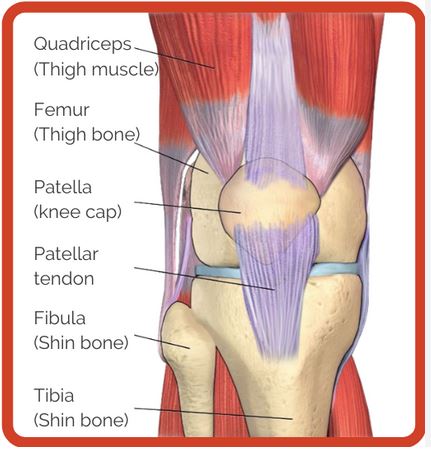
The patella is located at the front of the knee joint, embedded within the quadriceps tendon. It articulates with the femur via the patellofemoral joint and connects inferiorly to the tibia through the patellar tendon.
This positioning allows it to act as a protective shield and a leverage enhancer during knee extension.
B. Appearance and Structure
The patella is roughly triangular:
- Base (top): broad and thick, where the quadriceps tendon attaches
- Apex (bottom): pointed region where the patellar tendon originates
- Anterior surface: rough, providing traction for soft tissues
- Posterior surface: smooth and covered with thick articular cartilage — the thickest cartilage in the human body
- Medial & lateral facets: articulate with matching grooves on the femur
This thick layer of cartilage exists because the patella experiences extremely high compressive forces during knee flexion — especially in deep squats.
C. Size
Size varies with sex and overall body size, but generally:
- Length: 4–6 cm
- Width: 3–5 cm
- Thickness: ~1–2 cm (cartilage included)
Despite its small size, it is biomechanically essential for lower-body power output.
Muscles and Tendons Connected to the Patella
Although few muscles attach directly to the patella itself, it acts as a functional anchor point for the most powerful extensor muscles of the body.
Quadriceps Tendon (Superior Attachment)
- Connects the quadriceps muscles to the patella
- Allows the patella to function as a mechanical lever during knee extension
Patellar Tendon (Inferior Attachment)
- Extends from the patella to the tibial tuberosity
- Transfers quadriceps force to the tibia
- Critical for jumping, squatting, and leg extension
Indirect Muscular Influences
These muscles do not attach to the patella directly but strongly affect patellar tracking:
- Vastus medialis obliquus (VMO)
- Vastus lateralis
- IT band (via lateral retinaculum)
- Adductors & gluteus medius (through pelvis alignment)
These structures are highly relevant to lifters — weakness or imbalance can cause pain, poor tracking, and serious knee issues.
Blood Supply & Innervation
The patella receives blood from the genicular arterial network, a ring of arteries supplying the knee. Nerve supply comes mainly from branches of the femoral nerve, particularly through the quadriceps. Pain around the patella is often associated with irritation of the peripatellar soft tissues, not the bone itself.
Functions of the Patella
1. Increases Quadriceps Mechanical Advantage
The patella acts like a pulley, improving the leverage and force output of the quadriceps during knee extension.
This allows lifters to:
- Extend the knee under heavy load
- Maintain stability in squats
- Generate explosive power in leg press, jumps, and sprints
Without the patella, the quadriceps lose up to 30% of their strength advantage.
2. Protects the Knee Joint
It shields the delicate structures inside the knee from direct impact — crucial in contact sports, plyometrics, and accidental bumps.
3. Guides Patellar Tracking
The patella helps guide smooth movement within the femoral groove during knee flexion and extension. Poor tracking → a common cause of knee pain in lifters.
Interactions With Other Bones
Even though it’s a single bone, its biomechanical interactions are complex:
Patellofemoral Joint (with femur)
- Responsible for the gliding motion
- Subject to massive compressive forces during deep knee flexion
- A common site of pain or cartilage irritation
Connection With Tibia (via patellar tendon)
- Transfers extensor force to the lower leg
Integration With Quadriceps Tendon
- Forms a functional unit that stabilizes anterior knee forces
These interactions define how safely and efficiently you can squat, jump, run, and press weight with your legs.
Patella Biomechanics in Sports
The patella plays a central role in the biomechanics of nearly every athletic lower-body movement. As the primary lever for knee extension, it increases the quadriceps’ ability to generate force, especially during explosive actions like sprinting, jumping, and pushing out of the bottom of a squat.
During knee flexion, the patella glides within the femoral groove, distributing joint stress and allowing smooth patellofemoral motion. This dynamic interaction becomes even more critical under heavy load: the deeper the squat or lunge, the greater the compressive forces on the patella, making proper tracking and balanced muscle activation essential.
In sports, efficient patella biomechanics translate directly into better power output, improved landing mechanics, faster acceleration, and reduced risk of overuse injuries such as patellofemoral pain or patellar tendon irritation.
Trainer’s Perspective (Author’s Insight)
As a strength coach, I’ve seen more patella-related problems than almost any other lower-body issue — especially in athletes who squat and jump frequently. In many cases, the problem isn’t the patella itself, but the surrounding musculature and how the knee tracks under load.
I’ve worked with lifters who had chronic patellofemoral pain simply due to:
- Weak VMO
- Overactive vastus lateralis
- Tight IT band
- Poor ankle mobility
- Aggressive knee valgus
Once we addressed hip stability, improved foot position, and fixed squat mechanics, their knee pain decreased dramatically.
A healthy patella is not about having “strong knees” — it’s about balanced forces around the knee. When the patella glides smoothly, every lower-body lift becomes stronger, safer, and more explosive.
Exercises That Put the Most Stress on the Patella
These movements can overload the patella, especially with poor technique, imbalances, or excessive volume.
1. Deep Barbell Squats
Why: High compressive force on the patellofemoral joint
Risk: Pain beneath the kneecap, cartilage irritation
Tip: Improve hip/ankle mobility and maintain proper knee tracking
2. Leg Extensions (Heavy or With Poor Control)
Why: High shear forces at low knee flexion angles
Risk: Patellar tendon overload
Tip: Use controlled tempo, avoid locking out aggressively
3. Box Jumps and Plyometrics
Why: Rapid deceleration and landings stress the patellar tendon
Tip: Land softly; increase volume slowly
4. Lunges / Split Squats With Knee Collapse
Why: Medial collapse alters lateral/medial patellar tracking
Tip: Keep the knee aligned over the second toe
5. Running Hills or Stairs
Why: Increased quadriceps tension increases patellofemoral load
Tip: Strengthen glutes and hip stabilizers
Common Injuries and Conditions Affecting the Patella
In this section, we’ll briefly list the most common patella-related injuries and conditions without going too deep into medical detail. The goal is to give athletes and lifters a clear overview of what typically goes wrong around the kneecap and why these issues matter during training.
| Injury | Main Cause | Typical Symptoms | Risk for Lifters |
|---|---|---|---|
| Patellofemoral Pain Syndrome (PFPS) | Poor patella tracking, weak VMO, tight IT band | Front knee pain, grinding, pain during squats/stairs | High, especially with valgus collapse |
| Patellar Tendonitis (“Jumper’s Knee”) | Jumping, plyometrics, heavy leg extensions | Pain below kneecap, tendon stiffness | High for athletes doing jumps or high-volume squats |
| Chondromalacia Patella | Cartilage irritation from overload or maltracking | Sharp pain under kneecap, popping/clicking | Moderate—worse with deep knee flexion |
| Patellar Subluxation | Sudden movement, weak stabilizers, shallow groove | Knee giving way, lateral kneecap shift | Medium—but higher in sports with pivoting |
| Patellar Fracture | Direct trauma or heavy impact | Severe pain, swelling, inability to extend knee | Low—but serious when it occurs |
Common Treatments for Patella-Related Issues
- Rest and load management
- Ice for acute pain
- Strengthening VMO (Vastus Medialis Obliquus) and glute medius
- IT band and quad mobility work
- Taping or patellar tracking braces
- Physical therapy for chronic cases
- Medical evaluation for severe trauma or persistent symptoms
Tips for Keeping the Patella Healthy
- Maintain strong glutes, hips, and VMO (Vastus Medialis Obliquus)
- Improve ankle dorsiflexion
- Use proper squat/lunge mechanics
- Avoid excessive knee valgus
- Warm up thoroughly before leg workouts
- Manage training load and avoid sudden spikes
- Maintain healthy body weight (reduces patellofemoral pressure)
Importance of the Patella in Sports and Bodybuilding
- Enables heavy squatting and jumping by improving quadriceps leverage
- Essential for knee stability during all lower-body lifts
- Contributes to force transfer in running and sprinting
- Protects the knee during contact or accidental impact
- Directly affects lifting performance, speed, and power
A healthy patella = safer training + stronger performance.
Conclusion
The patella may be small, but its impact on lower-body movement is massive. It protects the knee, strengthens the quadriceps, and allows athletes to jump, squat, run, and lift with power and precision.
For lifters, understanding this tiny bone is key to preventing knee pain, improving technique, and building long-lasting lower-body strength.
Coach’s Corner: Patella Essentials for Lifters
Your kneecap is more than a passive bone — it’s a force-amplifying structure that determines how strong, stable, and pain-free your squats and leg extensions feel. Keep the patella healthy by training smart, fixing muscle imbalances, and respecting knee mechanics under load.
Key Takeaways – Patella for Athletes & Lifters
The patella (kneecap) may be small, but it plays a massive role in how strong, stable, and pain-free your lower body lifts feel.
- The patella is the largest sesamoid bone and sits inside the quadriceps tendon, acting as a powerful lever for knee extension.
- By increasing the quadriceps’ mechanical advantage, the patella directly boosts your ability to squat, jump, sprint, and leg press heavy loads.
- It protects the front of the knee joint and helps guide smooth tracking of the kneecap over the femur during flexion and extension.
- Most patella problems in lifters come from poor tracking, muscle imbalances (weak VMO, weak glutes), or bad technique rather than a “bad knee.”
- Smart programming, strong hips and quads, good ankle mobility, and clean squat/lunge mechanics are your best protection against patella pain.
- A healthy patella equals stronger performance, better power transfer, and fewer setbacks in your lower-body training.
Can heavy squats permanently damage the patella?
Not usually — but they can irritate the patellofemoral joint if technique or load management is poor. Permanent damage is rare unless there’s severe cartilage wear, repeated high-impact trauma, or long-term ignoring of pain signals. The real risk comes from poor tracking, weak hips, or low ankle mobility.
Why does my kneecap “pop” or “click” during squats?
Popping sounds typically come from soft tissue sliding over the patella, minor tracking deviations, or small pockets of gas in the joint fluid. If there’s no pain, it’s usually harmless. Clicking with pain, however, may indicate patellar maltracking, cartilage irritation, or early patellofemoral pain syndrome.
Is leg extension bad for the patella?
Heavy leg extensions at low knee-flexion angles (0–30°) increase shear force on the patella and patellar tendon. Used moderately and with controlled tempo, the exercise is safe. For sensitive knees, avoid max loads and focus on higher reps, slow eccentrics, and angles where discomfort is minimal.
Why do patella problems often start after increasing training volume?
The patellar tendon and surrounding tissues adapt slower than muscles. When volume jumps quickly — like adding more squat days, new plyometric sessions, or hill running — the tendon gets overloaded. The bone itself is rarely the issue; the tendon and cartilage bear the brunt.
Does patella mobility matter for lifters?
Yes — but not in the way people think. The patella shouldn’t “slide around” freely. Healthy mobility means that the patella glides smoothly in the femoral groove. Tight quadriceps, IT band, and retinaculum can restrict this glide, contributing to pain. Soft tissue work often helps.
Can weak glutes really cause kneecap pain?
Absolutely. Weak glute medius or external rotators allow the knee to collapse inward (valgus), which changes the patella’s tracking path. This creates excessive pressure on the lateral patellar facet. Hip strengthening is one of the quickest ways to reduce patellofemoral pain.
Why does patella pain get worse when walking down stairs?
Descending stairs increases patellofemoral joint reaction forces significantly — more than walking up. The quadriceps work eccentrically to control the descent, which increases compression between the patella and the femur. This often aggravates cartilage irritation or tendon overload.
Should lifters use knee sleeves to protect the patella?
Knee sleeves don’t “protect” the patella directly, but they improve warmth, blood flow, and proprioception. This can reduce discomfort and improve tracking. They are helpful, but not a cure for underlying issues like muscle imbalance, poor form, or inadequate mobility.
