



Introduction
The decline barbell bench press is one of the most effective compound pressing movements for emphasizing the lower fibers of the pectoralis major while allowing significant loading potential. By positioning the torso at a decline angle—typically 15-35 degrees—you shift the pressing trajectory downward relative to the torso, thereby changing the angle of shoulder flexion and horizontal adduction. This subtle mechanical adjustment often makes the movement feel stronger and more stable compared to flat or incline variations. Many lifters find they can handle slightly heavier loads in the decline position due to the reduced range of motion and favorable leverage.
When performed correctly, the decline barbell bench press primarily targets the sternal and lower fibers of the pectoralis major, while the triceps brachii and anterior deltoids assist the pressing motion. Compared with flat pressing, some lifters experience reduced shoulder strain due to a more shoulder-friendly bar path and lower shoulder flexion demand. In hypertrophy-focused training, the decline bench press is particularly valuable for developing lower chest thickness, which contributes to a fuller, more complete chest appearance.
Required Equipment
The decline barbell bench press requires a properly set decline bench with secure foot support and a stable barbell rack setup.
- Decline bench (15–35° angle recommended)
- Olympic barbell
- Weight plates
- Safety rack or spotter
- Optional: wrist wraps, lifting gloves
How to Do the Decline Barbell Bench Press?
Initial Setup
Correct setup is critical for both safety and optimal lower-chest activation.
- Set the bench to a decline of approximately 15–30 degrees (avoid extreme angles).
- Secure your feet under the ankle pads to prevent sliding.
- Lie back with your head lower than your hips, maintaining a neutral spine.
- Grip the bar slightly wider than shoulder width using a pronated grip.
- Retract and depress your shoulder blades before unracking the bar.
- Unrack the bar and position it directly above your lower chest with arms extended.
- Keep wrists stacked over elbows and forearms vertical.
Key cue: The bar should align over the lower chest, not the mid or upper chest.


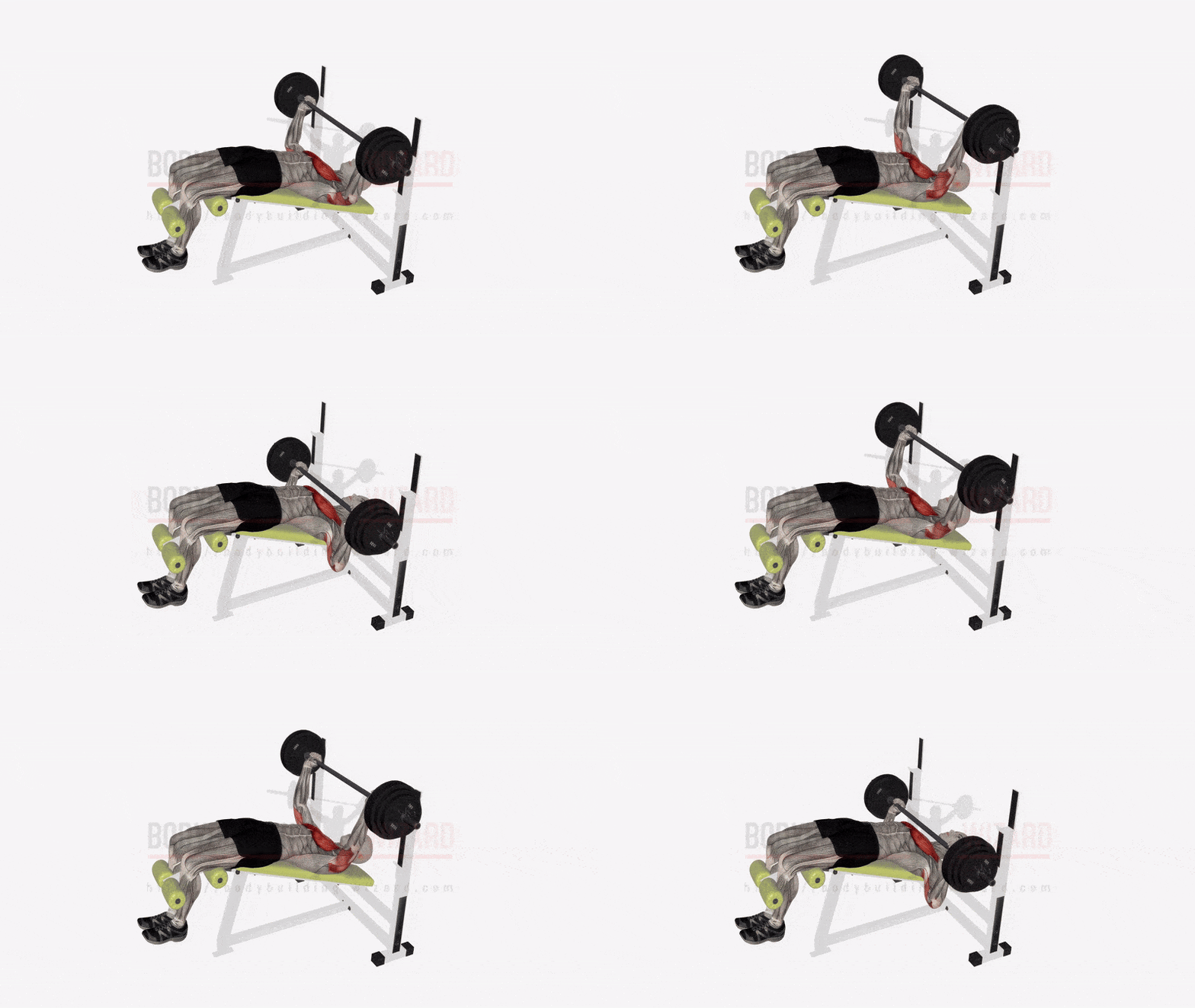
Pressing Phase
The pressing phase emphasizes controlled descent and powerful extension.
- Inhale and slowly lower the bar toward your lower chest.
- Keep elbows slightly flared but not excessively wide.
- Lower until the bar lightly touches the lower chest.
- Maintain tension without bouncing.
- Exhale and press the bar vertically upward.
- Avoid aggressive elbow lockout at the top.
- Maintain scapular retraction throughout the lift.
Movement path: The bar travels vertically relative to the floor, contacting the lower chest before returning along the same path.
Technique Optimization Tips
Here are some important tips to maximize lower-chest activation, improve pressing efficiency, and maintain shoulder health during the decline bench press.
- Use a moderate decline angle (20–30°) for optimal chest emphasis.
- Keep the chest lifted and shoulder blades retracted.
- Control the eccentric phase for 2–3 seconds.
- Avoid excessive elbow flare beyond 75–80 degrees.
- Keep wrists neutral and stacked over forearms.
- Use a spotter for heavy sets.
- Maintain consistent foot pressure against the support pads.
- Do not lift your head or excessively arch the spine.
Video Demonstration
Watching a proper demonstration can significantly improve your technical execution and help you internalize the correct bar path, elbow positioning, and bench setup for the decline barbell bench press. Pay close attention to how the lifter secures the feet under the pads, maintains scapular retraction, and lowers the bar specifically to the lower chest rather than the midline. Note the controlled eccentric phase, a brief pause near the chest, and a vertical pressing path relative to the floor. When reviewing the video, focus on consistent movement, wrist alignment over the forearms, and stable body positioning throughout the set.
Mechanical Resistance Analysis
As a free-weight movement, the decline barbell bench press follows a gravity-dependent resistance curve. The exercise is typically most challenging in the mid- to lower portions of the lift, where horizontal adduction of the shoulder is most demanding. Because the range of motion is slightly shorter than flat pressing, many lifters can handle greater loads while maintaining solid mechanical positioning.
A decline angle reduces shoulder flexion demands compared with incline pressing, which may reduce anterior shoulder stress for some individuals. However, stabilization demands remain moderate, requiring coordinated scapular control and precise bar path.
Common Mistakes
Even experienced lifters can reduce their effectiveness due to technical errors.
- Using an excessive decline angle
- Lowering the bar to mid-chest instead of lower chest
- Bouncing the bar off the chest
- Locking elbows aggressively at the top
- Losing scapular retraction
- Allowing wrists to bend backward
- Training without a spotter at heavy loads
Muscles Involved in Decline Barbell Bench Press
The decline press emphasizes the lower chest while maintaining strong triceps involvement.
- MAIN MUSCLES: Pectoralis major (sternal / lower fibers), triceps brachii, anterior deltoids
- SECONDARY MUSCLES: Pectoralis minor, serratus anterior, coracobrachialis, subscapularis
- ANTAGONISTS: Latissimus dorsi, biceps brachii, posterior deltoids
Decline Barbell Bench Press Pros and Cons
The decline barbell bench press offers distinct mechanical advantages for lower chest development, but it also presents certain limitations compared to other pressing variations.
Advantages
- Excellent lower-chest emphasis
- Allows heavier loads than the incline press
- Slightly reduced shoulder stress for some lifters
- A shorter range of motion improves strength potential
- Strong triceps involvement
- Effective alternative to dips
- Great for chest thickness development
Potential Drawbacks
- Requires specific equipment
- Inverted position may be uncomfortable
- Moderate risk without a spotter
- Limited carryover to flat bench max strength
- Not ideal for beginners unfamiliar with barbell pressing
In my coaching experience, the decline barbell bench press is underutilized in modern chest training. Many lifters obsess over incline work but neglect the lower chest, which contributes heavily to overall chest thickness and fullness. When programmed correctly, decline pressing can dramatically improve chest balance.
I often use the decline press during strength-focused phases because athletes can typically handle more load while maintaining stable mechanics. It’s also an excellent substitute for dips when shoulder discomfort is present.
Decline Barbell Bench Press Variations
Different setups can slightly change muscle emphasis and loading strategy.
- Smith Machine Decline Press – This variation provides a fixed bar path, which significantly reduces stabilization demands and increases safety when training close to failure. Because the bar travels along rails, lifters can focus entirely on controlled tempo and chest contraction. It is particularly useful for hypertrophy phases, drop sets, and high-intensity techniques where fatigue may compromise bar path control in a free-weight setup.
- Decline Dumbbell Press – Using dumbbells increases unilateral stabilization and allows a slightly greater range of motion at the bottom of the lift. The independent arm movement improves muscular balance and may enhance lower chest stretch and contraction. This version is especially valuable for correcting left-to-right strength asymmetries and increasing mind–muscle connection.
- Reverse-Grip Decline Press – By using a supinated (underhand) grip, elbow positioning changes, and the pressing angle shifts slightly. This can alter triceps recruitment and modify shoulder mechanics. While not commonly used, it may feel more comfortable for certain shoulder structures and can provide a novel stimulus when traditional pronated pressing becomes stale.
- Paused Decline Press – Adding a deliberate 1–2 second pause at the bottom position eliminates elastic rebound and increases time under tension. This variation improves bottom-end strength, reinforces proper bar control, and enhances muscular stability. It is particularly effective for building pressing power and preventing reliance on momentum.
- Band-Resisted Decline Press – Attaching resistance bands to the bar creates accommodating resistance, meaning the load increases as the bar moves upward. This intensifies lockout strength and triceps involvement while maintaining strong lower chest activation. It is often used in strength-focused programs to improve force production through the full pressing range.
Alternative Exercises for the Decline Barbell Bench Press
If the pressing equipment is unavailable, consider:
- Weighted chest dips
- High-to-low cable fly
- Decline dumbbell bench press
- Decline machine press
- Flat bench press
Decline Barbell Bench Press vs. Flat Barbell Bench Press
| Criteria | Decline Bench Press | Flat Bench Press |
|---|---|---|
| Stability requirement | Moderate | Moderate |
| Strength potential | Slightly higher | High |
| Chest isolation | Higher (lower fibers) | Balanced |
| Skill requirement | Moderate | Moderate |
| Safety without a spotter | Moderate | Moderate |
| Shoulder stress | Often lower | Moderate |
Conclusion: The decline bench press emphasizes the lower chest and often allows slightly heavier loading due to reduced range of motion. The flat bench press remains superior for balanced chest development and overall pressing strength. Combining both typically produces the best results.
Beginner Progression Strategy
Beginners should approach decline pressing cautiously.
- Start with a lightweight to master the setup.
- Practice controlled eccentric tempo.
- Use a spotter for safety.
- Gradually increase the load once you can control 10–12 reps.
- Maintain a consistent decline angle in each session.
Where This Exercise Fits in a Workout
Perform 3–4 sets of 6–12 repetitions. The decline barbell bench press works well as a primary lower-chest movement on chest day or as a secondary strength exercise following flat bench work.
Final Thoughts
The decline barbell bench press remains one of the most effective compound exercises for targeting the lower fibers of the pectoralis major. Its favorable leverage, reduced range of motion, and strong loading potential make it ideal for building lower-chest thickness and pressing strength. When integrated strategically with flat and incline pressing variations, it contributes to balanced chest development and improved overall upper-body strength.
Is the decline barbell bench press better for lower chest development than flat bench press?
The decline barbell bench press typically places more mechanical emphasis on the lower (sternal) fibers of the pectoralis major due to the downward pressing angle. While flat bench develops the entire chest more evenly, decline pressing often produces greater lower-chest thickness and outer chest fullness when programmed correctly.
Why can I lift more weight on decline bench compared to flat bench?
Many lifters can handle slightly heavier loads on the decline bench press because the range of motion is shorter and shoulder flexion demands are reduced. The decline angle also places the shoulders in a mechanically stronger position, allowing improved leverage.
Does decline bench press reduce shoulder stress?
For some lifters, yes. The decline angle decreases shoulder flexion compared to incline or flat pressing. This can reduce strain on the anterior deltoid and shoulder joint, especially for those who experience discomfort during flat bench pressing.
What is the best decline angle for lower chest activation?
A moderate decline of 15–30 degrees is typically optimal. Steeper angles may shift emphasis toward the triceps and reduce chest activation. Excessive decline angles can also increase discomfort due to the inverted position.
Is decline bench press necessary for complete chest development?
It is not mandatory, but it can significantly enhance lower chest development. Lifters struggling with lower chest fullness often benefit from including decline pressing alongside flat and incline variations.
How many reps should I perform for decline bench press?
For hypertrophy, 6–12 repetitions per set is ideal. For strength-focused training, use 4–6 repetitions. Controlled tempo and progressive overload are more important than simply increasing weight.
Is decline bench press safer than dips for lower chest training?
For some individuals, yes. Weighted dips can place high stress on the shoulders, especially in deep ranges of motion. The decline bench press provides similar lower-chest emphasis with greater stability and bar-path control.
Should beginners perform decline bench press?
Beginners should first master flat-bench mechanics before adding decline presses. Because the movement requires a stable setup and controlled bar path, some foundational pressing experience is recommended.
Can decline bench press improve flat bench performance?
Indirectly, yes. Strengthening the lower chest and triceps can improve lockout strength and overall pressing stability, which may contribute to improved flat bench performance.
Does decline bench press activate the triceps more than flat bench?
The decline press strongly engages the triceps due to the slightly reduced shoulder flexion and more favorable pressing mechanics. However, triceps involvement is high in both flat and decline variations.
Is it dangerous to train with your head lower than your heart?
Training in a moderate decline position is generally safe for healthy individuals. However, extreme decline angles or prolonged inverted positioning may increase intracranial pressure. Moderate angles and controlled breathing reduce this risk.
Can decline bench press replace flat bench press?
It can substitute in certain programs, but it should not fully replace the flat bench if your goal is balanced chest and maximal pressing strength development. The best results typically come from combining multiple angles.
