


Introduction
The Smith machine upright row is a variation of the upright row performed on a fixed bar path, targeting the lateral deltoids and upper trapezius while offering greater control and stability than free-weight versions. In many training setups, this makes it an appealing option for lifters who want to focus on the movement without worrying about balancing the weight.
The defining feature of this variation is the guided vertical-bar path. Unlike dumbbells or barbells, where the weight can move freely, the Smith machine restricts the movement to a single plane. This can help reduce unnecessary body movement and momentum, but it also means your arms and shoulders must adapt to the machine’s fixed trajectory.
In my experience as a coach, this is where the trade-off becomes important. While the Smith machine can make the exercise feel more stable and controlled, it can also feel more restrictive—especially if the fixed path doesn’t align perfectly with your natural shoulder mechanics. For some lifters, this leads to a strong, focused contraction. For others, it may feel less comfortable.
When used correctly, the Smith machine upright row can be a useful tool for building shoulder width and upper-back strength, particularly in hypertrophy-focused training. However, like all upright row variations, it requires proper technique, controlled range of motion, and awareness of individual comfort to be effective.
Other Names for the Smith Machine Upright Row
The Smith machine upright row may be referred to by several different names depending on the equipment context or coaching terminology. While the movement remains the same, the naming often reflects the use of the Smith machine.
- Smith machine upright row
- Upright row (Smith machine)
- Smith machine high pull (partial variation)
- Guided upright row
- Machine upright row (Smith variation)
In practice, these names all refer to the same fixed-path version of the upright row, in which the bar travels along a controlled vertical track, reducing movement variability compared to free-weight variations.
Required Equipment for the Smith Machine Upright Row
The Smith machine upright row requires a Smith machine setup, making it slightly more equipment-dependent than free-weight variations, but also more stable and controlled.
- Smith machine – provides a fixed vertical bar path and built-in stability
- Barbell (attached to the machine) – used for lifting within the guided track
Optional (but helpful):
- Weight plates – used to adjust resistance
- Safety stops (if available) – allow you to set a safe range of motion
- Mirror (if available) – helps monitor elbow position and posture
In practical training situations, the main advantage of this setup is that you don’t need to balance the bar, allowing you to focus more on the movement itself.
How to Perform the Smith Machine Upright Row with Proper Form
The Smith machine upright row provides a fixed movement path, which can make the exercise feel more controlled—but also less adaptable. In my experience working with lifters, the key is to align your body properly with the bar and avoid forcing the movement if it feels unnatural.
Starting Position (Setup)
A proper setup is essential to ensure the fixed bar path works with your body, not against it.
- Stand in the middle of the Smith machine with feet shoulder-width apart
- Position the bar at the upper-thigh level
- Grip the bar with a pronated (overhand) grip, slightly narrower than shoulder-width
- Keep your arms fully extended at the start
- Maintain a tall posture with chest up and core braced
- Keep your knees slightly bent and shoulders relaxed

Movement (Execution)
The goal is to lift the bar in a controlled, vertical path while keeping proper elbow positioning.
- Pull the bar upward along your torso
- Lead the movement with your elbows, keeping them higher than your wrists
- Keep the bar close to your body throughout the lift
- Raise until your elbows reach approximately shoulder height
- Avoid pulling higher than shoulder level
- Pause briefly at the top for control
- Lower the bar slowly back to the starting position
- Maintain smooth, controlled repetitions
The most important factor is making sure your body position aligns with the fixed bar path—if it doesn’t feel natural, small adjustments in stance or grip can make a significant difference.
Video Demonstration
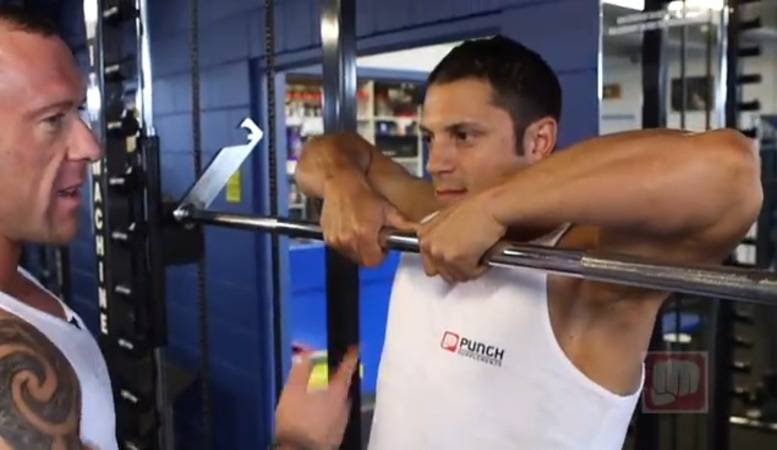
Watching a proper demonstration is especially important for the Smith machine upright row, since the fixed bar path changes how your body interacts with the movement. Small adjustments in stance and alignment can make a big difference in comfort and effectiveness.

A common issue I see is that lifters assume the machine will “guide everything correctly.” In reality, you still need to position your body properly so the fixed path works with your natural movement—not against it.
Muscles Worked in the Smith Machine Upright Row
- Primary muscles: Lateral deltoids (middle head), upper trapezius — responsible for lifting the arms and elevating the shoulders
- Secondary muscles: Anterior deltoid, supraspinatus, levator scapulae — assist in guiding and stabilizing the movement
- Stabilizing muscles: Rotator cuff muscles, serratus anterior, core musculature — help maintain shoulder alignment and body control
- Supporting muscles: Biceps brachii, forearm flexors, rhomboids — contribute to elbow flexion, grip, and control of the bar
Across all upright row variations (barbell, cable, dumbbell, and Smith machine), once the elbows rise above shoulder level, the movement progressively shifts emphasis away from the lateral deltoids and toward the trapezius, reducing the effectiveness for shoulder-focused development.
How the Smith Machine Upright Row Works: Biomechanics & Mechanics
The Smith machine upright row follows the same basic movement pattern as other upright row variations, but the fixed bar path significantly changes how the exercise is performed. In practical training situations, this creates a more controlled—but also more restrictive—mechanical environment.
Key Joint Actions
- Shoulder abduction and elevation – the arms move outward and upward, driven by the lateral deltoids and upper traps
- Elbow flexion – the elbows bend as the bar is lifted
- Scapular elevation – the shoulder blades rise slightly toward the top of the movement
Fixed Bar Path Effect
- The bar moves in a strict vertical line
- Reduces unnecessary horizontal movement and body sway
- Limits your ability to adjust the movement path naturally
- Requires your body to align with the machine, not vice versa
Stability vs. Restriction Trade-Off
- Increased stability allows for better control and reduced momentum
- Less freedom of movement can feel unnatural for some lifters
- The fixed path may not perfectly match individual shoulder mechanics
Role of Grip Width
- A wider grip increases lateral deltoid involvement
- A narrower grip shifts more load to the upper trapezius
- Grip width becomes even more important due to the fixed movement path
Range of Motion Considerations
- The movement typically ends at shoulder height
- Pulling higher increases trap involvement and shoulder stress
- The fixed path can amplify discomfort if the range of motion is excessive
Resistance Profile
- Resistance is gravity-based but machine-guided
- The Smith machine stabilizes the load, reducing coordination demands
- Encourages controlled tempo and consistent bar path
Common Mechanical Errors
- Forcing the body into an unnatural position
- Pulling too high above shoulder level
- Using excessive weight due to increased stability
- Leaning back to compensate for the fixed path
The key point to understand is that the Smith machine increases control, but also requires proper alignment—this balance determines whether the exercise feels effective or restrictive.
When Should You Use the Smith Machine Upright Row?
- When you want more control. The fixed bar path helps maintain consistent movement and reduces unnecessary variability.
- When you want to reduce momentum. The machine limits cheating, encouraging stricter and more controlled execution.
- For hypertrophy-focused training. The stability allows you to focus on muscle tension and controlled repetitions.
- When learning the movement pattern. The guided path can help beginners understand proper mechanics for the upright row.
Technique Optimization Tips
The Smith machine upright row can feel more controlled than free-weight versions, but the fixed bar path makes proper positioning even more important. In real training scenarios, small adjustments in stance and grip can make a big difference in both comfort and effectiveness.
- Align your body with the bar path. Position yourself so the bar travels naturally along your torso without forcing your shoulders into an awkward angle.
- Choose an appropriate grip width. A slightly wider grip often improves comfort and increases lateral delt involvement.
- Lead with your elbows. Focus on driving the elbows upward rather than pulling with your hands.
- Keep the bar close to your body. This maintains proper mechanics and improves leverage.
- Stop at shoulder height. Pulling higher increases shoulder stress and shifts emphasis to the traps.
- Maintain an upright posture. Keep your chest up, core braced, and avoid leaning back.
- Use controlled tempo. Avoid using momentum—the machine already reduces instability.
- Select a manageable load. The added stability can tempt you to go too heavy, which often leads to poor form.
The most important factor is how well your body aligns with the fixed path—this is what determines whether the exercise feels smooth or restrictive.
Technical Emphasis & Targeting Adjustments
The Smith machine upright row allows less movement variability, making small technical adjustments even more important. In real training scenarios, how you position your hands and control the range of motion will determine whether the exercise emphasizes the deltoids or the trapezius.
- Adjust your grip width. A wider grip increases lateral deltoid activation, while a narrower grip shifts more emphasis to the upper trapezius.
- Control the height of the pull. Stopping at shoulder height keeps the focus on the delts, while pulling higher increases trap involvement.
- Keep elbows flared outward. This helps maintain proper shoulder engagement rather than turning the movement into a shrug.
- Align your stance with the bar path. Small changes in foot position can improve comfort and movement efficiency.
- Limit excessive shrugging. Keeping the movement arm-driven reduces trap dominance.
- Maintain a consistent bar path. The fixed track should be used to reinforce clean, repeatable movement.
- Use controlled tempo. Slower repetitions improve control and reduce joint stress.
- Adjust the load based on comfort. If the movement feels restrictive, reducing weight often improves execution.
Smith Machine Upright Row Benefits and Drawbacks
The Smith machine upright row offers a more controlled version of the upright row, but that added stability comes with trade-offs. In many training situations, it can be effective for focused hypertrophy work, but it is not always the most natural option for every lifter.
Benefits
- Provides a fixed and controlled bar path. This reduces unnecessary movement and helps maintain consistent technique.
- Limits the use of momentum. The guided track makes it harder to “cheat” the lift.
- Lower stability demand. Allows you to focus more on the target muscles rather than balancing the weight.
- Beginner-friendly setup. Easier to learn the movement pattern compared to free weights.
- Encourages controlled tempo. The machine naturally promotes slower, more deliberate repetitions.
Drawbacks
- Restricts natural movement patterns. The fixed path may not align with individual shoulder mechanics.
- Can feel uncomfortable for some lifters. Limited freedom of movement may increase joint stress.
- Higher risk of forced positioning. You must adapt to the machine rather than moving freely.
- Less functional carryover. Does not develop stabilizing muscles as much as free-weight variations.
- Easy to overload due to added stability. This can lead to poor technique and increased strain.
The key takeaway is that this exercise offers more control but less adaptability—making it effective for some lifters while less suitable for others, depending on comfort and individual structure.
Smith Machine Upright Row Variations
The Smith machine upright row is already a fixed-path variation, but small adjustments in grip, range of motion, and setup can still significantly change how the exercise feels and which muscles are emphasized.
Wide-Grip Smith Machine Upright Row
Using a wider grip increases lateral deltoid involvement and often improves shoulder comfort by reducing internal rotation.
Narrow-Grip Smith Machine Upright Row
A closer grip shifts more emphasis toward the upper trapezius and allows a slightly higher pull, though it may feel less comfortable for some lifters.
Partial Range Smith Machine Upright Row
Limiting the range of motion to shoulder height keeps the focus on the deltoids and reduces stress on the shoulder joint.
High Pull (Trap-Focused Variation)
Pulling the bar higher toward the chin increases trapezius activation, but should be performed cautiously due to increased shoulder stress.
Pause Smith Machine Upright Row
Adding a pause at the top of the movement increases time under tension and reinforces control.
Slow Tempo Smith Machine Upright Row
Using a slower lifting and lowering phase improves muscle engagement and reduces reliance on momentum.
The most important factor is selecting a variation that allows you to maintain proper alignment, controlled execution, and joint comfort within the constraints of the fixed bar path.
Replacement Exercises (Substitutes)
If the Smith machine upright row feels too restrictive or uncomfortable, there are several effective alternatives that target the lateral deltoids and upper traps with more natural movement patterns. In many cases, these options allow for better joint alignment and individual adjustment.
- Barbell Upright Row
- Dumbbell Upright Row
- Cable Upright Row (Straight Bar)
- Rope Cable Upright Row
- Dumbbell Lateral Raise
- Seated Dumbbell Lateral Raise
- One-Arm Cable Lateral Raise
- Two-Arm Cable Lateral Raise
- Machine Lateral Raise
- Incline Side-Lying Lateral Raise
- Leaning Dumbbell Lateral Raise
- Face Pull (for upper back and shoulder stability)
For a complete overview of all recommended movements and variations, explore our full lateral deltoid exercise database to find the best options for building shoulder width and balanced development.
Where This Exercise Fits in a Workout
The Smith machine upright row is best used as a controlled accessory movement within your shoulder or upper-body training. In most programs, it serves as a more structured alternative to free-weight upright rows, especially when the goal is to focus on technique and muscle engagement.
- After primary compound lifts. Works well after overhead presses or rows when transitioning to accessory work.
- As a controlled hypertrophy exercise. The fixed path makes it suitable for focused, moderate-load training.
- For technique reinforcement. Can help lifters learn the upright row pattern with reduced movement variability.
- As a machine-based alternative. Useful when you want a more stable setup compared to free weights.
- Before isolation exercises. Can be followed by lateral raises to further target the deltoids.
The key point to understand is that this exercise is best used to refine control and maintain consistency, rather than as a primary heavy lift.
Sets and Reps Recommendations
The Smith machine upright row is best performed with moderate loads and controlled repetitions, taking advantage of the machine’s stability while avoiding excessive loading. In practice, this variation works best when the focus is on precision and muscle engagement rather than lifting heavy weights.
- Sets: 2–4 per workout
- Reps: 8–15 per set
- Tempo: Controlled lift with a steady, slightly slower lowering phase
- Rest time: 60–90 seconds between sets
Additional Programming Tips
- Choose a weight that allows you to maintain proper alignment with the bar path
- Avoid pulling above shoulder height to reduce unnecessary shoulder stress
- Focus on elbow-driven movement rather than simply lifting the bar
- Maintain an upright posture without leaning back to compensate for the fixed path
- Consider using moderate weight and higher reps for better joint comfort
What really makes a difference is how well your body aligns with the machine—this is what determines whether the movement feels controlled or restrictive.
Smith Machine Upright Row vs. Barbell Upright Row
The Smith machine upright row and the barbell upright row share the same basic movement pattern, but the key difference lies in how the bar moves. In real training scenarios, this comparison highlights the trade-off between control and movement freedom.
| Training Factor | Smith Machine Upright Row | Barbell Upright Row |
|---|---|---|
| Bar Path | Fixed vertical path | Free movement |
| Movement Freedom | Low | High |
| Stability | High | Moderate |
| Coordination Demand | Low | Higher |
| Joint Adaptability | Limited | Greater |
| Loading Potential | Moderate | Higher |
| Technique Flexibility | Low | High |
| Momentum Control | Easier | More challenging |
| Best Use | Controlled hypertrophy | Strength and natural movement |
Conclusion: The Smith machine upright row offers greater stability and control, making it useful for focused hypertrophy and consistent execution. The barbell upright row, on the other hand, allows a more natural movement path and greater adaptability to individual shoulder mechanics.
For most lifters, the best approach is to choose the variation that feels more comfortable and allows for pain-free, controlled movement, while still effectively targeting the intended muscles.
Bottom Line
The Smith machine upright row is a highly controlled variation that can be effective for building the lateral deltoids and upper traps, especially when your goal is consistent, repeatable execution. The fixed bar path reduces instability and limits momentum, allowing you to focus more directly on the target muscles.
However, that same fixed path also makes the exercise more restrictive. If the movement doesn’t align well with your natural shoulder mechanics, it may feel uncomfortable or less effective. This is why it works well for some lifters, but not for everyone.
In practical terms, this exercise is best used as a controlled accessory movement, rather than a primary lift. If it feels smooth and pain-free, it can be a valuable addition to your routine. If not, there are plenty of alternatives that offer greater freedom of movement.
Ultimately, the most important factor is choosing the variation that allows you to train with proper alignment, control, and long-term consistency.
Does the Smith machine upright row reduce injury risk?
Not necessarily. It reduces instability, but the fixed path can sometimes increase joint stress if it doesn’t match your natural movement.
Can the Smith machine upright row improve mind-muscle connection?
Yes. The guided path often allows lifters to focus more on the target muscles without worrying about balance.
Why does this exercise feel more restrictive than dumbbells?
Because the bar follows a fixed vertical track, limiting your ability to adjust the movement path naturally.
Should I adjust my stance during the exercise?
Yes. Small adjustments in foot position can help better align your body with the bar path and improve comfort.
Is this exercise good for training to failure?
Yes. The built-in stability of the Smith machine makes it safer to push closer to muscular failure compared to free weights.
Can I use this exercise for progressive overload?
Yes, but it’s typically better suited for controlled progression rather than maximal strength increases.
Why do my wrists feel uncomfortable in this variation?
The fixed grip position may force your wrists into a less natural angle. Adjusting grip width can often help.
Can this exercise help improve posture?
Indirectly, yes. Strengthening the upper traps and shoulders can contribute to better upper-body posture.
Is this exercise suitable for people with shoulder mobility limitations?
It depends. Some lifters may find the fixed path uncomfortable, while others benefit from the added stability.
What is the biggest advantage of the Smith machine in this exercise?
The biggest advantage is controlled movement, which reduces momentum and helps maintain consistent technique.
