



You finish a hard leg workout at 8 p.m. The training stimulus is over — but the physiological response is not. That night, your brain and body cycle repeatedly through NREM and REM sleep while brain activity, autonomic activity, hormone secretion, body temperature, and cardiovascular activity all shift in coordinated ways. Does deep sleep actually build muscle? Does REM matter to a bodybuilder? And how much does one bad night really hurt performance? This guide answers all three.
Sleep isn’t a passive period when the body simply “switches off.” It’s a dynamic physiological process in which NREM and REM sleep cycle throughout the night, supporting neural, metabolic, endocrine, cognitive, and physical recovery that can influence how well you train, recover, and perform. But here’s an equally important message this guide is built around: no single sleep stage is a magic “muscle-building stage.” Athletic recovery depends on obtaining sufficient, well-timed, and reasonably uninterrupted sleep across the entire night — not on chasing one specific stage as if it were a supplement.
QUICK ANSWER: Sleep supports physical recovery, neural recovery, motor learning, cognitive performance, endocrine regulation, metabolic health, immune function, and overall training readiness. Rather than trying to maximize one specific sleep stage, athletes benefit most from obtaining sufficient total sleep, good sleep continuity, and consistent sleep timing across the entire night.
What Happens When You Sleep?
Sleep isn’t one homogeneous state. Throughout the night, your brain and body cycle through distinct physiological states: NREM sleep (non-rapid eye movement, itself divided into N1, N2, and N3) and REM sleep (rapid eye movement). Each has a different neural, hormonal, and autonomic signature, and understanding that difference underpins everything else in this guide.
What Are the Four Stages of Sleep?
| Stage | General Characteristics | Athletic Relevance |
|---|---|---|
| N1 | Transition from wakefulness | Minimal direct training relevance |
| N2 | Stable sleep, spindles, K-complexes | Memory and motor learning |
| N3 | Slow-wave/deep sleep | Physical restoration, GH-associated physiology |
| REM | Active brain, muscle atonia | Motor learning, memory, cognitive recovery |
N1: Transition Into Sleep
The lightest stage — the brief transition from wakefulness into sleep, during which muscle tone and activity begin changing. This stage is relatively short and doesn’t deserve some special, invented “athletic recovery function” — a common problem with fitness content that tries to assign every sleep stage its own unique training superpower.
N2: Stable Light Sleep
Despite the “light” label, this is actually a substantial and important part of total sleep, characterized by sleep spindles and K-complexes on EEG, along with declining heart rate and body temperature. N2 also has genuine relevance to memory and motor-learning consolidation—worth knowing for anyone treating squat or deadlift technique as a skill refined session to session.
N3: Slow-Wave or Deep Sleep
Characterized by slow-wave EEG activity and reduced sympathetic activity, N3 is associated with a large pulse of growth hormone release, particularly in the early part of the night, and with broader physical restoration. But here’s the essential caveat: deep sleep supports recovery, but it shouldn’t be thought of as a period when your muscles simply “switch on” growth. The full nuance behind that statement gets its own section below.
REM Sleep
A markedly different physiological state — the brain is highly active, rapid eye movements occur, skeletal muscle experiences near-total atonia (a protective paralysis that prevents you from acting out dreams), and dreaming is common. REM plays a real role in memory processing and emotional regulation, and for athletes specifically, in motor learning and skill consolidation. But resist the tidy fitness-content split of “REM is for the brain, N3 is for the body”—that’s a much cleaner story than the overlapping, interdependent physiology supports.
What Does a Normal Sleep Cycle Look Like?
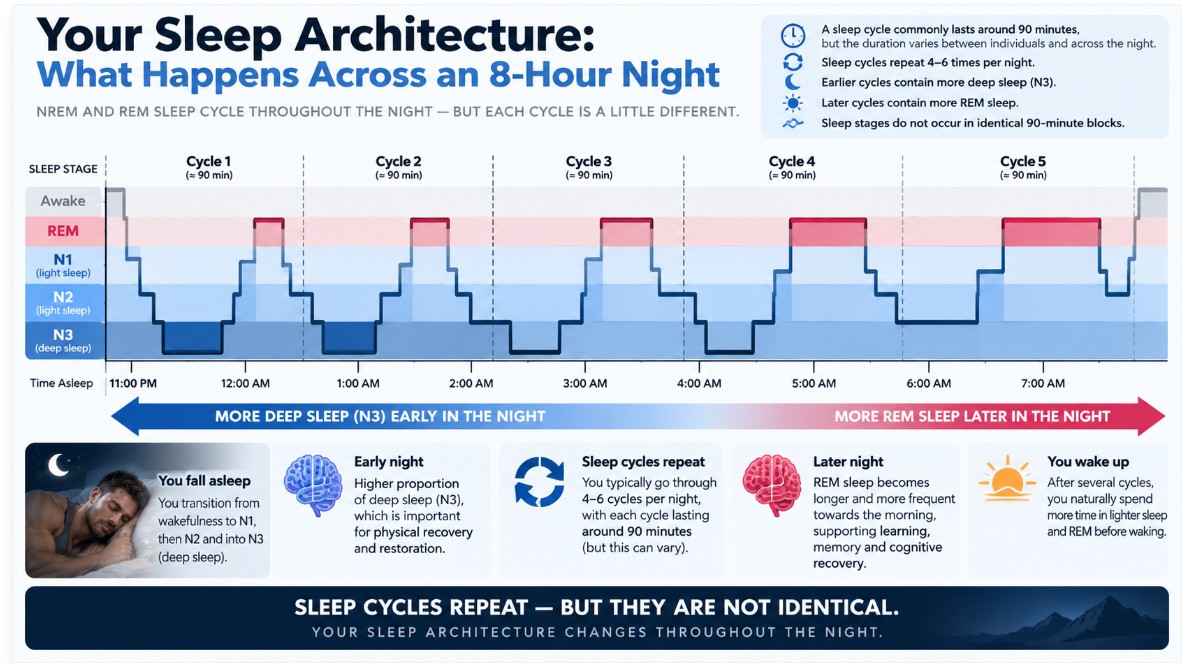
A typical sleep cycle progresses roughly N1 → N2 → N3 → lighter NREM → REM, then repeats. Sleep cycles commonly last roughly 90 minutes, but their duration varies between individuals and across the night—treating “90 minutes” as a fixed, precise number (as some sleep-tracking apps and calculators imply) oversimplifies real, meaningful individual and night-to-night variability.
How Sleep Architecture Changes Across the Night
This is one of the most practically important concepts in this entire guide. Early in the night, sleep is weighted more heavily toward N3, slow-wave sleep. Later in the night, REM sleep becomes progressively more prominent, with each successive cycle typically containing a longer REM period than the last. This has a direct, real consequence: if you cut your sleep short from the end — an early alarm, a late-night training session followed by an early morning class — you’re not simply losing “two more hours of the same kind of sleep” you got earlier in the night.
You’re disproportionately losing REM-rich sleep, and sleep restriction in general changes overall sleep architecture, not just total duration. A lifter who consistently cuts sleep short at the back end of the night, even while getting a reasonable total number of hours by simply going to bed earlier to compensate, may still be systematically shortchanging the REM-heavy portion of sleep that supports motor learning and skill consolidation — a genuinely different tradeoff than simply “fewer total hours.”
What Controls When You Feel Sleepy?
Process S: Homeostatic Sleep Pressure
The longer you’re awake, the more your homeostatic sleep pressure builds — adenosine accumulation in the brain is part of this mechanism, though Process S shouldn’t be reduced to adenosine alone. Sleep discharges this pressure.
Process C: Circadian Rhythm
Your internal biological clock, governed by the suprachiasmatic nucleus, light exposure, melatonin timing, and rhythms in core body temperature and cortisol. Sleep architecture is influenced by these two separate processes — Process S, the homeostatic sleep drive that increases with each hour spent awake, and Process C, the circadian rhythm responsible for maintaining appropriate sleep and wake timing. How tired you feel depends not only on how long you’ve been awake, but also on where you are in your circadian cycle — which is exactly why an all-nighter followed by a nap at 4 p.m. doesn’t feel the same as a normal night’s sleep, even with similar total hours.
Sleep Duration, Sleep Quality, and Sleep Timing Are Different
Sleep duration is simply how much you actually sleep. Sleep quality and continuity reflect fragmentation, awakenings, and overall sleep efficiency — time actually asleep relative to time in bed. Sleep timing is when you sleep relative to your circadian rhythm. Sleep regularity is how consistent that schedule is from night to night. Eight hours in bed is not necessarily eight hours of sleep — and eight hours of fragmented or poorly timed sleep may not provide the same recovery experience as consolidated, well-timed sleep. Someone lying in bed for eight hours but waking repeatedly, or sleeping eight hours on a wildly inconsistent schedule, isn’t necessarily getting the same recovery as someone with eight consolidated, well-timed hours.
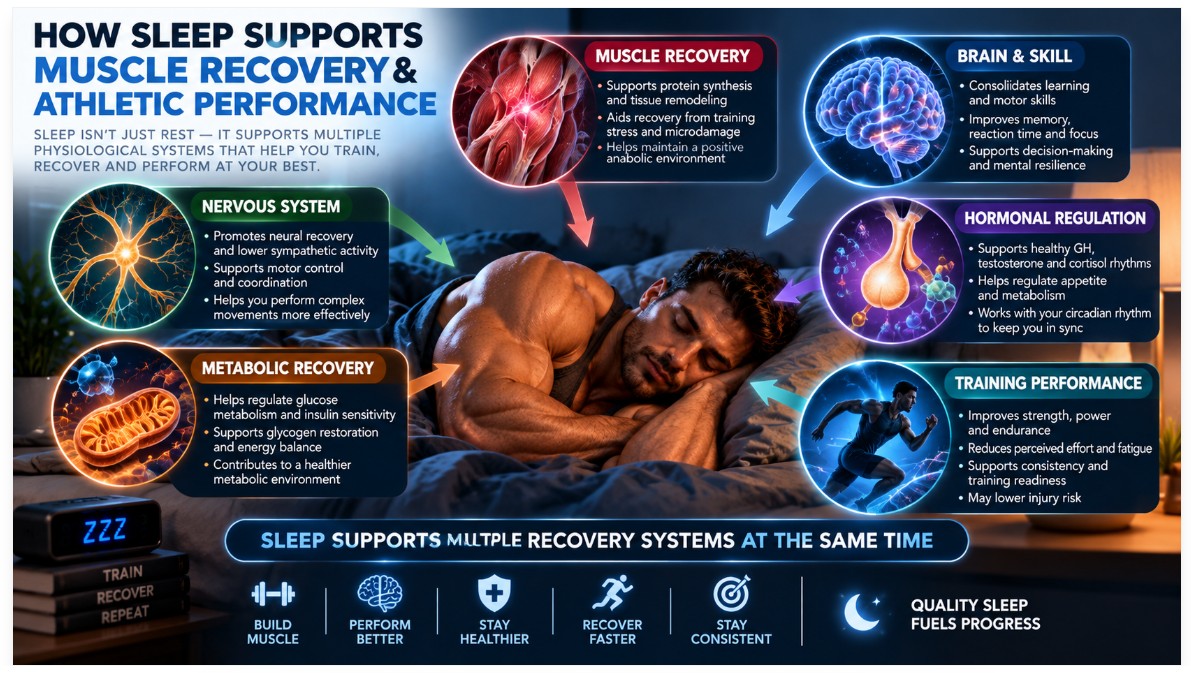
How Does Sleep Support Muscle Recovery?
Sleep is one major pillar of recovery, alongside the broader set of practices covered in our Guide to Rest and Muscle Recovery in Weight Training. Sleep and muscle protein metabolism: sleep restriction has been directly linked to impaired muscle protein synthesis and a more catabolic hormonal environment, covered in detail below. Also, sleep and nervous-system recovery: sleep supports the same nervous system covered in our guides on the Human Nervous System and Neural Adaptations to Strength Training, including motor learning and skill consolidation relevant to lifting technique. Sleep and metabolic recovery: sleep quantity and quality affect glucose regulation and broader energy metabolism. Sleep and immune/inflammatory regulation: adequate sleep supports normal immune function, part of the broader recovery picture alongside training load management.
Does Deep Sleep Build Muscle?
Not directly, in the simplistic way fitness content often claims. N3 is genuinely associated with important restorative physiology and growth hormone secretion, but hypertrophy depends on training stimulus, mechanical tension, protein and overall nutrition, total recovery, repeated cycles of muscle protein synthesis and remodeling, and the broader hormonal environment — not any single sleep stage acting in isolation. More deep sleep should not be interpreted as a direct dose-response measure of how much muscle you will build.
Someone getting slightly less N3 on a given night isn’t missing out on a proportional amount of muscle growth — the relationship simply isn’t that clean or linear. This matters practically because it’s exactly the kind of claim that sells sleep-tracking gadgets and supplements marketed around “boosting deep sleep for gains”—a narrative that overstates what a single sleep stage can deliver on its own, disconnected from everything else happening in your training and nutrition.
Growth Hormone and Sleep: What Actually Happens?
GH is pulsatile — it isn’t secreted only during sleep, though sleep is one significant trigger among several throughout a 24-hour period, alongside exercise, fasting, and other stimuli. A major GH pulse is genuinely associated with early-night slow-wave sleep — this part of the old story is accurate, and it’s one of the more robust, well-replicated findings in sleep endocrinology. But more GH does not automatically mean more hypertrophy. This is worth stating plainly because it directly debunks a persistent fitness myth: “if I increase my deep sleep by 20%, I’ll release 20% more anabolic GH and grow faster” doesn’t hold up — GH’s role in adult muscle hypertrophy is considerably more limited and complicated than that simple multiplication implies.
GH does contribute to broader tissue repair and metabolic regulation, but the direct hypertrophy signal in trained adults comes predominantly from mechanical tension and the local muscle protein synthesis response to training, not from circulating GH levels rising and falling with how much slow-wave sleep you got on any given night. For the full physiology of this hormone, see our guide on Growth Hormone.

How Does Sleep Affect Strength and Power?
It’s worth distinguishing acute total sleep deprivation (no sleep at all) from partial sleep restriction (reduced sleep) from chronic insufficient sleep sustained over weeks—these represent genuinely different physiological challenges, not points on one simple continuum with identical effects at different magnitudes. A systematic review evaluating the effects of sleep deprivation and sleep restriction on resistance exercise performance found that inadequate sleep can reduce physical performance and negatively affect hormonal and muscle-protein-metabolism markers relevant to resistance training outcomes. Potential effects span maximal strength, submaximal performance, power output, training volume, perceived effort, and motivation — though the magnitude isn’t identical across every test, sport, or individual, and some studies find smaller effects than others depending on how sleep loss was induced and measured.
A separate systematic review focused specifically on muscle strength similarly found that both acute and chronic sleep deprivation reduced measures of strength, power output, and muscular endurance in a meaningful share of the studies reviewed, alongside impaired neuromuscular function and increased fatigue — though, consistent with the broader literature, not every study found statistically significant effects, reflecting real variability in study design, sleep loss protocols, and individual response.
How Does Sleep Affect Endurance?
Rather than the old, oversimplified “deep sleep replenishes glycogen, therefore helps endurance” story, sleep loss more plausibly affects endurance performance through its influence on perceived exertion, fatigue, motivation, potentially thermoregulation and metabolism depending on context, cognitive pacing and decision-making during a race or session, and overall recovery capacity between training days.
Sleep, Reaction Time and Athletic Skill
Sleep loss affects reaction time, attention, decision-making, motor learning, and skill acquisition — all genuinely relevant to a lifter, not just to sports involving split-second reactions. Squats, deadlifts, Olympic lifts, and even posing all rely on motor learning, meaning the same sleep-dependent skill-consolidation processes that matter for a sprinter’s start or a basketball player’s free throw also matter for a lifter refining their technique on a new lift or variation.
One Bad Night vs. Chronic Sleep Restriction
An occasional poor night doesn’t mean “all gains lost” — you might experience somewhat reduced readiness, mood, or perceived effort the next day, but this is a manageable, temporary setback, not a catastrophe. Repeated short sleep across many nights is the genuinely more important problem, since cumulative effects on hormones, muscle protein metabolism, and training quality compound over time in a way a single rough night simply doesn’t. A useful mental model: one bad night is a withdrawal from a reserve you can rebuild the next day or two with normal sleep. Chronic restriction is a persistent deficit that never gets the chance to rebuild, and that accumulated, compounding deficit — not any single night — shows up in research linking insufficient sleep to blunted training adaptations over weeks and months. The occasional bad night is not a bodybuilding emergency; habitual insufficient sleep is the bigger concern.
Does Sleep Deprivation Reduce Muscle Growth?
The direct mechanistic evidence here is genuinely compelling. A controlled study found that a single night of total sleep deprivation reduced muscle protein synthesis by 18%, increased cortisol by 21%, and decreased testosterone by 24% compared to a normal night of sleep in the same individuals — direct evidence that even one bad night measurably shifts the hormonal and protein-synthesis environment in an unfavorable direction. That said, this doesn’t translate into a precise “5 hours of sleep equals X% less hypertrophy” formula — real-world hypertrophy depends on many interacting factors across weeks and months, and this single-night data point illustrates a genuine mechanism without licensing that kind of oversimplified extrapolation. It’s also consistent with the broader message of this guide: occasional disruption is a real but recoverable setback, while sustained sleep restriction compounds these unfavorable acute shifts night after night.
Sleep, Testosterone and Cortisol
Insufficient sleep can affect testosterone depending on severity, duration, and individual context — the acute study above showing a 24% drop after one deprived night is one clear data point among a broader literature. Cortisol has its own strong relationship with both sleep and circadian timing, tending to rise with sleep restriction as covered above. But sleep affects the endocrine environment broadly, and its importance for recovery cannot be reduced to testosterone and cortisol alone — treating those two hormones as the entire story oversimplifies a much larger physiological picture involving growth hormone, insulin sensitivity, and numerous other systems. For the fuller picture on each hormone, see our guides on Testosterone and Cortisol. If you’ve come across the claim that sleeping naked meaningfully boosts testosterone, we take a closer look at that specific claim in a dedicated piece.
How Much Sleep Do Athletes Need?
A joint consensus statement from the American Academy of Sleep Medicine and Sleep Research Society recommends that adults sleep 7 or more hours per night on a regular basis to promote optimal health, noting that regularly sleeping less than 7 hours is associated with a range of adverse health outcomes including weight gain, diabetes, hypertension, and depression. That’s the general adult baseline — but athletes often need more sleep opportunity than that baseline suggests, depending on training load, age, competition schedule, travel, accumulated sleep debt, and real individual variability.
Research directly measuring elite athletes has found a meaningful gap between self-assessed sleep need and actual habitual sleep duration, with athletes in one study reporting needing over 8 hours to feel rested while averaging under 7 — a real-world sleep deficit that likely applies to many committed non-elite lifters as well. Rather than a single number like “athletes need exactly 9-10 hours,” it’s more accurate and more useful to think in terms of adequate sleep opportunity — enough time in bed, under the right conditions, to actually get the sleep an individual genuinely needs.
Do Athletes Need More Sleep Than Non-Athletes?
The underlying biology of sleep stages isn’t different for athletes. But an expert consensus statement on sleep and the athlete notes that elite athletes are particularly susceptible to sleep inadequacies, characterized by habitual short sleep and poor sleep quality, and cautions that a one-size-fits-all recommendation is unlikely to be ideal for athlete health and performance. Higher training stress, competition schedules, travel across time zones, early training sessions, and elevated recovery demands can all increase an athlete’s practical sleep need or, just as often, make it harder to actually obtain the sleep they need — a genuinely different problem from simply needing more hours in some biological sense.
Can Sleeping More Improve Athletic Performance?
Sleep extension studies in athlete populations have found potential improvements in reaction time, sprint performance, accuracy, mood, and subjective readiness, though the specific benefits and their magnitude vary by sport and study design. One important distinction worth making clear: sleep extension makes the most sense, and shows the clearest benefit, specifically when someone was previously not meeting their actual sleep need — extending sleep for someone already well-rested doesn’t produce the same magnitude of benefit as it does for someone starting from a meaningful sleep deficit.
Can Naps Improve Performance and Recovery?
Short naps can improve alertness with relatively low sleep inertia — that groggy, disoriented feeling upon waking. Longer naps provide more total sleep opportunity but come with greater sleep inertia and timing considerations, since a long nap deep enough to reach slow-wave sleep can leave you groggier on waking than a shorter one. When should athletes nap? Not so late in the day that it interferes with nighttime sleep. And critically: a nap is not a complete substitute for chronically inadequate nighttime sleep — it can help manage an acute deficit or support same-day readiness, but it doesn’t replace the broader physiological value of consolidated overnight sleep night after night.
Caffeine vs. Sleep: Can You Compensate for Sleep Loss?
Caffeine can increase alertness, reduce perceived fatigue, and partially preserve performance in a sleep-deprived state — but it does not reproduce sleep physiology. It masks some subjective and cognitive symptoms of sleep loss without providing the restorative processes sleep itself provides. And there’s a real downside loop worth flagging: caffeine taken late enough in the day to help push through fatigue can further disrupt that same night’s sleep, worsening the underlying problem it was used to paper over the day before. If you’re looking at the supplement side of sleep instead — rather than trying to counteract sleep loss with a stimulant — see our guide to Best Sleep Supplements for Muscle Recovery.
How to Optimize Sleep for Training and Recovery
- Keep a consistent sleep-wake schedule, even on rest days.
- Give yourself enough sleep opportunity — enough time in bed to actually obtain the sleep you need, not just the minimum you think you can survive on.
- Manage evening light exposure, particularly bright screens close to bedtime.
- Get daytime or morning light exposure to support healthy circadian timing.
- Time caffeine strategically, avoiding it late enough in the day that it could disrupt that night’s sleep.
- Keep the bedroom dark, quiet, and comfortably cool.
- Avoid turning every single poor night into a crisis — context and patterns matter more than any one night.
- Consider your own training timing individually, since morning versus evening training suits different people differently.
- Use naps strategically rather than as a routine substitute for adequate nighttime sleep.
- Consider what and when you eat before bed — see our guide on the link between pre-sleep meals and muscle recovery for the specifics.
Can Wearables Accurately Measure Sleep Stages?
The gold standard for sleep staging is polysomnography (PSG) — a clinical, multi-signal recording of brain activity, eye movement, and muscle activity conducted in a sleep lab. Consumer wearables infer sleep stages indirectly from combinations of movement, heart rate, heart rate variability, and other signals, without directly measuring brain activity as PSG does. A multicenter validation study comparing eleven popular consumer sleep trackers against polysomnography found substantial variation in accuracy across devices and sleep stages, with performance notably weaker for deep sleep and wake detection than for REM sleep classification. REM tends to be easier for wearables to detect accurately because it has distinctive physiological signatures — irregular heart rate and breathing alongside near-total muscle atonia — that indirect sensors can pick up more reliably than the subtler distinctions between light and deep NREM sleep.
Wearables are reasonably useful for trends, sleep-wake timing, estimated total duration, and schedule regularity. They tend to be considerably less reliable for precise stage-by-stage classification—the exact “deep sleep score” or “REM percentage” figure many apps prominently display, often to two decimal places, in a way that implies far more precision than the underlying technology supports. Don’t let a smartwatch convince you that you recovered poorly simply because it gave you a low “deep sleep” score — that number carries real measurement uncertainty that most apps don’t communicate to users, and treating it as a precise clinical measurement rather than a rough estimate is a common, avoidable source of unnecessary worry.
Signs You May Not Be Getting Enough Sleep
Difficulty waking up, relying on multiple alarms, excessive daytime sleepiness, poor concentration, irritability, declining training quality, unusually high perceived effort for a given workload, and an increasing reliance on caffeine to function are all reasonable signs of inadequate sleep. One important addition: if someone consistently gets adequate sleep but still experiences pronounced daytime sleepiness, along with symptoms like snoring or gasping during sleep, that combination is worth discussing with a healthcare professional rather than assuming it’s simply a training or lifestyle problem to fix alone.
Sleep and Training — What Should You Do After a Bad Night?
There’s no single universal rule like “skip the workout if you got under 6 hours.” Instead, assess readiness, the complexity and risk of the planned exercises, the load, and the volume you’d intended. A rough night before an easy machine-based hypertrophy session is a genuinely different situation than a rough night before an attempted one-rep max on the squat. Reasonable adjustments include reducing load, reducing volume, avoiding training to failure, choosing lower-risk exercise variations, or simply moving a planned maximal test to another day rather than forcing it through on compromised readiness.
Possible Adjustments — Not Rigid Rules
| Planned Training | Practical Adjustment |
|---|---|
| Light/moderate hypertrophy | Often train normally or slightly reduce volume |
| Heavy compound session | Assess readiness; consider reducing load |
| Training to failure | Consider leaving more reps in reserve |
| 1RM/maximal testing | Consider postponing |
| Technique-heavy/Olympic lifts | Prioritize safety and concentration |
These are starting points for judgment, not a rigid, one-size-fits-all prescription — how a specific lifter responds to a specific bad night varies enough that no table can substitute for actually assessing how you feel and perform once you’re warming up.
Coach’s Note: I’ve seen lifters spend far more time optimizing supplements, meal timing, and advanced training techniques than protecting an extra hour of sleep. In practice, sleep is often the recovery variable with the least glamour and the biggest room for improvement — nobody posts their bedtime on social media the way they post their pre-workout stack. But one bad night isn’t something to panic over. What I actually pay attention to as a coach is the pattern over weeks, not any single night — a lifter who’s consistently shortchanging sleep is a very different situation from someone who had one rough night before a light training day.
Bodybuilder’s Take
You don’t need to “hack” your deep sleep. You need enough high-quality sleep, consistently enough, to support the training you’re asking your body to recover from. Train hard, eat appropriately, sleep enough, repeat — sleep isn’t a separate wellness category from training; it’s part of the same recovery equation as your food and your programming.
Common Sleep Myths for Lifters and Athletes
Myth 1: Deep sleep is when all muscle growth happens. Hypertrophy depends on training stimulus, nutrition, and total recovery across the whole night and beyond — not one isolated sleep stage.
Myth 2: Every sleep cycle lasts exactly 90 minutes. That’s a useful rough average, not a precise, fixed number — real cycle length varies between individuals and across a single night.
Myth 3: REM is only important for the brain. An oversimplification — REM contributes to motor learning and skill consolidation directly relevant to physical performance, not just abstract cognitive processes.
Myth 4: You can catch up for chronic sleep loss with caffeine. Caffeine masks symptoms without reproducing the underlying restorative physiology sleep itself provides.
Myth 5: Your smartwatch knows exactly how much deep sleep you got. Consumer wearables estimate sleep stages indirectly and show lower accuracy for deep sleep than the polysomnography gold standard meaningfully.
Myth 6: One bad night will destroy your gains. A single rough night is a manageable, temporary setback — chronic, repeated sleep restriction is the pattern that actually matters for long-term outcomes.
Key Takeaways
- ✓Sleep consists of N1, N2, N3, and REM stages that cycle repeatedly throughout the night, not once.
- ✓N3/slow-wave sleep predominates earlier in the night, while REM becomes more prominent later.
- ✓Sleep-related muscle recovery cannot be reduced to growth hormone or any single hormone or stage.
- ✓Sufficient total sleep matters more than chasing a particular sleep stage in isolation.
- ✓A single night of total sleep deprivation measurably reduces muscle protein synthesis and shifts testosterone and cortisol unfavorably.
- ✓Chronic sleep restriction matters far more for long-term outcomes than an occasional bad night.
- ✓Sleep influences both physical performance (strength, power) and cognitive performance (reaction time, motor learning).
- ✓Athletes may need greater sleep opportunity than general adult recommendations suggest, though individual needs vary substantially.
- ✓Naps can meaningfully complement, but shouldn’t routinely replace, adequate nighttime sleep.
- ✓Wearables estimate sleep stages reasonably well for trends and timing, but far less precisely than polysomnography for exact stage classification.
Frequently Asked Questions
How many sleep cycles do you need per night?
Most adults experience roughly 4-6 sleep cycles per night, though this depends on total sleep duration and individual variability. What matters more than a specific cycle count is obtaining adequate total sleep and letting those cycles complete with minimal disruption.
How long does one sleep cycle last?
Sleep cycles commonly last roughly 90 minutes, but this is an average, not a fixed rule — actual cycle length varies between individuals and shifts across a single night.
Which sleep stage is most important for muscle recovery?
No single stage is exclusively responsible for muscle recovery. N3 (deep sleep) is associated with a major growth hormone pulse, but overall recovery depends on total sleep quantity and quality across all stages, not one stage in isolation.
Is deep sleep important for muscle growth?
Deep sleep is associated with a significant growth hormone pulse and supports physical restoration, but it isn’t a direct, dose-response driver of hypertrophy on its own. Muscle growth depends on training stimulus, nutrition, and total recovery, not the amount of deep sleep specifically.
Does REM sleep help athletic performance?
Yes — REM sleep contributes to motor learning, skill consolidation, and cognitive functions like reaction time and decision-making, all of which are relevant to athletic and lifting performance, not just general cognition.
How much sleep should a bodybuilder get?
General adult guidance recommends 7 or more hours per night, but athletes and lifters with significant training loads often benefit from greater sleep opportunity, with actual need varying by individual, training volume, and recovery demands.
Can one night of poor sleep hurt gym performance?
It can modestly reduce readiness, strength, or perceived effort the next session, but one bad night is a manageable, temporary setback rather than a serious problem. Repeated, chronic sleep restriction is the pattern that actually matters most for long-term performance and recovery.
Does lack of sleep reduce muscle growth?
Sleep deprivation has been shown to measurably reduce muscle protein synthesis and shift testosterone and cortisol in an unfavorable direction after even a single night, which can plausibly impair muscle growth over time if sleep restriction becomes chronic.
Can naps compensate for lost sleep?
Naps can help manage an acute sleep deficit and support same-day alertness and readiness, but they are not a complete substitute for chronically inadequate nighttime sleep.
How accurate are fitness trackers at measuring deep and REM sleep?
Consumer wearables are reasonably useful for sleep-wake timing, estimated total duration, and tracking trends over time, but they show meaningfully lower accuracy for precise sleep-stage classification, particularly for deep sleep, compared to the polysomnography gold standard.
References
- Physiology, REM Sleep. StatPearls. NCBI Bookshelf. ncbi.nlm.nih.gov/books/NBK531454
- Watson, N. F., Badr, M. S., Belenky, G., et al. (2015). Recommended amount of sleep for a healthy adult: a joint consensus statement of the American Academy of Sleep Medicine and Sleep Research Society. Sleep. pmc.ncbi.nlm.nih.gov/articles/PMC4434546
- Walsh, N. P., Halson, S. L., Sargent, C., et al. (2021). Sleep and the athlete: narrative review and 2021 expert consensus recommendations. British Journal of Sports Medicine. experts.arizona.edu/en/publications/sleep-and-the-athlete
- Knowles, O. E., Aisbett, B., Main, L. C., et al. (2018). Inadequate sleep and muscle strength: implications for resistance training. Journal of Science and Medicine in Sport. pubmed.ncbi.nlm.nih.gov/29422383
- Lamon, S., Morabito, A., Arentson-Lantz, E., et al. (2021). The effect of acute sleep deprivation on skeletal muscle protein synthesis and the hormonal environment. Physiological Reports. pmc.ncbi.nlm.nih.gov/articles/PMC7785053
- Kim, H., et al. (2023). Accuracy of 11 wearable, nearable, and airable consumer sleep trackers: prospective multicenter validation study. JMIR mHealth and uHealth. pubmed.ncbi.nlm.nih.gov/37917155
- Borbély, A. A., & Achermann, P. (1999). Sleep homeostasis and models of sleep regulation. Journal of Biological Rhythms.
- Kenney, W. L., Wilmore, J. H., & Costill, D. L. (2021). Physiology of Sport and Exercise (8th ed.). Human Kinetics.
