


Are you looking to build a strong and muscular chest? Building a strong and well-defined chest is a goal for many fitness enthusiasts. Whether you’re looking to increase your pressing power, improve posture, or simply achieve a more aesthetic physique, proper chest-building exercises are essential. Overlooking the lower chest, as well as the middle and upper chest can hinder achieving the robust, filled-out physique popularized by bodybuilding icons such as Arnold Schwarzenegger and Franco Columbu. If you’re aiming to enhance your lower chest muscles, there are various exercises (compound and isolation) you can embark on to bolster your pectoral muscles.
In this ultimate guide, we will share with you the most effective chest exercises that target the lower portion (lower fibers) of the pectoralis major muscle. Whether you’re a beginner or an experienced lifter, these exercises are perfect for muscle growth (true mass builders) and overall strength. Each chosen exercise will be backed up with detailed instructions, tips, and a clear video presentation of the correct technique of performance.
Brief anatomy of the chest muscles
Often called the ‘pecs’, the pectoral muscles contribute significantly to the chest’s form and aesthetics. Beyond aesthetics, they also play a crucial role in various arm movements. Flexing, rotating the arm, and pulling it towards the center of the body (adduction) all require the involvement of these muscles.
The chest is made up primarily of two muscles:
- The pectoralis major, and
- The pectoralis minor
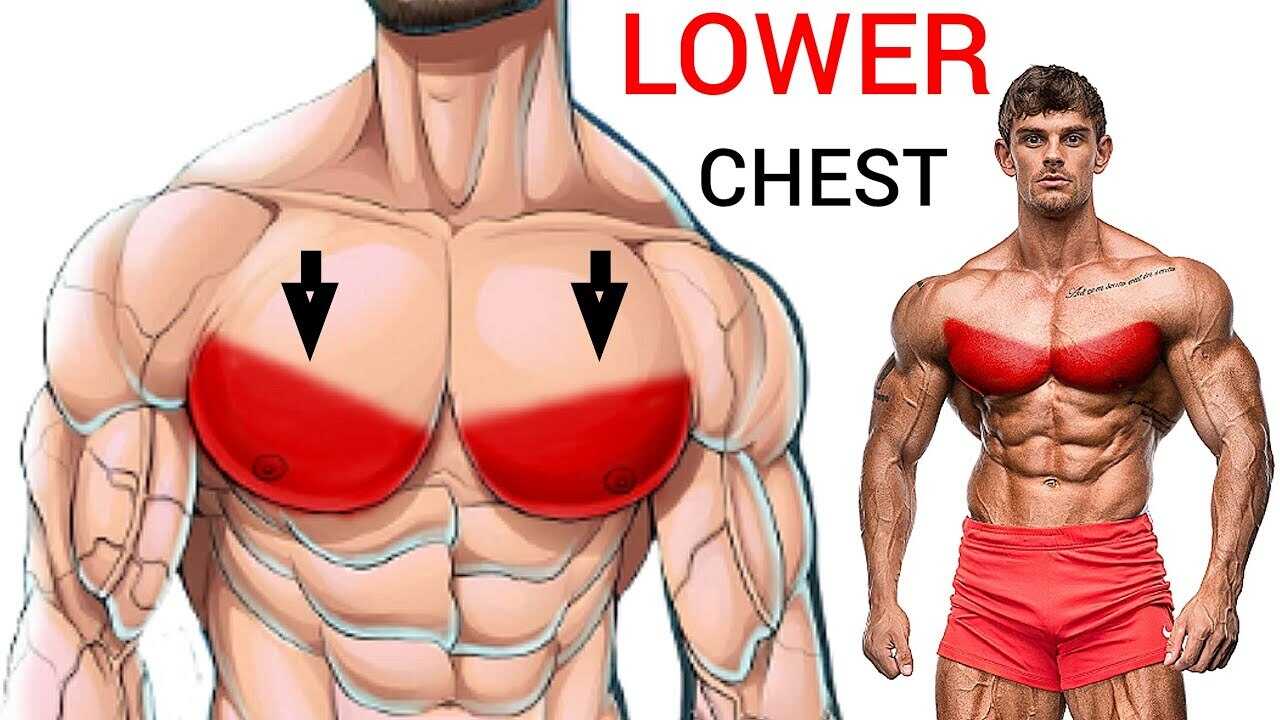
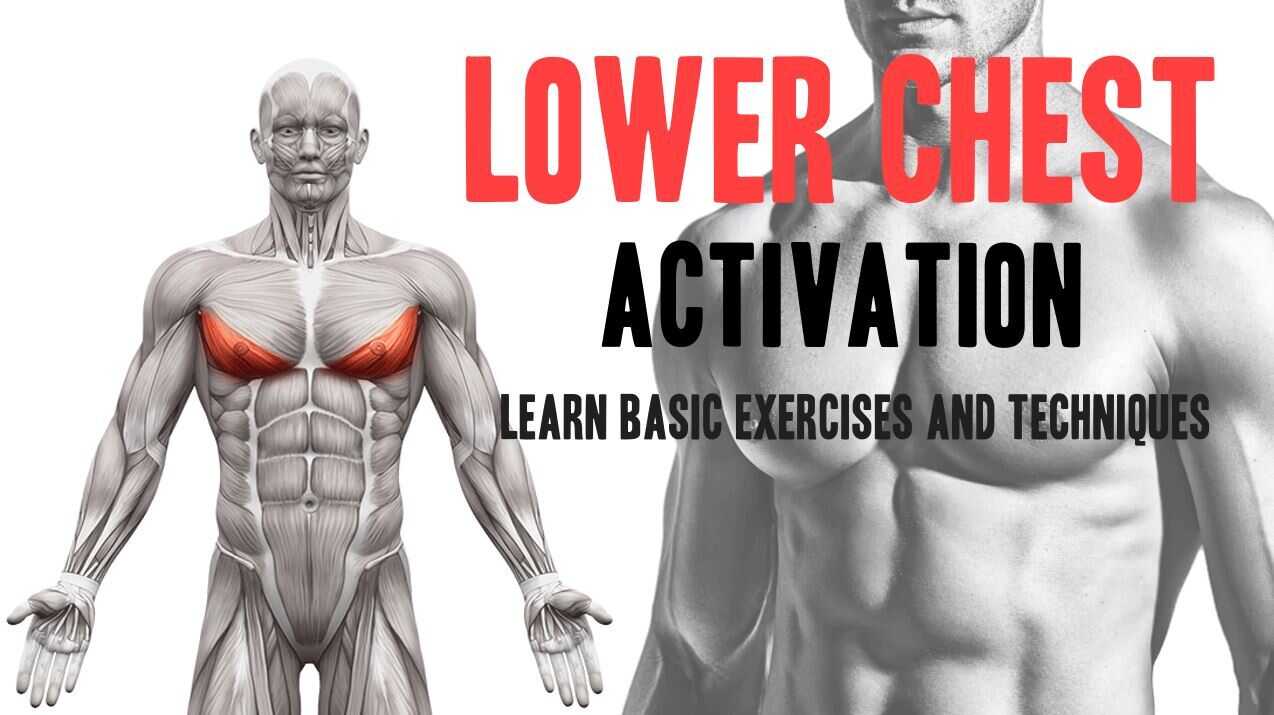
The pectoralis major is a fan-shaped muscle that spans from the chest bone and clavicle to the upper arm bone. It has two anatomic sections or heads. The first one is the upper clavicular head (upper pectoralis major). The second one is the lower sternal head (lower pectoralis major). These two heads work in concert to control arm movements like flexion, adduction, and rotation. Of specific interest for our discussion is the sternal head, which gives the lower chest its shape and contour.
Although the pectoralis muscle has only two anatomic divisions, functionally it may be considered in three sections (upper, middle, and lower) depending on the angle through which the arm is moved. This is the main reason why we can talk about the lower, upper, and middle chest exercises. The lower chest is the smallest section of the pecs, and it is emphasized by performing decline actions. The hands should finish down low close to the hips to target this area of the pecs.
On the other hand, the pectoralis minor lies beneath the pectoralis major. Though it’s smaller and less visible, its role shouldn’t be underestimated. It stabilizes the shoulder, assists in deep breathing, and helps maneuver the shoulder blades.
Understanding this complex interplay of muscles is crucial if you’re looking to specifically target your lower chest. Knowing which exercises stimulate the sternal head of the pectoralis major will enable you to focus your workout regimen accordingly.
If you are more interested in the anatomy of the pectoral muscles (which is certainly recommended for every serious bodybuilder to know), we refer you to our article which deals exclusively with the anatomy of the pectoral muscles.
Targeting the lower chest requires a subtle shift in your exercise routine. This involves adjusting the press angle during your workout. You can accomplish this by incorporating exercises that make use of a decline bench (about 30 degrees below parallel; where your legs are higher than your head), or by adding a forward lean when doing regular exercises like dips and pushdowns.
The best exercise to target the lower chest area (sternal head)
When it comes to lower chest exercises, there are plenty of options to choose from. Our exercise database contains many lower chest exercises you can choose from. However, not all exercises are created equal (while they all have their unique advantages), and some may be more effective than others in achieving your desired results (maximal muscle growth). Since you can’t do them all, we’re sure you want to know the best lower-chest exercises to include in your chest workout routine – those that provide total muscle stimulation. We’ve done the work to compare them for you and to make the list of those who really stand out with their ability to promote the greatest growth of the pectoral muscle.
However, one thing must be absolutely clear at the start. It is impossible to fully isolate the lower, upper, and middle portions (fibers) of the pectoralis major muscle. This is because the chest muscles (pectoralis major and minor) work together as a unit. Every chest exercise will hit the entire area of the muscle – all three portions. However, there are some exercises that can place a little more emphasis on either the lower, upper, or middle portion of the muscle.
Based on what criteria did we choose these exercises? These exercises were chosen based on their proven results in the lab (measuring activation from electromyography), total muscle stimulation and intensity, ease of learning and performing, popularity among lifters and bodybuilders, as well as the availability of equipment in commercial gyms. By incorporating a combination of these exercises into your routine, you can effectively target and develop your chest muscles.
It comes as no surprise that most of the chosen exercises are basic, compound lifts (multi-joint exercises) that work several joints at once. These exercises, therefore, require the coordinated action of two or more muscle groups with motion occurring at more than one joint. Compound exercises are generally similar to the ways that people naturally push, pull, and lift objects.
#1 DECLINE BARBELL BENCH PRESS
HOW TO DO IT:
- Adjust the decline bench to a comfortable angle (usually around 15-30 degrees decline).
- Load the desired weight on the barbell and secure it with collars.
- Lie on your back on the decline bench (your head is lower than your hips) with your feet securely anchored at the bottom.
- Grip the barbell with a slightly wider than shoulder-width grip, palms facing forward.
- Lift the barbell off the rack, straightening your arms, and position the barbell directly above your lower chest.
- Inhale and slowly lower the barbell to the lower part of your chest. Keep your elbows at a 90-degree angle or slightly below, allowing for a full range of motion.
- Exhale and press the barbell back up to the starting position. Fully extend your arms without locking out your elbows.
- Perform the desired number of repetitions.
COACH’S TIP (HELPFUL HINTS):
- Engage your core to maintain stability on the decline bench.
- Focus on feeling the contraction in your lower chest throughout the movement.
- Use a spotter, especially when lifting heavy weights, for safety.
- Keep your lower back and entire body stable throughout the movement.
- Do not lift your head and do not bridge or arch.
#2 DECLINE DUMBBELL BENCH PRESS
The decline dumbbell bench press is another effective pressing exercise (compound) to target the lower chest.
HOW TO DO IT:
- Adjust the decline bench to a comfortable angle (usually around 15-30 degrees decline).
- Pick up the dumbbells and hold them with an overhand grip, palms facing forward.
- Extend your arms straight up above your chest, keeping a slight bend in your elbows.
- The dumbbells should be directly above your lower chest.
- Inhale and slowly lower the dumbbells to the sides of your lower chest. Your elbows should point down and flare at 45 to 60 degrees from your sides.
- Exhale and press the dumbbells back up to the starting position. Fully extend your arms without locking out your elbows.
- Perform the desired number of repetitions.
COACH’S TIP (HELPFUL HINTS):
- Engage your core to maintain stability on the decline bench.
- Focus on feeling the contraction in your lower chest throughout the movement.
- Use a spotter, especially when lifting heavy weights, for safety.
#3 SMITH-MACHINE DECLINE CHEST PRESS
HOW TO DO IT:
- Start by lying face up on a decline bench, adjusted to an angle between 20 to 45 degrees decline. This should be arranged within a Smith machine in a way that aligns the bar with the lower part of your chest.
- Grasp the Smith machine bar with an overhand grip, palms facing forward, and with your hands slightly wider than shoulder-width apart. Ensure your wrists are in a straight, neutral position.
- Proceed to release the safety hooks, lift the bar off the supports, and hold it above your lower chest with your arms fully extended. Ensure your feet are secured under the ankle pads.
- Begin the movement by bending your elbows to gently lower the bar towards your chest. The bar should come very close to touching your lower chest.
- Exhale and press the Smith machine bar back up to the starting position. Fully extend your arms without locking out your elbows.
- Perform the desired number of repetitions.
COACH’S TIP (HELPFUL HINTS):
- Ensure that when you lower the bar, it comes to roughly an inch above the upper region of your chest, but avoid making contact with the chest.
- Do not lift your head and do not bridge or arch.
#4 CHEST DIPS
HOW TO DO IT:
- Stand between the parallel bars and grab each bar with an overhand grip.
- Jump or step up to the point where your arms are fully extended, and your body is lifted off the ground.
- Keep your elbows slightly bent at this starting position, and cross your legs (or keep them together).
- Lean your torso slightly forward. This lean encourages the activation of your chest muscles instead of your triceps.
- Inhale and lower your body by bending your elbows. Keep your elbows close to your body. You should lower until your shoulders are slightly below your elbows, or as far as comfortable (until your upper arms are about parallel to the floor).
- Exhale and push through your palms to extend your elbows, raising your body back up to the starting position, keeping your body slightly leaned forward throughout. Focus on using your chest and triceps to lift your body.
- Repeat these steps for your desired number of repetitions.
COACH’S TIP (HELPFUL HINTS):
- Keep your body slightly leaned forward to emphasize the chest muscles.
- Avoid locking out your elbows at the top to maintain tension on the muscles.
- Engage your core to stabilize your body during the movement.
- The lower you can safely go, the more your lower pecs will benefit.
#5 INCLINE PUSH-UPS
Although this is called the incline push-up, it focuses more on the lower pecs.
HOW TO DO IT:
- Place your hands slightly wider than shoulder-width apart on the elevated surface. Choose an incline level that suits your fitness level.
- Position your feet behind you, creating a straight line from head to heels.
- Ensure that your body is in a plank position with a neutral spine.
- Inhale as you bend your elbows, lowering your chest toward the elevated surface (until it nearly touches the surface).
- Exhale and push through your palms to extend your elbows.

COACH’S TIP (HELPFUL HINTS):
- Keep your body in a straight line throughout the movement.
- Squeeze your chest muscles at the top of the movement.
- Adjust the incline level based on your fitness level; higher incline for beginners, lower incline for advanced.
#6 CABLE CROSSOVER EXERCISES
HOW TO DO IT:
- Adjust the pulleys on the cable crossover machine to the highest position (above your head) and attach D-handles.
- Set the weight on each side of the cable machine according to your fitness level.
- Stand in the center of the cable crossover station., grasp the handles firmly, and step forward to create tension in the cables.
- With a slight bend in your elbows, pull the cables downward and across your body (in a hugging motion), aiming to meet them just below your waist.
- Hold the peak contraction for a moment, feeling the squeeze in your chest.
- Release the tension slowly, allowing your arms to follow the same pathway back to the original position.
COACH’S TIP (HELPFUL HINTS):
- A low trajectory, in which the handles meet in front of your hip or waist, targets the lower fibers of the pectoral muscle. A high trajectory, in which the handles meet at chest level, targets the midsection of the pecs.
- Your arms are the levers here but the force should come from your chest muscles.
- Perform this exercise with a moderate weight where you can control the movement and feel the burn in your lower pecs.
- Focus on maintaining a controlled and deliberate movement.
- Keep your chest lifted and engage your core for stability.
#7 DECLINE BENCH DUMBBELL FLY
HOW TO DO IT:
- Set up a decline bench at a slight decline angle (usually around 30 degrees).
- Place two dumbbells that are appropriate for your fitness level on the floor on either side of the bench.
- Sit on the decline bench with a dumbbell in each hand and your feet locked under the supports.
- Lie back and push the weights up over your chest (above your sternum) with your palms facing each other and maintaining a slight bend in your elbows.
- With a slight bend in your elbows, open your arms wide to your sides in a controlled and deliberate motion.
- When your arms are fully extended to your sides, make sure you feel the stretch in your pectoral muscles. This should be your lowest point.
- Reverse the motion and squeeze your chest as you bring the weights back up to the starting position. Imagine hugging a large barrel as you bring your arms together.
- Perform the desired number of repetitions.
COACH’S TIP (HELPFUL HINTS):
- Focus on the mind-muscle connection, feeling the contraction in your chest. Use a weight that challenges you without compromising your form.
- Don’t let the dumbbells drop too low at your sides.
- Always try to keep your arms slightly bent at the elbows.
#8 DECLINE BENCH CABLE FLY
HOW TO DO IT:
- Position a decline bench between two low pulley cable machines. Select the weight you’re comfortable with on each side of the machine, ensuring they’re the same on both sides.
- Lie down on the decline bench with your head at the lower end and your feet secured at the top.
- Grab a handle in each hand, palms facing each other, and extend your arms directly above your chest.
- While keeping a slight bend in your elbows lower your arms out to the sides in a controlled and deliberate motion until your chest feels a good stretch, especially in the lower part.
- Engage your chest muscles to bring the handles back toward the centerline of your body. Imagine hugging a large tree as you bring your arms together.

COACH’S TIP (HELPFUL HINTS):
- At the end of the movement, contract your chest muscles and squeeze them together for a moment to maximize the engagement.
- As with all flye exercises, don’t let the handles drop too low at your sides; this could easily strain your chest muscles.
- Always try to keep your arms slightly bent at the elbows.
#9 SVEND PRESS ON A DECLINE BENCH
Let’s plunge into the Svend Press, a rather unconventional lower chest exercise that can offer surprising results.
HOW TO DO IT:
- Start by positioning yourself on a decline bench with your head at the lower end and your feet secured at the top.
- Hold the weight plate with both hands; your fingers should face outwards while your thumbs should wrap around the plate’s edge. This unique grip is used to maintain a firm hold on the weight plate.
- Extend your arms straight above your chest, holding the weight plate at arm’s length. Simultaneously, press the plates hard against one another while you extend your arms.
- Hold for a count of two at the top and squeeze your chest muscles even more if possible.
- Lower the weight plate slowly and with control towards your lower chest.
COACH’S TIP (HELPFUL HINTS):
- Focus on engaging your lower chest muscles during the upward movement.
- Ensure that the weight plate remains stable and under control at all times.
- Use a weight that challenges you without compromising your form.
- The harder you press the plates together, the harder the contraction of the chest, and a bigger contraction leads to greater gains.
Quick tips for lower-chest training
When it comes to enhancing your lower chest, there’s no one-trick-solution. It requires a combination of the right exercises, training strategies, and dedication. Let’s dive into some quick tips that can optimize your lower chest training.
- Perform decline sets: To emphasize the lower section of your chest muscle, you should carry out exercises on a declined bench – about 30 degrees below parallel; where your legs are higher than your head. This will help target and engage your lower pecs more.
- Compound exercises before isolation exercises: Perform multi-joint exercises for the lower pecs (decline barbell bench press, decline bench dumbbell press) before the single-joint (isolation) exercises (like decline bench dumbbell fly, decline bench cable fly, etc).
- Do chest dips: Dips can be a great compound exercise for targeting the lower chest. Ensure your body is leaning forward slightly to place more emphasis on the lower chest.
- Do cable crossovers: Use cable machines for crossovers, adjusting the pulley height to target the lower chest.
- Maintain the correct posture: A proper posture is crucial in all exercises as it reduces the risk of injury and improves performance. So, always ensure that your back is straight and your core is engaged.
- Focus on the range of motion: Make sure to go through the full range of motion in each exercise. This ensures that the muscle is fully stretched and contracted, leading to optimal gains.
- Vary the exercises: Don’t stick to just one routine. Mix different exercises to target your lower chest from various angles. Each of the exercises listed above offers a unique way to engage your pecs, so try them all!
- Practice proper breathing: Take a deep breath while lowering the weights and exhale while pushing them up. This helps in maintaining rhythm and stability.
- Mind-muscle connection: Focus on contracting and squeezing the lower chest during each repetition. Concentrate on the muscle you are working to maximize engagement.
- Consistent training: Train the lower chest consistently, but also ensure a balanced overall chest workout. Include a mix of compound and isolation exercises.
- Ensure proper recovery: Give your muscles ample time to recover between workouts. This aids in muscle growth and prevents overuse injuries.
Closing thoughts: Best exercises for building lower-chest mass and strength
To effectively target the chest muscles as a whole, it’s important to incorporate a variety of exercises that stimulate different areas of the chest. Your lower chest (sternal head) is one of three areas you have to cover. The other two areas are the upper and middle fibers of the pectoral muscle. So make sure you always incorporate one or two exercises that target your lower chest area (sternal head) into your chest workout. Based on extensive research and expert recommendations, we have compiled a list of the best lower-chest exercises for muscle growth.
The exercises presented in this article will add size and mass to your chest and stimulate muscle growth (hypertrophy) in the shortest time. Also, these exercises are useful for developing functional strength – supporting your everyday life and sports activities. Whether you are a gym-goer or a home workout enthusiast, we’ve outlined multiple exercises with both weights and bodyweight options. The objective is to make these workouts accessible and adaptable to your fitness routine and personal goals.
Literature consulted
- "Anatomy Trains: Myofascial Meridians for Manual Therapists" by Tom Myers
- "Muscle: Fundamental Biology and Mechanisms of Disease" by Joseph Hill, Ph.D., and Eric Olson, M.D.
- "Bodybuilding Anatomy" by Nicholas Evans, M.D.
- "Training for Speed, Agility, and Quickness" by Lee Brown & Vance Ferrigno
- "Strength Training Anatomy" by Frederic Delavier
- "Principles and Practice of Resistance Training" by Michael Stone, Meg Stone and William A. Sands
- "Bench Press: The Science" by Josh Bryant
- "Science and Development of Muscle Hypertrophy" by Brad Schoenfeld
- "The Science of Weight Lifting: Improve Your Performance, Boost Your Health and Prevent Injury" by Chad Waterbury
- "Muscle Medicine" by Rob DeStefano and Bryan F. Kelly
- Study: "The Effect of Bench Press Load Knowledge on Neuromuscular Activation and Power Production Potentiation - A Biomechanical Perspective" - Journal of Strength and Conditioning Research
- Study: "Effect of Bench Press Form Change on Muscle Activity and the Load–Velocity Relationship" - Journal of Strength and Conditioning Research
- Study: "Muscle Activation in Unilateral Barbell Exercises: Implications for Strength Training and Rehabilitation" - Journal of the American College of Sports Medicine
- Study: "Muscle Activity During the Bench Press Exercise at Short and Long Muscle Lengths" - Journal of Sports Sciences
- Study: "Effects of Different Volume-Equated Resistance Training Loading Strategies on Muscular Adaptations in Well-Trained Men" - Journal of Strength and Conditioning Research
