


Introduction
Walk into any gym, and you’ll see the same debate playing out: one lifter confidently loading up a barbell, while another chooses the Smith machine for the same exercise. It raises a simple but important question—Smith machine vs. barbell bench press: which is actually better for strength and muscle? At first glance, both movements look nearly identical. You press the weight, train your chest, and aim to get stronger. But under the surface, they are fundamentally different.
Some lifters avoid the Smith machine completely, believing it’s inferior or “unnatural.” Others prefer it for the added stability and safety. The problem is that most opinions are based on gym culture and assumptions—not on how these movements actually work.
As a coach working with lifters and athletes, I’ve seen both variations produce great results—and I’ve also seen both limit progress when used incorrectly. The key difference is not which one you choose, but how and when you use each.
This isn’t just a matter of preference. The choice between the Smith machine and barbell bench press affects stability, muscle activation, strength development, and long-term progress.
In this article, we’ll break down the real differences between the Smith machine vs. barbell bench press, explain how each variation impacts muscle growth and strength, and help you decide which option is best for your goals.
Smith Machine vs Barbell Bench Press (Quick Answer)
If you’re comparing the Smith machine vs. the barbell bench press, the main difference comes down to stability vs natural movement and force production.
Smith machine bench press:
- Provides maximum stability with a fixed bar path
- Requires less coordination and balance
- Allows you to focus more on muscle contraction
Barbell bench press:
- Requires full-body stabilization
- Uses a natural bar path
- Allows greater force production and strength development
So which is better?
- For strength and overall performance → barbell bench press
- For controlled hypertrophy and isolation focus → Smith machine bench press
The key point is this: both can build muscle, but they do it in different ways.
Key Differences Between the Smith Machine and the Barbell Bench Press
At a glance, both movements look almost identical—you’re pressing a bar away from your chest. But the biggest difference lies in how that bar moves, and that changes everything.
Bar Path: Fixed vs Natural
This is the most important difference.
- Smith machine: the bar moves on a fixed vertical (or slightly angled) path
- Barbell: the bar follows a natural, slightly curved path based on your mechanics
With a barbell, your body determines the most efficient path. With the Smith machine, you must adapt to the machine’s path—even if it’s not ideal for your structure.
Stability and Muscle Recruitment
- Smith machine: high external stability
- Barbell: requires internal stabilization
Because the Smith machine stabilizes the bar for you:
- Less demand on stabilizer muscles
- Easier to control the weight
- Reduced coordination requirements
With a barbell:
- Shoulders, core, and smaller muscles must stabilize the load
- More muscles are involved overall
- Coordination becomes a key factor
Force Production
The barbell allows greater force production.
- Barbell: higher potential for strength development
- Smith machine: slightly reduced force output due to constrained movement
This is why most lifters can build more raw strength with free weights.
Joint Position and Mechanics
The Smith machine can sometimes force unnatural positioning.
- A fixed path may not match your shoulder or arm mechanics
- Can increase joint stress for some lifters
Barbells allow your joints to move more naturally, adjusting slightly throughout the lift.
Safety and Control
- Smith machine: safer for solo training (built-in safety stops)
- Barbell: requires more control and proper setup (spotter recommended)
The Smith machine is often preferred by beginners or in situations where safety is a concern.
Practical Takeaway
The difference between the Smith machine and the barbell bench press is not about one being universally better.
It’s about how each variation changes:
- Movement freedom
- Muscle recruitment
- Strength potential
Understanding this allows you to use each tool with a clear purpose instead of relying on assumptions.
Next, we’ll break down exactly which muscles are doing the work in each variation.
Muscles Worked (Detailed Breakdown)
To understand the real difference between the Smith machine and barbell bench press, you need to look at how each variation distributes the workload across the same muscle groups.
Both exercises target the chest, shoulders, and triceps—but the way those muscles are recruited changes depending on the stability and bar path.
Smith Machine Bench Press — Primary Muscles
The Smith machine reduces the need for stabilization, allowing you to focus more directly on the pressing muscles.
Main muscles involved:
- Pectoralis major (chest) — primary driver
- Anterior deltoids (front shoulders)
- Triceps
Because the machine stabilizes the bar:
- Less involvement from stabilizer muscles
- More isolated tension on the chest
- Easier to maintain consistent form
This can make it easier to focus on the chest, especially for hypertrophy.
Barbell Bench Press — Primary Muscles
The barbell bench press recruits the same primary muscles but adds a significant stabilization component.
Main muscles involved:
- Pectoralis major (chest) — primary driver
- Anterior deltoids
- Triceps
- Stabilizer muscles (shoulders, core, and supporting muscles)
Because you must control the bar path:
- More muscles are engaged overall
- Greater coordination is required
- Higher demand for stabilizing structures
Key Difference in Muscle Contribution
The key difference is not which muscles are used, but how they are used.
- Smith machine → more isolated tension, less stabilization
- Barbell → more total muscle involvement, more coordination
Both variations train the same major muscle groups, but the emphasis shifts between controlled isolation and full-body integration.
Which One “Activates More Muscle”?
This depends on how you define activation.
- The Smith machine can increase focus on the chest due to reduced stabilization demands
- The barbell engages more total muscle mass due to the need for control and balance
Both approaches can be effective for muscle growth.
Coach’s Takeaway — Smith Machine vs Barbell Bench Press
If your goal is controlled hypertrophy and better focus on the chest, the Smith machine bench press can be useful.
If your goal is overall strength, coordination, and full muscle recruitment, the barbell bench press is the more effective option.
The best results come from understanding how each variation works and using both strategically in your training.
Next, we’ll answer the key question: which one actually builds more muscle and strength?
Which Is Better for Strength and Muscle?
Now to the key question: Smith machine vs barbell bench press — which is actually better for strength and muscle?
The answer depends on your primary goal.
For Strength Development
If your goal is to build maximum strength:
The barbell bench press is clearly superior.
Because it requires:
- Full-body stabilization
- Control of the bar path
- Coordination across multiple muscle groups
This leads to:
- Greater force production
- Better transfer to real-world strength
- Stronger overall pressing performance
The barbell allows you to develop strength that carries over to other lifts and athletic movements.
For Muscle Growth (Hypertrophy)
If your goal is muscle growth:
Both variations can be effective—but in different ways.
The Smith machine can help:
- Maintain constant tension
- Reduce technical limitations
- Focus more directly on the chest
The barbell can help:
- Increase total training load
- Build foundational strength
- Recruit more muscle mass overall
The Real Verdict
If you want a clear, practical answer:
- For maximum strength → barbell bench press
- For controlled hypertrophy and isolation → Smith machine bench press
Neither variation is universally better.
Each one contributes to muscle growth in a different way.
Coach’s Takeaway — Best Strategy for Strength and Muscle
If your goal is both strength and muscle, the best approach is to use both variations strategically.
- Use barbell bench press to build strength, coordination, and progressive overload
- Use Smith machine bench press to focus on controlled muscle work and consistent chest tension
Combining both allows you to train more effectively, reduce weak points, and keep progressing over time.
Next, we’ll compare both variations side by side in a clear table.
Smith Machine vs Barbell Bench Press — Comparison Table
To make the differences clear at a glance, here’s a direct side-by-side comparison:
| Feature | Smith Machine Bench Press | Barbell Bench Press |
|---|---|---|
| Bar Path | Fixed | Natural, slightly curved |
| Stability | Very high (machine-assisted) | Requires full-body stabilization |
| Muscle Recruitment | More isolated (less stabilizers) | Greater overall muscle involvement |
| Load Potential | Moderate | Higher |
| Joint Freedom | Limited (fixed path) | More natural movement |
| Safety | High (built-in safeties) | Requires spotter or safety setup |
| Best For | Controlled hypertrophy and isolation | Strength, coordination, and performance |
The table highlights a simple but important idea:
Smith machine and barbell bench press are not competing exercises—they serve different purposes.
- The Smith machine offers control and stability
- Barbell builds real strength and coordination
Using both allows you to train more thoroughly rather than limiting yourself to a single approach.
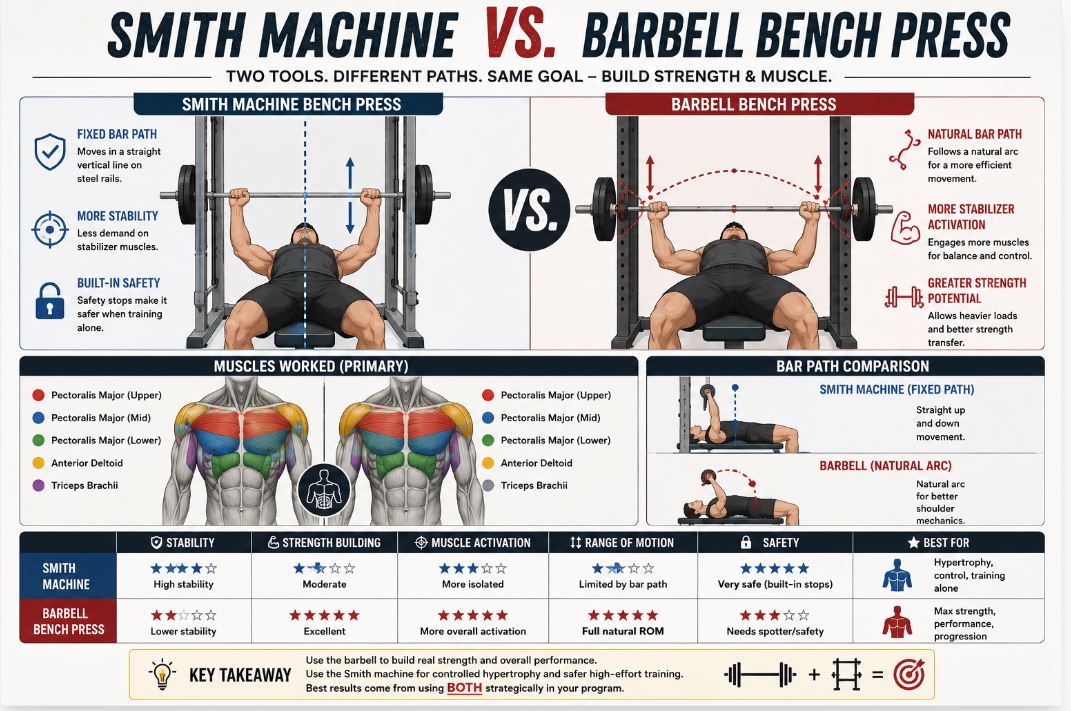
This infographic breaks down the key differences between the Smith machine and the barbell bench press, including stability, strength potential, muscle activation, and bar-path mechanics.
When to Use the Smith Machine vs. the Barbell Bench Press
Now that you understand the differences, the next step is knowing when to use each variation in your training.
The goal is not to choose one and ignore the other, but to use each strategically based on your goal, experience level, and current situation.
Use Barbell Bench Press for Strength and Performance
The barbell bench press should be your primary choice when your goal is to build real strength and overall performance.
Use it when you want to:
- Develop maximum pressing strength
- Improve coordination and stability
- Build transferable strength
- Progress with heavier loads
This makes it the best option for your main compound lift.
Use the Smith Machine Bench Press for Controlled Hypertrophy
The Smith machine becomes useful when your goal is to focus on muscle development with more control.
Use it when you want to:
- Reduce stability demands
- Maintain consistent technique
- Focus more directly on the chest
- Train safely without a spotter
It is especially helpful when you want to push close to failure without worrying about balance.
Best Approach: Use Both
The most effective strategy is to combine both variations.
Option 1 — Same workout
- Start with the barbell bench press
- Follow with the Smith machine bench press
Option 2 — Different training days
- Day 1: Barbell (strength focus)
- Day 2: Smith machine (hypertrophy focus)
Option 3 — Situation-based approach
- Use the Smith machine when training alone or fatigued
- Use a barbell when fresh and focused on strength
Where They Fit in Your Program
A simple structure:
- Main lift: barbell bench press
- Secondary lift: Smith machine bench press
This allows you to:
- Maximize strength development
- Maintain controlled hypertrophy work
- Reduce risk when training close to failure
Practical Takeaway
Smith machine and barbell bench press are tools, not competitors.
Use the barbell to build strength and coordination.
Use the Smith machine to focus on controlled muscle work and safety.
Using both together yields better long-term results than relying on a single variation.
Next, we’ll cover the most common mistakes that limit your results.
Common Mistakes That Limit Results
Even if you’re using the right variation for your goal, poor execution can limit both strength and muscle growth. Most lifters don’t have a problem with exercise selection—they have a problem with technique and programming.
Treating the Smith Machine Like a Free Weight
One of the biggest mistakes is trying to use the exact same mechanics on the Smith machine as on a barbell.
Because the path is fixed:
- Body positioning matters more
- Improper setup can stress the shoulders and wrists
Fix:
Adjust your bench and body position so the fixed bar path feels natural for your structure.
Using the Smith Machine as a Shortcut
Some lifters rely only on the Smith machine because it feels easier or safer.
This can:
- Reduce stabilizer development
- Limit coordination
- Create dependency on machine stability
Fix:
Use the Smith machine strategically—not as a replacement for all free-weight pressing.
Going Too Heavy on Barbell Bench Press
Many lifters sacrifice technique just to move more weight.
This often leads to:
- Poor bar control
- Reduced chest activation
- increased injury risk
Fix:
Focus on controlled reps and proper mechanics before chasing heavier loads.
Ignoring Stabilizer Strength
With free weights, stabilizers play a major role.
Weak stabilizers can:
- Reduce performance
- Create instability
- Limit progression
Fix:
Include accessory work and avoid relying only on machine-based pressing.
Incorrect Bar Path
This is common in both variations.
- Smith machine: Poor bench placement can force awkward movement
- Barbell: an uncontrolled path reduces efficiency and stability
Fix:
Use a consistent pressing path that feels natural and controlled.
No Focus on Progressive Overload
Some lifters treat the Smith machine as “just a pump exercise” and stop tracking progression.
Fix:
Progressively increase:
- Weight
- Reps
- Control
- Training quality
over time.
Coach’s Takeaway — Execution Beats Equipment
Most limitations in strength and muscle growth come from poor execution and programming—not from choosing the Smith machine or barbell.
Fixing these mistakes will improve performance, muscle activation, and long-term progress with both variations.
Final Thoughts
The difference between the Smith machine and barbell bench press is not about one being universally better—it’s about understanding what each tool is designed to do.
The barbell bench press remains superior for building real-world strength, coordination, and overall pressing performance. The Smith machine, on the other hand, offers greater stability and control, making it useful for focused hypertrophy work and safer high-effort training.
If you rely exclusively on one variation, you limit your potential. Using both strategically allows you to combine heavy overload with controlled muscle-focused training, leading to better long-term results.
Understanding when and why to use each variation gives you a major advantage—because effective training is not about choosing sides, but about using the right tool for the right purpose.
Complete Your Chest Training Knowledge
Want to get the full picture of chest training? These related guides will help you master bench press technique, compare the most important pressing variations, fix common activation problems, and understand why your chest may not be growing as expected.
- 🔗 Flat Barbell Bench Press – Complete Guide to Technique, Benefits & Maximum Chest Strength
- 🔗 Smith Machine Bench Press
- 🔗 Incline vs Flat Bench Press: Which Builds More Chest?
- 🔗 Barbell vs Dumbbell Bench Press: Which Builds More Muscle?
- 🔗 Wide-Grip vs Close-Grip Bench Press: Which Builds More Muscle?
- 🔗 Why You Feel Your Shoulders Instead of Your Chest When Bench Pressing (And How to Fix It)
- 🔗 Why Your Chest Isn’t Growing (Even If You Bench Press): 10 Real Reasons & Proven Fixes
Can Smith machine bench press build real strength
Yes, but mostly within the movement itself. Because the machine stabilizes the bar path, it develops less overall coordination and stabilizer strength compared to free weights.
Why does barbell bench press usually transfer better to sports and real-world strength?
Because it requires full-body stabilization, balance, and control. This creates a more realistic strength stimulus that carries over better to athletic performance and other compound lifts.
Is the Smith machine actually safer for beginners?
In many cases, yes. The fixed path and built-in safety hooks reduce the risk of losing control of the weight, especially when training alone.
Why do some bodybuilders prefer the Smith machine for chest training?
Because it allows them to focus more directly on muscle tension and fatigue without spending as much energy stabilizing the bar.
Can the Smith machine reduce shoulder strain?
Sometimes. For certain lifters, the added stability can reduce stress. For others, the fixed path may actually feel less natural and increase discomfort. Individual mechanics matter.
Does barbell bench press activate more muscle overall?
Yes. Because you must stabilize and control the bar path yourself, more muscles contribute to the movement.
Why does Smith machine bench press often feel easier?
The machine removes much of the stabilization demand, allowing you to focus mainly on pressing the weight.
Can relying only on the Smith machine limit long-term progress?
Potentially yes. Over time, avoiding free-weight stabilization work may limit coordination, balance, and transferable strength development.
Is it true that the Smith machine is “bad” for chest training?
No. That’s an oversimplification. The Smith machine can be highly effective for hypertrophy when used correctly within a balanced training program.
What is the best way to combine Smith machine and barbell bench press?
A highly effective approach is to use barbell bench press first for heavy strength work and then use the Smith machine afterward for controlled hypertrophy-focused sets.
