



Introduction
The cable crossover, often performed as a high-to-low cable fly, is one of the most effective isolation exercises for developing the lower and inner portions of the chest. Unlike pressing movements that combine elbow extension with shoulder flexion, the cable crossover emphasizes horizontal shoulder adduction — the primary function of the pectoralis major.
One of the biggest advantages of the cable crossover machine is its adjustable line of pull. By bringing the handles downward toward the waist (high-to-low trajectory), you shift mechanical emphasis toward the lower fibers of the pectoralis major. This makes the high-to-low cable fly an excellent complement to decline presses and chest dips in a lower-chest training program.
Because the movement is performed standing without bench support, the cable crossover also requires core and lower-body stabilization, increasing overall muscular engagement compared to machine fly variations.
Required Equipment
To perform the cable crossover correctly, you need:
- Cable crossover machine (dual high pulleys)
- Two D-handles
- Stable stance with staggered foot position
Because the movement is unsupported, proper stance and bracing are essential.
Other Names for Cable Crossover
The cable crossover exercise is commonly referred to by several names, depending on gym terminology, execution style, and pulley height.
- High-to-Low Cable Fly
- Standing Cable Fly
- Cable Chest Fly
- High Pulley Crossover
- Cable Fly (High Position)
- Cable Cross-Over
Although “cable crossover” is the most widely recognized term, the variation performed from a high pulley downward is more precisely described as the high-to-low cable fly, especially when the goal is to emphasize the lower fibers of the pectoralis major.
How to Perform Cable Crossover (High-to-Low Cable Fly)
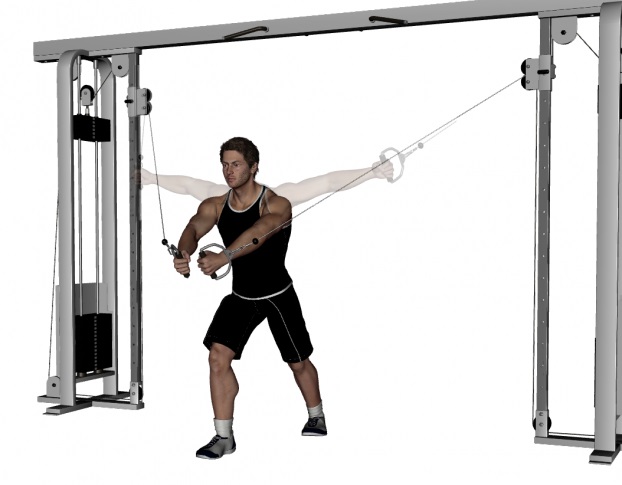
Initial Setup
Proper setup emphasizes the lower chest rather than the mid-chest or shoulders.
- Attach D-handles to the highest pulley setting.
- Stand centered between the towers.
- Take a staggered stance for balance.
- Lean slightly forward (15–30°).
- Keep knees softly bent.
- Retract and depress the shoulder blades.
- Bend elbows slightly (maintain this angle throughout).
Key cue: Your torso angle determines which chest fibers are emphasized.
Execution Phase
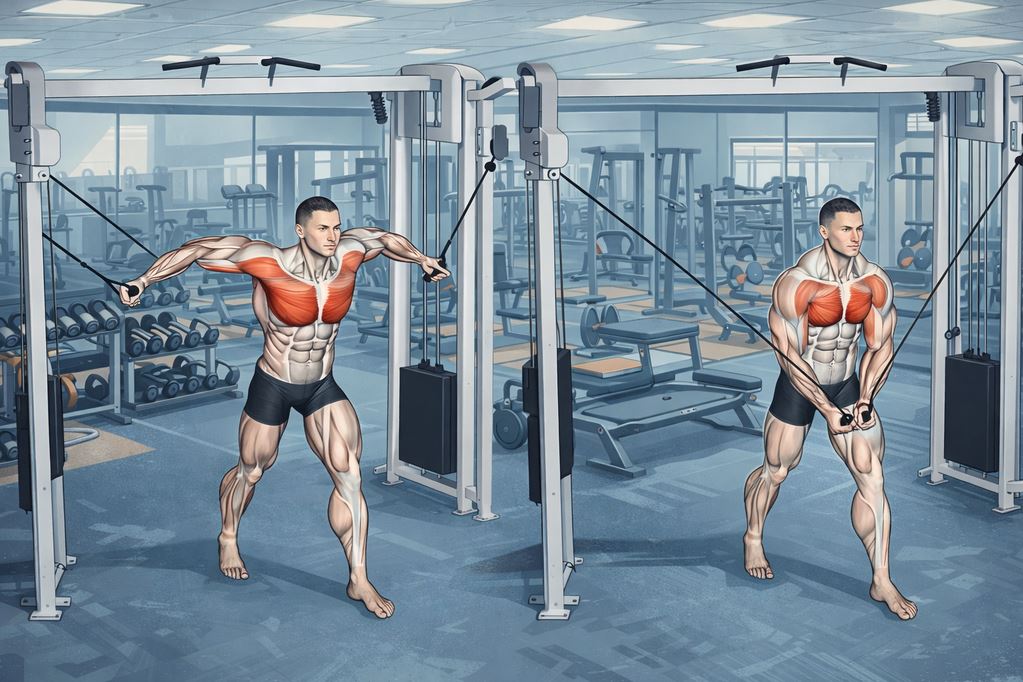
The high-to-low cable fly motion should resemble a controlled “bear hug.”
- Begin with arms extended outward in a wide arc.
- Keep elbows slightly bent and fixed.
- Pull the handles downward and inward simultaneously.
- Bring your hands together in front of your waist or hips.
- Briefly squeeze the chest at peak contraction.
- Slowly return to the starting position under control.
A low trajectory, where the handles meet in front of the waist, emphasizes the lower chest. Crossing the hands slightly at the bottom increases the range of motion and intensifies contraction in the inner chest.
Technique Optimization Tips
Here are key strategies to maximize lower-chest activation and maintain joint safety during cable crossovers.
- Use moderate weight — not so heavy that it pulls your torso backward.
- Avoid turning the movement into a press.
- Keep elbows fixed at a slight bend.
- Do not straighten your arms fully at any point.
- Maintain constant tension— do not rest between reps.
- Focus on chest contraction, not shoulder shrugging.
- Keep both arms moving at the same speed.
Mechanical Resistance Analysis
Unlike dumbbell flyes, which lose tension at the top, the cable crossover provides constant resistance throughout the entire range of motion. The high-to-low cable fly creates peak tension as the hands approach the body’s midline. Because the load direction can be adjusted, the exercise allows precise targeting of different chest regions.
When the handles travel downward toward the hips, the line of force aligns more closely with the lower fibers of the pectoralis major. This makes the cable crossover uniquely adaptable for complete chest development.
Common Mistakes
Even experienced lifters often compromise the effectiveness of cable crossovers.
- Turning the movement into a press
- Using excessive body momentum
- Allowing the shoulders to round forward
- Using too much weight
- Fully extending elbows
- Failing to control the eccentric phase
Muscles Involved in Cable Crossover
Understanding muscle recruitment improves exercise precision.
- MAIN MUSCLES: Lower pectoralis major, anterior deltoids
- SECONDARY MUSCLES: Pectoralis minor, serratus anterior, coracobrachialis, subscapularis, biceps (stabilizing)
- ANTAGONISTS: Latissimus dorsi, posterior deltoids, triceps
Cable Crossover Pros and Cons
The cable crossover is one of the most versatile chest isolation movements available, but it should be programmed strategically.
Advantages
- Constant tension through the full range
- Adjustable line of pull
- Minimal triceps involvement
- Excellent peak contraction
- Effective for mind-muscle connection
- Safer than heavy flies for many lifters
Potential Drawbacks
- Limited maximal strength carryover
- Easy to cheat with body momentum
- Overloading can strain elbows and shoulders
- Requires cable machine access
The cable crossover is one of the best finishing movements for lower chest development. When performed as a strict high-to-low cable fly, it allows you to isolate the chest without excessive triceps fatigue.
I often program this exercise after compound presses or dips to maximize metabolic stress and refine inner-chest definition.
Cable Crossover Variations
Small adjustments to pulley height, arm path, or execution style can significantly alter muscle emphasis in the chest while preserving the core fly movement pattern.
- Low-to-High Cable Fly – In this variation, the pulleys are set low, and the handles are pulled upward in an arc toward the upper chest or shoulder line. This upward trajectory aligns resistance with the clavicular (upper) fibers of the pectoralis major, making it an effective upper-chest isolation movement. It is often used as a complement to incline pressing.
- Mid-Level Cable Fly – The pulleys are positioned at chest height, and the handles are brought together directly in front of the sternum. This creates a more horizontal line of pull, emphasizing the mid-portion of the pectoralis major. It provides balanced chest activation and is often used in general hypertrophy phases.
- Single-Arm Cable Fly – Performing the cable crossover with one arm at a time increases core activation and demands anti-rotational stability. This variation improves mind–muscle connection, helps correct strength imbalances between sides, and allows greater focus on controlled peak contraction.
- Cross-Over Emphasis – Instead of stopping when the hands meet at the midline, actively cross one hand over the other at the bottom of the movement. This increases the range of motion and intensifies peak contraction, particularly in the inner chest. The crossing motion should be controlled and deliberate to avoid shoulder strain.

Alternative Exercises
If cable crossovers are unavailable, similar isolation movements for the lower chest include:
All listed exercises are included in our comprehensive Bodybuilding Wizard exercise database.
Where This Exercise Fits in a Workout
Perform 3–4 sets of 10–15 repetitions. The cable crossover works best as a finishing isolation movement after heavy compound pressing.
Cable Crossover vs. Decline Bench Cable Fly
| Criteria | Cable Crossover (High-to-Low) | Decline Bench Cable Fly |
|---|---|---|
| Body Position | Standing, unsupported | Lying on a decline bench |
| Stability Demand | Moderate (core and legs engaged) | Low to moderate (bench support) |
| Lower Chest Emphasis | High (with low trajectory) | Very high (fixed decline angle) |
| Line of Pull Adjustability | Highly adjustable | Fixed by bench angle |
| Peak Contraction | Strong at midline | Strong with stretch emphasis |
| Stretch Position | Moderate stretch | Greater stretch due to a decline in positioning |
| Triceps Involvement | Minimal | Minimal |
| Balance Requirement | Higher | Lower |
| Ease of Progressive Overload | Moderate | Moderate |
Conclusion:
Both exercises effectively target the lower fibers of the pectoralis major, but they differ in their emphasis on stability and stretch. The cable crossover (high-to-low cable fly) allows greater freedom of movement and adjustable line of pull, making it highly versatile for fine-tuning chest activation. The decline bench cable fly, on the other hand, provides a more stable setup and often allows a deeper, more controlled stretch of the lower chest. For complete lower-chest development, combining these movements can provide complementary benefits—one emphasizing dynamic control, the other maximizing stretch and isolation.
Cable Crossover vs. Decline Bench Dumbbell Fly
| Criteria | Cable Crossover (High-to-Low Cable Fly) | Decline Bench Dumbbell Fly |
|---|---|---|
| Body Position | Standing, unsupported | Lying on a decline bench |
| Stability Demand | Moderate (core engaged) | Low to moderate (bench supported) |
| Resistance Type | Constant cable tension | Gravity-based resistance |
| Peak Tension | Strong near midline contraction | Strongest in the stretched position |
| Lower Chest Emphasis | High (with low trajectory) | Very high (decline stretch emphasis) |
| Stretch Potential | Moderate | Greater stretch depth |
| Triceps Involvement | Minimal | Minimal |
| Range of Motion Control | Highly adjustable | Fixed by dumbbell path |
| Ease of Progressive Overload | Moderate | Moderate |
Conclusion:
Both exercises effectively target the lower fibers of the pectoralis major but emphasize different aspects of hypertrophy. The cable crossover (high-to-low cable fly) provides constant tension and adjustable angles, making it ideal for controlled peak contraction and metabolic stress. The decline bench dumbbell fly, on the other hand, provides a deeper stretch stimulus from gravity and bench positioning, which can enhance stretch-mediated hypertrophy. Combining both movements within a training program allows you to benefit from continuous tension and maximal stretch — two complementary mechanisms for lower-chest development.
Final Thoughts
The cable crossover, particularly when performed as a high-to-low cable fly, is one of the most effective isolation exercises for refining lower-chest definition. By adjusting pulley height and movement trajectory, lifters can precisely target specific portions of the chest while maintaining constant tension throughout the range of motion. When programmed strategically alongside pressing movements, cable crossovers significantly enhance overall chest development.
What muscles does the cable crossover work?
The cable crossover primarily targets the pectoralis major, especially the lower (sternal) fibers when performed as a high-to-low cable fly. Secondary muscles include the anterior deltoids, serratus anterior, and coracobrachialis. The triceps play only a stabilizing role, making this an effective chest isolation exercise.
Is the cable crossover better than dumbbell flyes?
Neither exercise is strictly better — they emphasize different stimuli. The cable crossover provides constant tension throughout the movement, while dumbbell flyes emphasize stretch at the bottom. For optimal lower chest development, combining both exercises can produce superior hypertrophy results.
How do you target the lower chest with cable crossovers?
To emphasize the lower chest, set the pulleys high and pull the handles downward toward your waist in a controlled arc (high-to-low cable fly). The downward trajectory aligns resistance with the sternal fibers of the pectoralis major.
Should you cross your hands at the bottom of a cable crossover?
Crossing the hands slightly at the bottom increases range of motion and peak contraction in the inner chest. However, the movement should remain controlled to avoid unnecessary shoulder strain.
How heavy should cable crossovers be?
Cable crossovers should be performed with moderate weight that allows strict form and constant tension. This exercise is designed for controlled isolation, not maximal loading. Most trainees benefit from 10–15 repetitions per set.
Is the cable crossover a compound or isolation exercise?
The cable crossover is primarily an isolation exercise. Although multiple muscles assist with stabilization, the movement mainly involves horizontal adduction of the shoulder joint, targeting the chest with minimal triceps involvement.
Why does the cable crossover feel different from pressing exercises?
Pressing exercises involve elbow extension and heavy triceps contribution. The cable crossover minimizes elbow extension and keeps tension focused on the pectorals, creating stronger peak contraction and metabolic stress in the chest.
Is standing cable crossover better than bench cable fly?
Standing cable crossovers require more core stabilization and allow greater angle adjustments. Bench cable flyes provide more body support and may allow better stretch control. Both are effective; choice depends on training goal and stability preference.
How often should you include cable crossovers in your workout?
Cable crossovers are typically programmed after heavy pressing movements as a hypertrophy-focused accessory. Performing them 1–2 times per week within a chest program is sufficient for most lifters.
Can beginners perform cable crossovers safely?
Yes, beginners can perform cable crossovers safely if they use moderate weight and maintain proper form. The movement is technically simpler than heavy barbell pressing and can help develop mind–muscle connection in the chest.
