


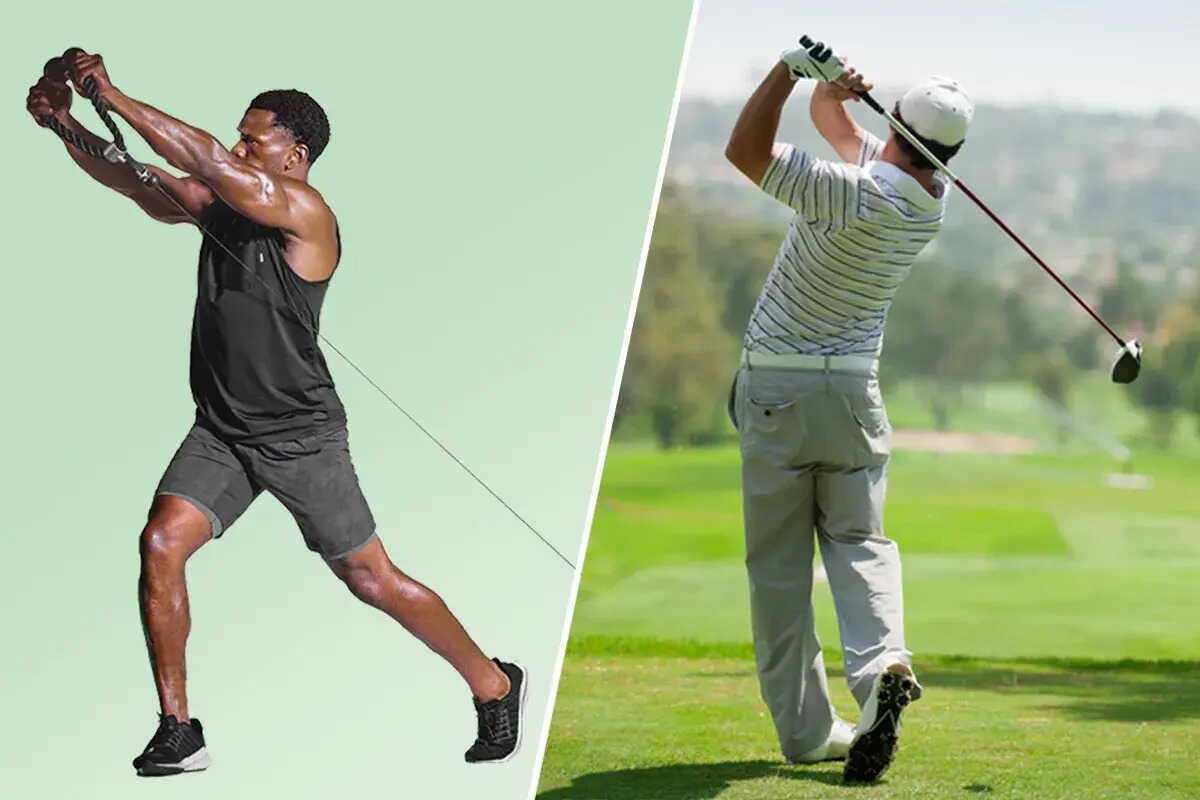
Have you ever wondered what lies behind the power of a golf swing? Just as Tiger Woods or Gary Player pushes effortlessly through ball after ball, their expert strokes showcase the honed skill that marks them as Masters of the sport. Indeed, a potent blend of strength, joint safety, and flexibility lies at the heart of this domination.
Whether you’re a professional golfer looking to go the extra mile in your training or an ambitious hobby player aiming to enhance your performance, this guide is custom-made just for you. It can serve as your companion on your journey towards becoming a fitter, stronger, and ultimately, a better golf player. We’ll be delving into the nitty-gritty of golf-specific workouts, key exercises, and the most effective strength training principles. Plus, we’ll be dishing out pro tips and useful insights straight from the experts.
Strength training for golf is less about bulking up and more about strengthening the specific muscles used during a swing. It includes exercises that target balance (unilateral exercises), flexibility, and rotational strength – all of which are vital for a powerful and accurate golf shot.
The essential components of a golfer’s workout plan
An effective and well-rounded workout plan for a golf player should comprise of six crucial components: strength training, cardiovascular conditioning, flexibility exercises, leg workouts, balance training, and rest.
- Strength Training: Central to any golf player’s workout plan, strength training can enhance swing power, increase the distance covered by the ball, and boost endurance on the course. It’s typically recommended that golfers engage in strength training exercises 2-3 times per week, focusing on core muscles like the abdomen, back, and hips, but also the upper and lower body.
- Cardiovascular Conditioning: This plays a pivotal role in maintaining high energy levels throughout a round of golf. Whether it’s cycling, running, or fast-paced walking, cardio workouts can help improve stamina, enabling golfers to maintain optimal performance, even towards the end of a long game. A good guideline is to include at least 150 minutes of moderate-intensity, or 75 minutes of high-intensity, cardio activity each week.
- Flexibility Exercises: Golf requires a wide range of motion. Therefore, flexibility training aids in improving your swing technique, reducing the risk of injuries, and enhancing overall athletic performance. Daily stretching focusing on all major muscle groups is advised.
- Leg Workouts: Powerful drives on the golf course are driven from the ground up. Therefore, training your legs, particularly your glutes and quads, can contribute significantly towards enhancing your swing power. Exercises like squats, lunges, and leg presses can be included in your strength training sessions.
- Balance Training: Balance and stability training is another key component. Many golfers overlook this aspect, but a good balance can significantly improve the accuracy and power of your swing. Exercises like single-leg stand, Bosu ball workouts, and yoga can help improve balance.
- Rest: Last but not least, rest is an integral part of any golf workout plan. Muscles grow and gain strength during periods of rest, not when you’re working out. The right amount of rest helps in recovery and prevents overtraining, which can eventually lead to injuries.

The most effective strength training exercises specifically for golfers
Golfers can greatly benefit from strength training exercises that focus on improving core stability, flexibility, and power.
- Russian Twist. This exercise targets the obliques and other core muscles that are crucial for a powerful and stable swing. It can be performed with a medicine ball or a dumbbell for added resistance.
- Another effective exercise is the Dumbbell Row. This exercise strengthens the muscles in the back and shoulders, which are essential for maintaining a good posture during the swing. The Dumbbell Row also helps to improve the player’s ability to control the club during the swing.
- Deadlifts are another excellent strength training exercise for golfers. They target the lower back, glutes, and hamstrings, which are all vital for generating power during the swing. Deadlifts also help to improve overall body strength and stability.
- Squats, particularly Goblet Squats, are also beneficial. They target the lower body, including the quads, glutes, and hamstrings. These muscles are crucial for maintaining a stable stance during the swing and for generating power.
- Squat with Overhead Press. This exercise helps to improve the transfer of power from your lower body to your upper body, mimicking the golf swing movement. Start in a squat position with a dumbbell in each hand, your elbows bent and palms facing each other. As you stand up, press the weights above your head.
- Finally, the Rotational Medicine Ball Throw is a golf-specific exercise that can help improve a golfer’s rotational power and speed. This exercise mimics the rotational movement of a golf swing, therefore, it helps to improve the power and speed of the swing.
Here you can find some even more specific strength training exercises for golfers, like anti-rotation lunge to SLS, resisted backswing, and resisted downswing/follow-through.
How strength training enhances golfers’ performance on the Field
Strength training is crucial for golfers as it improves their overall performance in several ways.
- Firstly, it enhances the power of their swing. By strengthening the muscles used in a golf swing, such as the core, hips, and shoulders, golfers can drive the ball further. This is because a stronger muscle can generate more force, leading to a more powerful swing.
- Secondly, strength training helps to improve a golfer’s endurance. Golf may not seem like a physically demanding sport, but a full round can involve several hours of walking, not to mention the repeated action of swinging a club. By improving their muscular endurance through strength training, golfers can maintain a high level of performance throughout the round.
- Thirdly, strength training can help to prevent injuries. The repetitive nature of a golf swing can put a lot of strain on certain muscles and joints, particularly in the back and shoulders. By strengthening these areas, golfers can reduce their risk of injury, allowing them to play more consistently.
- Lastly, strength training can also improve a golfer’s balance and stability. This is particularly important in golf, where maintaining a stable stance and balanced swing is crucial for accuracy. By strengthening the core and lower body, golfers can improve their balance, leading to more consistent shots.
Overall, strength training can significantly enhance a golfer’s performance by improving their power, endurance, injury prevention, and balance. However, it’s important for golfers to follow a well-designed strength training program that targets the specific muscles used in golf and takes into account their individual needs and goals.
Relevant statistics
- Strength training can increase a golfer’s drive distance by up to 20%
- Golfers who strength train regularly have a 30% lower risk of injury
- Strength training can increase a golfer’s drive accuracy by 20%
- A golfer’s core strength is directly related to their swing speed and accuracy
- Strength training can reduce the risk of lower back injuries in golfers by 50%
- Golfers who strength train can increase their endurance on the course by 40%
Key muscle groups for golf players
Every golfer, whether beginner or pro, taps into numerous muscles to keep their golf game on par – pun intended! Let’s dive in, and understand the principal muscle groups involved in a golf swing, and the crucial role they play:
- Glutes: The gluteal muscles – your posterior powerhouses – play a major role in maintaining posture during a golf swing and providing powerful drive for longer shots. They help stabilize your lower body and are key to preventing injuries.
- Quadriceps and Hamstrings: Your leg muscles are your base of support in a golf swing. The quadriceps (front of thighs) and hamstrings (back of thighs) act in tandem to maintain balance, provide strength to the swing, and absorb the impact on the knee joints.
- Core Muscles: Comprising the muscles in the abdomen, lower back, and sides, the core is responsible for transmitting power from the lower body to the upper body during a swing. A strong core is vital for a controlled, accurate swing.
- Forearms and Wrists: These smaller yet substantial muscles control the golf club during the swing. Strong forearms and wrists are essential for grip strength, precision, and minimizing wrist injuries.
- Shoulders and Chest: The deltoids (shoulders) and pectorals (chest) are predominantly active during the backswing and downswing. Together, they assist in maintaining proper posture and provide power to the swing, hugely impacting swing speed and ball flight.
- Back: The latissimi dorsi, or “lats”, are your wing-like back muscles, majorly contributing to rotational power and helping maintain an upright posture. Moreover, the lower back muscles aid in stabilizing and turning the trunk during a swing.
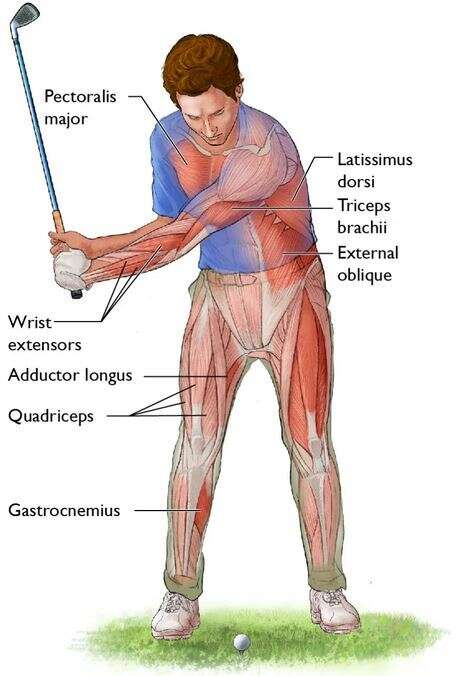
Strengthening these key muscle groups through tailor-made exercises will significantly enhance your golf performance, giving you that desired edge on the course.
The most important golf strokes and related muscles
The most important golf strokes include the drive, the approach, the chip, and the putt. Each of these strokes engages different key muscle groups.
- The drive is the first stroke on each hole, designed to cover as much distance as possible. It primarily engages the core, glutes, and shoulders. The core muscles, including the abs and lower back, provide the rotational power necessary for a strong drive. The glutes provide stability and power, while the shoulders, particularly the rotator cuff muscles, are essential for a smooth, controlled swing.
- The approach shot is used to get the ball onto the green from a distance. This stroke engages the same muscles as the drive but requires more precision. The forearm muscles become more important in the approach shot for controlling the clubface and directing the ball.
- The chip shot is used when near the green, to get the ball into a better position for putting. This stroke relies heavily on the wrists and forearms for control, as well as the core for stability.
- Finally, the putt is used on the green to get the ball into the hole. This stroke requires a steady hand and engages the forearm and wrist muscles for precision, with minimal involvement from the larger muscle groups.
- In addition to these specific strokes, golfers also need strong leg muscles for stability and balance throughout the game, and a strong back to maintain posture and prevent injury.
Expert tips for improving a golfer’s strength training routine
- Incorporating a variety of exercises into a golfer’s strength training routine can help improve their overall performance. This includes not only focusing on upper body strength, but also incorporating exercises that target the core, lower body, and flexibility. This will ensure a well-rounded workout that addresses all the key muscles used in golf.
- Another expert tip is to focus on functional training exercises that mimic the movements made during a golf swing. This can include rotational exercises or those that improve balance and stability. These exercises can help improve a golfer’s swing and reduce the risk of injury.
- Strength training should also be complemented with cardio exercises. Cardiovascular fitness is important for golfers as it helps improve endurance, allowing them to maintain a high level of performance throughout the game.
- Proper form and technique are crucial in strength training. Golfers should ensure they are performing exercises correctly to maximize their benefits and prevent injuries. It may be beneficial to work with a personal trainer or physical therapist who can provide guidance on proper form.
- Rest and recovery are equally important as the workout itself. Golfers should ensure they are getting adequate rest between workouts to allow their muscles to recover and grow stronger. This also includes proper nutrition and hydration.
- Golfers should regularly reassess their strength training routine and make adjustments as needed. As their strength and fitness levels improve, they may need to increase the intensity or volume of their workouts to continue seeing progress.
- Strength training for golfers should also be periodized. This means that the training program should be divided into different phases, each with specific goals. For example, the off-season might focus on building general strength and muscle mass, while the pre-season might focus on more golf-specific exercises and movements.
- Lastly, golfers should remember that strength training is just one component of a comprehensive training program. They should also focus on improving other aspects of their game, such as their technique, mental game, and nutrition.

One-Month Weight Training Workout Plan for Golfers
Here’s an example of a one-month strength training workout plan you can follow as a golf player. This routine is designed to be performed twice a week. It’s best to work with a local trainer or expert as you’re beginning for personalized adjustments and to ensure proper form. Perform all the prescribed exercises from these tables. For example, if you see two upper body exercises in a line you should perform both. Or, if you see 3 core exercises you should execute all of them, not only pick one of them.
| Week #1 | Exercise | Sets | Reps |
|---|---|---|---|
| Day 1 | Warm-up: Air bike | 1 | 10-15 mins |
| Leg workout: Back squats, Walking dumbbell lunges | 3 | 10-12 | |
| Upper body: Flat bench dumbbell press, One-arm dumbbell row | 3 | 8-10 | |
| Core: Basic forearm planks, Russian twists, Lateral medicine ball throw | 3 | 15-20 | |
| Day 2 | Warm-up: Rope jumping | 1 | 10-15 mins |
| Leg workout: Traditional deadlifts, Lying leg curls | 3 | 8-10 | |
| Upper body: Pull-ups, Leaning dumbbell lateral raise | 3 | 8-10 | |
| Arms: Cable rope hammer curls; Cable triceps kickbacks | 3 | 8-12 |
| Week #2 | Exercise | Sets | Reps |
|---|---|---|---|
| Day 1 | Warm-up: Rowing ergometer | 1 | 15 mins |
| Leg workout: Romanian deadlifts, Lateral lunges | 3 | 10-12 | |
| Upper body: Wide-grip lat-pulldowns, Seated dumbbell shoulder press | 3 | 8-10 | |
| Core: Reverse plank, Hanging windshield wiper, Lateral medicine ball throw | 3 | 15-20 | |
| Day 2 | Warm-up: Stair climber | 1 | 15 mins |
| Leg workout: Step-ups, Smith machine standing calf raises | 3 | 8-10 | |
| Upper body: Pull-ups, Machine lateral raises | 3 | 8-10 | |
| Arms: Cable preacher curls, Wrist roller wrist curl | 3 | 8-10 |
| Week #3 | Exercise | Sets | Reps |
|---|---|---|---|
| Day 1 | Warm-up: Treadmill | 1 | 15 mins |
| Leg workout: Goblet squats, Stability ball leg curls | 3 | 10-12 | |
| Upper body: Incline dumbbell bench press, Dumbbell lateral raises | 3 | 8-10 | |
| Core: Stability ball hand to feet pass; Standing cable woodchopper | 3 | 15-20 | |
| Day 2 | Warm-up: Stair stepper | 1 | 10 mins |
| Leg workout: Dumbbell squats, Standing leg curls | 3 | 8-10 | |
| Upper body: Barbell rows, Push-ups | 3 | 8-10 | |
| Core: Axe chop or medicine ball wood chop; Side planks, Medicine ball slams | 3 | 15-20 |
| Week #4 | Exercise | Sets | Reps |
|---|---|---|---|
| Day 1 | Warm-up: Elliptical trainer | 1 | 20 mins |
| Leg workout: Barbell hip thrust, Seated calf raises | 3 | 10-12 | |
| Upper body: Pull-ups, Machine rear deltoid fly | 3 | 8-10 | |
| Arms: Dumbbell triceps kickbacks, Reverse barbell wrist curls | 3 | 10-12 | |
| Day 2 | Warm-up: Burpees | 3 | 8-12 |
| Leg workout: Dumbbell straight-leg deadlifts, Bulgarian split squats | 3 | 8-10 | |
| Upper body: Incline barbell bench press; Dumbbell shrugs | 3 | 8-10 | |
| Core: Kneeling cable crunches, Reverse crunch, Medicine ball slams | 3 | 15-20 |
As you progress through this strength training guide for golf players, it is crucial to remember that the specific training variables – including the number of sets and reps, the intensity, and the frequency of your workouts – require personal adjustments. These modifications should align with your individual fitness levels, goals, and comfort zones. Moreover, your training schedule should be closely related to the golf season. For instance, the pre-season and late pre-season phases present an ideal opportunity to hone your strength and muscular endurance, while an in-season routine should focus more on maintaining your achieved fitness levels. Conversely, during the off-season, your training could skew towards recovery and cross-training. Tailoring these parameters to your specific needs and periodization will ensure more sustainable progress and peak performance on the green.
How intense should strength training be for golf players?
When it comes to the intensity of strength training for golfers, it shouldn’t be underestimated. A balance between maintaining fitness levels and pushing your limits should be the aim.
Foundational Phase: For beginners or players coming off an extended break, it’s essential to focus on building a strong foundation. This phase emphasizes low-load, high-repetition exercises to build muscle endurance and familiarize the body with weight training.
Developmental Phase: Once your body is acclimated to strength training, the intensity should gradually increase. During this phase, you’ll start lifting heavier weights, but with fewer repetitions. The goal here is to increase muscle strength without risking injury.
Performance Phase: This is where the intensity really ramps up. You’ll be lifting heavier weights at high velocity to simulate the explosive power needed in a golf swing. However, it’s crucial to monitor fatigue and recovery in this phase to avoid overtraining.
Active Rest Phase: After periods of high-intensity training, it’s critical to have an active rest phase. This isn’t about total rest, but rather engaging in lighter activities to promote recovery and injury prevention.
Conclusion
In summary, strength training is integral for golf players. It helps to enhance strength, power, flexibility, and joint safety, all essential components for a golf player’s performance on the field. A well-rounded strength training program can notably improve the core muscles involved in golf strokes, thus stepping up game performance.
