


An Old-School Lift With Modern Hypertrophy Benefits
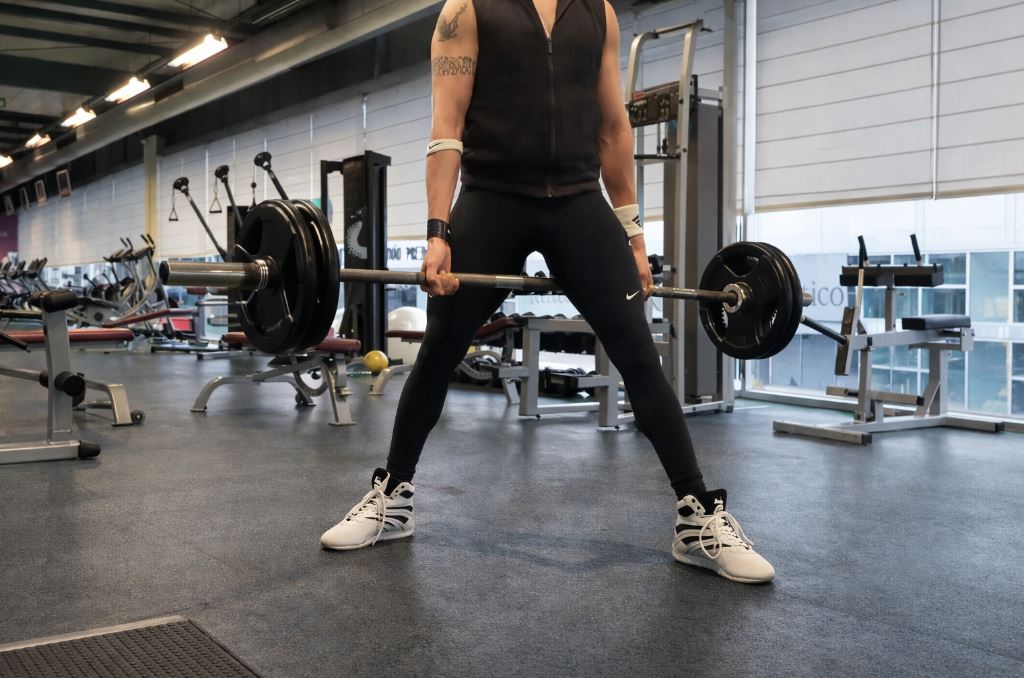
The Jefferson squat is a unique, asymmetrical squat variation that blends elements of conventional squatting, deadlifting, and unilateral loading. Originally popularized by old-time strongmen, this lift has found renewed relevance in modern hypertrophy-focused training thanks to its ability to challenge the legs, glutes, and core in ways that differ from standard bilateral squats.
Unlike the conventional back squat, the Jefferson squat places the barbell between the legs with a staggered stance, creating rotational forces that demand greater muscular control and coordination. When programmed correctly, it can be a powerful hypertrophy tool rather than just a novelty lift.
How to Perform the Jefferson Squat (Step-by-Step)
Proper execution is essential with the Jefferson squat, as asymmetrical loading introduces biomechanical demands that differ significantly from those of classic squat patterns.
Coach’s Note
Asymmetrical loading refers to lifting a load that is not evenly distributed across both sides of the body, forcing one side to work differently than the other. This type of loading increases the demand on stabilizing muscles and the core, as the body must actively resist rotation and maintain proper alignment during the movement.
Starting Position (Setup):
- Place the barbell on the floor lengthwise between your feet.
- Stand in a staggered stance, with one foot in front of the bar and the other behind it.
- Grip the bar with one hand in front of the body and the other behind, using a mixed or neutral grip.
- Keep the chest tall, spine neutral, and brace the core before lifting.
Movement (Execution):
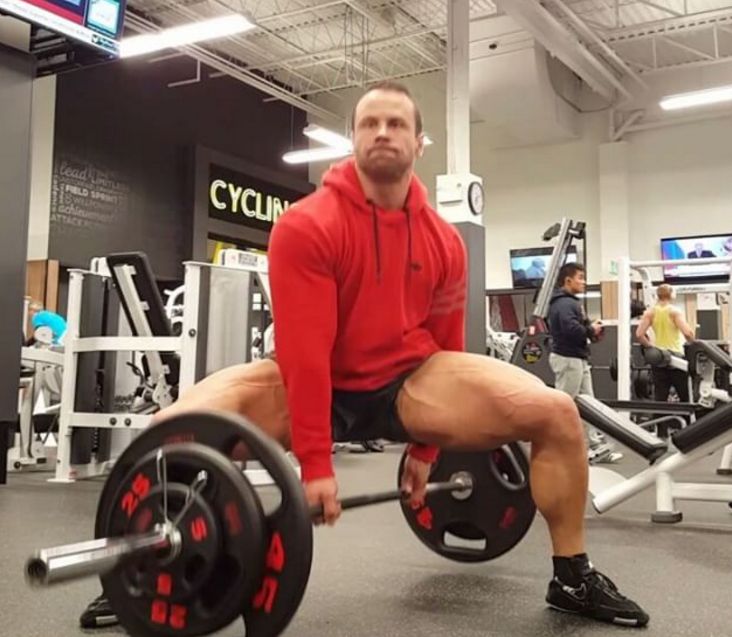
- Initiate the movement by pushing through both feet while keeping the bar close to your center of mass.
- Descend into a squat by bending the knees and hips simultaneously.
- Maintain torso control to resist rotation caused by the uneven load.
- Drive upward through the midfoot and heels to return to the standing position.
For balanced development, alternate stance positions between sets and maintain equal volume on both sides.
Muscles Worked in the Jefferson Squat
Although it looks unconventional, the Jefferson squat engages a wide range of muscle groups, making it highly effective for lower-body hypertrophy.
- Quadriceps – heavily involved during knee extension, especially in the front leg
- Gluteus Maximus – contributes significantly during hip extension
- Adductors – strongly activated due to the staggered stance and bar path
- Hamstrings – assist in hip stabilization
- Erector Spinae – work isometrically to maintain spinal alignment
- Core Muscles (Obliques & Transverse Abdominis) – resist rotational forces
- Grip & Forearms – actively involved due to the unconventional grip
Key Hypertrophy Benefits of the Jefferson Squat
From a muscle-building perspective, the Jefferson squat offers several advantages that are difficult to replicate with standard bilateral squats.
- Creates high mechanical tension through asymmetrical loading
- Increases time under tension due to slower, more controlled execution
- Enhances mind–muscle connection, especially in quads and adductors
- Reduces spinal compression compared to heavy back squats
- Allows hard leg training with relatively lighter absolute loads
Common Mistakes to Avoid
Because the Jefferson squat is less commonly performed, technical errors are frequent—especially among lifters who rush into heavy loading.
- Allowing excessive torso rotation during the descent
- Uneven weight distribution between the front and back legs
- Rounding the lower back under load
- Using momentum instead of controlled tempo
- Neglecting grip positioning and bar alignment
Coach’s Note
The Jefferson squat is one of those exercises that looks strange but makes perfect sense once you feel it. The asymmetrical bar position forces your body to stabilize in ways that classic squats simply don’t. For hypertrophy-focused athletes, this means more muscular engagement with less reliance on maximal loads. It’s an excellent tool when traditional squats start to feel stale or overly stressful on the spine.
That said, beginners should absolutely stick to the traditional barbell squat. In the early stages of training, there is no need to experiment with alternative squat variations. Building a solid foundation with the classic squat pattern should always come first, before introducing more complex and asymmetrical movements like the Jefferson squat.
Coach’s Note — Jefferson Squat vs. Jefferson Deadlift
Although this movement is most commonly called the Jefferson squat, you will often see it labeled the Jefferson deadlift as well—and technically, both names are correct.
The confusion comes from the hybrid nature of the exercise. The barbell starts on the floor like a deadlift, positioned between the legs with a staggered stance. However, once the lift begins, the movement pattern closely resembles a squat: significant knee flexion, an upright torso, and strong involvement of the quadriceps alongside the hips.
In practice, the name usually reflects how the exercise is programmed and emphasized. When performed with greater knee bend, a controlled tempo, and for leg development, it makes sense to call it a Jefferson squat. When loaded heavily and treated more like a hip-dominant pull from the floor, some lifters prefer the term Jefferson deadlift.
From a coaching perspective, what matters most is not the label—but understanding that this is an asymmetrically loaded, multi-planar lower-body movement that challenges strength, coordination, and trunk stability in a way that traditional bilateral squats and deadlifts do not.
Jefferson Squat vs. Conventional Back Squat (Hypertrophy Perspective)
While both exercises can build muscle, their mechanisms of hypertrophy differ significantly. Understanding these differences helps determine when and why to use each lift.
| Criterion | Jefferson Squat | Conventional Back Squat |
|---|---|---|
| Loading Pattern | Asymmetrical | Bilateral & symmetrical |
| Spinal Compression | Lower | Higher |
| Core Activation | Very high (anti-rotation) | Moderate |
| Adductor Engagement | High | Moderate |
| Absolute Load Potential | Lower | Very high |
| Hypertrophy Efficiency | High with lighter loads | High with heavier loads |
| Joint Stress | Generally lower | Higher at maximal loads |
| Variety & Novel Stimulus | Excellent | Limited over time |
From a hypertrophy standpoint, the Jefferson squat excels as a secondary or accessory squat, providing a novel stimulus without excessive joint stress.
Jefferson Squat Variations for Muscle Growth
Adding variations keeps the stimulus fresh and allows targeting slightly different muscle emphasis.
- Jefferson Squat with Dumbbells – improves balance and unilateral control
- Paused Jefferson Squat – increases time under tension
- Trap Bar Jefferson Squat – reduces grip complexity
- Tempo Jefferson Squat (3–1–1) – maximizes hypertrophy stimulus
Programming Tips for Hypertrophy
To maximize muscle growth, the Jefferson squat should be programmed intelligently rather than treated as a maximal strength lift.
- Use moderate loads (60–75 % perceived effort)
- Perform 3–4 sets of 8–12 repetitions per side
- Control tempo, especially during the eccentric phase
- Pair with bilateral squats or leg presses in the same session
- Ideal for leg days focused on volume rather than maximal strength
Replacement Exercises for the Jefferson Squat
If the Jefferson squat feels uncomfortable, impractical, or unsuitable due to equipment availability or individual limitations, several alternative exercises can provide similar hypertrophy benefits. These replacements maintain a strong emphasis on the legs and core while offering different loading patterns or greater technical simplicity.
Suitable replacement exercises include:
- Conventional Barbell Back Squat – the foundational lower-body exercise for overall leg hypertrophy and strength
- Front Squat – increases quad emphasis while reducing spinal loading compared to back squats
- Goblet Squat – a beginner-friendly option that reinforces upright posture and knee-dominant mechanics
- Split Squat – introduces unilateral loading and improves left–right muscular balance
- Bulgarian Split Squat – delivers high hypertrophy stimulus with reduced axial load
- Trap Bar Squat – offers a more neutral loading pattern that is often easier on the lower back
- Hack Squat – machine-based alternative for quad-dominant hypertrophy with maximal stability
- Cyclist Squat
Each of these exercises can be selected based on training goals, experience level, and joint tolerance, making them effective substitutes when the Jefferson squat is not the optimal choice.
Conclusion
The Jefferson squat is a unique yet highly effective lower-body exercise that blends old-school strength principles with modern hypertrophy-focused training. Its asymmetrical loading challenges the legs, core, and stabilizing muscles in ways that traditional squats cannot, creating a powerful growth stimulus without relying on maximal spinal loading.
When programmed intelligently, the Jefferson squat serves as an excellent accessory movement for hypertrophy, improving muscular balance, coordination, and mind–muscle connection. While it should not replace the classic barbell squat—especially for beginners—it offers experienced lifters a valuable tool to diversify leg training, reduce repetitive stress, and continue making progress when conventional movements start to plateau.
