


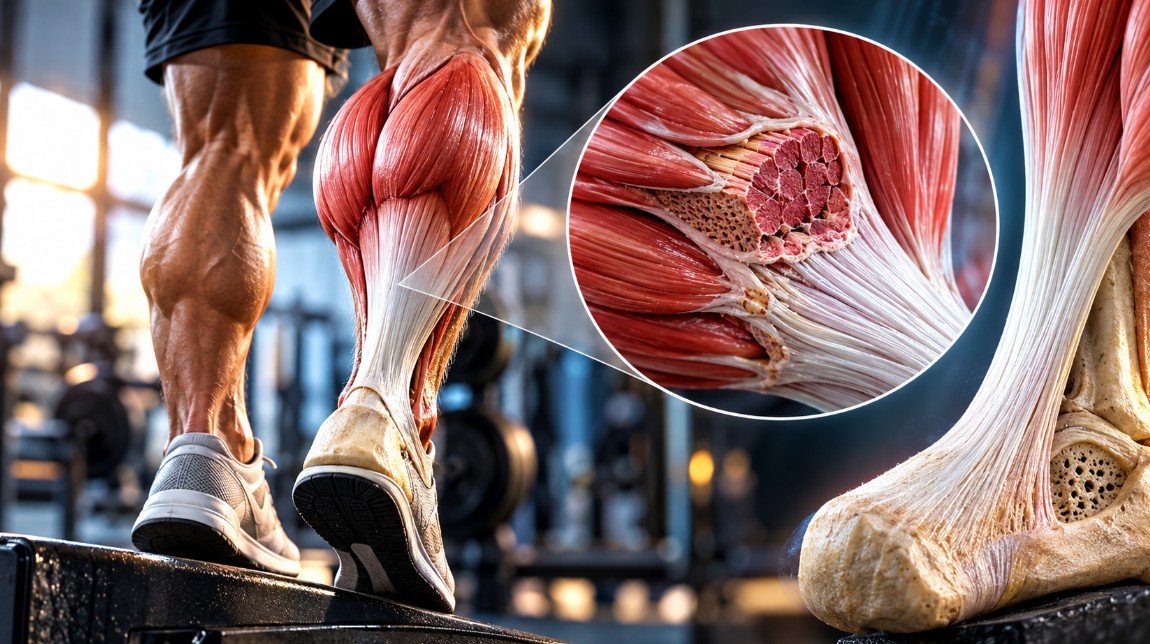
When you perform a calf raise, your calf muscles generate force — but the muscle fibers do not directly pull on the heel bone. That force must travel through several structures before it can produce movement: muscle fibers → connective tissue → tendon → bone → joint movement. This functional chain is what we call the muscle-tendon unit (MTU).
The basic premise is simple: muscles produce active force, tendons transmit that force, and the skeleton provides the lever system through which force becomes movement. But as we’ll see throughout this guide, the tendon is not simply a passive rope connecting muscle to bone — it’s an active mechanical participant in how force actually gets used. This guide builds on our Muscular System pillar, our guide to Tendons and Ligaments, and our guide to muscle origin and insertion to explain exactly how force gets from a contracting muscle fiber to a moving joint.
QUICK ANSWER: The muscle-tendon unit is the functional combination of a skeletal muscle and its tendon(s). Muscle fibers generate active force, while connective tissues and tendons transmit that force to bone. Together, they allow muscular force to create or control movement at a joint. Tendons can also stretch, store elastic energy, and return part of that energy during movement.
What Is the Muscle-Tendon Unit?
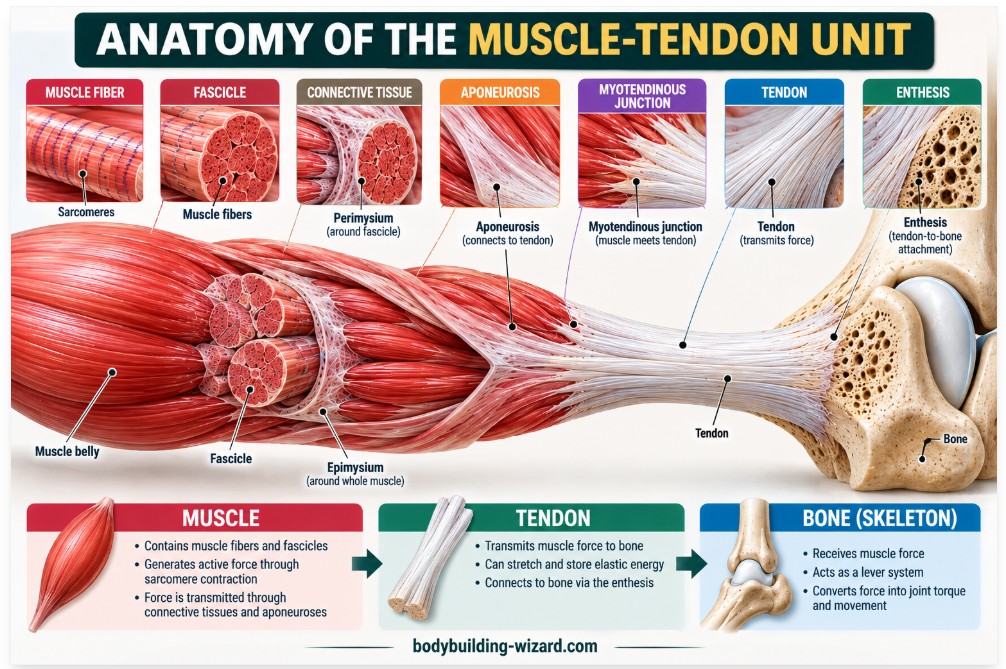
The muscle-tendon unit refers primarily to the muscle plus its series elastic and tendinous structures, as described in standard anatomy references: the muscle belly, its muscle fibers and fascicles, the intramuscular connective tissue surrounding them, the aponeurosis, and the tendon. The enthesis and the bone itself continue this force-transmission pathway rather than being components of the MTU proper. The MTU is not a formally defined anatomical organ system in the same sense as the muscular or skeletal system — it’s a functional biomechanical concept that describes how these structures work together as a single force-transmission pathway.
Muscle-Tendon Unit vs. Muscle
A muscle is not the same thing as the entire MTU. The muscle is the contractile component; the MTU includes the muscle plus everything that transmits its force onward to bone.
Muscle-Tendon Unit vs. Tendon
Similarly, the tendon is only one part of the MTU, not the whole thing. The tendon transmits force generated elsewhere in the system.
Anatomy of the Muscle-Tendon Unit
Skeletal Muscle Fibers
Force originates at the sarcomere level, where sarcomeres are organized into myofibrils, myofibrils into muscle fibers, and muscle fibers into fascicles. We won’t go deep into this here since it’s covered fully in our Muscular System guide — what matters for this guide is what happens to that force once it’s produced.
Intramuscular Connective Tissue
Three layers of connective tissue — the endomysium surrounding individual fibers, the perimysium surrounding fascicles, and the epimysium surrounding the whole muscle — are far more than passive packaging. These layers actively transmit force within and around the muscle.
Aponeuroses
Aponeuroses are broad, flat sheets of connective tissue that connect muscle fascicles to tendons. They’re frequently skipped over entirely in fitness content, but they play a genuinely important mechanical role in how fascicle-level force gets collected and transmitted toward the tendon.
Tendons
Tendons are dense connective tissue rich in collagen. Their primary job in this story is transmitting force between muscle and bone, but as covered later in this guide, they also deform and store elastic energy — they’re not simply inert cables. See Tendons and Ligaments for the complete anatomical picture.
Enthesis: Where Tendon Meets Bone
The enthesis is the specific attachment site where tendon meets bone. This is the final link in the chain, closing the pathway from contractile tissue to the skeleton.
From Muscle Fiber to Bone: The Force-Transmission Pathway
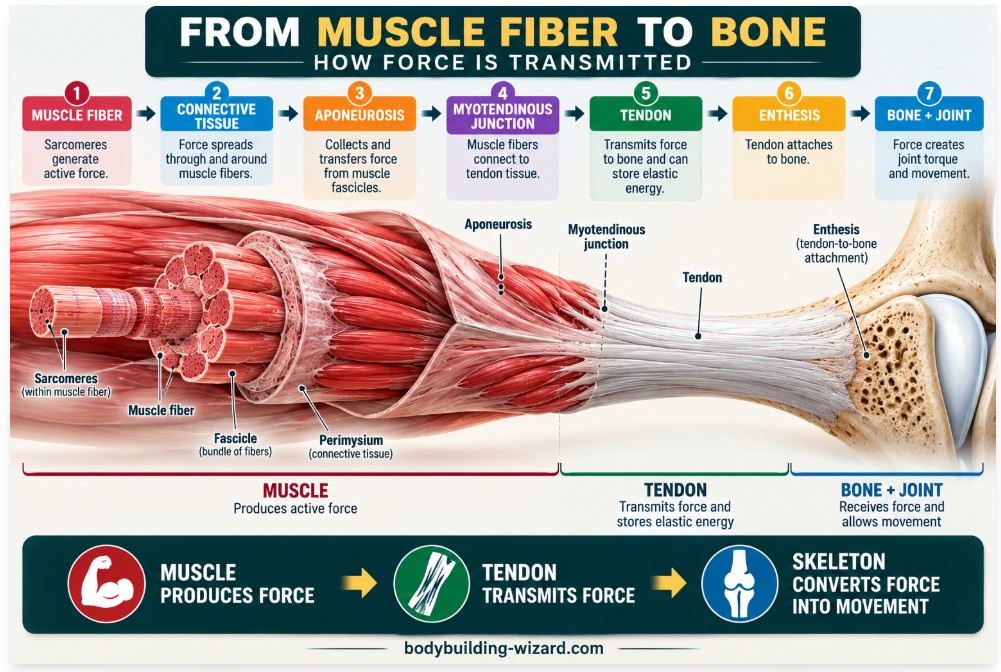
Putting the whole anatomical picture together, the pathway runs as follows: a motor neuron activates muscle fibers, sarcomeres generate active force, that force is transmitted through muscle fibers and their surrounding connective tissues, the aponeurosis and tendon receive the collected force, the tendon transmits that force to its bony attachment, the resulting force creates torque around a joint, and the body produces, controls, or resists movement as a result. Every section that follows in this guide fills in a piece of that seven-step chain.
How Do Muscle Fibers Produce Force?
Actin, Myosin, and Cross-Bridge Cycling
Force originates from the cyclical interaction between actin and myosin filaments within the sarcomere — the cross-bridge cycle. We cover this mechanism in depth elsewhere, so we’ll keep this brief here.
Sarcomeres Generate Active Tension, and Force Capacity Depends on Parallel Arrangement
Individual sarcomeres generate tension, but how that tension translates into whole-muscle force depends on how contractile elements are arranged. Sarcomeres arranged in series (end-to-end along a fiber) primarily determine shortening excursion and contraction velocity rather than adding to force output; force capacity instead depends on how much contractile material is arranged in parallel — reflected in a muscle’s physiological cross-sectional area. But producing force is only half the story — that force still has to reach the skeleton to do anything useful. See our Muscular System guide for the complete picture of force production itself.
How Force Travels Through a Muscle
The classic simplified picture — fiber pulls directly on tendon, tendon pulls on bone — isn’t the complete story.
Longitudinal Force Transmission
Some force travels longitudinally, along the length of a fiber toward its ends, which is the pathway most people picture when they think about how muscles work.
Lateral Force Transmission
Research on force transmission between synergistic muscles has established that force can also be transmitted laterally through extracellular and connective-tissue pathways, sideways toward neighboring structures, rather than purely end-to-end along a single fiber. This is a genuine upgrade over the average fitness article’s mental model of how muscles work, even though the exact functional importance of this pathway during normal, intact movement is still an active area of research.
The Myotendinous Junction: Where Muscle Meets Tendon
The myotendinous junction (MTJ) is the specialized interface where muscle fiber tissue meets tendon tissue. Rather than a simple flat boundary, this junction is highly folded, with interdigitations that substantially increase contact surface area and help distribute mechanical stress across a larger area than a flat interface could.
Why Is the Myotendinous Junction Important in Training?
The MTJ has to tolerate substantial mechanical demand during sprinting, jumping, heavy lifting, and eccentric actions in particular. It’s also a region relevant to musculotendinous injury discussions — though it’s worth being precise that not every muscle strain is specifically an “MTJ injury”; strain location and mechanism vary by muscle and task.
Tendons Are More Than Passive Cables
The old simplified model — muscle is the motor, tendon is the rope — undersells what tendons actually do, as a detailed review of muscle-tendon unit mechanics makes clear. Tendons deform under load, and that deformation is functionally important.
Tendon Stiffness and Compliance
Stiffness describes the relationship between the force applied to a tendon and how much it elongates in response. It’s worth resisting the instinct to treat “stiffer” as automatically better — the practical implications of stiffness versus compliance depend heavily on the task, the muscle involved, and the training goal. A more compliant tendon isn’t a flawed tendon; it behaves differently under load, with its own set of functional tradeoffs.
Elastic Energy Storage and Return
This matters especially for running, jumping, hopping, and other tasks that rely on the stretch-shortening cycle. The Achilles tendon is the clearest example: it stretches under load and returns a portion of that stored elastic energy on rebound, functioning much like a spring rather than a passive rope.
Muscle-Tendon Interaction During Movement
Here’s one of the more genuinely interesting biomechanical ideas in this whole guide: muscle fascicles and the entire muscle-tendon unit do not necessarily change length by the same amount, or even in the same direction, during a given movement. The tendon can stretch while the fascicles shorten, stay relatively stable, or even lengthen, depending on the specific task.
Muscle fascicle length is not the same thing as whole muscle-tendon unit length. This single idea explains several things that would otherwise seem confusing about how muscles behave during real movement.
Muscle-Tendon Unit During Concentric, Eccentric and Isometric Exercise
During concentric actions, muscle fascicles generally shorten while producing force, though tendon behavior also participates in the overall length change of the MTU. During eccentric actions, the active muscle produces force while its fascicles lengthen, and the tendon can absorb part of the overall MTU length change rather than the fascicles bearing it all.
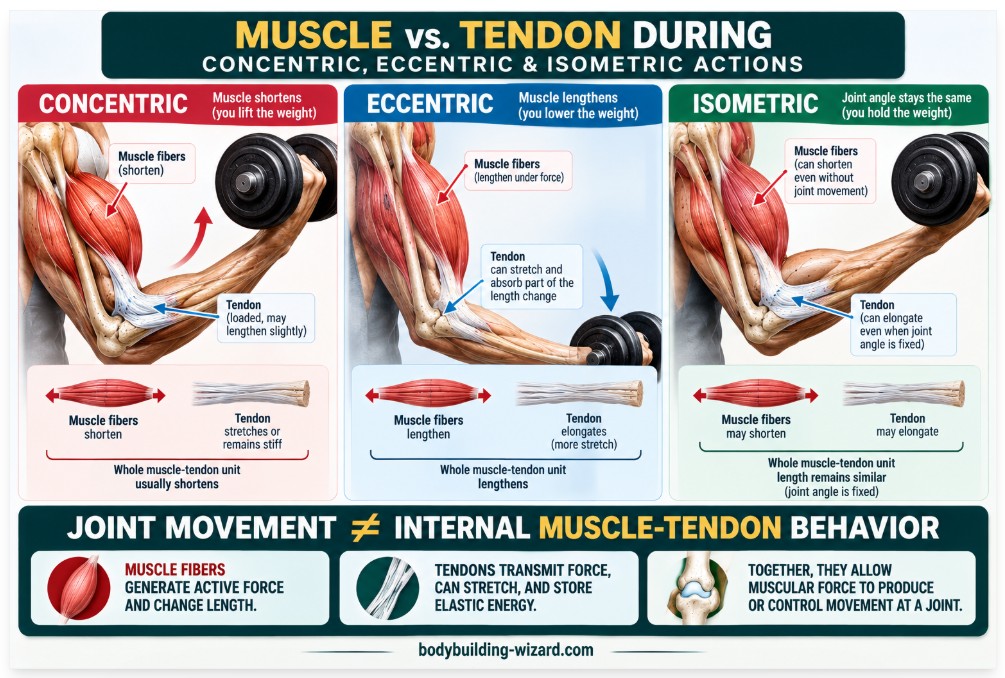
Isometric actions are where this gets especially interesting: an externally isometric joint action — meaning the joint angle isn’t visibly changing — does not mean every internal structure is holding still. In vivo ultrasound research on the muscle-tendon complex has repeatedly shown that muscle fascicles can shorten substantially while the tendon elongates under load, even while the joint angle itself remains essentially unchanged. That’s a genuinely useful fact for lifters to know: “isometric” describes what’s happening at the joint, not necessarily what’s happening inside the muscle and tendon. See Types of Muscle Contractions for the complete picture of concentric, eccentric, and isometric muscle action.
How Muscle Force Becomes Joint Torque
The basic relationship is straightforward: joint torque equals muscle force multiplied by moment arm.
What Is a Moment Arm?
A moment arm is the perpendicular distance between a muscle’s line of pull and the joint’s center of rotation. It’s a purely geometric property, determined by where structures attach and how the joint is positioned.
Why Attachment Location Matters
Tendon attachment location is a key determinant of a muscle’s moment arm, along with joint geometry and joint position. See Muscle Anatomy Basics: Points of Origin & Insertion, Innervation for the complete picture of how attachment sites are described and why they matter.
More Muscle Force Does Not Always Mean More Joint Torque
Because torque depends on both force and moment arm, a muscle producing more force doesn’t automatically produce more torque at every joint angle — the moment arm itself changes throughout the range of motion.
Why Joint Angle Changes Muscle-Tendon Mechanics
As joint angle changes throughout a movement, so do muscle length, tendon length and load, moment arm, force capacity, and overall leverage. This is exactly why the same subjective “effort” doesn’t produce the same joint torque throughout an exercise’s full range of motion — a concept closely related to resistance curves, without needing to go deeper into that topic here.
Examples of Muscle-Tendon Units in the Gym
Calf Raise: Gastrocnemius–Soleus–Achilles Tendon Complex
The clearest teaching example: calf muscles generate force, that force travels through the Achilles tendon to the calcaneus, and the result is ankle plantarflexion. See Standing Barbell Calf Raise for the full exercise breakdown.
Biceps Curl
The elbow flexors transmit force through their distal tendons to the radius and forearm, producing elbow-flexion torque. Attachment geometry here directly influences leverage throughout the curl’s range of motion. See Supinating Dumbbell Curl for more.
Leg Extension
This is a particularly good example because force passes through the patella as part of the extensor mechanism: quadriceps force travels through the quadriceps tendon, across the patella, through the patellar ligament (often called the patellar tendon in clinical and training contexts, since it functionally continues the extensor mechanism even though it technically connects two bones) to the tibial tuberosity. See Machine Leg Extension for the full guide.
Romanian Deadlift
The hamstring MTU changes length substantially throughout hip flexion and extension, making this a good illustration of MTU behavior across a large range of motion. See Romanian Deadlift.
Bench Press
Not every story ends with a long external tendon. The pectoralis major’s humeral insertion is a good example of a different attachment architecture within the same general force-transmission framework. See Flat Barbell Bench Press.
The Muscle-Tendon Unit and the Stretch-Shortening Cycle
The stretch-shortening cycle — an eccentric pre-stretch, a brief transition, then concentric propulsion — relies heavily on the tendon’s ability to store and return elastic energy, seen clearly in countermovement jumps, running, pogo jumps, and explosive calf movement. It’s worth being precise, though: the stretch-shortening cycle isn’t simply a “rubber band effect.” Neural and contractile factors are also genuinely involved, not just passive tendon elasticity.
What Happens to Tendons With Strength Training?
A systematic review and meta-analysis of tendon adaptation to mechanical loading found that resistance training can produce genuine changes in tendon stiffness, material properties, and morphology, with the evidence suggesting stiffness changes are driven more by adaptations in tendon material properties than by simple size increases. A related systematic review of increased-loading interventions confirms that loading magnitude, not just contraction type, plays a key role in how much a tendon adapts.
Muscle and Tendon Do Not Adapt at the Same Rate
Muscle strength and hypertrophy can progress on a different timeline than tendon adaptation. This has a real practical implication for progressive overload: connective tissue needs its own gradual exposure to increasing load, separate from how quickly muscular capacity itself is improving. See Tendons and Ligaments for more on how these tissues adapt.
Heavy vs. Light Loading for Tendon Adaptation
The magnitude and duration of mechanical loading both influence tendon response, and research suggests higher-strain loading tends to produce greater tendon adaptation than lower-strain loading. We won’t try to hand you a single universal “optimal tendon rep range” here — this isn’t a tendon-training guide, and the honest answer is that this remains an active area of ongoing research.
What Happens When Muscle Gets Stronger Faster Than the Tendon?
It would be an overreach to claim that “muscle grows faster, therefore the tendon gets injured” as a simple cause-and-effect rule. A more careful way to put it: rapid increases in muscular loading capacity without adequate progressive exposure of connective tissue may create a mismatch between loading demands and tissue preparedness. That’s a meaningfully different, and more accurate, claim than a blanket injury prediction.
Muscle-Tendon Unit and Injury
Muscle strains often occur near musculotendinous regions, though the exact location and mechanism vary by muscle and injury. Tendinopathy is not simply “an inflamed tendon” — it’s a more complex tissue-level condition than that casual description implies. Tendon rupture is a distinct injury category from tendinopathy, not a more severe version of the same thing. Across all of these, sudden load spikes matter: tissues genuinely can adapt to increased loading, but the rate and progression of that loading increase matters just as much as the final load itself.
Can You Make Your Muscle-Tendon Unit Stronger?
Yes, but it’s worth being precise about what “stronger” actually means here, since several separate systems are involved: the muscle adapts its force capacity, the tendon adapts its mechanical and structural properties, the nervous system adapts its force production and control, and movement skill and coordination improve independently of any of the above. MTU performance is the combined result of this entire system working together, not any single component in isolation.
Practical Training Principles for a Strong Muscle-Tendon Unit
Progress load gradually rather than in large unplanned jumps — a principle emphasized throughout strength and conditioning certification curricula like the NSCA’s. Train through an appropriate range of motion for the muscle and goal in question. Include controlled eccentric loading. Use heavy resistance where it’s appropriate for your goals. Include explosive loading progressively if your sport actually requires it. Allow adequate recovery between demanding sessions. And avoid sudden spikes in unfamiliar loading, especially after a period of reduced training. None of this requires exotic “tendon hacks” — it’s the same sound progressive-overload logic that governs the rest of your training.
Muscle-Tendon Unit vs. Kinetic Chain
These are related but distinct concepts worth keeping separate. The MTU describes the muscle-tendon relationship within a single functional unit. The kinetic chain describes the interaction among multiple body segments and joints during movement — a much broader concept than any single MTU.
Muscle-Tendon Unit vs. Origin and Insertion
Origin and insertion describe attachment anatomy — where a muscle physically begins and ends. The MTU describes the functional force-producing and force-transmitting system as a whole. See Muscle Anatomy Basics: Points of Origin & Insertion, Innervation for the complete breakdown of attachment terminology.
Why the Muscle-Tendon Unit Matters for Lifters
Understanding the MTU explains why muscles don’t act directly on bones, why tendon properties genuinely matter beyond just muscle size, why joint angle changes force production throughout a lift, why an “isometric” exercise still involves real internal tissue movement, why explosive movements benefit from elastic energy return, why progressive loading matters for connective tissue specifically and not just muscle, and why muscle strength alone doesn’t fully describe movement performance.
Bodybuilder’s Take: You don’t need to think about myotendinous junctions and Young’s modulus every time you train, but understanding the muscle-tendon unit changes how you think about progression. Muscular strength can increase without an equivalent or simultaneous change in tendon mechanical properties. That’s not a reason to avoid heavy training — it’s a reason to progress load gradually and respect connective-tissue timelines, especially after time off or when jumping into new, unfamiliar movement patterns.
Coach’s Note. When lifters think about strength, they usually think only about the muscle. But the force produced by a muscle is only useful if it can actually be transmitted through connective tissue and tendon to the skeleton. In practice, I think of the muscle, tendon, joint, and nervous system as parts of the same force-production pathway, not as isolated structures that happen to sit next to each other.
Key Takeaways
- ✓The muscle-tendon unit combines skeletal muscle and its tendon into a functional force-transmitting system.
- ✓Muscle fibers generate active force through sarcomere contraction.
- ✓Intramuscular connective tissues and aponeuroses contribute to force transmission, including laterally, not just end-to-end.
- ✓Tendons transfer muscle force to bone but also deform and store elastic energy.
- ✓The myotendinous junction connects muscle fiber tissue with tendon tissue through a highly folded interface.
- ✓Muscle fascicles and the entire MTU do not necessarily change length by the same amount, even during isometric exercise.
- ✓Joint torque depends on both muscle force and mechanical leverage (moment arm).
- ✓Progressive resistance training can adapt both muscle and tendon, although their adaptations are not identical or synchronized.
Frequently Asked Questions
What is the muscle-tendon unit?
The muscle-tendon unit is the functional combination of a skeletal muscle and its tendon(s), including the connective tissues that link them, working together as a single force-transmission pathway from muscle to bone.
What is the main function of the muscle-tendon unit?
To generate active force in the muscle and transmit that force to bone, allowing it to create or control movement at a joint, while also allowing some elastic energy storage and return through the tendon.
How does a muscle transfer force to a bone?
Force generated in muscle fibers passes through intramuscular connective tissue and the aponeurosis to the tendon, which transmits it to its bony attachment site (the enthesis), where it creates torque around a joint.
Do muscles attach directly to bones?
Not directly in the way people often picture it. Muscle fibers connect to tendons via the myotendinous junction, and the tendon itself attaches to bone at the enthesis — the muscle fiber tissue itself does not directly contact the bone.
What is the myotendinous junction?
The myotendinous junction is the specialized, highly folded interface where muscle fiber tissue connects to tendon tissue, designed to distribute mechanical stress across a larger surface area than a flat junction would allow.
Do tendons produce force?
No, tendons don’t actively produce force the way muscle does. They transmit force generated by the muscle, and they can also store and return elastic energy under load.
Do tendons stretch during exercise?
Yes. Tendons elongate under load, and the amount of elongation depends on the applied force and the tendon’s stiffness. This is a normal, functionally important part of how the muscle-tendon unit behaves.
Can tendons store elastic energy?
Yes. Tendons like the Achilles stretch under load and return a portion of that stored elastic energy during movement, which is especially important during running, jumping, and other stretch-shortening cycle activities.
What happens to the muscle-tendon unit during isometric exercise?
Even though the joint angle stays essentially fixed during an isometric exercise, the muscle fascicles can shorten while the tendon elongates under load. An externally isometric joint action doesn’t mean every internal structure stays the same length.
Can strength training make tendons stronger?
Yes. Resistance training can increase tendon stiffness and improve its material and structural properties. Muscle and tendon can adapt on different timescales, and increases in muscle strength are not necessarily matched proportionally by tendon adaptation.
Why do muscles and tendons adapt differently to training?
Muscle and tendon differ in their structure, cellular composition, extracellular matrix, mechanical function, and response to loading, so their adaptations are not identical or necessarily synchronized. This is why progressive overload should account for connective tissue readiness, not just muscular strength gains.
References
- Betts, J. G., et al. (2023). Anatomy and Physiology 2e. OpenStax. openstax.org/details/books/anatomy-and-physiology-2e
- Neumann, D. A. (2016). Kinesiology of the Musculoskeletal System: Foundations for Rehabilitation (3rd ed.). Elsevier.
- Haff, G. G., & Triplett, N. T. (Eds.). (2021). Essentials of Strength Training and Conditioning (4th ed.). National Strength and Conditioning Association / Human Kinetics. nsca.com
- Kawakami, Y. (2012). Morphological and functional characteristics of the muscle-tendon unit. The Journal of Physical Fitness and Sports Medicine. jstage.jst.go.jp/article/jpfsm/1/2/1_287
- Maas, H., & Sandercock, T. G. (2010). Force transmission between synergistic skeletal muscles through connective tissue linkages. Journal of Biomedicine and Biotechnology. pmc.ncbi.nlm.nih.gov/articles/PMC2853902
- Fukunaga, T., Kubo, K., Kawakami, Y., Fukashiro, S., Kanehisa, H., & Maganaris, C. N. (2001). In vivo behaviour of human muscle tendon during walking. Proceedings of the Royal Society B. pmc.ncbi.nlm.nih.gov/articles/PMC1088596
- Bohm, S., Mersmann, F., & Arampatzis, A. (2015). Human tendon adaptation in response to mechanical loading: A systematic review and meta-analysis of exercise intervention studies on healthy adults. Sports Medicine – Open. sportsmedicine-open.springeropen.com
- Wiesinger, H. P., Kösters, A., Müller, E., & Seynnes, O. R. (2015). Effects of increased loading on in vivo tendon properties: A systematic review. Medicine & Science in Sports & Exercise. pubmed.ncbi.nlm.nih.gov/25563908
