


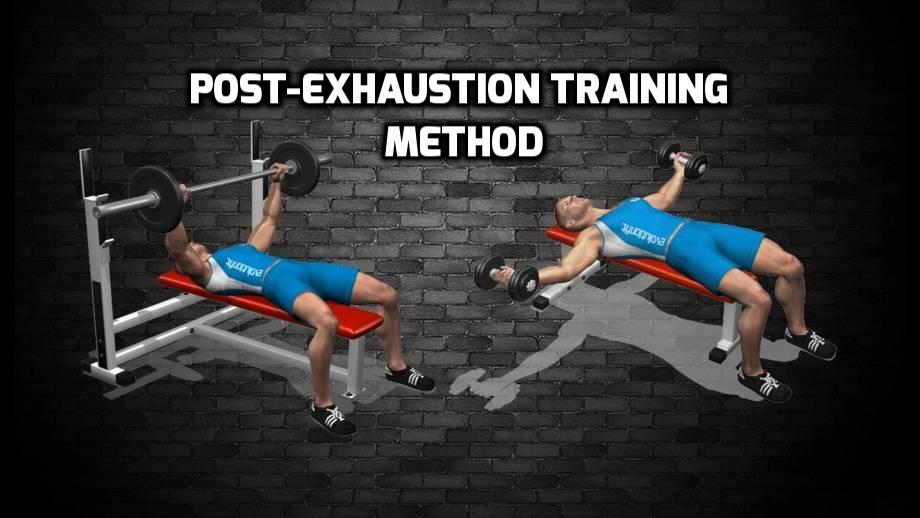
Since pre-exhaustion has been found to be less effective than it was previously thought to be, alternative ways of increasing the effectiveness of multiple-joint exercises have to be found. One way of increasing training intensity in the target muscle (groups) when performing multiple-joint exercises is the post-exhaustion training method.
The true test of an advanced training strategy lies in its ability to push boundaries and redefine growth. Post-exhaustion training promises just that. — Shaun Stafford, fitness coach
In essence, this technique involves performing a compound exercise followed by an isolated one, designed to thoroughly fatigue the targeted muscle group.
This article analyzes in depth the post-exhaustion training strategy, exploring examples, benefits, disadvantages, and its effectiveness for hypertrophy. It provides insights into incorporating this method into your workouts and discusses the scientific aspects versus practical reality. Additionally, the article compares post-exhaustion with pre-exhaustion training approaches to determine which is more beneficial.
What is Post-Exhaustion Training Technique?
Post-exhaust training is similar to pre-exhaust training except that the exhaustive movement follows the initial movement. The goal is to work the target muscle to the maximum using a multi-joint (compound) exercise first. At failure, you immediately (without taking any rest) move to an easier isolation exercise, which allows the target muscle to give everything it has left. Because you perform two exercises back-to-back, with no rest in between, post-exhaustion is also a form of supersetting.
Step 1: Perform the compound movement for the desired muscle group.
Step 2: Immediately move on to an isolation movement incorporating the same muscle.
This is considered one post-exhaust set. Once you’ve completed one set, take a minute to rest before performing the second set. Repeat for the recommended number of sets. Then, move to another pair of exercises using the same logic.
Post-Exhaustion Training Examples
Below are some post-exhaustion examples for various major muscle groups:
- Quads – Squats (compound exercise) followed by leg extensions (isolation exercise);
- Hamstrings – Romanian deadlifts (compound exercise) followed by leg curls (isolation exercise);
- Chest – Bench press (compound exercise) followed by dumbbell flyes (isolation exercise);
- Shoulders – Military press (compound exercise) followed by dumbbell front raise (isolation exercise);
- Back – Pull-ups (compound exercise) followed by straight arm lat pull down (isolation exercise);
- Triceps – Close-grip bench press (compound exercise) followed by skullcrushers (isolation exercise);
The Logic Behind the Post-Exhaustion Training Method
The rationale behind this method of training is threefold.
First, performing a post-exhaust exercise immediately after a major movement (compound exercise) increases the likelihood of overloading that particular muscle group. This is especially true if a more minor stabilizer muscle limits maximal performance, as in the bench press example.
Second, post-exhaust training increases the ability to isolate a muscle or muscle group that needs the extra work, especially if it is hard to train or develop.
Third and finally, post-exhaust exercises are a form of conditioning because you will extend the length of a normal set by 30 seconds or more. This makes it a valuable method for muscular endurance training.
Two Ways of Incorporating Post-Exhaustion
- One practical approach is to integrate post-exhaustion with a superset methodology. This involves performing one set of compound exercises targeting a specific muscle group immediately followed by a set of isolation exercises engaging the same muscle. Using post-exhaustion in combination with a superset is common, but not necessary. However, we strongly recommend this method.
- An alternative method is to complete all sets and repetitions of compound exercises before moving on to the isolation exercises in a traditional fashion (no supersets).
Examples of Post-Exhaustion Workout Routine
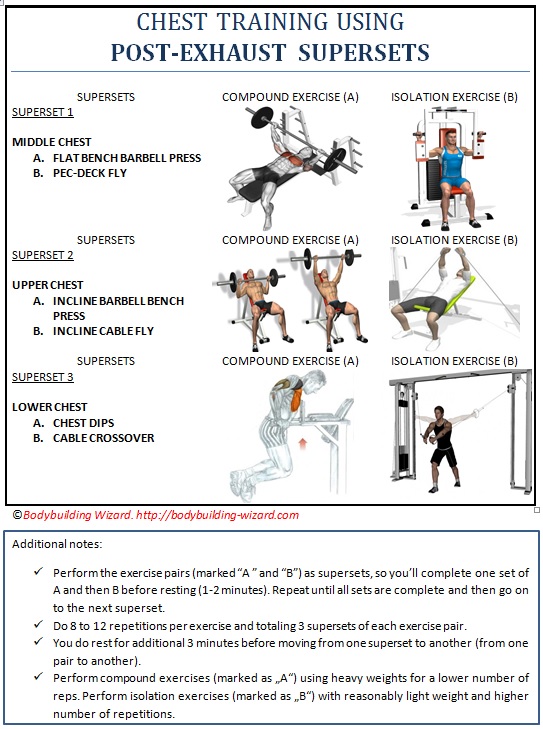
Example 1: Chest Training Using Post-Exhaust Supersets
For example, you can easily organize your whole chest training using only post-exhaustion supersets. First, select six chest exercises (3 compound and 3 isolation movements). Now create three pairs of exercises so that each pair contains one compound and one isolation movement. Perform each pair of exercises in the form of supersetting. It this is too difficult for you, perform only the first two exercises using the post-exhaustion training method. Do all other exercises traditionally.
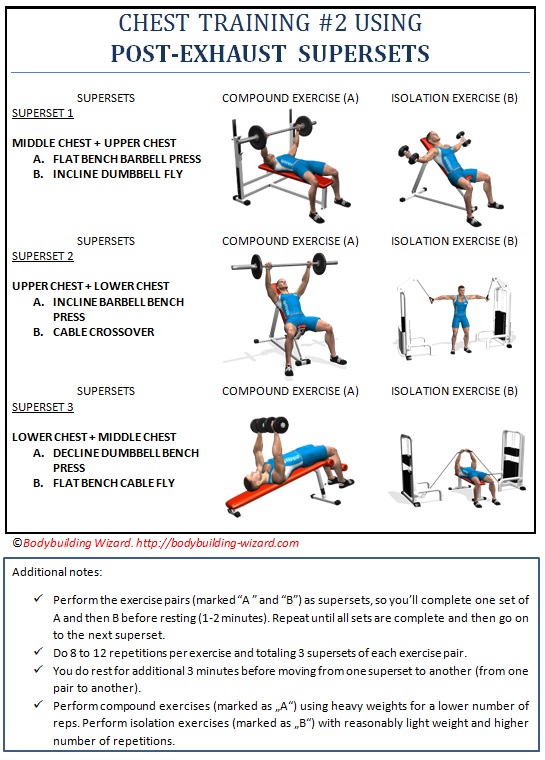
Example 2: Full Body Workout Using Post-Exhaustion Supersets
Furthermore, you can organize your whole body training using post-exhaustion supersets. A list of supersets for post-exhaustion is shown below:
- Chest: Flat bench barbell press and incline bench dumbbell fly
- Back: Wide grip pull-ups (or lat pull-downs) and dumbbell pullovers (or straight arm pull-downs)
- Legs (Quadriceps): Barbell squat (or leg press) and leg extension
- Legs (Hamstrings): Stiff-leg deadlift and lying (or standing) leg curl
- Shoulders: Front military press and dumbbell lateral raises
- Trapezius: Upright rows and barbell shrugs
- Biceps: Chin-ups (close underhand grip) and dumbbell concentration curls
- Triceps: Triceps dips and cable triceps push-down
In addition, you can work half of the body (upper body) in one session and the other half of the body (lower body) in the next session. Therefore, you have many possibilities how to incorporate this method into your workouts.
Benefits of Post-Exhaustion Training System
- Enhanced Muscle Growth: By taxing the larger muscle groups completely, post-exhaustion training encourages hypertrophy and helps in breaking through plateaus.
- Improved Muscle Endurance: Alternating between compound and isolation movements can enhance your muscle endurance, allowing for increased training volume over time.
- Greater Muscle Recruitment: This technique activates more muscle fibers, leading to more comprehensive muscle engagement.
- Lower Risk of Injury: Maintaining technique through lighter isolation exercises following heavy lifts reduces the risk of improper form and subsequent injuries.
- Time Efficiency: The intense nature of post-exhaustion training superset-style workouts can help you use your gym time more efficiently.
Drawbacks of Post-Exhaustion Training Strategy
- Increased Risk of Overtraining: Due to its intensity, there’s a potential for overtraining, which can lead to fatigue, decreased performance, or even injury if not monitored properly.
- Requires Precise Execution: Proper form and technique are crucial since the risk of injury increases when muscles are already fatigued from the initial exercise.
- Not Suitable for Beginners: This advanced technique can be overwhelming and is not recommended for those new to strength training.
- Potential for Imbalance: Focusing heavily on certain exercises could lead to muscle imbalances if complementary muscle groups are neglected.
- Requires More Recovery: The high level of muscle fatigue induced by this strategy can necessitate longer rest periods between workouts to allow for proper recovery and muscle repair.
Pros
Cons
Post-Exhaustion vs Pre-Exhaustion Training Strategy – Which is More Beneficial?
Researchers suggest that post-exhaustion training method may be superior to popular pre-exhaustion method. Since the relative weakness of smaller muscles indeed affects training intensity negatively when performing multiple-joint exercises, it is evident that you first have to perform the multiple-joint exercises.
After the set has been taken to the point of momentary muscular failure (PMF), it is immediately followed by a single-joint exercise which does not depend on the strength of the smaller muscles as much as the execution of a multiple-joint exercise does. This is the main reason why this training method is far more effective when compared to the pre-exhaustion method.
If you pre-exhaust your chest muscles with an isolation movement, you will lift less on the pressing movement. That means less overload, and less of the stimulation needed to achieve maximal size and strength. This is the main disadvantage of the pre-exhaustion method. Using post-exhaustion method you will be able to use heavy weights on your compound movements.
Is Post-Exhaustion Training System Suitable for Beginners?
Be very careful not to overdo it with this type of training. It’s easy to over train and become stagnant, so listen to your body and maximize your recovery. Post-exhaust training will push you to the limits and for that reason should be used by those considered advanced only. Novice weightlifters should steer well clear of such a technique as it has the potential to overload your target muscles, resulting rapidly in over training and enhancing the likelihood of injury.
Use this advanced bodybuilding method only from time to time to shock your muscles. Post-exhaustion training method gives the best results when used to train big muscle groups like chest, back, quadriceps, and hamstrings.
For beginners, consulting with a fitness professional or coach when adding post-exhaustion exercises to your regimen is highly recommended. This guidance can help tailor the strategy to align with your fitness level and personal goals.
How Post-Exhaustion Sets Compare to Other Advanced Training Techniques?
When comparing post-exhaustion sets to other advanced training techniques, it’s important to consider the unique approach each method offers. Post-exhaustion maintains the integrity of your movement form by focusing on compound exercises before isolations, a stark contrast to methods like drop sets or supersets, which emphasize continuous muscle stress. This approach reduces injury risks and ensures higher muscle recruitment without sacrificing form.
Unlike the intensity-focused methods such as forced reps or rest-pause sets, post-exhaustion allows athletes to push muscles to failure strategically, ensuring a well-rounded fatigue of both large and supporting muscle groups. This makes it a versatile technique for hypertrophy, especially if you find that other techniques lead to technique deterioration as fatigue sets in.
Additionally, post-exhaustion can be more approachable than techniques like German Volume Training or Tabata, which require immense stamina and recovery ability due to their high volume and intensity. Overall, while each method has its strengths, post-exhaustion offers a balanced approach, providing the benefits of intense training while preserving technical execution and reducing injury potential.
Closing Thoughts
Post-exhaust works to fatigue the primary muscle group via the compound exercise so that it can be further fatigued on the isolation exercise that follows. Of course, you will compromise the strength of the targeted muscle on the second exercise. This prevents most bodybuilders from using the post-exhaust method regularly. Finally, like other advanced training methods, post-exhaustion training should only be used for selected exercises and you should limit this method to once a week per muscle group.
