


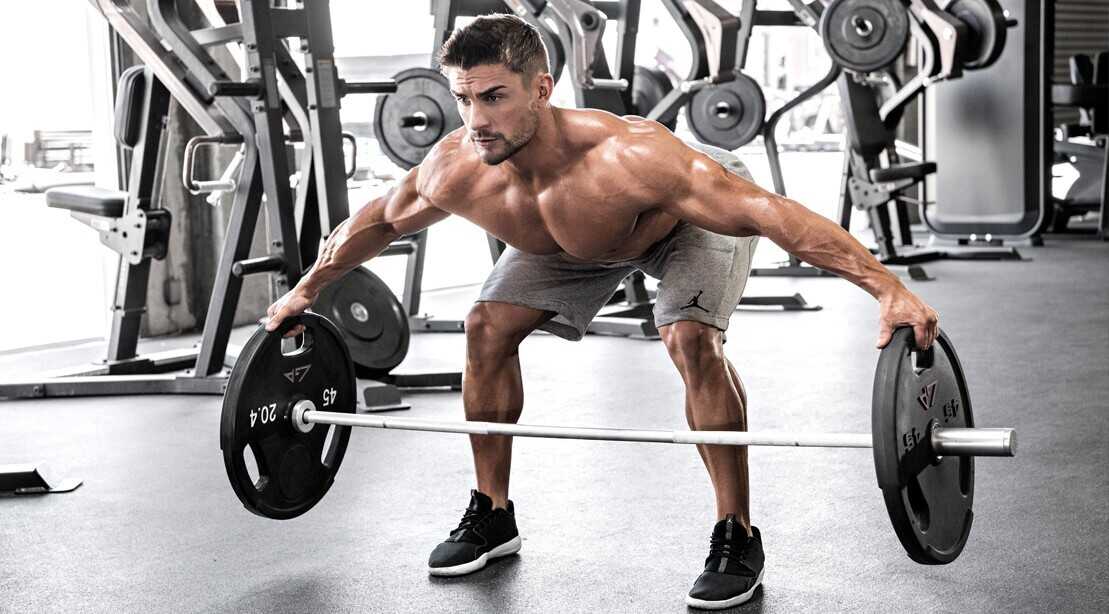
If you’re searching for a unique way to step your deadlift game up a notch, let us introduce you to the Reeves deadlift. This deadlift variation combines strength, hypertrophy, and grip enhancement all in one power-packed movement. It’s named after the legendary bodybuilder Steve Reeves, whose broad, chiseled physique still remains an ideal benchmark for many bodybuilding enthusiasts.
The Reeves deadlift not only challenges your back, hamstrings, quads, and glutes but also hits your forearms thanks to the expanded grip challenge. It’s an excellent lifting technique that will take your strength training to greater heights.
The distinctive feature of the Reeves deadlift, setting it apart from other deadlift variations, lies in its unique hand positioning. In the Reeves deadlift, individuals pinch the plates rather than gripping the bar conventionally. This modification is intended to enhance grip strength. The Reeves deadlift is particularly beneficial for individuals aiming to develop a stronger grip or as a supplementary exercise to enhance their overall deadlift performance.
This comprehensive guide aims to break down every aspect of the Reeves deadlift, providing you with the knowledge and insight to perform it with confidence and get the most out of each rep.
Reeves deadlift instructions – proper technique
Follow these instructions to ensure the correct execution of the exercise and to avoid potential injuries.
STARTING POSITION (SETUP):
- Initiate your Reeves deadlift setup similar to your regular deadlift approach—load the bar on an Olympic barbell.
- For this specific exercise, ensure the first plate on each side has its rim facing outward. Once the initial plates are in place, you can proceed to add smaller ones. This layout aids in achieving a firm grip on the first plates. Choose relatively smaller plates like 10s or 25s to create sufficient room between the initial 45s and the subsequent ones. Alternatively, you may opt to gradually decrease the size of the weight plates.
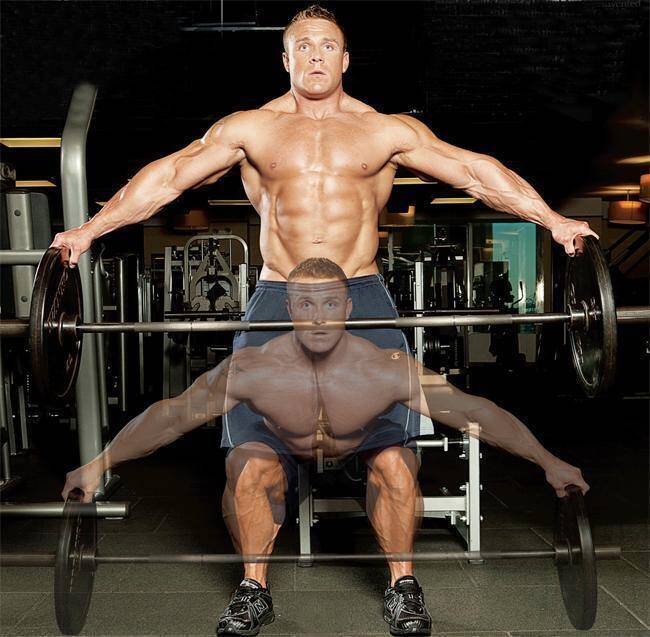
- Begin by pushing your hips back and bending forward until your upper body is nearly aligned with the ground.
- Use your fingertips to securely grip the weight plates.
- Lower your hips and engage your lats – visualize the act of squeezing oranges in your armpits for the right muscle activation.
MOVEMENT (ACTION):
- Perform the same motion you normally would when executing a traditional deadlift. Place your entire foot firmly on the ground and concentrate on pushing it down as if shifting the floor away from you.
- Make sure you maintain a straight trajectory with the bar as you straighten your knees and hips.
- Upon fully extending your hips, initiate the movement in reverse by shifting your hips backward and leaning forward.
- This completes one rep.
- Repeat for the desired number of repetitions.
Additional tips and performance pointers
- Ensure the crease of your armpit stays directly above the bar and your midfoot to enable a linear path for the bar.
- To avoid the bar drifting away, concentrate on contracting your lats to maintain proximity, facilitating a linear movement.
- Due to the wider grip associated with the Reeves deadlift, it might be necessary for you to use lifting straps as the weight increases.
- Keep the hips positioned lower than the shoulders. A helpful tip to remember is that the lifter’s shirt logo should be visible before initiating the pull (i.e., maintain a “chest up” stance).
Benefits of the Reeves deadlift
The Reeves deadlift can be a game-changer for your growth and strength goals. This exercise is designed to target multiple muscle groups, while simultaneously challenging your grip strength.
- Grip Strength: Gripping the plates rather than the barbell helps to significantly improve your grip strength. You won’t be able to encircle the bar with your fingers and thumb anymore; instead, you’ll need to hook your fingers around the plate’s rim and pinch the smooth side with your thumb.
- Upper Body Development: Due to the wider grip, you’ll stimulate more of your upper back and shoulder muscles, leading to improved upper body development.
- Core Engagement: Maintaining a straight back and proper form throughout the lift engages your core muscles, aiding in overall body strength and stability.
Downsides of the Reeves deadlift
The Reeves deadlift requires an exceptionally wide grip, broader than a snatch grip. In this variation, you grasp the edges or handles of the weight plates rather than the bar itself. While the wide grip targets the upper back and lats intensely, it can be awkward and comes with several drawbacks.
- The Reeves deadlift usually requires lighter weights due to the challenge of handling heavy loads with an extremely wide grip.
- Despite involving lighter weights, the Reeves deadlift is notorious for placing significant stress on the lower back. Maintaining a neutral spine becomes challenging, especially when reaching the bottom position.
- Employing an exceptionally wide grip while holding a barbell loaded to the front exposes the lower back and spine to excessive risk.
- The traditional barbell Reeves deadlift is often seen more as an upper-body exercise than a leg builder. Limited loading capabilities make it challenging to fully engage and target the lower body muscles.
Fortunately, these challenges can be addressed by executing the Reeves deadlift using a trap bar.
Muscles engaged in Reeves deadlift
The Reeves deadlift effectively targets the following muscle groups:
- Primary muscles: Hamstrings
- Secondary muscles: Quadriceps, Calves, Abdominals, Lats, adductors, Spinal Erectors, Forearms, Glutes, Traps, Upper Back
Exercise variations
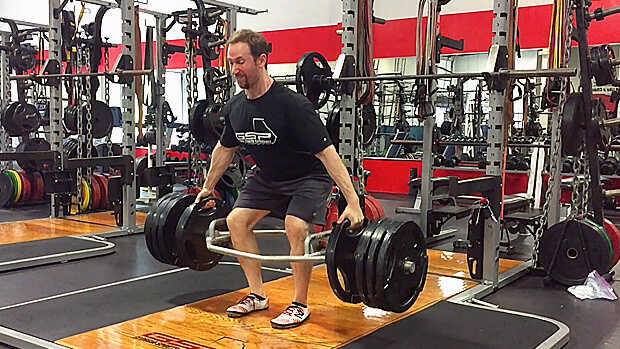
- Trap bar Reeves deadlift. The Reeves deadlift, an exercise crafted by revered bodybuilder Steve Reeves, generally employs a traditional barbell. Notably, because it requires such a broad grip, this workout often proves awkward for many athletes, making it a challenge to overload effectively. However, this can be rectified by using a trap bar that offers a grip placement of around 25-30% narrower compared to Olympic barbells. With a trap bar, you have the advantage of a wide grip that targets your traps optimally without too much discomfort of gripping the plates.
Replacement exercises
- Conventional deadlift
- Romanian deadlift
- Hex bar deadlift
- Straight-leg deadlift (Stiff-leg deadlift)
- Single-leg Romanian Deadlift
Closing thoughts
This exercise is designed for advanced weightlifters to add an interesting twist to their traditional routine. Beginners, especially those who haven’t mastered the technique of conventional deadlifting, should avoid this exercise at all costs. While this exercise certainly has some advantages, its drawbacks far outweigh the potential benefits. These drawbacks can be mitigated to some extent by using a trap bar.
