



Squatting is one of the most fundamental exercises (king of the exercises) you can include in your workout routine. Not only does it build strength, but it also enhances your endurance and flexibility. Knowing your one repetition maximum (1RM) for the squat exercise is crucial to tailor your training program effectively. But what exactly is a 1RM? Simply put, it’s the maximum weight you can lift for a single repetition. However, achieving this number isn’t always about testing your limits directly—it can be safely estimated using submaximal loads.
This guide will show you how to use a squat max calculator, share practical advice for boosting your squat max, and highlight the benchmark scores for barbell squats tailored for various fitness levels.

What is the concept of a one-repetition maximum?
A one-repetition maximum (1RM) represents the maximum weight you can lift for a single repetition of a specific exercise while maintaining proper form and technique. It’s an essential measure in strength training, signifying the utmost weight you can handle in one go, which helps guide your workout intensity and progression.
Read more about the concept of one-repetition maximum in our previous article, “One-Repetition Maximum (1RM) Concept and Calculator“.
What is the squat one-repetition maximum?
The squat one-repetition maximum, often abbreviated as 1RM, is the maximum weight you can lift for a single, complete squat with proper technique. Having a clear understanding of your squat 1RM can be incredibly advantageous. It enables you to customize your workout programs to align with your current strength, set achievable targets, and monitor your progress over time. Additionally, it guides you in choosing the appropriate load percentage for various training goals such as hypertrophy, power, muscular strength, or endurance, ensuring each workout remains effectively challenging.
Consider this example: if your squat one-rep max is 85 kg, and your goal is to train for muscle hypertrophy, you would typically want to operate within 70-85% of your 1RM. So, you would aim to lift between 60 kg and 72 kg. For best results in muscle growth, perform 8-12 reps per set with this range, ensuring each set is demanding yet allowing you to maintain proper form throughout all repetitions.
Calculating (estimating) squat one-rep max
Determining your one-repetition maximum (1RM) for squats (or any exercise) can be done using several formulas, each crafted to provide a reliable estimate. The Brzycki formula is favored due to its accuracy and straightforward approach.
The Brzycki formula helps you estimate your 1RM by using the weight you can lift for a set number of repetitions. Here’s how it works:
1RM = Weight lifted * (36 / (37 - Reps)
Where: W = Weight lifted, R = Number of repetitions performed
To estimate your 1RM with this formula, select a weight lighter than your suspected maximum. You aim to do as many reps as possible until muscle failure when you can’t safely do another repetition with proper form. The weight you lift and the number of reps you achieve are crucial for these calculations.
For example, pick a weight you can comfortably lift for 8 to 10 reps. Say you lifted 150 lbs (68 kg) for 8 reps before stopping. Using the Brzycki formula, your estimation would look like this:
1RM = 150 lbs * (36 / (37 - 8))
1RM = 150 lbs * (36 / 29)
1RM = 150 lbs * 1.241379
1RM ≈ 186 lbs or 84 kg
This gives you a realistic 1RM estimation without attempting to lift maximum weights in a single attempt, thereby reducing the risk of injury.
How to use a squat max calculator?
Using a squat max calculator is straightforward and insightful in efficiently estimating your one repetition maximum (1RM). Let’s walk through the steps:
- Collect Your Data: Start by completing a squat session in which you lift a weight as many times as you can before reaching muscle fatigue. Ensure that this weight is challenging but manageable.
- Note Your Inputs: After your workout, jot down the heaviest weight lifted and the maximum number of repetitions performed. This data is crucial for accurate calculations.
- Access a Squat Max Calculator: Find a reliable online squat max calculator. Many fitness websites and apps offer such tools.
- Input Your Numbers: Enter the weight you lifted and the number of reps you performed into the calculator. For example, if you squatted 200 lbs for 5 reps, input these values accordingly.
- Calculate: Hit the calculation button, and the calculator will estimate your 1RM. This estimation helps you understand the maximum weight you can lift for a single squat rep.
- Review the Result: Carefully review the estimated 1RM. Use this information to guide your training sessions, adjusting loads and reps for optimal strength gains.
Remember, while squat max calculators provide a proper estimate, they are just that—an estimate. Fatigue, technique, and physical conditions can influence this number. Always prioritize safety and proper form above all.
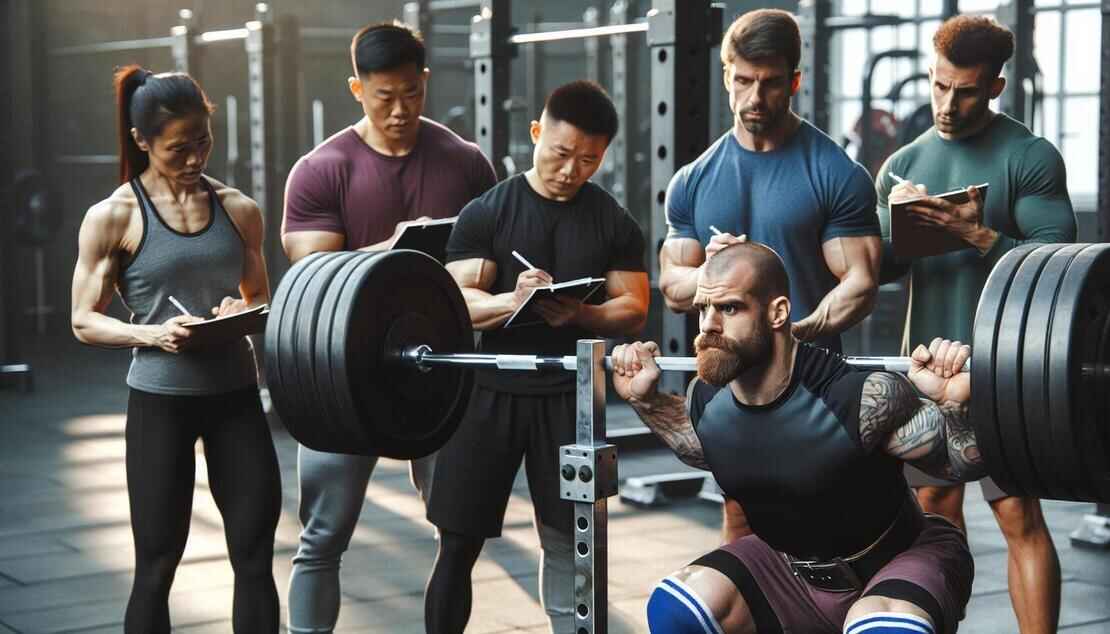
How do you determine a squat one repetition maximum directly?
Discovering your squat one-repetition maximum (1RM) directly means performing the squat with enough weight to find the heaviest load you can manage for a single repetition without relying on estimation methods. Here’s how you can tackle this:
Step 1: Prepare Your Body
Ensure you are well-rested and fueled adequately with a nutritious meal before attempting your squat 1RM. Proper warm-up is essential to prevent injuries.
Step 2: Warm Up
Begin with light weights to prepare your muscles. Gradually increase the weight, performing several sets of lower reps (5-10 reps) to prepare for heavier attempts.
Step 3: Attempt the 1RM
Once fully warmed up, move on to attempting your squat 1RM. Keep these tips in mind:
- Start with a weight that is roughly 80% of your estimated 1RM.
- Take 3-5 minutes of rest between each attempt.
- Increase the weight by about 5-10% after each successful attempt.
Step 4: Ensure Safety
Always have a spotter when testing your squat 1RM. This ensures safety, as the spotter can assist in case of difficulty during the lift.
Step 5: Record Your Results
After successfully lifting a weight, note it as your new 1RM. Use this number to tailor your training programs and set new goals.
While directly testing your squat 1RM has specific benefits and drawbacks:
Pros:
- Accurately measures your maximal strength capacity.
- It offers motivation as you push through personal boundaries.
Cons:
- Increases the chance of injury if done improperly or without proper assistance.
- It requires significant preparation and could lead to longer recovery due to high intensity.
- It might not be suitable for those new to squatting or lacking in form and technique mastery.
Tips for improving squat 1 RM
- Progressive Overload: Gradually increase the training stimulus by adding a small weight to your squat over time. This will help to challenge your muscles and promote strength gains continually.
- Focus on Technique: Ensure you’re using the proper form. Proper technique maximizes efficiency, reduces the risk of injury, and activates the right muscle groups.
- Strengthen Supporting Muscles: Work on strengthening your core, hamstrings, and glutes, as these are crucial for performing squats effectively.
- Consistency in Training: Stick to a regular training schedule, giving your body time to rest and recover between intense sessions.
- Recovery and Nutrition: Prioritize rest days and ensure you consume enough protein and calories to support muscle repair and growth.
- Utilize Different Training Techniques: Incorporate pause squats or box squats to help break through plateaus and enhance your overall strength.
- Seek Professional Guidance: If possible, work with a trainer who can help refine your form and provide a tailored program suited to your needs.
What are the benchmark scores for squats across different fitness levels?
Knowing where you stand can be incredibly motivating and also guide your training goals. Comparing your squat performance against benchmark scores can help you understand your current fitness level and identify areas for improvement. Here’s a look at the typical squat benchmarks categorized by experience level, from beginners to advanced lifters.
| Fitness Level | Beginner (Bodyweight Squat Ratio) | Intermediate (Bodyweight Squat Ratio) | Advanced (Bodyweight Squat Ratio) |
|---|---|---|---|
| Men | 0.75x – 1x | 1.25x – 1.5x | 1.75x – 2x |
| Women | 0.5x – 0.75x | 1x – 1.25x | 1.5x – 1.75x |
The table breaks down what is considered a good one-repetition maximum (1RM) for squats based on various fitness levels and body weight ratios for both men and women. For men, beginners typically squat between 0.75 to 1 times their body weight. As they move to an intermediate level, this range increases to 1.25 to 1.5 times their body weight. Advanced male lifters reach an impressive 1.75 to 2 times body weight. Meanwhile, for women, beginners aim to squat 0.5 to 0.75 times their body weight. This goal shifts to 1 to 1.25 times body weight at the intermediate stage. Advanced women lifters strive for 1.5 to 1.75 times their body weight. These ranges provide a useful benchmark for assessing and setting squat goals tailored to your fitness level and gender.
Related calculators
Conclusion: Squat max calculator
In essence, the squat max calculator is a vital tool in bodybuilding, offering a safe, practical, and efficient way to gauge your strength levels without the risks associated with direct testing. Using the calculator, you can tailor your training regimen to enhance your squat capacity progressively. Remember, while personal growth is essential, patience and safety should remain at the forefront of your fitness pursuits. Use the squat max calculator wisely to track your progress and reach your personal best in the squat exercise!
We’d love to hear about your squat journey. What’s your one-rep max (1RM) for squats? Please share your results with us in the comments section below!
