


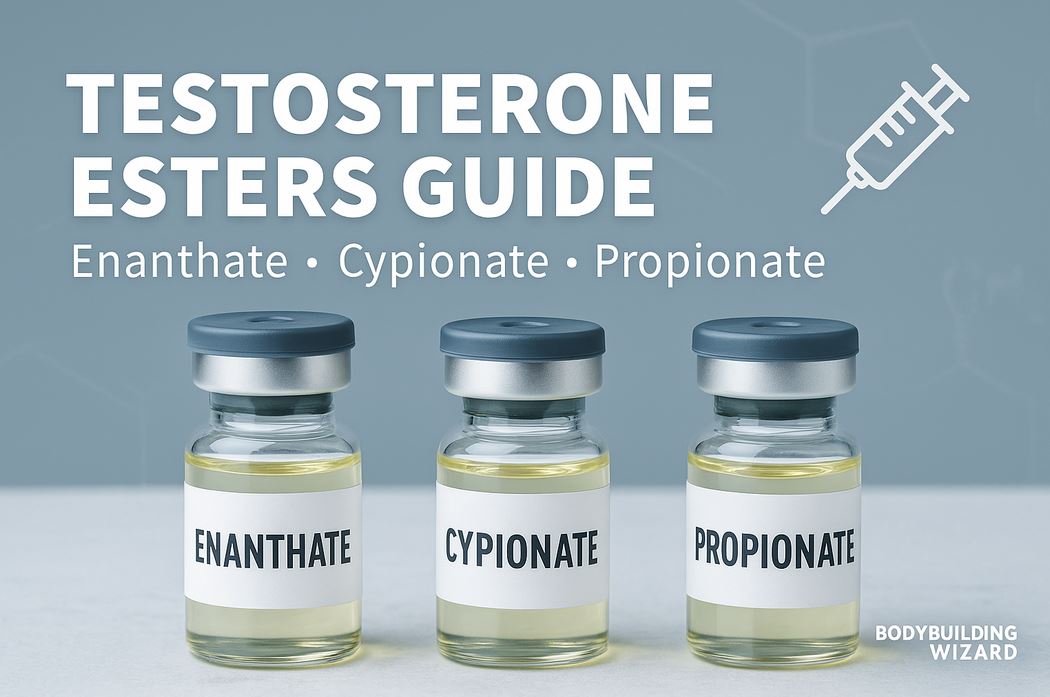
Testosterone is the cornerstone hormone in male development, muscle growth, and overall vitality. But when it comes to testosterone therapy or performance enhancement, it’s not just about testosterone—it’s about the form in which it’s delivered. This is where testosterone esters come into play. Among the most commonly used are testosterone enanthate, cypionate, and propionate—each with distinct half-lives, injection frequencies, and user preferences. This guide breaks down everything you need to know about these esters to help you make an informed decision, whether you’re a TRT patient or a performance-focused athlete.
📌 What Are Testosterone Esters?
- The base testosterone is always the same.
- The difference lies in the speed of release and how often injections are required.
By attaching a specific ester, such as enanthate or propionate, the hormone’s half-life and activity duration are altered—providing either a slow or fast release into the body.
📌 History of Testosterone Esters
Testosterone was first isolated in the 1930s, revolutionizing medicine and athletic performance. However, pure testosterone had a very short half-life, making it impractical for therapy. Scientists quickly developed esters like Propionate (1937), Enanthate (1954), and later Cypionate (1950s) to prolong testosterone’s action and reduce injection frequency. Today, these three esters remain the most prescribed and widely used forms of injectable testosterone.
📌 How Testosterone Esters Work
All testosterone esters share the same base hormone: testosterone. The difference lies in the attached ester, which slows the release of testosterone into the bloodstream by increasing the molecule’s oil solubility and size.
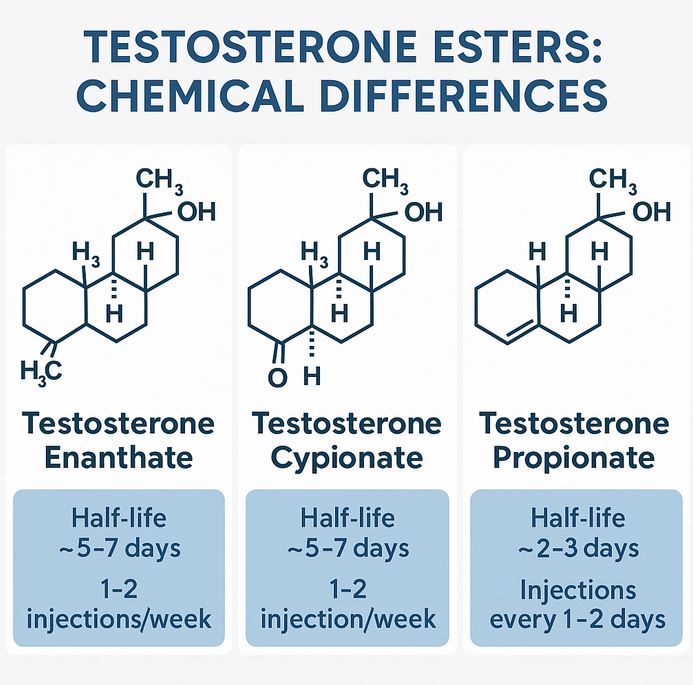
- Shorter esters, such as Propionate, release quickly (half-life ~2-3 days), requiring frequent injections.
- Medium esters, such as Enanthate and Cypionate, release more slowly (half-life ~5-7 days), allowing for less frequent injections.
Understanding these kinetics is crucial for maintaining stable hormone levels during cycles or Testosterone Replacement Therapy (TRT).
📌 Method of Administration
Testosterone Enanthate, Cypionate, and Propionate are administered via intramuscular injection, typically in large muscles, such as the gluteal muscles or thighs.
- Propionate requires injections every 1-2 days.
- Enanthate and Cypionate are typically injected once or twice a week.
Frequent injection schedules with Propionate can be challenging for some users, while Enanthate and Cypionate provide more convenience.
📌 Potential Benefits (Informational Only)
Testosterone esters offer several key benefits to athletes and patients:
- Enhanced muscle mass and strength.
Testosterone binds to androgen receptors in muscle cells, stimulating protein synthesis and nitrogen retention, which directly leads to hypertrophy and strength gains. - Increased red blood cell production.
Testosterone enhances erythropoiesis, improving oxygen delivery to muscles, thereby enhancing endurance and accelerating recovery. - Improved libido, mood, and well-being.
Optimal testosterone levels regulate neurotransmitters such as dopamine and serotonin, contributing to a positive mood, increased confidence, and enhanced sex drive. - Bone density support.
Testosterone increases bone mineral density by stimulating osteoblast activity, reducing the risk of fractures.
These benefits are consistent across all esters in this Testosterone esters guide; however, injection frequency, peak levels, and stability can vary significantly depending on the chosen ester.
📌 Side Effects and Health Risks
While testosterone esters offer many benefits, they also carry significant risks:
- Estrogenic side effects (gynecomastia, water retention).
Testosterone aromatizes into estradiol, which can cause fluid retention and stimulate breast tissue growth if estrogen isn’t controlled with aromatase inhibitors. - Androgenic side effects (acne, hair loss).
Testosterone increases dihydrotestosterone (DHT) production, which binds to androgen receptors in the skin and scalp, leading to oily skin, acne, and male pattern baldness in predisposed individuals. - Suppression of natural testosterone production.
Exogenous testosterone suppresses the hypothalamic-pituitary-gonadal axis, halting endogenous testosterone, leading to testicular atrophy and low natural testosterone after a cycle if PCT isn’t implemented. - Adverse effects on cholesterol and cardiovascular health.
Supraphysiological testosterone levels lower HDL and raise LDL, promoting atherosclerosis and increasing cardiovascular risks.
Each ester covered in this Testosterone esters guide carries these risks, though frequency and peak fluctuations can influence severity.
📌 Legal Status
Testosterone esters are classified as Schedule III controlled substances in the US, making them illegal to possess or use without a prescription. In Europe and most other countries, similar regulations apply. Purchasing them online without a prescription can expose buyers to counterfeit products and legal penalties.
📌 Comparison Table: Enanthate vs. Cypionate vs. Propionate
Choosing the right testosterone ester can make a big difference in cycle results, injection convenience, and side effect management. The following table compares Testosterone Enanthate, Cypionate, and Propionate side by side, allowing you to quickly see their key differences and determine which one best suits your goals.
| Feature | Enanthate | Cypionate | Propionate |
|---|---|---|---|
| Half-life | ~5-7 days | ~5-7 days | ~2-3 days |
| Injection freq. | 1-2x/week | 1-2x/week | Every 1-2 days |
| Peak stability | More stable levels | More stable levels | Fluctuates more |
| Estrogenic effects | Moderate | Moderate | Lower (shorter spikes) |
| Pain at injection | Rare | Rare | More common (PIP) |
| Common use | TRT & cycles | TRT & cycles | Cutting cycles, shorter bursts |
📌 Which Testosterone Ester Is Best for You?
The “best” ester depends on your goals, tolerance, and lifestyle:
- TRT users often go with Enanthate or Cypionate for stability and ease of injection.
- Bodybuilders in bulking cycles prefer Enanthate or Cypionate for sustained anabolic effects.
- Cutting or short cycles typically favor Propionate for its rapid clearance and leaner look.
Always consider blood level stability, injection comfort, and cycle duration when choosing.
📌 Stacking and Cycle Considerations
- Enanthate/Cypionate are often stacked with Deca, Dianabol, or Equipoise in mass cycles.
- Propionate is commonly stacked with Winstrol or Masteron during cutting cycles.
- For recomp phases, many athletes combine propionate with short esters like Tren A or NPP for fast manipulation.
Due to their different half-lives, esters should not be mixed unless carefully planned (e.g., front-loading with propionate, transitioning to enanthate).
📌 Common Mistakes and Myths
Many athletes make critical mistakes or believe myths when using testosterone esters:
- “Propionate is safer because it’s shorter-acting.”
➤While Propionate clears faster, all esters carry the same risks when doses are equivalent. - “Enanthate and Cypionate are the same.”
➤Although very similar, some users report subtle differences in water retention and side effects, likely due to individual responses or slight ester variations. - “You don’t need PCT after a testosterone cycle.”
➤All testosterone esters suppress natural production, making PCT essential for recovery. - “Mixing esters improves results.”
➤Unless carefully planned, mixing esters can destabilize blood hormone levels and increase side effects.
📌 How Testosterone Esters Are Misused in Bodybuilding
Athletes often stack testosterone esters with other steroids for bulking or cutting. Common mistakes include:
- Using excessively high doses in the expectation of faster gains only increases the likelihood of side effects.
- Ignoring aromatase inhibitors leads to severe estrogenic side effects.
- Starting cycles without planning Post-Cycle Therapy, resulting in prolonged hypogonadism.
📌 Post-Cycle Therapy (PCT) After Testosterone
PCT is crucial after any testosterone ester cycle to restore natural hormone production. SERMs, such as Clomid or Nolvadex, stimulate the pituitary to release luteinizing hormone (LH) and follicle-stimulating hormone (FSH), thereby reigniting endogenous testosterone production.
📌 Conclusion
Choosing the right testosterone ester is crucial for achieving a balance between convenience, stable hormone levels, and practical side effect management. As explained in this Testosterone esters guide, understanding the differences between Enanthate, Cypionate, and Propionate helps athletes and patients make informed decisions about cycles or TRT protocols. Always consult a qualified medical professional before considering anabolic steroids.
The information provided in this article is intended for educational and informational purposes only. The author and the Bodybuilding Wizard website do not promote, condone, or encourage the use of anabolic steroids or any other performance-enhancing drugs without a prescription and medical supervision. Use of such substances carries potential legal and health risks. Always consult with a qualified medical professional before making any decisions regarding hormone therapy, supplementation, or performance enhancement.
📌 Key Takeaways
1️⃣ Testosterone esters provide flexibility in injection frequency and hormone stability.
2️⃣ Propionate has a short half-life and requires frequent injections, but it can minimize water retention.
3️⃣ Enanthate and Cypionate offer convenient injection schedules with stable blood levels.
4️⃣ All esters carry similar risks of estrogenic, androgenic, and cardiovascular side effects.
5️⃣ This Testosterone esters guide is educational and does not promote steroid use.
What is the main difference between Testosterone Enanthate and Cypionate?
Enanthate and Cypionate are almost identical in half-life (5–7 days), but Cypionate has a slightly longer carbon chain, which some users report causes more water retention. Otherwise, their effects are nearly indistinguishable, and both are excellent choices for TRT and cycles.
How often should you inject Testosterone Propionate?
Testosterone Propionate’s short half-life (2–3 days) requires injections every 1–2 days to maintain stable testosterone levels and avoid hormonal fluctuations that cause mood swings and estrogen spikes.
Is Testosterone Enanthate better for bulking or cutting?
Testosterone Enanthate can be effectively used for both bulking and cutting, but its tendency to cause moderate water retention makes it more popular in bulking cycles where maximum size is desired.
Does Testosterone Propionate cause less bloating than Enanthate or Cypionate?
Yes. Because of its shorter half-life and lower peak estrogen conversion, Propionate often causes less water retention, leading to a drier, harder look — which is why it’s favored in cutting cycles.
Can women use Testosterone esters safely?
In most cases, no. Even low doses of testosterone esters can cause rapid virilization in women, including deepened voice, facial hair growth, and menstrual irregularities, making them generally unsafe for female athletes.
What is the half-life of Testosterone Enanthate, Cypionate, and Propionate?
Enanthate and Cypionate have a half-life of approximately 5–7 days, while Propionate has a much shorter half-life of 2–3 days, requiring more frequent injections to keep stable hormone levels.
Why do some users mix Testosterone Propionate with Enanthate or Cypionate?
Some athletes stack Propionate with a longer ester at the start of a cycle to quickly elevate testosterone levels (a “kickstart”), then rely on Enanthate or Cypionate for sustained levels with fewer injections.
How do Testosterone esters affect cholesterol levels?
All testosterone esters can lower HDL (good cholesterol) and raise LDL (bad cholesterol), increasing cardiovascular risks if not carefully monitored — effects are dose-dependent and worsen with longer cycles.
Is Post-Cycle Therapy (PCT) needed after using Testosterone esters?
Absolutely. Any testosterone ester cycle suppresses natural testosterone production. PCT with SERMs like Clomid or Nolvadex is essential to restore endogenous hormone levels and prevent prolonged hypogonadism.
Which Testosterone ester causes the most injection pain?
Testosterone Propionate is known for causing more post-injection pain (PIP) due to its higher concentration per milliliter and irritant nature of the shorter ester, while Enanthate and Cypionate are generally smoother.
