

⚠️ Educational Disclaimer: All information shared here is grounded in available scientific research and clinical data. This article is purely educational in nature and is not intended to promote anabolic steroid use. Self-administration of such compounds without appropriate medical oversight can lead to dangerous health outcomes and is considered illegal in many jurisdictions.
Complete Overview of Testosterone Propionate
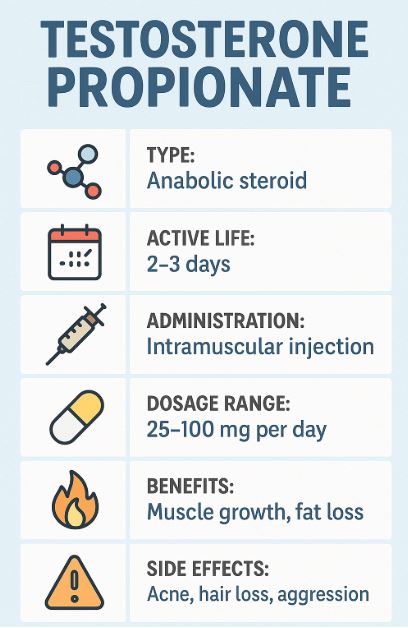
Testosterone Propionate is one of the oldest and fastest-acting testosterone esters available. With a short half-life and rapid onset of action, it’s favored by bodybuilders who seek tight control over hormone levels and quicker results, particularly during cutting phases or short cycles.
In this Testosterone Propionate steroid guide, we’ll explore how this compound works, its muscle-building benefits, potential side effects, administration protocols, and how it compares to other esters and popular anabolic steroids.
History and Medical Background
Testosterone Propionate was first synthesized and marketed in the 1930s, making it one of the earliest commercially available forms of injectable testosterone. It was originally developed for testosterone replacement therapy (TRT), but due to its short half-life (~2 days), it requires frequent injections — a trait that led to its gradual replacement in clinical settings by longer esters like Enanthate and Cypionate.
Despite this, it remains popular in bodybuilding due to its fast onset, minimal water retention, and tight hormonal control, especially in short or pre-contest cycles.
Notably, some clinical evidence suggests that short-acting esters, such as Testosterone Propionate, may induce fewer estrogenic side effects and allow for better individual control of hormonal fluctuations, as discussed in this PubMed article.
How It Works — Mechanism of Action
Like all testosterone esters, Testosterone Propionate works by releasing free testosterone into the bloodstream after enzymatic cleavage of the ester chain. This free testosterone binds to androgen receptors in muscle tissue and triggers a cascade of anabolic effects:
- Protein synthesis — stimulates muscle fiber repair and growth
- Nitrogen retention — creates a favorable anabolic environment
- Increased IGF-1 activity — promotes cellular growth and recovery
- Enhanced erythropoiesis — increases red blood cell count and oxygenation
Due to its short duration, hormone levels peak quickly and drop just as fast, which can be advantageous for users who want precise timing and shorter cycle commitments.
For readers who may not be familiar with the scientific terminology used above, here’s a quick breakdown of the key biological processes involved in testosterone’s anabolic effects.
| Term | Explanation |
|---|---|
| Protein Synthesis | The process where muscle cells build new proteins using amino acids. More synthesis leads to more muscle growth. |
| Nitrogen Retention | The ability to maintain nitrogen levels in the muscles — a key indicator of an anabolic (muscle-building) state. |
| Increased IGF-1 Activity | IGF-1 is a hormone that promotes muscle growth and recovery by enhancing cellular repair after training. |
| Enhanced Erythropoiesis | This is the increased production of red blood cells, which enhances oxygen delivery, improves endurance, and promotes recovery. |
Method of Administration
Testosterone Propionate is administered intramuscularly, most commonly in the glute, thigh, or deltoid muscles. Given its short half-life (~2 days), injections are required every other day (EOD) or even daily for consistent blood levels.
| Form | Route | Frequency |
|---|---|---|
| Injectable | Intramuscular (IM) | Every other day (EOD) |
While the frequent injections may be inconvenient, they provide more stable hormonal control compared to longer esters.
Potential Benefits in Bodybuilding (Informational Only)
Testosterone Propionate is commonly used by athletes for cutting cycles, rapid strength gains, and cycles where water retention needs to be minimized. Let’s look at the primary benefits — and how each occurs at the physiological level.
1. Rapid Muscle Hardness and Definition
- Mechanism: Less aromatization compared to longer esters → reduced estrogen levels.
- Result: Leaner appearance and sharper muscle definition.
- Study: Bhasin et al., 1996 demonstrated that supraphysiologic testosterone doses led to significant increases in lean mass and reduction in fat mass — especially when estrogen levels were controlled.
2. Faster Strength Gains
- Mechanism: Immediate increase in androgenic signaling due to rapid peak.
- Result: Noticeable improvement in lifts within the first 1–2 weeks.
- Study: Bhasin et al., 1996 also showed clear increases in 1RM strength for bench press and squat after testosterone administration, even without resistance training.
3. Precise Hormonal Control
- Mechanism: Short ester means hormone levels can be fine-tuned or dropped quickly.
- Result: Easier to manage side effects and plan brief cycles (e.g., 6 weeks).
- Study: While direct studies on Propionate control are limited, a PubMed study suggests short-acting esters offer tighter pharmacokinetic control and may reduce systemic estrogenic impact.
4. Reduced Water Retention
- Mechanism: Lower cumulative estrogen levels due to rapid clearance.
- Result: Dry gains, ideal for pre-contest body composition.
- Study: Friedl et al., 1994 observed reduced extracellular water in subjects administered testosterone under caloric restriction, suggesting enhanced nitrogen preservation without excessive fluid buildup.
5. Improved Recovery and Muscle Growth via IGF-1
- Mechanism: Testosterone stimulates hepatic IGF-1 production and increases local IGF-1 expression in muscles.
- Result: Faster cellular repair, satellite cell activation, and enhanced training volume tolerance.
- Study: Urban et al. (1995) confirmed elevated IGF-1 levels following testosterone treatment in older males, contributing to lean mass gains.
6. Increased Endurance Through Erythropoiesis
- Mechanism: Testosterone boosts erythropoietin (EPO) signaling and red blood cell production in bone marrow.
- Result: Improved oxygen delivery to muscles and enhanced endurance capacity.
- Study: Coviello et al. (2008) found that testosterone administration increased hemoglobin and hematocrit, key markers of enhanced aerobic performance.
Side Effects and Their Mechanisms (with Scientific References)
Though generally well-tolerated, Testosterone Propionate — like all androgens — comes with risks. Understanding how side effects occur, how to manage them, and what the science says helps build a well-informed view.
1. Injection Site Irritation
- Cause: High concentration of propionic acid can irritate muscle tissue, especially with frequent injections.
- Management: Rotate injection sites and use lower injection volumes to minimize irritation and localized pain.
- Study: Zhang, G., et al. “Local irritation from repeated intramuscular injections: implications for depot formulation.” International Journal of Pharmaceutics, 2007.
2. Estrogenic Side Effects (Gynecomastia, Water Retention)
- Cause: Aromatization of testosterone into estradiol leads to estrogenic activity.
- Management: Use of aromatase inhibitors (e.g., Anastrozole/Arimidex) during cycle, and estrogen receptor blockers (e.g., Nolvadex) post-cycle if symptoms appear.
- Study: de Ronde, W., et al. “Aromatase inhibitors in men: effects and therapeutic options.” Reproductive Biology and Endocrinology, 2009. PMC3143915
3. Suppression of Natural Testosterone Production
- Cause: Exogenous testosterone suppresses LH and FSH via negative feedback on the hypothalamic–pituitary–testicular axis.
- Management: Employ post-cycle therapy (PCT) with agents like Clomiphene Citrate (Clomid) or hCG to restore natural testosterone levels.
- Study: Matsumoto, A. M. “Hormonal therapy of male infertility.” Endocrinology and Metabolism Clinics, 1994.
4. Cardiovascular and Lipid Effects
- Cause: Testosterone can reduce HDL (“good” cholesterol), raise LDL, and increase hematocrit, which may raise cardiovascular risk.
- Management: Monitor lipid panels and hematocrit levels; adjust dose or discontinue if values become abnormal. Include omega-3 and a cardiovascular-friendly diet.
- Study: Basaria, S., et al. “Adverse effects of testosterone therapy in older men.” New England Journal of Medicine, 2010.
5. Androgenic Side Effects (Acne, Hair Loss, Body Hair Growth)
- Cause: Conversion of testosterone into DHT (dihydrotestosterone) enhances androgenic traits.
- Management: Consider 5-alpha reductase inhibitors, such as finasteride (with caution), and maintain good skin hygiene.
- Study: Kaufman, K. D. “Androgens and alopecia.” Molecular and Cellular Endocrinology, 2002.
Comparison: Testosterone Propionate vs. Other Testosterone Esters
When choosing a testosterone ester, understanding how each variant differs in terms of half-life, release speed, and injection frequency is essential. Below is a comparison of Testosterone Propionate with other commonly used esters to help clarify its unique pharmacological profile.
| Testosterone Ester | Half-Life | Injection Frequency | Best Use Case |
|---|---|---|---|
| Propionate | ~2 days | Every other day (EOD) | Cutting / short cycles |
| Enanthate | ~5–7 days | 2× per week | Bulking / TRT (Europe) |
| Cypionate | ~8 days | 1–2× per week | Bulking / TRT (USA) |
| Undecanoate | ~21 days | Every 10–14 weeks | Long-term TRT |
Conclusion: Testosterone Propionate is the fastest-acting ester, offering unmatched control and short recovery periods. While it demands frequent injections, it excels in cutting phases, short-term experimentation, and scenarios where estrogenic side effects need to be minimized quickly.
Comparison With Other Popular Anabolic Steroids
To truly understand the unique profile of Testosterone Propionate, it’s helpful to compare it with other commonly used anabolic steroids. The table below highlights key differences in anabolic and androgenic potency, estrogenic effects, and usage patterns to provide a broader perspective.
| Steroid | Anabolic Rating | Injection Frequency | Water Retention |
|---|---|---|---|
| Testosterone Propionate | 100 | EOD (every other day) | Low to moderate |
| Winstrol | 320 | Daily (oral/injectable) | None |
| Trenbolone Acetate | 500 | EOD | Low |
| Dianabol | 210 | Daily (oral) | High |
| Deca-Durabolin | 125 | Weekly | Moderate |
Conclusion: While not as anabolic as Trenbolone or Winstrol, Testosterone Propionate delivers more consistent, predictable results with a lower side effect profile, especially when used intelligently. It is especially effective when used as a base compound in shorter cycles or pre-contest phases.
Common Myths About Testosterone Propionate
Like many anabolic steroids, Testosterone Propionate is often surrounded by misinformation, oversimplifications, and outdated gym lore. These misconceptions can lead to poor decision-making, unnecessary risk, or unrealistic expectations. In this section, we set the record straight by addressing the most persistent myths and explaining the actual science behind each one.
- “Short esters are weaker.” → False. Propionate delivers full testosterone potency; only the release rate differs.
- “You don’t need PCT after Propionate.” → False. All exogenous testosterone suppresses natural production.
- “Propionate is only for cutting.” → Misleading. It can be used in bulking if you’re willing to inject frequently.
Post Cycle Therapy (PCT)
Given the rapid clearance of Testosterone Propionate, PCT can begin 3–5 days after the last injection.
Suggested PCT Protocol:
- Clomid: 50/50/25/25 mg over 4 weeks
- Nolvadex: 40/40/20/20 mg over 4 weeks
Post Cycle Therapy (PCT) is designed to help restore the body’s natural testosterone production after a cycle of anabolic steroid use. Its primary goal is to minimize hormonal imbalances, preserve muscle gains, and reduce the risk of side effects like low libido, fatigue, and depression.
Conclusion
This Testosterone Propionate steroid guide clearly demonstrates the compound’s efficiency, speed, and precision. Ideal for shorter cycles and users who prefer tight hormonal control, Propionate remains a staple in the enhanced performance world.
With smart application, medical guidance, and proper PCT, it offers lean gains, strength, and rapid action — but it’s not without its demands.
Disclaimer
📢 This article is for educational purposes only. The use of anabolic steroids without medical supervision is illegal in many countries and may lead to serious health risks, including infertility, cardiovascular disease, and hormonal disruption. The author and Bodybuilding Wizard assume no responsibility for misuse or misinterpretation of this information.
Key Takeaways
- Testosterone Propionate has a short half-life and fast onset.
- Best suited for short cycles, cutting, or pre-contest prep.
- Requires frequent injections but allows rapid adjustment.
- Estrogenic and androgenic side effects are manageable.
- PCT is mandatory and should begin 3–5 days post-cycle.
Consulted Literature
- Bhasin S, Storer TW, Berman N, et al. “The effects of supraphysiologic doses of testosterone on muscle size and strength in normal men.” The New England Journal of Medicine. 1996.
- Friedl KE, Moore RJ, Hoyt RW, et al. “Endocrine markers of semistarvation in healthy lean men in a multistressor environment.” Journal of Applied Physiology. 1994.
- Urban RJ, Bodenburg YH, Gilkison C, et al. “Testosterone administration to elderly men increases skeletal muscle strength and protein synthesis.” American Journal of Physiology. 1995.
- Coviello AD, Kaplan B, Lakshman KM, et al. “Effects of graded doses of testosterone on erythropoiesis in healthy young and older men.” The Journal of Clinical Endocrinology & Metabolism. 2008.
- Zhang G, Thakker DR, Mattison CP. “Local irritation from repeated intramuscular injections: implications for depot formulation.” International Journal of Pharmaceutics. 2007.
- de Ronde W, de Jong FH. “Aromatase inhibitors in men: effects and therapeutic options.” Reproductive Biology and Endocrinology. 2009.
- Matsumoto AM. “Hormonal therapy of male infertility.” Endocrinology and Metabolism Clinics of North America. 1994.
- Basaria S, Coviello AD, Travison TG, et al. “Adverse effects of testosterone therapy in older men.” The New England Journal of Medicine. 2010.
- Kaufman KD. “Androgens and alopecia.” Molecular and Cellular Endocrinology. 2002.
