


Introduction
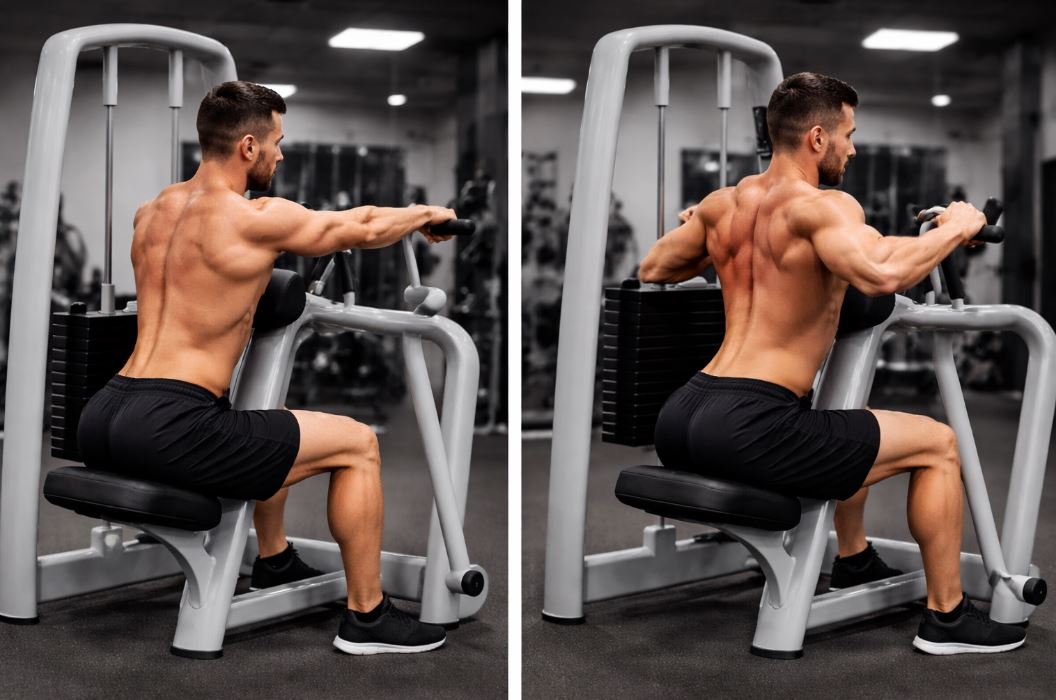
The machine row is one of the most effective exercises for developing mid-back thickness while minimizing lower-back stress. Unlike free-weight rowing variations, this movement provides external torso support, allowing lifters to focus purely on scapular retraction and horizontal pulling mechanics.
While exercises such as bent-over barbell rows demand significant spinal stabilization, the machine row shifts the emphasis toward controlled hypertrophy and technical precision. This makes it especially valuable for beginners, lifters managing lumbar fatigue, or athletes seeking higher-volume back work without excessive systemic strain.
Although often underestimated, the machine row remains a foundational back-thickness exercise in serious strength and bodybuilding programs.
Required Equipment
- Chest-supported rowing machine
- Weight stack or plate-loaded resistance
- Adjustable seat (on most models)
Because the torso is supported against a pad, spinal stabilization demands are reduced compared to free-weight rows.
Other Names for Machine Row
- Chest-Supported Machine Row
- Plate-Loaded Row Machine
- Selectorized Row
- Seated Chest-Supported Row
Although designs vary by manufacturer, the defining feature is torso support combined with a horizontal pulling motion.
How to Perform the Machine Row
Proper technique is essential to maximize mid-back activation and prevent compensation patterns.
Starting Position (Setup)
- Sit facing the weight stack.
- Position your chest and abdomen firmly against the pad.
- Keep feet flat on the floor or on machine supports.
- Adjust the seat so your arms are parallel to the floor when gripping the handles.
- Fully extend the arms without allowing the weight stack to rest at the bottom.
- Maintain a neutral spine with natural lumbar curvature.
Key principle: Your torso must remain fixed against the pad throughout the set.

Execution Phase
- Initiate the movement by retracting your shoulder blades.
- Pull the handles toward your chest or upper abdomen.
- Keep elbows traveling directly backward (not flared excessively outward).
- Squeeze the shoulder blades together at peak contraction.
- Return slowly under control until arms are fully extended.
- Maintain constant tension — do not let the stack touch down between reps.
The movement should occur in a horizontal plane with minimal torso motion.
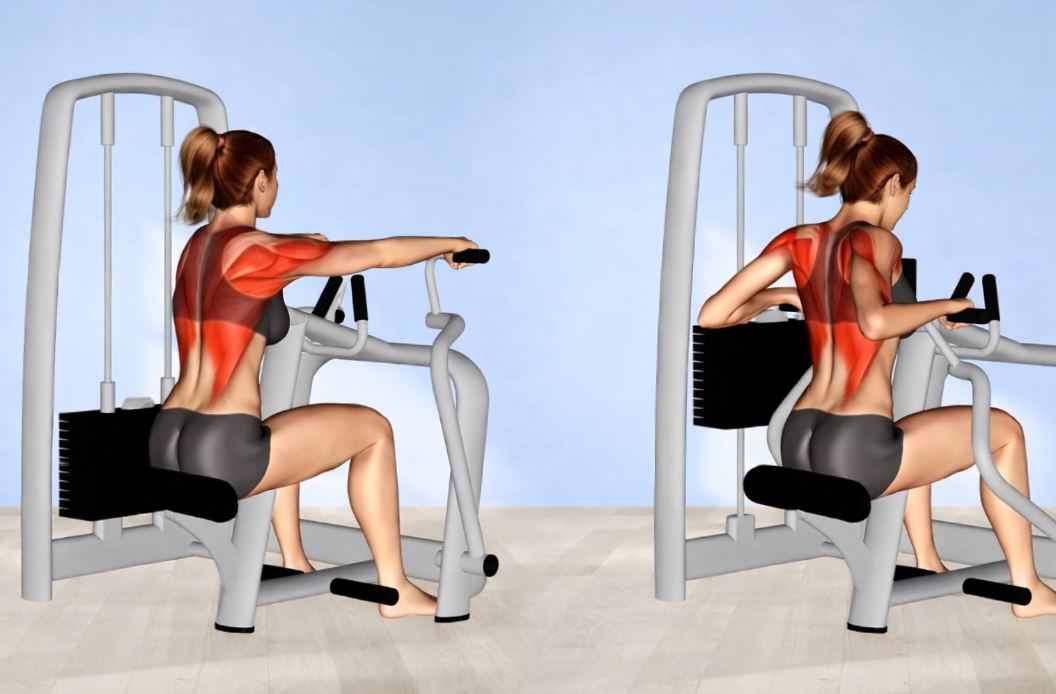
Quick Form Checklist — Machine Row
- Chest remains firmly against the pad
- Spine stays neutral throughout
- Arms fully extend without relaxing tension
- Elbows travel backward, not outward excessively
- Shoulder blades retract fully at the top
- No torso swinging
- Controlled eccentric phase
- The weight stack does not slam
If you feel your lower back engaging dynamically, reduce the load.
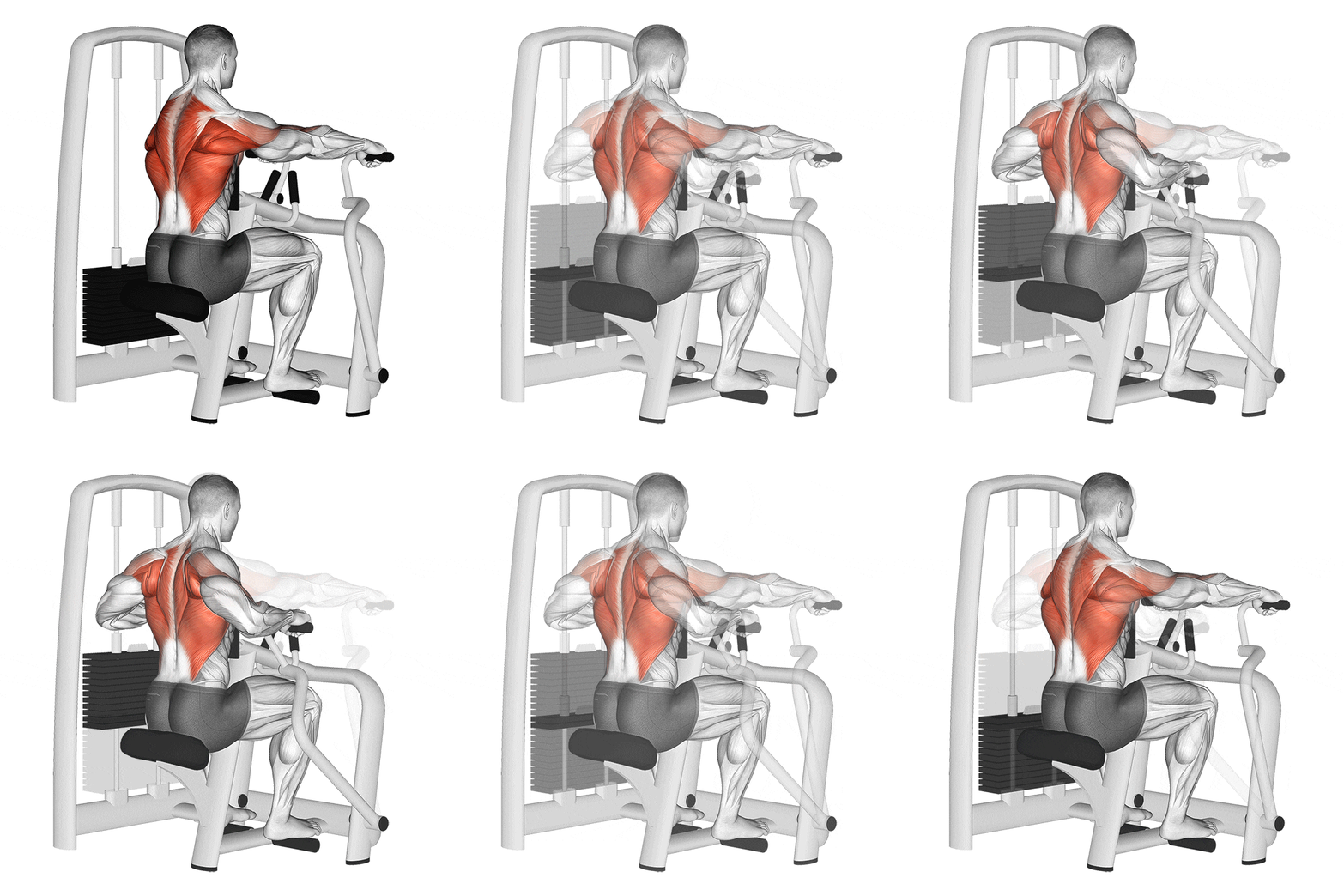
Mechanical Resistance Analysis
Unlike barbell rows, which rely on gravity and change leverage across the range of motion, the machine row follows a guided path with a relatively consistent resistance profile.
Because the torso is supported:
- Lumbar isometric demand is reduced
- Posterior chain fatigue is minimized
- Scapular retraction can be isolated more effectively
This makes the machine row particularly useful during hypertrophy phases or after heavy deadlifts when lower-back fatigue is present.
Compared to cable rows, resistance direction may vary depending on cam design, slightly altering peak tension.
Muscles Involved in Machine Row Exercise
Understanding recruitment improves programming precision.
MAIN MUSCLES:
Latissimus dorsi, rhomboids, middle trapezius
SECONDARY MUSCLES:
Posterior deltoid, teres major and minor, brachialis, biceps brachii
STABILIZERS:
Lower trapezius, deep scapular stabilizers
ANTAGONISTS:
Pectoralis major, anterior deltoid, triceps
Because torso stabilization is externally supported, erector spinae involvement is significantly lower than in bent-over rows.
Technical Emphasis & Targeting Adjustments
Small seat and grip adjustments alter muscle emphasis.
- Pulling toward lower abdomen → greater lower-lat emphasis
- Pulling higher toward the chest → more upper-back and trapezius activation
- Neutral grip → balanced lat involvement
- Wider grip → increased rear deltoid and mid-trap emphasis
- Slower eccentric → improved hypertrophy stimulus
Seat height adjustment significantly changes the pulling trajectory.
Machine Row Variations
Although each manufacturer has its own version of the machine row, the same basic rules of horizontal pulling and scapular retraction always apply. Depending on the brand, the handles may be parallel, perpendicular, or positioned diagonally, and some machines offer multiple grip options on the same unit. While the movement pattern remains fundamentally the same, experimenting with different grips and seat positions can significantly change muscle emphasis and overall training stimulus.
Neutral-Grip Machine Row
Balanced activation and joint-friendly position.
The neutral grip (palms facing each other) aligns the shoulders more naturally and typically reduces internal rotation stress. This position allows a strong elbow path close to the torso, promoting consistent lat activation while also engaging the mid-back musculature. For many lifters, this grip feels mechanically strongest and allows smooth, controlled contractions without unnecessary shoulder strain.
Wide-Grip Machine Row
Greater upper-back and posterior deltoid recruitment.
Using a wider grip shifts emphasis toward the upper back, particularly the rhomboids, middle trapezius, and posterior deltoids. Because the elbows travel slightly farther from the torso, scapular retraction becomes more dominant than pure shoulder extension. This variation is useful when the goal is to increase mid-scapular density rather than focusing strictly on lower-lat development.
Plate-Loaded Iso-Lateral Row
Allows independent arm movement and corrects asymmetries.
Isolateral designs permit each arm to move independently, preventing the stronger arm from compensating for the weaker one. This improves left–right symmetry and enhances neuromuscular control. It also allows slight natural variation in arm path, which can feel more anatomically comfortable compared to fully fixed selectorized machines.
Single-Arm Machine Row
Improves unilateral scapular control.
Performing the movement one arm at a time increases focus on individual lat contraction and scapular mechanics. It also introduces mild anti-rotational core demand, even with chest support. This variation is particularly effective for correcting strength imbalances and improving mind–muscle connection.
Alternative Exercises for Back Thickness
If the machine row is unavailable, similar horizontal pulling exercises include:
- Bent-over barbell rows
- One-arm dumbbell row
- One-arm cable row
- Seated cable row
- Smith-machine bent-over row
- T-bar row
- Barbell seal rows
- Supported T-bar row
- Bodyweight or inverted row
- TRX inverted row
- Pendlay row
- Single-arm landmine row
Use the barbell, dumbbells, cables, a gym machine, or your own body weight to perform the rowing motion without a machine.
Machine Row Pros and Cons
The machine row is an excellent back-thickness exercise, but like any movement, it offers specific advantages and limitations depending on your goals, training level, and programming context.
Advantages
- Superior lumbar protection. Because your torso is supported against a chest pad, compressive and shear forces on the lumbar spine are significantly reduced. This makes the machine row a safer option for beginners, lifters recovering from lower-back fatigue, or athletes training after heavy deadlifts or squats.
- Improved mid-back isolation. With reduced stabilization demands, more attention can be directed toward scapular retraction and lat contraction. This often results in better mind–muscle connection and more consistent tension in the rhomboids and middle trapezius.
- Lower technical complexity. Compared to free-weight rows, machine rows require less coordination and hip-hinge control. This allows beginners to focus on pulling mechanics without worrying about spinal alignment under load.
- Reduced systemic fatigue. Since the posterior chain is not heavily engaged isometrically, machine rows generate less overall fatigue. This makes them ideal for higher-rep hypertrophy work or late-session volume accumulation.
- Controlled resistance path. The guided movement pattern reduces the likelihood of excessive torso swinging or momentum-based cheating, promoting cleaner repetitions.
The guided movement pattern reduces the likelihood of excessive torso swinging or momentum-based cheating, promoting cleaner repetitions.
Potential Drawbacks
- Reduced core and posterior chain activation. Because the torso is externally supported, the erector spinae, glutes, and deep core muscles are less involved. This limits full posterior-chain development compared to barbell rows.
- Limited movement freedom. The fixed machine trajectory may not perfectly match every lifter’s limb length or shoulder mechanics. In some cases, this can reduce comfort or optimal muscle recruitment.
- Lower athletic carryover. Since machine rows remove the stabilization component, they do not develop the same anti-rotation strength, hip-hinge endurance, or real-world pulling strength as free-weight rows.
- Potential breathing restriction. The chest pad’s pressure on the abdomen and rib cage can slightly restrict breathing, particularly during heavier sets, which may affect performance.
- Overreliance risk. Lifters who rely exclusively on machines may neglect the foundational stabilization strength needed for more demanding compound lifts.
Where This Exercise Fits in a Workout
Machine rows work best:
- After heavy vertical pulls
- After deadlifts (when the lower back is fatigued)
- During hypertrophy-focused blocks
- As a primary thickness movement for beginners
3–4 sets of 8–15 reps is optimal.
Machine Row vs Bent-Over Barbell Row
Both exercises build back thickness through horizontal pulling mechanics, but they differ significantly in stabilization demands, spinal loading, and total-body involvement.
| Criteria | Machine Row | Bent-Over Barbell Row |
|---|---|---|
| Stability | Chest-supported | Self-stabilized (hip hinge) |
| Lumbar Stress | Low | High |
| Core Activation | Moderate | High |
| Posterior Chain Demand | Minimal dynamic load | Significant isometric load |
| Technical Complexity | Moderate | High |
| Movement Freedom | Guided path | Free path |
| Progressive Overload | Moderate | High |
| Athletic Carryover | Moderate | High |
| Hypertrophy Isolation | Strong mid-back focus | Integrated full-chain focus |
From the table, it’s clear that the machine row prioritizes controlled hypertrophy with reduced spinal stress, making it ideal for higher-volume work, beginners, or lifters managing lower-back fatigue.
The bent-over barbell row, on the other hand, develops greater total-body strength and posterior chain stability due to its self-supported hip-hinge position. It demands stronger core engagement and produces higher systemic fatigue.
In practical programming:
- Choose machine rows for safer volume accumulation and mid-back isolation.
- Choose barbell rows for maximal strength development and structural posterior-chain loading.
The strongest back programs typically include both, strategically placed according to training phase and fatigue management.

Final Thoughts — A Coach’s Perspective
Machine rows are often dismissed as “easier” than barbell rows. That’s a mistake.
When programmed intelligently, machine rows allow you to accumulate high-quality volume without compromising spinal health. They are not a replacement for free-weight rows — they are a strategic complement.
If you want back thickness with longevity, machine rows deserve a permanent place in your program.
What muscles does the machine row work most?
The machine row primarily targets the latissimus dorsi, rhomboids, and middle trapezius, making it highly effective for building back thickness. Secondary muscles include the posterior deltoids, biceps, teres major, and lower trapezius. Because the torso is supported, the lower back acts mainly as a stabilizer rather than a prime mover.
Is the machine row good for beginners?
Yes, the machine row is excellent for beginners because it reduces lumbar spine stress and provides guided movement. The chest support helps lifters maintain proper posture while learning scapular retraction mechanics, making it safer than free-weight rows for those with limited core stability.
How does machine row compare to bent-over barbell row?
The machine row provides more spinal support and stability, while the bent-over barbell row demands greater core and lower-back strength. The machine version is ideal for hypertrophy and isolation, whereas the barbell row builds more total-body strength and posterior chain stability.
Is machine row better for back thickness or width?
Machine rows are primarily used to develop back thickness, not width. Horizontal pulling movements emphasize the rhomboids and middle traps, while vertical pulls like pull-ups and lat pulldowns are better for building back width.
What grip should I use on the machine row?
Most machines offer neutral, pronated, or angled grips.
Neutral grip: balanced lat and mid-back activation
Pronated grip: greater upper-back emphasis
Higher pull trajectory: more upper trap involvement
Lower trajectory toward abdomen: more lower-lat emphasis
Grip choice slightly shifts muscle emphasis but does not change the primary horizontal pulling pattern.
How many reps should I perform for muscle growth?
For hypertrophy, the ideal range is 8–15 reps per set. Moderate to controlled tempo with full scapular retraction at the top maximizes muscle tension. Avoid using momentum or allowing the weight stack to rest between repetitions.
Why is scapular retraction important in the machine row?
Fully retracting the shoulder blades ensures optimal activation of the rhomboids and middle trapezius. A helpful cue is to imagine squeezing a pencil between your shoulder blades at the top of the movement. Without this contraction, much of the tension shifts away from the mid-back.
Can the machine row replace free-weight rows?
It can temporarily replace them during hypertrophy phases or when managing lower-back fatigue. However, free-weight rows provide greater stabilization demands and strength transfer. Ideally, both variations should be included in a balanced program.
Is machine row safe for lower-back pain?
Because the torso is supported, machine rows significantly reduce lumbar loading compared to bent-over rows. This makes them a suitable option for individuals recovering from mild lower-back discomfort — provided proper posture and bracing are maintained.
Where should machine rows be placed in a workout?
Machine rows work best after heavy compound lifts like deadlifts or pull-ups, when controlled hypertrophy work is needed. They are also effective as a primary movement during moderate-intensity back sessions focused on thickness and muscular control.
