



Introduction
Why do I feel my shoulders when bench pressing is a question many lifters ask after finishing a workout where their chest barely feels worked, but their shoulders are burning. If you’ve ever done a set of bench press expecting a strong chest contraction, only to feel most of the tension in your front delts, you’re not alone.
This is one of the most common issues I see as a coach working with lifters and athletes. People train hard, add weight to the bar, and stay consistent—yet their chest development lags behind. Instead of building a stronger, fuller chest, they end up overloading their shoulders and reinforcing poor movement patterns.
The problem is rarely effort. In most cases, it comes down to technique and muscle activation. The bench press is a compound movement, and if your setup or execution is even slightly off, your body will naturally shift the load to muscles that are easier to recruit—especially the anterior delts.
Over time, this creates a frustrating cycle. You keep bench pressing, your numbers might even go up, but your chest isn’t growing the way it should. Worse, your shoulders may start to feel overworked or even irritated.
If you’ve ever felt your shoulders taking over during bench press, or struggled to properly engage your chest, this guide will show you exactly why it happens—and how to fix it step by step.
Why You Feel Your Shoulders Instead of Your Chest When Bench Pressing (Quick Answer)
If you’re wondering why I feel my shoulders when bench pressing, the short answer is this: your shoulders (anterior delts) are taking over because your chest isn’t properly engaged.
This usually happens due to a combination of:
- Poor setup — shoulders not properly retracted and stabilized
- Incorrect elbow angle — too flared or too tucked
- Wrong bar path — shifting tension away from the chest
- Lack of chest activation — weak mind-muscle connection
- Too much weight — leading to compensation by stronger muscles
As a result, instead of your chest driving the movement, your shoulders take over and do most of the work.
The key thing to understand is this:
The bench press doesn’t automatically train your chest—it trains whatever muscles you use to move the weight.
If your technique favors your shoulders, they will dominate every rep.
That’s why many lifters feel:
- Fatigue in the front delts
- Tension in the shoulders
- Very little contraction in the chest
To fix this, you don’t need to press harder—you need to press more precisely, with the right setup, positioning, and intent.
Why This Happens More Than You Think
At first glance, the bench press seems simple. You lower the bar, press it back up, and repeat. But in reality, it’s a highly technical movement where small details make a huge difference.
The chest is supposed to be the primary driver of the lift. However, the shoulders are heavily involved as well—especially the anterior delts. If your body senses that the chest isn’t in an optimal position to produce force, it will naturally shift the workload to the shoulders.
This is especially common in:
- Beginners who haven’t learned proper setup
- Intermediate lifters using too much weight
- Lifters with poor mind-muscle connection
- People who spend a lot of time training their shoulders
Another factor is posture and positioning. If your shoulders are not properly retracted and stabilized, they move into a position that takes over the lift. Over time, this becomes your default pattern.
As a coach working with lifters, I often see people who believe they are “training chest,” but their movement pattern is actually shoulder-dominant from start to finish.
And once that pattern is established, it reinforces itself:
- Shoulders get stronger
- The chest stays underdeveloped
- Imbalance increases
That’s why simply adding more volume or weight rarely solves the problem.
You don’t need more bench pressing—you need better bench pressing.

7 Reasons You Feel Your Shoulders Instead of Your Chest
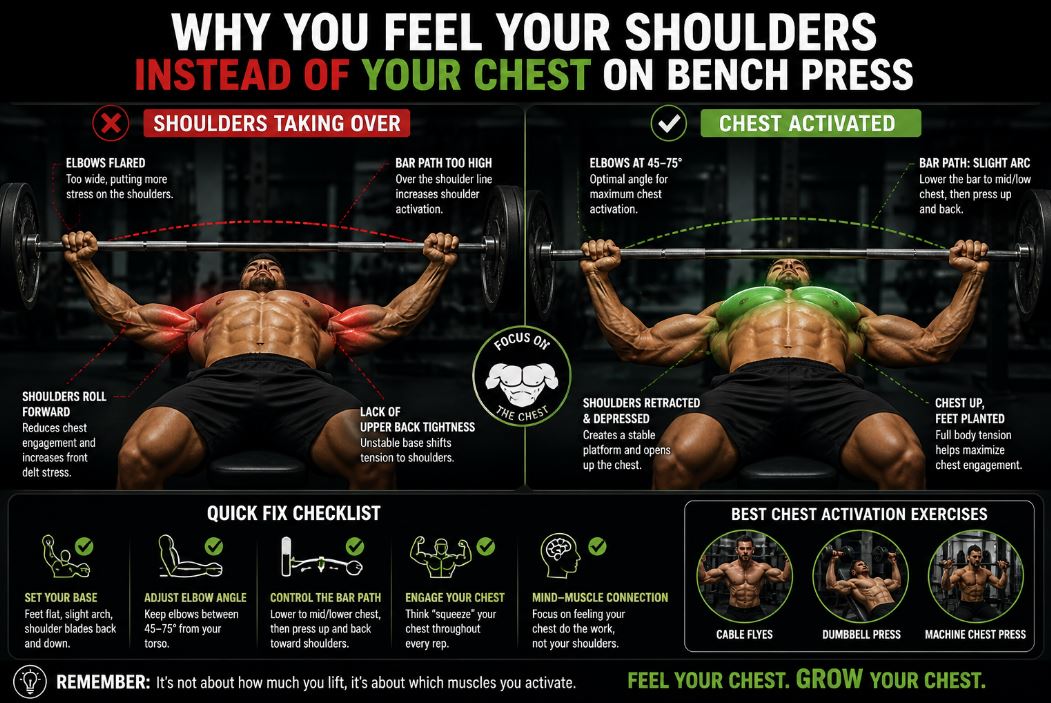
Reason #1: Your Elbows Are Too Flared
One of the biggest technical mistakes.
When your elbows flare out too much (close to 90°), you shift the load toward the shoulders and reduce chest involvement.
How to fix it:
- Keep elbows at about 45–75°
- Think “slightly tucked,” not flared
- Find a natural, strong pressing angle
Reason #2: Poor Shoulder Position (No Scapular Retraction)
If your shoulders are not pulled back and down, they move forward during the press, putting them in a dominant position.
How to fix it:
- Retract your shoulder blades (“pinch them together”)
- Keep them locked in place during the set
- Maintain a stable upper back
Reason #3: Wrong Bar Path
Many lifters press the bar straight up and down, or too high toward the shoulders.
This reduces chest activation and increases shoulder involvement.
How to fix it:
- Lower the bar toward your mid-to-lower chest
- Press slightly back toward your shoulders
- Follow a natural arc, not a straight line
Reason #4: You’re Using Too Much Weight
Heavy weight forces your body to compensate.
Your stronger muscles (shoulders) take over to complete the lift.
How to fix it:
- Reduce the load
- Focus on control and tension
- Build the technique first
Reason #5: No Chest Activation Before the Set
If your chest is not “awake,” it won’t contribute effectively.
How to fix it:
- Do light activation sets (cable fly, machine press)
- Focus on squeezing your chest before benching
Reason #6: Poor Mind-Muscle Connection
If you’re only focused on moving the bar, your chest won’t engage properly.
How to fix it:
- Think about bringing your arms together
- Focus on chest contraction during each rep
Reason #7: Shoulder-Dominant Movement Pattern
If you’ve been benching incorrectly for a long time, your body has learned to rely on your shoulders.
How to fix it:
- Relearn the movement with a lighter weight
- Slow down your reps
- Focus on chest-driven movement
How to Fix It (Step-by-Step)
Now that you understand the reasons, it’s time to fix the problem the right way.
This is where most lifters finally make progress—not by trying random tips, but by following a clear, repeatable setup and execution process. If you apply these steps consistently, you’ll start shifting tension from your shoulders to your chest almost immediately.
Step 1: Set a Strong Upper Body Position
Everything starts before the first rep.
If your setup is wrong, your shoulders will take over no matter how hard you try to “feel your chest.”
What to do:
- Lie on the bench and plant your feet firmly
- Slightly arch your upper back (natural, not excessive)
- Pull your shoulder blades back and down
- Keep your chest up and proud
Think: “chest up, shoulders locked in place.”
This creates a stable base and puts your chest in a stronger position to work.
Step 2: Choose the Right Grip Width
Your grip directly affects how much your chest vs shoulders are involved.
A grip that’s too narrow increases triceps and shoulder involvement, while a grip that’s too wide can put unnecessary stress on the joints.
What to do:
- Use a grip where your forearms are roughly vertical at the bottom
- Hands slightly wider than shoulder-width for most people
- Adjust slightly based on comfort and structure
Goal: find a position where your chest can generate force efficiently.
Step 3: Control Your Elbow Position
The elbow angle is one of the biggest factors in chest activation.
If your elbows flare too much, your shoulders take over. If they’re too tucked, the movement shifts toward triceps.
What to do:
- Keep elbows at about 45–75 degrees
- Let them follow a natural path—not forced
- Think about bringing your arms inward, not just pushing up
Cue: “Press with your chest, not your shoulders.”
Step 4: Use the Correct Bar Path
The bar’s path determines where the tension goes.
A straight-up-and-down path often shifts the load onto the shoulders.
What to do:
- Lower the bar toward your mid-to-lower chest
- Press slightly back toward your shoulders
- Follow a smooth, natural arc
Think: “down to chest, back toward shoulders.”
This keeps tension where you want it—on the chest.
Step 5: Slow Down and Control the Tempo
If you rush the movement, you lose control—and your shoulders take over.
What to do:
- Lower the bar in 2–3 seconds
- Press up with control (not explosive at first)
- Avoid bouncing the bar off your chest
Controlled reps = better activation
Step 6: Actively Engage Your Chest
Most lifters press the weight without thinking about the muscle.
That’s a mistake.
What to do:
- Focus on bringing your arms together
- Imagine squeezing your chest at the top
- Stay mentally engaged during every rep
Cue: “hug the bar inward.”
This helps shift tension from the shoulders to the chest.
Step 7: Use a Proper Warm-Up for Activation
Jumping straight into heavy bench press often leads to shoulder dominance.
Your chest needs to be “activated” first.
What to do:
- Do 2–3 light sets of:
- Cable flyes
- Machine chest press
- Focus on squeezing your chest
This improves mind-muscle connection before heavy work.
Quick Form Checklist — Feel Your Chest, Not Shoulders
Use this during your next workout:
- ✅ Chest up and shoulder blades locked
- ✅ Elbows at a natural angle, not flared
- ✅ Bar lowered to mid-to-lower chest
- ✅ Smooth, controlled tempo
- ✅ Full range of motion
- ✅ Active chest contraction
👉 If your shoulders are still taking over, go back to the setup—it’s almost always the issue.
Common Mistakes That Shift Tension to Shoulders
If you feel your shoulders more than your chest during bench press, one of these mistakes is usually the reason:
- ❌ Letting your shoulders roll forward during the press
- ❌ Flaring your elbows too wide
- ❌ Lowering the bar too high toward your upper chest or neck
- ❌ Using too much weight and losing control
- ❌ Pressing without retracting and stabilizing your shoulder blades
- ❌ Bouncing the bar off your chest
- ❌ Rushing reps instead of controlling the lowering phase
- ❌ Focusing only on moving the bar instead of engaging your chest
Best Exercises to Target Your Chest (Not Shoulders)
If you constantly feel your shoulders during pressing movements, the solution is not just fixing your bench press—it’s also choosing exercises that help you relearn proper chest activation.
As a coach working with lifters, I often temporarily reduce heavy barbell pressing and introduce movements that make it easier to feel and control the chest. Once that connection improves, it transfers back to the bench press.
Here are some of the best exercises for targeting your chest while minimizing shoulder involvement:
Dumbbell Bench Press
Dumbbells allow for a more natural movement pattern compared to a barbell.
- Greater freedom of movement
- Easier to adjust the elbow angle
- Better mind-muscle connection
👉 Focus on bringing the dumbbells slightly inward at the top to emphasize chest contraction.
Machine Chest Press
Machines are one of the most underrated tools for chest activation.
- High stability = less shoulder compensation
- Consistent tension throughout the movement
- Easier to focus purely on the chest
👉 Perfect for learning how chest activation should feel.
Cable Chest Fly
One of the best exercises for isolating the chest.
- Minimal shoulder involvement
- Strong contraction at the peak
- Excellent for mind-muscle connection
👉 Think about hugging a tree—bringing your arms together using your chest.
Pec Deck Machine
Similar to cable fly, but even more stable.
- Fixed path reduces technical errors
- Allows full focus on chest contraction
- Great for beginners struggling with activation
👉 Pause and squeeze at the end of each rep.
Incline Dumbbell Press
Targets the upper chest while still allowing better control than a barbell.
- Less shoulder dominance than the barbell incline press
- Easier to control elbow position
- Strong stretch at the bottom
👉 Keep the incline moderate (not too steep) to avoid excessive shoulder involvement.
Push-Ups (Controlled Form)
A simple but very effective movement when done correctly.
- Natural movement pattern
- Easy to control tempo
- Great for reinforcing chest activation
👉 Slow down your reps and focus on squeezing your chest at the top.
Key Takeaway
If your shoulders are taking over, don’t rely only on the bench press.
👉 Use these exercises to:
- Build mind-muscle connection
- Improve chest activation
- Reduce shoulder dominance
Once you learn how to properly engage your chest, your bench press will improve—and your chest will finally start doing the work.
Coach’s Note — The Truth About Chest Activation
As a coach working with lifters and athletes, I see this problem all the time. Many people think they have a weak chest, but in reality, they have never learned how to press with proper chest engagement.
When the shoulders take over during bench press, adding more weight usually makes the problem worse. The lifter gets stronger at the wrong pattern, while the chest continues to receive less effective tension.
The fix is not to abandon the bench press. The fix is to rebuild the movement from the setup: lock the shoulder blades, control the elbow angle, use the correct bar path, and press with intention. Once you learn to feel the chest working, the bench press becomes a much more productive exercise.
If you’re struggling with overall chest development—not just activation during bench press—this detailed guide will help you understand exactly what’s holding you back.
Final Thoughts
If you’ve been wondering why I feel my shoulders when bench pressing, the issue is rarely effort—it’s almost always technique and muscle activation. When your setup, elbow position, or bar path is off, your shoulders naturally take over.
The solution is not to press harder, but to press smarter. Fix your setup, control the movement, and focus on engaging your chest with every rep.
Once you shift the tension where it belongs, the bench press finally becomes what it’s meant to be—a chest exercise.
Fixing your technique is critical — but understanding how different bench variations affect chest activation will take your results to the next level.
Do long arms make it harder to feel your chest on bench press?
Yes. Lifters with longer arms often experience a greater range of motion, which can increase shoulder involvement. Focusing on tighter setup and controlled tempo becomes even more important.
Can poor shoulder mobility affect chest activation?
Absolutely. Limited shoulder mobility can prevent proper positioning, forcing your shoulders into a dominant role during pressing movements.
Does bench angle affect whether you feel chest or shoulders?
Yes. A higher incline shifts more load to the shoulders, while a flat or slight incline is generally better for chest activation.
Is it better to use dumbbells if I feel my shoulders too much?
Often yes. Dumbbells allow a more natural movement path and can make it easier to engage the chest while reducing shoulder stress.
Can grip strength affect chest activation on bench press?
Indirectly, yes. Over-gripping the bar can increase tension in the arms and shoulders, making it harder to focus on the chest.
Should I arch my back more to feel my chest?
A slight natural arch can improve chest engagement, but excessive arching can shift the movement away from the chest and reduce range of motion.
Why do I feel one shoulder more than the other during bench press?
This is often caused by imbalances, poor bar control, or uneven muscle activation. Single-arm exercises can help correct this.
Can warming up incorrectly lead to shoulder dominance?
Yes. Skipping chest activation work or warming up too heavy can prevent your chest from properly engaging during the main sets.
Do machines help fix shoulder-dominant bench press?
Yes. Machines provide stability and allow you to focus on chest contraction without worrying about balance and coordination.
Is shoulder fatigue before chest exercises a problem?
Definitely. If your shoulders are already fatigued, they may take over even more during pressing movements, reducing chest activation.
