


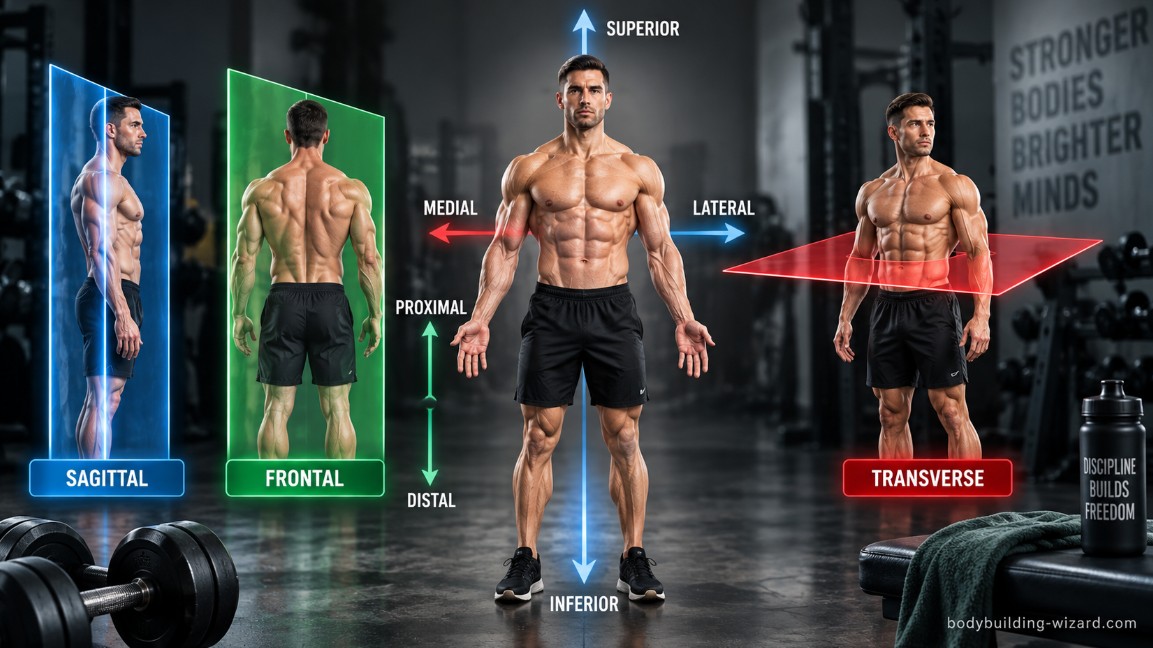
When an anatomy guide says the sternum is medial to the shoulders, the elbow is proximal to the wrist, or the abdominal muscles are superficial to many structures inside the abdomen, what does that actually mean? Anatomy uses a standardized language for describing where one structure sits relative to another, precisely so that a description stays unambiguous no matter how a person is currently standing, sitting, or moving through a lift.
Understanding these terms makes exercise anatomy, muscle attachments, joint mechanics, and movement analysis far easier to follow — and it’s the missing piece that connects everything we’ve covered in our Basic Anatomy and Physiology pillar, our guide to Anatomical Movements, and our guide to Planes of Motion and Axes of Rotation.
QUICK ANSWER: Anatomical position is the standard reference position from which all anatomical relationships are described. Directional terms are standardized words describing where one body structure lies relative to another, including superior/inferior, anterior/posterior, medial/lateral, proximal/distal, and superficial/deep. These terms describe relationships between structures — not simply where something appears from the viewer’s current perspective.
What Is the Anatomical Position?
The anatomical position is a specific reference posture: standing upright, head and eyes facing forward, feet directed forward, upper limbs alongside the body, palms facing forward, and thumbs pointing laterally — an internationally standardized reference position. Every directional term in this guide is defined relative to a body in this exact position.
Why Do Anatomists Use a Standard Position?
Without a fixed reference, descriptions of the body would constantly shift depending on the current pose. If someone raises their arm overhead, their hand is now physically above their elbow — but that doesn’t change the underlying anatomical relationships or terminology used to describe that limb. The standard position exists exactly so this kind of confusion can’t happen.
Why Anatomical Direction Does Not Change With Body Position
Take a biceps curl as an example. Whether the arm is hanging at the side, resting on a preacher bench, or extended overhead, the standard anatomical relationships between the biceps, the humerus, and the forearm remain defined relative to anatomical position, not to whatever position the limb happens to be in during that specific rep. In short: anatomical terminology uses a fixed reference system, not the body’s temporary orientation in space.
The Main Anatomical Directional Terms
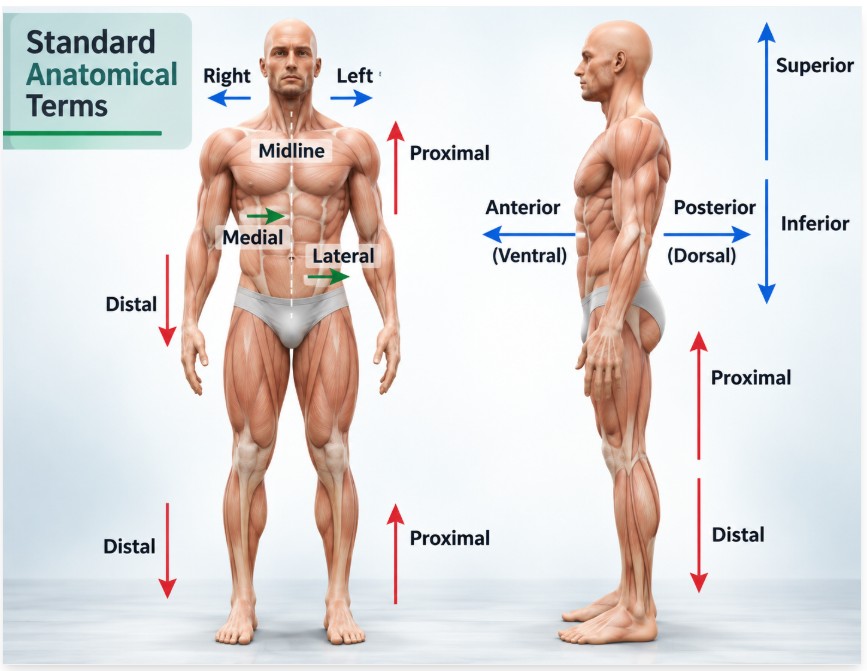
These five pairs, as defined in standard anatomy and physiology references, cover the vast majority of directional language you’ll encounter in exercise and anatomy writing.
| Term | Opposite | Meaning | Example |
| Superior | Inferior | Toward the head | The chest is superior to the abdomen |
| Anterior | Posterior | Toward the front | The sternum is anterior to the heart |
| Medial | Lateral | Toward the midline | The sternum is medial to the shoulders |
| Proximal | Distal | Nearer the trunk/attachment | Elbow is proximal to the wrist |
| Superficial | Deep | Nearer the body surface | Pectoralis major is superficial to the ribs |
Superior vs. Inferior
Superior means toward the head or the upper part of a structure — the chest is superior to the abdomen, and the shoulders are superior to the hips. Inferior means away from the head or toward the lower part — the knee is inferior to the hip, and the abdomen is inferior to the chest. The terms cranial and caudal exist as near-synonyms in some contexts, but in standard fitness and anatomy writing, you’ll encounter superior/inferior far more often.
Anterior vs. Posterior
Anterior means toward the front of the body — the sternum is anterior to the heart, while the vertebral column is posterior to the heart. Posterior means toward the back — a good fitness example is that the quadriceps are anterior to the hamstrings, while the hamstrings are posterior to the quadriceps.
This is a good moment to connect two other guides on this site: the terms anterior and posterior are true anatomical directional terms, while Anterior Chain and Posterior Chain are functional, coaching-oriented groupings built loosely around this same front/back language — not official anatomical systems in their own right.
Medial vs. Lateral
This is one of the most important pairs for lifters to internalize. Medial means toward the body’s midline — the sternum is medial to the shoulder. Lateral means away from the midline — the shoulders are lateral to the sternum.
Gym Example
The name “lateral raise” uses the everyday/anatomical idea of moving the arm laterally, but the formal joint action occurring at the shoulder is abduction. In other words, lateral describes a direction or relative position, whereas abduction describes a movement. See Anatomical Movements for the full breakdown of that distinction, and Best Lateral Deltoid Exercises for more on the muscle this movement targets.
Proximal vs. Distal
This pair is especially useful for describing the limbs, and it’s also one people commonly get wrong. Proximal means nearer to the trunk or the point where a limb or structure begins or attaches; distal means farther from it. On the limbs, the terms are especially straightforward: the elbow is proximal to the wrist, while the fingers are distal to the elbow.
Why Lifters Should Know This
These terms show up constantly in real training and injury contexts: proximal or distal biceps, a proximal or distal tendon, a distal triceps tear, a proximal hamstring strain, the distal radius, and general tendon injury discussions. The important warning here: proximal does not automatically mean “upper,” and distal does not automatically mean “lower.” They describe a relationship to an attachment point or the trunk, not a simple up/down position — which matters a great deal once you’re discussing something like the proximal hamstring (near the hip) versus the distal hamstring (near the knee).
Superficial vs. Deep
Superficial means closer to the body’s surface — the pectoralis major is superficial to the pectoralis minor. Deep means farther from the surface — the pectoralis minor is deep to the pectoralis major. Good bodybuilding-relevant examples of this relationship include the trapezius sitting superficial to the rhomboids, the gastrocnemius sitting superficial to the soleus, and the rectus abdominis sitting superficial to deeper abdominal musculature. These examples should click immediately for anyone who’s trained these muscle groups.
Intermediate
One additional term worth knowing: intermediate describes a structure positioned between two other structures — for example, a structure can be intermediate between a more medial structure and a more lateral one. It’s not one of the primary pairs, but it rounds out the vocabulary.
Ipsilateral vs. Contralateral
Ipsilateral means on the same side of the body — the right arm and the right leg are ipsilateral to each other. Contralateral means on opposite sides — the right arm and the left leg are contralateral.
Why This Matters in Exercise
This distinction matters throughout gait, running, unilateral training, and cross-body movement patterns. A suitcase carry loaded in the right hand, for instance, creates a demand on the trunk that plays out differently depending on which side and which specific stabilizing function you’re describing — worth being precise about here rather than oversimplifying which muscles are doing what.
Unilateral vs. Bilateral — Are They Directional Terms?
Not quite, though lifters encounter them constantly alongside true directional terms. Unilateral means involving one side of the body, and bilateral means involving both — a Bulgarian split squat is unilateral, while a standard barbell back squat is bilateral. Don’t confuse this pair with ipsilateral/contralateral: unilateral and bilateral describe how many sides of the body are involved in an exercise, while ipsilateral and contralateral describe the relationship between two specific structures or sides.
Prone vs. Supine
These aren’t directional terms in the same sense as the pairs above — they’re body-position terms — but they’re fundamental enough to anatomical-position language to belong in this guide. Supine means lying face upward; prone means lying face downward. Both show up constantly in fitness language: supine bench or floor exercises, prone back exercises, the prone leg curl, and prone Y or T raises are all named directly after this pair.
Central vs. Peripheral
This pair is particularly useful in the context of the nervous system: the central nervous system (brain and spinal cord) versus the peripheral nervous system (the nerves branching out from it). The exact meaning of “central” and “peripheral” shifts somewhat depending on the anatomical context, so treat this pair as context-dependent rather than as rigidly defined as the pairs above. See our Nervous System guide for the full picture of how this division works.
Anatomical Directional Terms vs. Planes of Motion
These answer genuinely different questions. Directional terms answer where the structure is. Planes of motion answer: in what plane does movement occur? The biceps being anterior to the triceps is a directional relationship; a biceps curl occurring predominantly in the sagittal plane is a plane-of-motion classification. See Planes of Motion and Axes of Rotation for the complete picture of that second question.
Directional Terms vs. Anatomical Movements
Another distinction worth locking in: “lateral” is a direction or location, while abduction is a movement away from the midline. “Anterior” is a location or direction, while shoulder flexion is a joint action. Keeping these separate prevents a lot of the confusion that trips up anatomy students early on — see Anatomical Movements Explained for the full joint-action vocabulary.
Directional Terms vs. Muscle Origin and Insertion
Origin and insertion describe a muscle’s specific attachment sites; proximal and distal describe relative position. These are related concepts but not synonyms — a muscle’s insertion can be described as distal to its origin, but “distal” and “insertion” aren’t interchangeable terms. See Muscle Anatomy Basics: Points of Origin & Insertion, Innervation for the full breakdown of attachment terminology.
How Directional Terms Appear in Strength Training
Real fitness language leans on this vocabulary constantly. Fitness language often uses terms such as “lateral deltoid,” although formal anatomical terminology commonly describes the deltoid as having anterior (clavicular), middle/acromial, and posterior (spinal) parts — a good illustration of the gap between everyday gym terminology and formal anatomical terminology. “Proximal” and “distal tendon” show up whenever biceps, hamstring, or other tendon issues are discussed — see Biceps Tendonitis and Weightlifting for a real-world example of this terminology in action.
“Superficial” and “deep muscles” explain why some muscles are never visible no matter how lean someone gets. “Anterior” and “posterior muscles” show up constantly when comparing the quads to the hamstrings, or discussing anterior and posterior chain terminology. And “contralateral loading,” as covered above, describes carries and split-stance work. This isn’t an exercise-programming guide, so we won’t go deeper than these quick illustrations — the point is simply that this vocabulary is already part of the language you use in the gym, whether or not you’ve had the formal terms for it.
Common Mistakes With Anatomical Directional Terms
Mistake 1: Thinking anterior means “up” and posterior means “down.” Anterior and posterior describe front and back, not up and down — that’s the job of superior and inferior.
Mistake 2: Confusing medial with “middle.” Medial means toward the midline, not necessarily positioned in the exact center of something.
Mistake 3: Using proximal and superior interchangeably. They aren’t the same. Proximal is relative to the trunk or an attachment point; superior is relative to the head.
Mistake 4: Using distal to mean “lower.” As covered above, distal is relative to an attachment point, not a simple vertical position.
Mistake 5: Confusing superficial with “unimportant.” Superficial only describes a depth relationship to the body surface — it says nothing about a structure’s functional significance.
Mistake 6: Describing left/right from the viewer’s perspective. This is a genuinely important and frequently forgotten rule: anatomical left and right always refer to the subject’s own left and right, not the observer’s. If you’re looking at someone facing you, their anatomical right hand is on your left.
How to Read an Anatomy Description
Here’s a real example sentence pulled straight from typical anatomy writing: “The pectoralis minor lies deep to the pectoralis major, lateral to the sternum, and anterior to the thoracic cage.” Breaking it down: deep to tells you the pectoralis major sits closer to the surface than the pectoralis minor does; lateral to tells you the pectoralis minor sits farther from the midline than the sternum; anterior to tells you it sits toward the front of the thorax. Once you can parse a sentence like this fluently, directional terminology stops feeling like jargon and starts functioning as exactly what it is: a coordinate system for anatomy.
Bodybuilder’s Take: You don’t need to speak in perfect anatomical Latin to train effectively. What’s actually useful is being able to read an anatomy diagram or a muscle description without getting lost — knowing that “proximal” isn’t “upper,” that “medial” isn’t “middle,” and that “superficial” says nothing about how important a muscle is. That small vocabulary shift makes every other anatomy resource on this site, and every exercise-science article you’ll ever read, dramatically easier to follow.
Coach’s Note: Why Lifters Should Learn Anatomical Language. As a coach, I don’t expect lifters to memorize anatomical terminology simply to sound technical. The value is practical: once you understand terms like proximal, distal, medial, lateral, superficial, and deep, exercise anatomy becomes much easier to interpret. You can understand where a muscle lies, where a tendon attaches, and what a biomechanics explanation is actually describing without relying entirely on diagrams.
Key Takeaways
- ✓Anatomical position provides the fixed reference every directional term is defined against.
- ✓Directional terms describe relationships between structures, not the viewer’s perspective.
- ✓Superior/inferior describe toward the head versus toward the feet.
- ✓Anterior/posterior describe toward the front versus toward the back.
- ✓Medial/lateral describe toward versus away from the midline.
- ✓Proximal/distal describe nearer versus farther from the trunk or attachment point, not simply up or down.
- ✓Superficial/deep describe nearer versus farther from the body surface.
- ✓Ipsilateral/contralateral describe the same side versus opposite sides of the body.
- ✓These terms remain fixed to anatomical position regardless of how the body is actually oriented during an exercise.
- ✓Directional terms are not the same thing as joint actions or planes of motion.
Frequently Asked Questions
What is the anatomical position?
The anatomical position is the standard reference posture: standing upright, facing forward, arms at the sides, palms facing forward, thumbs pointing away from the body. All directional terms are defined relative to a body in this position.
What are anatomical directional terms?
Anatomical directional terms are standardized words that describe where one body structure lies relative to another, such as superior, inferior, anterior, posterior, medial, lateral, proximal, distal, superficial, and deep.
What are the main directional terms in anatomy?
The core pairs are superior/inferior, anterior/posterior, medial/lateral, proximal/distal, and superficial/deep, along with ipsilateral/contralateral for describing sides of the body.
What is the difference between anterior and posterior?
Anterior means toward the front of the body, while posterior means toward the back. The sternum, for example, is anterior to the heart.
What is the difference between medial and lateral?
Medial means toward the body’s midline, while lateral means away from the midline. The sternum is medial to the shoulders, and the shoulders are lateral to the sternum.
What is the difference between proximal and distal?
Proximal means nearer the trunk or a structure’s point of attachment, while distal means farther from it. These describe a relationship to an attachment point, not simply “up” or “down.”
What is the difference between superficial and deep?
Superficial means nearer the body’s surface, while deep means farther from it. The pectoralis major, for instance, is superficial to the pectoralis minor.
What is the difference between superior and inferior?
Superior means toward the head, while inferior means toward the feet. The chest is superior to the abdomen, for example.
What do ipsilateral and contralateral mean?
Ipsilateral means on the same side of the body, while contralateral means on opposite sides. The right arm and right leg are ipsilateral; the right arm and left leg are contralateral.
Do anatomical directional terms change when the body moves?
No. Directional relationships are defined using anatomical position as the standard reference. A person does not need to remain physically in anatomical position for those terms to retain their meaning — raising an arm overhead doesn’t change the anatomical relationships used to describe that limb.
Is proximal the same as superior?
No. Proximal describes nearness to the trunk or an attachment point, while superior describes nearness to the head. They often overlap in casual usage but describe different anatomical relationships.
Is lateral the same as abduction?
No. Lateral is a directional term describing location or position, while abduction is a joint action describing movement away from the midline. A lateral raise moves the arm through abduction, but “lateral” and “abduction” describe different concepts.
References
- Federative International Programme for Anatomical Terminology (FIPAT). Terminologia Anatomica, 2nd ed., Part 1: General Anatomy. cdn.dal.ca (FIPAT TA2 Part 1)
- Betts, J. G., et al. (2023). Anatomy and Physiology 2e — Anatomical Terminology. OpenStax. openstax.org/details/books/anatomy-and-physiology-2e
- Standring, S. (Ed.). (2020). Gray’s Anatomy: The Anatomical Basis of Clinical Practice (42nd ed.). Elsevier.
- Moore, K. L., Dalley, A. F., & Agur, A. M. R. (2023). Clinically Oriented Anatomy (9th ed.). Wolters Kluwer.
- Neumann, D. A. (2016). Kinesiology of the Musculoskeletal System: Foundations for Rehabilitation (3rd ed.). Elsevier.
