
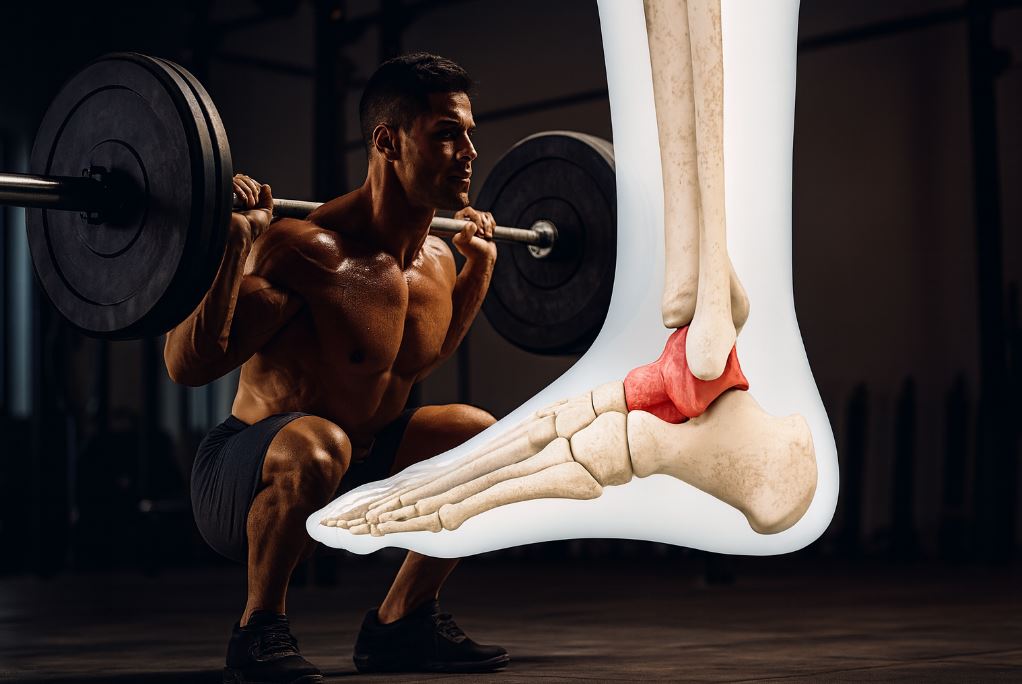
The talus is one of the most important yet least discussed bones in the athletic world. It plays a critical role in ankle stability, movement efficiency, and the ability to transfer force through the lower body. For athletes, bodybuilders, and serious lifters, understanding how the talus works can dramatically improve performance while reducing injury risk.
In this article, we take a clear and practical look at the anatomy of the talus and why this small ankle bone plays such a significant role in athletic performance. We explain where the talus is located, how it is shaped, and how it forms key joints that influence ankle mobility, stability, and force transfer. You will also learn how the talus affects squat depth, running mechanics, and overall lower-body movement quality.
In addition, we cover the most common talus injuries, exercises that put high stress on this bone, effective treatment options, coach-specific insights, and a final FAQ section that provides athletes with everything they need to train safely and perform better.
Brief Anatomy of the Talus
Definition
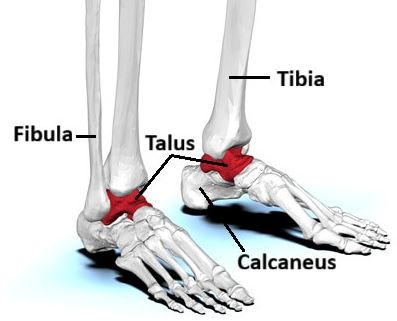
The talus is a small but structurally powerful ankle bone that sits between the tibia, fibula, and calcaneus. It forms the primary connection between the leg and the foot, transferring bodyweight downward while enabling ankle dorsiflexion, plantarflexion, inversion, and eversion.
Understanding the anatomy of the talus is essential for athletes to recognize how this compact ankle bone stabilizes force transfer, enables multidirectional movement, and influences injury risk during training and competition.
A. Location
The talus sits in the ankle joint between the tibia and fibula above, and the calcaneus below. It forms the “ankle mortise,” the hinge that allows smooth up-and-down ankle motion.
B. Appearance
- dome-shaped top (trochlea)
- narrow posterior section
- smooth cartilage-covered surfaces
- no muscle attachments (rare among bones!)
This unique design allows the talus to act as a pure force-transfer bone.
C. Size
Small compared to the tibia/fibula, but incredibly dense. Takes 100% of bodyweight during standing and up to 6× bodyweight during running or jumping.
D. Articulations
The talus forms three major joints:
| Joint | Connection | Purpose |
|---|---|---|
| Tibiotalar joint | Talus + tibia | Dorsiflexion/plantarflexion |
| Subtalar joint | Talus + calcaneus | Inversion/eversion |
| Talonavicular joint | Talus + navicular | Rotational stability, arch mechanics |
Biomechanics of the Talus in Sports
Before looking at specific motions, it’s important to understand how strongly the talus influences balance, mobility, and power output in sports and strength training.
The talus is the “keystone” bone of the ankle complex. It:
- transmits forces between the leg and the foot
- controls ankle stability under load
- allows smooth direction changes
- absorbs torque and twisting forces
- influences squat depth, running stride, and explosive jumps
Even minor restrictions in talus mobility can affect:
- squat ankle dorsiflexion
- calf tightness
- knee tracking
- foot arch stability
- balance and power output
Muscles & Ligaments Connected to the Talus
The talus is unique because no muscles attach directly to it.
Stabilization is provided by ligaments, including:
- Deltoid ligament (medial stability)
- Anterior talofibular ligament (ATFL)
- Posterior talofibular ligament (PTFL)
- Calcaneofibular ligament (CFL)
- Interosseous talocalcaneal ligament
These ligaments prevent ankle sprains, rolling, and rotational collapse.
Blood Supply & Nerve Supply
The talus has a poor blood supply, which slows healing after injury.
Blood supply sources:
- posterior tibial artery
- dorsalis pedis artery
- perforating the peroneal artery
Innervation comes from:
- deep peroneal nerve
- tibial nerve
- sural nerve
Functions of the Talus
The talus plays a far more influential role in movement and athletic performance than its small size suggests. As the central connector between the leg and the foot, it serves as the pivot point of the entire ankle complex. Because it has no direct muscle attachments, its position and motion depend entirely on surrounding ligaments, joint geometry, and the forces placed upon it — making its function uniquely crucial for athletes.
Here are the core functions of the talus:
1. Force Transmission
The talus is the primary bone responsible for transferring load from the tibia into the foot. Every step, jump, landing, and squat funnels force through the talus before it disperses into the rearfoot and forefoot. This makes it essential for stability under heavy loads.
2. Controlled Ankle Movement Under Load
The talus enables smooth dorsiflexion and plantarflexion by gliding within the ankle mortise. Restricted talar glide can limit squat depth, affect stride mechanics, and create compensations further up the chain (knees, hips, lower back).
3. Shock Absorption
Although small, the talus helps dissipate impact forces during running, jumping, and landing. Proper talus positioning protects both the ankle joint and the surrounding soft tissues, reducing injury risk.
4. Multiplanar Motion
Together with the calcaneus, the talus allows inversion, eversion, and subtle rotational movements. These motions are crucial for agility, cutting, direction changes, and stability on uneven surfaces.
5. Posture and Balance Adjustments
The talus acts as the “balancing stone” of the foot. Small shifts in its position influence the entire alignment of the ankle and foot arch, affecting balance, proprioception, and stability during athletic performance.
Interactions With Other Bones
The talus is part of the rearfoot tripod:
- tibia
- fibula
- calcaneus
It also interacts with the navicular, influencing foot arch mechanics.
Exercises That Stress the Talus
Specific movements place much higher mechanical stress on the talus than others, especially those that demand deep ankle dorsiflexion, explosive landings, or uneven-surface stability. The table below highlights key exercises that load the talus, their main risks, and practical tips to reduce injury potential.
| Exercise | Risk | Tip |
|---|---|---|
| Deep Squats | High dorsiflexion demands compress the talus against the tibia, which can cause anterior ankle impingement. | Work on ankle mobility and reduce depth or load if you feel pinching at the front of the ankle. |
| Box Jumps | Landing forces load the talus heavily and can overload the subtalar joint if mechanics are poor. | Focus on soft, controlled landings through the midfoot and avoid “crashing” onto the heels. |
| Heavy Calf Raises | Strong plantarflexion forces the talus into a posterior glide, which may contribute to rearfoot stiffness. | Use a slow tempo and full control at the bottom position, and pair calf work with ankle mobility drills. |
| Trail Running | Uneven terrain stresses the subtalar joint and can increase rotational load on the talus. | Choose stable footwear with good rearfoot support and gradually increase time spent on technical terrain. |
Common Injuries Affecting the Talus
The talus is vulnerable to several injuries that can significantly impact ankle mobility, stability, and overall athletic performance. Because this bone absorbs high forces during running, jumping, squatting, and directional changes, even minor trauma can lead to noticeable symptoms. The table below summarizes the most common talus-related injuries, their causes, hallmark symptoms, and the level of risk they pose to athletes.
| Injury | Main Cause | Key Symptoms | Risk for Athletes |
|---|---|---|---|
| Talus Fracture | High-impact trauma, hard landings, twisting injuries during sport. | Severe ankle pain, swelling, inability to bear weight, bruising. | High in parkour, basketball, gymnastics, trail running. |
| Osteochondral Lesion of the Talus (OLT) | Repeated ankle sprains or cartilage damage after twisting injuries. | Deep ankle pain, catching/locking, stiffness, instability. | Medium–high in athletes with chronic ankle sprains. |
| Anterior Ankle Impingement | Repetitive dorsiflexion from squats, sprints, and explosive jumping. | Sharp pain at the front of the ankle during deep flexion. | High in weightlifters, sprinters, CrossFit athletes. |
| Subtalar Joint Sprain | Running on uneven surfaces, rapid cutting, or directional changes. | Lateral ankle pain, instability on slopes or uneven terrain. | High in trail runners and field athletes. |
| Avascular Necrosis (AVN) of the Talus | Loss of blood supply after a fracture or severe trauma. | Deep persistent pain, stiffness, limited ankle ROM. | Low overall but serious when trauma is involved. |
Common Treatments for Talus Injuries
Managing talus injuries requires a structured approach, since this bone has a limited blood supply and plays a vital role in ankle mechanics. Effective treatment focuses on reducing load, restoring joint mobility, and stabilizing the ankle to prevent long-term complications. The table below provides a clear overview of the most commonly recommended treatment strategies, including when to use them, who benefits most, and expected recovery times.
| Treatment Method | Description | When to Use It | Best For | Typical Duration |
|---|---|---|---|---|
| Rest & Load Reduction | Reduces stress on the talus by limiting high-impact and deep dorsiflexion activities. | Initial phase of pain, swelling, or when walking becomes uncomfortable. | Mild sprains, early impingement, overuse-based talar irritation. | 3–10 days depending on severity. |
| Ice & Inflammation Control | Helps reduce swelling and pain in acute or post-exertion phases. | Immediately after injury or after training sessions that irritate the ankle. | Sprains, OLT flare-ups, impact trauma. | 10–15 minutes per session, up to 2–3× daily. |
| Ankle Mobility Drills | Improves talus glide and restores ankle dorsiflexion essential for squats and running. | When movement restriction or pinching occurs during dorsiflexion. | Weightlifters, sprinters, CrossFit athletes. | Daily practice for 2–6 weeks. |
| Strength & Stability Training | Focuses on peroneals, tibialis posterior, and foot intrinsics to support the talus. | After acute pain subsides and mobility begins improving. | Chronic instability, subtalar sprains, recurring ankle dysfunction. | 4–12 weeks depending on deficits. |
| Footwear Modification | Enhances rearfoot stability and reduces excessive subtalar rotation. | During running, HIIT, and plyometric training. | Athletes with pronation issues, trail runners. | Immediate relief; reassess every 4–6 months. |
| Physical Therapy | Combines mobility, strengthening, proprioception, and gait retraining. | When pain or instability persists beyond the first week. | OLT cases, chronic ankle sprains, post-fracture rehab. | 6–12 weeks depending on injury complexity. |
| Medical Imaging & Evaluation | Used to diagnose talus fractures, OLT lesions, and AVN risk after significant trauma. | When severe pain, swelling, or inability to bear weight is present. | Suspected fracture, deep joint pain, post-traumatic symptoms. | Immediate evaluation recommended. |
Coach’s Corner
Coach’s Corner
Understanding the anatomy of the talus is one of the most underrated performance advantages an athlete can have. I’ve coached lifters, runners, and field athletes for years, and ankle issues often come back to how the talus moves — or fails to move — under load. When the talus gets locked up, dorsiflexion drops, squat mechanics collapse, and landing forces shoot through the knee and hip instead of being absorbed efficiently. That’s why I always program targeted ankle mobility, controlled landings, and rearfoot stability work. A healthy talus doesn’t just keep you injury-free — it directly improves power output, balance, and every movement that starts from the ground up.
Conclusion
Understanding the anatomy of the talus is essential for anyone who relies on strong, efficient lower-body movement—especially athletes, runners, and lifters. This small but powerful ankle bone controls how force travels from the leg into the foot, influencing balance, mobility, and performance in every step, jump, or squat. By maintaining good ankle mobility, strengthening the surrounding muscles, and addressing early signs of irritation or instability, athletes can protect the talus and maintain smooth, strong, injury-free movement patterns.
Key Takeaways
- The anatomy of the talus plays a central role in ankle mobility, stability, and force transfer in every athletic movement.
- The talus connects the tibia, fibula, and calcaneus, acting as the primary link between the leg and the foot.
- Poor talus mechanics reduce dorsiflexion, disrupt squat depth, and increase stress on the knees, hips, and lower back.
- Common talus injuries include fractures, osteochondral lesions (OLT), anterior ankle impingement, subtalar sprains, and, in rare cases, avascular necrosis.
- High-risk movements include deep squats, explosive landings, trail running, and heavy calf raises.
- Early treatment focuses on rest, load reduction, mobility drills, and inflammation control; advanced cases require physical therapy or medical evaluation.
- Athletes benefit from combining ankle mobility, foot-strengthening work, and technique refinement to protect the talus long-term.
- Optimizing talus function directly improves athletic performance, balance, and overall movement efficiency.
What makes the talus different from other bones in the foot?
The talus is unique because it has no direct muscular attachments. All movement around it is controlled by forces transmitted through the tibia, fibula, calcaneus, and surrounding ligaments. This makes talus positioning highly dependent on ankle mechanics and joint surface alignment.
Why is talus blood supply clinically important?
The talus has a limited and fragile blood supply, which puts it at higher risk for complications like delayed healing or avascular necrosis (AVN) after trauma. Even minor fractures can compromise circulation, so early imaging and diagnosis are essential.
How does the anatomy of the talus influence squat depth?
Deep squat depth depends heavily on how well the talus can glide posteriorly during dorsiflexion. Restricted talar glide leads to early “ankle block,” causing heels to lift, knees to cave in, or the torso to pitch forward.
Can poor talus mobility cause knee or hip pain?
Yes. When the talus cannot move correctly, the body compensates by altering knee and hip mechanics. This can contribute to patellar tracking issues, medial knee stress, hip rotation imbalances, and reduced force transfer during athletic movements.
What is an osteochondral lesion of the talus (OLT)?
An OLT is a cartilage-and-bone injury on the top of the talus (talar dome). It often follows ankle sprains and can cause deep joint pain, clicking, catching, or stiffness that doesn’t resolve with standard sprain treatment.
Why does dorsiflexion improve when the talus is mobilized?
During dorsiflexion, the talus must slide backward. If this movement is blocked by joint stiffness, scar tissue, or altered alignment, mobility decreases. Manual talus mobilizations restore this glide and immediately increase ankle ROM.
Can athletes train normally after a talus fracture?
Return to training depends on fracture type and healing progress. Because the talus withstands high compressive forces, athletes usually need strict immobilization first, followed by graded weight-bearing and targeted mobility work under medical supervision.
Is trail running riskier for the talus than flat-surface running?
Yes. Uneven surfaces increase subtalar joint rotation, which places more torsional stress on the talus. Trail runners often report lateral ankle instability or subtalar sprains related to rapid foot adjustments on rocks, roots, and slopes.
How can I tell if my talus is contributing to limited ankle mobility?
If you feel a pinch at the front of the ankle during dorsiflexion, struggle with squat depth, or notice asymmetry between ankles, the talus is likely not gliding properly. Mobility tests, such as the wall ankle test, can help confirm this.
Do lifting shoes help reduce stress on the talus?
Yes. Lifting shoes with an elevated heel reduce the required dorsiflexion angle during squats, decreasing anterior ankle compression. This decreases talar impingement risk, especially for athletes with stiff ankles or restricted joint glide.
