



Introduction
Well-developed rear delts are essential for building balanced shoulders, improving posture, and maintaining long-term shoulder health. In my experience, however, this is one of the most commonly neglected muscle groups, largely because many lifters struggle to properly isolate the posterior deltoids with free weights.
The reverse pec deck fly, also known as the machine rear deltoid fly, is one of the most effective exercises for targeting the rear delts in a controlled and stable environment. This movement is typically performed on a standard pec deck machine — the same machine used for chest flyes — but with your body positioned in reverse, facing the pad.
Depending on the machine design, you may be using either handles or elbow pads, but the principle remains the same. If the machine has handles, you grip them and move your arms outward. If it has pads, you drive the movement with your elbows instead. In both cases, the goal is identical: to perform a controlled rear delt fly with minimal assistance from other muscle groups.
What makes this exercise especially valuable is its ability to provide consistent resistance throughout the entire range of motion, something that is harder to achieve with dumbbells. It also eliminates the need to stabilize your torso in a bent-over position, allowing you to focus entirely on activating your rear delts.
In this complete guide, I’ll show you how to perform the reverse pec deck fly with proper technique, how to avoid the most common mistakes, and how to use this machine to maximize posterior deltoid development.
Alternative Names for the Reverse Pec Deck Fly
The reverse pec deck fly is known under several different names depending on the type of machine, gym terminology, and coaching background. In my experience, this is one of those exercises where multiple names refer to the exact same movement, which can sometimes confuse beginners.
Understanding these alternative names will help you recognize the exercise across different programs, tutorials, and gym environments — regardless of how it’s labeled.
- Reverse pec deck fly
- Machine rear deltoid fly
- Machine rear delt fly
- Rear delt machine fly
- Reverse machine fly
- Pec deck rear delt fly
Equipment Needed for the Reverse Pec Deck Fly
The reverse pec deck fly requires only a single machine, which makes it one of the most accessible and beginner-friendly rear delt exercises. In my experience, this simplicity is a big advantage, as it allows you to focus entirely on execution rather than setup or stabilization.
- Pec deck machine – used in reverse position (facing the pad) to perform the rear delt fly
- Adjustable seat (built-in) – ensures proper alignment so your shoulders are level with the handles or pads
- Handles or elbow pads – depending on the machine design, you either grip the handles or drive the movement with your elbows
How to Perform the Reverse Pec Deck Fly
Proper setup is essential when using the pec deck machine in reverse, as even small adjustments in seat height or arm position can significantly affect rear delt activation. In my experience, this is one of the few exercises where getting the setup right immediately improves how the movement feels.
Starting Position (Setup)
Before initiating the movement, make sure the machine is properly adjusted to match your body proportions. A correct setup ensures that the rear delts are aligned with the resistance.
- Sit facing the machine with your chest firmly against the pad
- Keep your core engaged, chest up, and spine neutral
- Adjust the seat so that your shoulders are level with the handles or elbow pads
- Place your hands on the handles (neutral or pronated grip) or position your elbows on the pads
- Start with your arms extended forward with a slight bend in the elbows
- Keep your shoulders relaxed and not elevated

Movement (Execution)
Once you’re properly set up, the goal is to move the arms using the rear delts while keeping the movement controlled and consistent.
- Initiate the movement by moving your arms outward and backward in an arc
- Focus on leading with your elbows, not your hands
- Keep your arms roughly parallel to the floor throughout the movement
- Pull until your arms are in line with your torso or slightly behind it
- Squeeze your rear delts at the top of the movement
- Pause briefly to maximize contraction and control
- Slowly return to the starting position under control
- Avoid letting the weight stack rest completely between repetitions

If your machine has elbow pads instead of handles, think about driving your elbows outward rather than forcing the movement with your hands. This usually makes it much easier to keep the tension on the rear delts and prevents the exercise from turning into a trap-dominant movement.
Video Demonstration
Watching a proper demonstration of the reverse pec deck fly can help you understand the correct movement pattern much faster. In practice, many lifters think they’re performing the exercise correctly until they see how controlled and precise the motion should actually be.
Pay close attention to the arm path, elbow positioning, and tempo. Notice how the movement is driven by the elbows, not the hands, and how the shoulders stay down without shrugging. Also, observe the controlled return phase, which is just as important as the lift itself.
Below, you can watch a demonstration showing proper technique for the reverse pec deck fly.
Muscles Worked in Reverse Pec Deck Fly
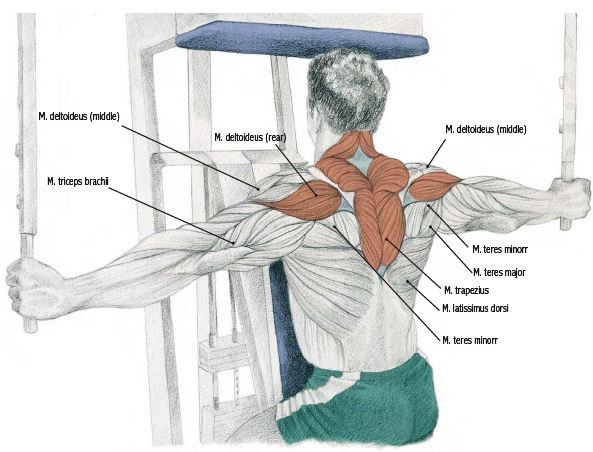
The reverse pec deck fly primarily targets the muscles responsible for shoulder horizontal abduction, with the machine setup helping to reduce momentum and improve isolation. In my experience, this is one of the easiest exercises to truly feel the rear delts working, especially compared to free-weight variations.
- Primary muscles: posterior deltoids
- Secondary muscles: rhomboids, middle trapezius, infraspinatus, teres minor
- Stabilizing muscles: lower trapezius, rotator cuff musculature
- Antagonist muscles: anterior deltoids, pectoralis major
In practice, this is one of the few rear delt exercises where beginners can immediately feel the target muscle working. The machine limits compensation from stronger muscle groups, making it much easier to develop a proper mind-muscle connection with the posterior deltoids.
How the Reverse Pec Deck Fly Works: Biomechanics & Mechanics
The reverse pec deck fly is a machine-based isolation movement designed to train shoulder horizontal abduction in a highly controlled environment. In my experience, one of the biggest advantages of this exercise is that the machine reduces the need for balance and torso stabilization, making it much easier to keep tension on the rear delts.
Key Joint Actions
- Shoulder horizontal abduction – the arms move outward and backward away from the midline, driven primarily by the posterior deltoids
- Minimal scapular retraction – the shoulder blades move slightly, but excessive retraction shifts the emphasis to the upper back
- Minimal elbow movement – the elbow angle stays relatively fixed, keeping the movement focused on the shoulder joint
Role of Machine Design
- Handles or pads guide the movement path – this makes the exercise more stable than dumbbell or cable variations
- The machine reduces momentum – this improves isolation and makes cheating more difficult
- Seat height affects alignment – the shoulders should line up with the handles or pads for the best rear delt recruitment
Arm Path Mechanics
- The movement follows a wide arc – the arms travel outward rather than straight backward
- Leading with the elbows improves rear delt activation – especially on machines with pads
- A controlled path helps keep tension on the posterior deltoids – instead of shifting the work to the traps and rhomboids
Resistance Profile
- Resistance is machine-based – this usually provides more consistent tension than dumbbells
- The rear delts stay loaded through most of the range of motion – especially in the mid-to-shortened range
- The machine makes it easier to maintain tension between reps – as long as you don’t let the stack fully rest
Stability and Isolation Advantage
- Chest support reduces lower-back involvement – this is especially helpful for lifters who struggle with bent-over variations
- The fixed setup improves repeatability – making progression easier to track
- The exercise is highly isolation-focused – fewer supporting muscles are needed to control body position
From a coaching perspective, the biggest strength of the reverse pec deck fly is that it makes rear delt training more precise and repeatable. When the seat is adjusted correctly and the movement is driven by the elbows, it becomes one of the most effective ways to isolate the posterior deltoids without unnecessary compensation from the rest of the upper body.
Technique Optimization Tips
The reverse pec deck fly may look simple, but small technical details make a big difference in how effectively you target the rear delts. In practice, most mistakes come from poor arm path and excessive trap involvement. However, once you dial in a few key cues, the exercise becomes much more effective.
- Lead with your elbows, not your hands. This keeps the focus on the rear delts and prevents the movement from turning into a trap-dominant pull.
- Keep your chest firmly against the pad. This reduces momentum and helps maintain a consistent movement pattern.
- Avoid shrugging your shoulders. Elevating the shoulders shifts the load to the upper traps instead of the rear delts.
- Use a controlled tempo. Lift smoothly and lower the weight slowly to maintain constant tension.
- Adjust the seat height correctly. Your shoulders should align with the handles or pads for optimal mechanics.
- Don’t over-retract your shoulder blades. Excessive scapular retraction turns the exercise into a mid-back movement.
- Pause briefly at the top. This improves contraction and strengthens the mind-muscle connection.
- Use a manageable load. If you rely on momentum, the weight is too heavy.
Technical Emphasis & Targeting Adjustments
Small setup and execution changes can noticeably alter how the reverse pec deck fly feels. In practice, these adjustments help you keep more tension on the rear delts and reduce help from the traps and mid-back.
- Lead more with the elbows. This usually improves rear delt isolation, especially on machines with pads.
- Keep the shoulders down. This reduces upper trap dominance and keeps the movement cleaner.
- Use a slightly shorter range of motion if needed. Stopping just before the traps take over can improve rear delt tension.
- Adjust the seat height carefully. A better shoulder-to-handle alignment often makes the exercise feel much smoother.
- Pause briefly at peak contraction. This strengthens the mind-muscle connection and improves control.
- Use one arm at a time if necessary. This can help reduce compensation and improve focus on the rear delt on each side.
The most effective way to use this exercise is to adjust your setup and arm path so the rear delts stay under tension, rather than letting the traps or upper back take over.
Reverse Pec Deck Fly Benefits and Drawbacks
The reverse pec deck fly is one of the most effective exercises for isolating the rear delts, thanks to its stable, controlled setup. In my experience, it’s a great option for most lifters, but like any exercise, it comes with both advantages and limitations.
Benefits
- Provides excellent rear delt isolation. The machine setup minimizes momentum and keeps tension on the posterior deltoids.
- Offers consistent resistance. Unlike dumbbells, the machine maintains tension throughout most of the range of motion.
- Easy to learn and perform. The guided path makes it beginner-friendly and reduces technical complexity.
- Reduces lower-back involvement. The seated, supported position eliminates the need for torso stabilization.
- Improves mind-muscle connection. The controlled environment helps you feel the rear delts working more clearly.
Drawbacks
- Limited functional carryover. The fixed machine path does not provide as much stabilization as free-weight exercises.
- Can encourage over-retraction. Many lifters pull too far back, shifting the load to the upper back.
- Machine setup matters. An incorrect seat height can reduce effectiveness and alter muscle activation.
- Not always available. Some gyms may not have a suitable machine for this movement.
- Easy to rely on the machine too much. Overusing machines may limit overall shoulder development if free weights are neglected.
This exercise works best when used alongside free-weight variations, allowing you to combine isolation with functional strength and control.
Reverse Pec Deck Fly Variations
Although the reverse pec deck fly is already a highly effective isolation exercise, small variations can change the feel of the movement and improve rear delt activation. In practice, rotating these options can help you avoid plateaus and better target the posterior deltoids.
🔹 One-Arm Reverse Pec Deck Fly

Performing the movement one arm at a time improves focus and helps correct muscular imbalances. It also reduces compensation from the upper back and allows for a more controlled contraction.
🔹 Reverse Pec Deck Fly with Elbow Pads

Some machines use pads instead of handles, which shifts the emphasis toward driving the movement with the elbows. In my experience, this often improves rear delt isolation and reduces wrist involvement.
🔹 Reverse Pec Deck Fly with Handles

Using handles allows for different grip positions, such as neutral or pronated. This variation offers more freedom of movement and can feel more natural for some lifters.
🔹 Partial Range Reverse Pec Deck Fly
Using a slightly reduced range of motion can help maintain constant tension on the rear delts. This is especially useful if you tend to lose tension at the end of the movement.
🔹 Slow Tempo Reverse Pec Deck Fly
Slowing down both the lifting and lowering phases increases time under tension. As a result, this variation is excellent for improving mind-muscle connection and hypertrophy.
🔹 Reverse Pec Deck Fly with Pause
Adding a pause at the peak contraction forces you to control the weight and maximize rear delt activation. Even a one-second pause can significantly increase the effectiveness of the exercise.
From a coaching perspective, the best variation is the one that lets you perform the movement with proper alignment, controlled execution, and no joint discomfort. If a certain machine setup feels awkward or shifts the tension away from the rear delts, don’t force it—adjust the variation so the target muscle stays in charge.
Replacement Exercises for the Reverse Pec Deck Fly
If the reverse pec deck fly isn’t available or you’re not comfortable with it, you still have several effective options for targeting the rear delts. In practice, rotating between different tools can improve activation and help you avoid plateaus.
- Bent-over dumbbell lateral raise. A classic free-weight option that builds control and coordination while targeting the posterior deltoids.
- Chest-supported rear delt raise. This variation reduces momentum and lower-back involvement, making it easier to isolate the rear delts.
- Two-arm cable rear delt fly. Cables provide more consistent tension, especially in the bottom portion of the movement.
- One-arm cable rear delt fly. Improves focus on each side and helps correct muscular imbalances.
- Reverse cable crossover. This variation allows for a deep stretch and constant tension, making it highly effective for activating the rear delt.
- Face pull. A versatile exercise that targets the rear delts along with the upper back and rotator cuff.
- Resistance band rear delt fly. A simple, effective, home-friendly alternative with adjustable resistance.
For more options, explore our full collection of rear deltoid exercises.
Where This Exercise Fits in a Workout
The reverse pec deck fly works best as an isolation accessory within your shoulder or upper-body training. Because the machine stabilizes your body, you can focus fully on activating your rear delts. In practice, this makes it ideal for controlled, higher-rep work.
- After primary compound lifts. Place it after rows, pull-ups, or presses when you move into isolation work.
- As a rear delt isolation movement. Use it to directly target the posterior deltoids, which are often undertrained.
- In hypertrophy-focused sessions. It responds well to moderate-to-high reps with strict control.
- As a corrective or balance exercise. Helps improve posture and shoulder symmetry over time.
- In supersets or finishers. Pair it with lateral raises or face pulls to increase volume and time under tension.
Sets and Reps Recommendations
The reverse pec deck fly works best with controlled reps and moderate loads. Because the machine stabilizes your body, you can focus on clean execution and consistent tension. In practice, chasing heavy weight usually reduces rear delt activation, so prioritize control over load.
- Sets: 2–4 per workout
- Reps: 10–20 per set
- Tempo: Controlled lift with a slow and deliberate lowering phase
- Rest time: 45–75 seconds between sets
Additional Programming Tips
- Use a weight you can fully control. If you need momentum, the load is too heavy.
- Focus on smooth, consistent reps. Each repetition should look the same from start to finish.
- Pause briefly at the top. This improves contraction and reinforces the mind-muscle connection.
- Stop the set when the form breaks down. Quality reps matter more than quantity.
- Use higher reps if needed. Rear delts often respond better to controlled, higher-rep work.
Reverse Pec Deck Fly vs Bent-Over Dumbbell Lateral Raise
Both the reverse pec deck fly and the bent-over dumbbell lateral raise target the posterior deltoids, but they differ in stability, resistance profile, and overall execution. In practice, choosing between them depends on your experience level and how well you can control the movement.
| Training Factor | Reverse Pec Deck Fly | Bent-Over Dumbbell Lateral Raise |
|---|---|---|
| Exercise Type | Machine isolation | Free-weight isolation |
| Primary Focus | Rear delts (high isolation) | Rear delts + stabilizers |
| Stability Requirement | Low | Moderate to high |
| Ease of Execution | Beginner-friendly | Technique-dependent |
| Resistance Profile | More consistent tension | Less tension at the bottom |
| Mind-Muscle Connection | Easier to achieve | Harder for beginners |
| Lower Back Involvement | Minimal | Moderate (hinge position) |
| Cheating Potential | Low | Higher (momentum possible) |
| Progression Tracking | Easy (machine stack) | Moderate |
| Best Use | Isolation & hypertrophy | Control & coordination |
Conclusion: Both exercises are highly effective, but they serve slightly different purposes. The reverse pec deck fly is better for strict isolation and consistent tension, while the bent-over dumbbell lateral raise develops control and coordination. In my experience, combining both delivers the best rear delt development.
Closing Thoughts
The reverse pec deck fly is one of the most reliable exercises for targeting the rear delts with precision and control. Because the machine removes much of the need for stabilization, it allows you to focus fully on the quality of each repetition. As a result, it’s often easier to build a strong mind-muscle connection compared to free-weight variations.
However, effectiveness still depends on execution. If you rush the movement or let other muscles take over, the benefit quickly disappears. That’s why I always emphasize controlled tempo, proper setup, and a clear focus on rear delt contraction.
In my experience, this exercise works best when combined with free-weight movements. The machine helps you isolate and activate the rear delts, while dumbbells and cables build control and coordination. Used together, they create a more complete approach to shoulder development.
If you stay consistent and focus on quality over weight, the reverse pec deck fly can significantly improve both the look and function of your shoulders.
What is the reverse pec deck fly?
The reverse pec deck fly is a machine-based exercise performed on a pec deck in reverse, with you facing the pad and moving your arms outward. It primarily targets the posterior deltoids and helps improve shoulder balance and posture.
Is the reverse pec deck fly the same as the machine rear deltoid fly?
Yes, both terms refer to the same exercise. The name “reverse pec deck fly” comes from using a chest fly machine in reverse, while “machine rear deltoid fly” describes the muscle being targeted.
What muscles does the reverse pec deck fly work?
The exercise mainly targets the posterior deltoids. It also involves the rhomboids, middle trapezius, and rotator cuff muscles as stabilizers during the movement.
Should I use handles or elbow pads on the pec deck?
Both options are effective. Handles allow more grip variation, while elbow pads often make it easier to focus on driving the movement with the elbows, which can improve rear delt activation.
Why do I feel this exercise more in my traps than rear delts?
This usually happens when you shrug your shoulders or pull too far back. Keeping your shoulders down and focusing on a wide arm path helps maintain tension on the rear delts.
How high should I raise my arms during the reverse pec deck fly?
You should raise your arms until they are roughly in line with your torso or slightly behind it. Going too far can shift the load to the upper back and reduce rear delt isolation.
Is the reverse pec deck fly better than dumbbell rear delt raises?
It depends on your goal. The machine provides more stability and isolation, while dumbbells require more control and engage additional stabilizing muscles. Using both is often the best approach.
Can beginners do the reverse pec deck fly?
Yes, this is one of the most beginner-friendly rear delt exercises. The machine guides the movement and reduces the need for balance, making it easier to learn proper form.
What is the best rep range for reverse pec deck fly?
Most lifters benefit from 10–20 repetitions per set. This range allows for better control, increased time under tension, and improved rear delt activation.
Where should I place this exercise in my workout?
It is typically used after compound exercises as an isolation movement. However, if rear delts are a weak point, placing them earlier in the workout can improve activation and results.
