



Introduction
The dumbbell rear delt row is a highly effective exercise for targeting the posterior deltoids while allowing you to use slightly heavier loads than traditional rear delt fly variations. By keeping your elbows bent and lifting the weights outward rather than straight back, you combine elements of a row and a fly, making it a powerful tool for building stronger, more developed rear delts.
Unlike standard rowing exercises that primarily target the lats, the rear delt row shifts the emphasis toward the upper back and rear shoulders. This makes it especially valuable for improving shoulder balance, posture, and overall upper-body aesthetics. When performed correctly, it can help address one of the most common weaknesses in lifters — underdeveloped rear delts.
Another advantage of this exercise is its versatility. It can be performed seated or standing, but the seated version is often more stable and easier to control, particularly for those who want to minimize lower-back involvement.
In my experience, this is one of the most underrated rear delt exercises. Many lifters either perform it incorrectly or avoid it altogether, missing out on its potential to deliver both strength and hypertrophy benefits.
In this guide, I’ll show you how to perform the dumbbell rear delt row with perfect form, avoid common mistakes, and use it effectively in your training.
Alternative Names for the Dumbbell Rear Delt Row
The dumbbell rear delt row is known under several different names depending on coaching style and gym terminology. Because it sits between a fly and a row, naming can vary, which is one reason this exercise is often misunderstood.
- Rear delt row
- Dumbbell rear delt row
- Bent-over rear delt row
- Seated rear delt row
- Bent-arm rear delt fly
- Rear delt row (dumbbell)
Equipment Needed for the Dumbbell Rear Delt Row
This exercise requires minimal equipment, but setup can influence stability and execution quality. In practice, using a seated position can reduce lower-back strain and improve control.
- Dumbbells – allow a natural movement path and controlled resistance
- Flat bench (optional) – provides a seated position for better stability and reduced lower-back involvement
You can perform this exercise either seated or standing, but the seated version is often the better choice for stricter form and better isolation. In practice, sitting down reduces unnecessary body movement and makes it easier to keep the emphasis on the rear delts instead of letting the torso or stronger upper-back muscles take over.
How to Perform the Dumbbell Rear Delt Row with Perfect Form
Proper setup and execution are essential for this exercise. Because the dumbbell rear delt row sits between a fly and a traditional row, it’s easy to turn it into the wrong movement. In practice, the goal is to keep the focus on the rear delts by controlling the arm path and avoiding excessive pulling backward.
Starting Position (Setup)
Before you begin, position your body in a stable and controlled setup.
- Sit on the end of a flat bench (or stand with a slight forward lean)
- Hold a dumbbell in each hand
- Keep your feet firmly planted on the ground
- Lean your torso forward while maintaining a neutral spine
- Let your arms hang down naturally
- Bend your elbows to approximately 90 degrees
- Use a neutral or slightly pronated grip
- Keep your shoulders down (not shrugged)
- Engage your core to stabilize your torso
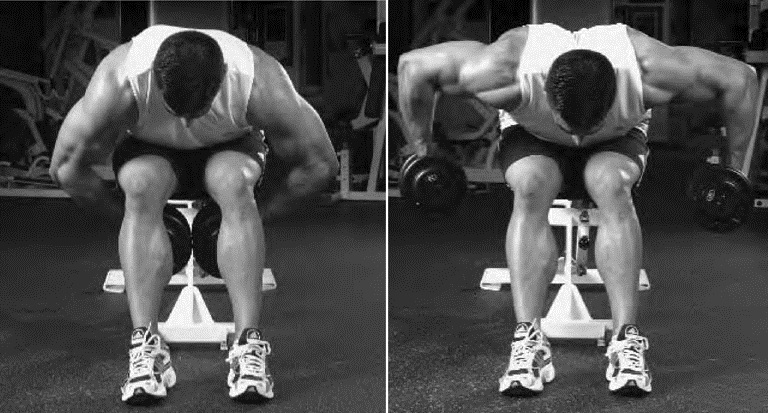
Movement (Execution)
Once you are stable, focus on moving the weights outward rather than backward.
- Raise your arms out to the sides, not straight back
- Maintain the 90-degree bend in your elbows throughout the movement
- Lead with your upper arms (elbows), not your hands
- Lift until your upper arms are parallel to the floor
- Keep your forearms pointing downward at the top
- Squeeze your rear delts at peak contraction
- Pause briefly to improve control and activation
- Slowly lower the dumbbells back to the starting position
- Avoid using momentum or swinging your torso
In practice, this exercise is most effective when you treat it as a rear delt movement—not a traditional row. The key is to focus on outward movement and controlled execution rather than lifting heavier weights.
Video Demonstration
Watch the video below to see proper setup, elbow positioning, and the correct outward rowing path for the dumbbell rear delt row.

Muscles Worked in Dumbbell Rear Delt Row
The dumbbell rear delt row primarily targets the muscles responsible for shoulder horizontal abduction, with the bent-arm position allowing slightly heavier loading compared to fly variations. In practice, this creates a strong stimulus for both the rear delts and upper back.
- Primary muscles: posterior deltoids
- Secondary muscles: rhomboids, middle trapezius, infraspinatus, teres minor
- Stabilizing muscles: lower trapezius, rotator cuff musculature
- Antagonist muscles: anterior deltoids, pectoralis major
How the Dumbbell Rear Delt Row Works: Biomechanics & Mechanics
The dumbbell rear delt row is a hybrid movement that combines elements of a row and a rear delt fly. While it resembles a rowing pattern due to the bent-arm position, the key difference lies in the direction of force — the movement emphasizes shoulder horizontal abduction rather than pure shoulder extension. In practice, this shifts the load away from the lats and toward the posterior deltoids and upper back.
Key Joint Actions
- Shoulder horizontal abduction — the upper arms move outward away from the midline, driven primarily by the posterior deltoids
- Controlled scapular retraction — the shoulder blades move slightly, assisting the movement without dominating it
- Static elbow angle (~90°) — maintaining a fixed bend helps isolate the shoulder joint
Bent-Arm Advantage
- Allows heavier loading — shorter lever arm compared to straight-arm fly variations
- Reduces strain on the shoulder joint — more stable and controlled movement
- Bridges the gap between fly and row — combines isolation with load potential
Movement Path Mechanics
- Outward movement is critical — the elbows move to the sides, not straight back
- Elbow-driven motion improves activation — leading with the elbows keeps tension on the rear delts
- Incorrect path turns it into a row — pulling backward shifts the load to the lats
Resistance Profile
- Gravity-based resistance — tension increases as the arms rise
- Peak tension near the top — the rear delts work hardest in the contracted position
- Less tension at the bottom — typical of dumbbell-based movements
Stability and Control
- Moderate stability demand — higher when standing, lower when seated
- Core engagement is required, especially in the standing version
- Greater potential for compensation — requires attention to technique
From a coaching perspective, the biggest advantage of this exercise is its ability to load the rear delts more than traditional fly variations while still maintaining a strong isolation component. However, this also makes it easier to perform incorrectly, so controlling the movement path is essential.
Technique Optimization Tips
The dumbbell rear delt row is one of those exercises where small technical mistakes can completely change the muscle emphasis. Because it combines elements of a row and a fly, it’s very easy to turn it into a lat-dominant movement. In practice, precise execution is what keeps the tension on the rear delts.
- Pull outward, not backward. This is the most important cue—pulling backward turns the exercise into a traditional row.
- Keep your elbows fixed at ~90 degrees. Changing the elbow angle shifts the load away from the rear delts.
- Lead with your upper arms. Focus on moving your elbows out to the sides rather than thinking about the hands.
- Control the tempo. Avoid explosive lifting; slow, controlled reps improve activation.
- Keep your torso stable. Excessive movement reduces isolation and increases compensation.
- Use moderate weights. Heavier loads often lead to poor form and loss of rear delt focus.
- Avoid shrugging. Keep your shoulders down to minimize trapezius involvement.
- Pause briefly at the top. This reinforces contraction and improves mind-muscle connection.
Technical Emphasis & Targeting Adjustments
Small adjustments in setup and execution can significantly change how the dumbbell rear delt row feels and which muscles take on the most work. Because this exercise sits between a fly and a row, precise control of the movement path is essential to keep the emphasis on the rear delts. In practice, these tweaks help you avoid turning it into a lat-dominant exercise.
- Adjust your torso angle. A more horizontal torso increases rear delt involvement, while a more upright position brings in more traps and upper back.
- Keep the elbows slightly below shoulder height. Going too high increases trap activation and reduces focus on the rear delt.
- Limit excessive scapular retraction. Pulling the shoulder blades too far together shifts the load to the rhomboids.
- Use a pronated grip for more rear delt emphasis. A neutral grip may feel stronger but can shift some load away from the target muscle.
- Control the movement range. Stop the rep when the rear delts are maximally engaged rather than forcing extra range.
- Focus on outward elbow drive. This is the key to keeping the movement rear delt–dominant.
- Slow down the eccentric phase. This improves control and keeps tension on the target muscle longer.
Dumbbell Rear Delt Row Pros and Cons
The dumbbell rear delt row is a unique hybrid movement that allows you to load the rear delts more than traditional fly variations. However, its effectiveness depends heavily on proper execution, and it can easily turn into a different exercise if performed incorrectly.
Pros
- Allows heavier loading than fly variations. The bent-arm position reduces lever length and increases potential strength.
- Strong rear delt stimulus. Combines isolation with load for effective hypertrophy.
- Improves upper-back strength. Engages the supporting muscles, including the rhomboids and trapezius.
- Versatile execution. Can be performed seated or standing, depending on preference.
- Great alternative to fly exercises. Offers a different stimulus for developing the rear delt.
Cons
- Easy to perform incorrectly. Many lifters turn it into a lat-dominant row.
- Requires good technique awareness. Proper elbow path and positioning are critical.
- Higher risk of compensation. Stronger muscles can take over if form breaks down.
- Less isolation than strict fly variations. Involves more upper-back musculature.
- Moderate stability demand. Especially in the standing version.
This exercise works best when used alongside stricter isolation movements, allowing you to balance load and precision for complete rear delt development.
Dumbbell Rear Delt Row Variations
Although the dumbbell rear delt row is already a versatile movement, a few variations can help you adjust the difficulty, improve control, and target the rear delts from slightly different angles. In practice, rotating these variations can enhance both muscle activation and overall training quality.
🔹 Standing Dumbbell Rear Delt Row
A more natural version that requires greater core stability and coordination, but allows slightly heavier loading.
🔹 Head-Supported Rear Delt Row
Bracing your head or chest against a bench reduces momentum and helps maintain a consistent path of movement.
🔹 Incline Bench Rear Delt Row
Performed chest-supported on an incline bench, this variation further reduces cheating and improves isolation.
🔹 Single-Arm Dumbbell Rear Delt Row
A unilateral variation that improves control, balance, and helps correct muscle imbalances.
🔹 Cable Rear Delt Row
Using cables provides constant tension throughout the movement and can improve resistance in the stretched position.
Replacement Exercises for the Dumbbell Rear Delt Row
If the dumbbell rear delt row isn’t available or you want to add variety to your training, there are several effective alternatives that target the rear delts through similar movement patterns. In practice, combining these exercises can improve both isolation and overall shoulder development.
- Incline dumbbell rear delt fly. A chest-supported variation that emphasizes strict form and rear delt isolation.
- Prone dumbbell rear delt fly. Maximizes isolation with the torso fully parallel to the floor.
- Seated bent-over dumbbell rear delt fly. A stable free-weight option with controlled execution.
- Bent-over dumbbell rear delt fly (standing). Adds more coordination and overall control demands.
- Two-arm cable rear delt fly. Provides constant tension and allows efficient bilateral training.
- One-arm cable rear delt fly. A unilateral variation that improves control and helps correct imbalances.
- Reverse cable crossover. Offers a slightly different angle with strong rear delt and upper back involvement.
- Machine rear deltoid fly (reverse pec deck). A highly stable option that simplifies rear delt isolation.
- Face pull. A versatile exercise that targets the rear delts along with the upper back and rotator cuff.
- Resistance band rear delt row/fly. A simple and effective option for home workouts or warm-ups.
Where This Exercise Fits in a Workout
The dumbbell rear delt row works best as a hybrid movement that bridges the gap between strict isolation and heavier loading. Because it allows more weight than fly variations while still targeting the rear delts, it fits well in the middle of your workout. In practice, it’s ideal for building both size and strength in the rear delts.
- After primary compound lifts. Use it after rows, pull-ups, or presses when you move into accessory work.
- Before strict isolation exercises. Perform it prior to rear delt fly variations to take advantage of higher loading potential.
- As a main rear delt movement. Can serve as your primary rear delt exercise in a session.
- In hypertrophy-focused workouts. Works well with moderate weights and controlled tempo.
- In supersets or combinations. Pair it with fly or cable exercises to balance load and isolation.
Sets & Reps Recommendations
The dumbbell rear delt row allows slightly heavier loading than traditional rear delt fly variations, but it still requires controlled execution to keep the emphasis on the posterior deltoids. In practice, the best results come from balancing load with strict form.
- Sets: 2–4 per workout
- Reps: 10–15 per set
- Tempo: Controlled lift with a steady and deliberate lowering phase
- Rest time: 60–90 seconds between sets
Additional Programming Tips
- Start with moderate weights. This exercise allows heavier loading, but form must remain strict.
- Perform it before lighter isolation work. Use it early in your rear delt sequence to take advantage of strength.
- Focus on consistent elbow position. Keeping the angle stable is key to proper muscle targeting.
- Avoid training to failure too often. Form breakdown can quickly turn this into a different movement.
- Combine with fly variations. This creates a balanced approach to rear delt development.
Dumbbell Rear Delt Row vs Dumbbell Rear Delt Fly
Both the dumbbell rear delt row and the dumbbell rear delt fly target the posterior deltoids, but they differ in mechanics, loading potential, and overall training stimulus. In practice, the choice depends on whether your goal is stricter isolation or the ability to use more weight.
| Training Factor | Dumbbell Rear Delt Row | Dumbbell Rear Delt Fly |
|---|---|---|
| Arm Position | Bent arms (~90°) | Mostly straight arms |
| Movement Pattern | Hybrid (row + fly) | Pure fly (horizontal abduction) |
| Primary Focus | Rear delts + upper back | Rear delts (maximum isolation) |
| Loading Potential | Higher | Lower |
| Stability Requirement | Moderate | Moderate to low |
| Ease of Execution | More technical | Simpler |
| Trap Involvement | Moderate | Lower |
| Mind-Muscle Connection | Moderate to high | Very high |
| Risk of Compensation | Higher | Lower |
| Best Use | Heavier rear delt work | Strict isolation and control |
Conclusion: Both variations are highly effective, but they serve different roles in training. The rear delt row allows you to use more weight and build strength, while the rear delt fly provides stricter isolation and better control. In my experience, combining both leads to the best overall development of the rear delt.
Closing Thoughts
The dumbbell rear delt row is a powerful and often overlooked exercise for developing the posterior deltoids. Combining elements of a row and a fly allows you to load the rear delts more effectively than traditional isolation movements while still maintaining a strong focus on the target muscle.
However, its effectiveness depends entirely on execution. If you control the movement, keep the elbows driving outward, and avoid turning it into a standard row, this exercise can significantly improve both rear delt size and upper-back strength.
In my experience, this is one of the best exercises to bridge the gap between strict isolation and heavier loading. When combined with fly variations and cable work, it becomes an essential part of a well-rounded rear delt training strategy.
What is a dumbbell rear delt row?
It’s a rear delt–focused rowing variation where you pull the dumbbells outward with bent arms to target the posterior deltoids.
Is the rear delt row better than rear delt fly?
Not better—just different. Rows allow more weight, while flys provide stricter isolation.
Should I pull backward or outward in a rear delt row?
Outward. Pulling backward turns the exercise into a lat-dominant row.
Why do I feel this exercise in my lats instead of rear delts?
You’re likely pulling too far back or not keeping your elbows out to the sides.
What elbow angle should I use?
About 90 degrees. This helps keep the focus on the rear delts.
Can beginners do rear delt rows?
Yes, but they should start light and focus on correct arm path and control.
Is seated or standing rear delt row better?
Seated is more stable and easier to control, while standing requires more coordination.
How heavy should I go on rear delt rows?
Moderate weights work best. Too heavy will compromise form and shift the load.
What’s the biggest mistake in rear delt rows?
Turning it into a standard row by pulling the weights backward instead of outward.
Can this exercise replace rear delt flys?
It can complement them, but combining both gives the best results.
