



Introduction
The two-arm cable rear delt fly is one of the most efficient exercises for targeting the rear delts while maintaining constant tension throughout the entire movement. Unlike dumbbell variations, which drop resistance at certain points, the cable setup keeps the posterior deltoids engaged from start to finish.
This variation is typically performed using a cable crossover machine, where both arms move simultaneously in a controlled arc. This bilateral setup allows you to train both sides at once, making it more time-efficient while still delivering strong rear delt activation.
One of the key advantages of this exercise is its ability to provide a smooth and consistent resistance profile. The cables guide the movement and help maintain tension even in the stretched position, which is often lacking in free-weight exercises. As a result, you get a more complete stimulus across the entire range of motion.
In my experience, this is one of the best rear delt exercises for adding volume to your training without overcomplicating the setup. It’s especially useful when you want a balance between control, efficiency, and muscle engagement.
In this guide, I’ll show you how to perform the two-arm cable rear delt fly with perfect form, avoid common mistakes, and use it effectively in your training.
Alternative Names for the Two-Arm Cable Rear Delt Fly
The two-arm cable rear delt fly is known by several different names depending on gym terminology and coaching style. In practice, all of these refer to the same bilateral cable movement focused on rear delt isolation.
- Cable rear delt fly
- Cable rear delt raise (two-arm)
- Bent-over cable rear delt fly
- Cable rear lateral raise
- Cable crossover rear delt fly
Equipment Needed for the Two-Arm Cable Rear Delt Fly
This exercise requires a proper cable setup to ensure smooth resistance and consistent tension. In practice, the cable crossover machine is essential for performing this movement correctly.
- Cable crossover machine (dual pulleys) – allows bilateral movement with constant tension
- D-handle attachments – provide a natural grip and better control
Make sure both pulleys are set to a low position and that you have enough space to perform the movement without restriction.
How to Perform the Two-Arm Cable Rear Delt Fly with Perfect Form
Proper setup is critical for this exercise. Because both arms are working simultaneously, maintaining control and alignment is key to keeping the tension on the rear delts. In practice, small setup mistakes can quickly shift the load to the upper back.
Starting Position (Setup)
Before you begin, position yourself correctly between the cables. This ensures balanced tension and a smooth path of movement.
- Set both pulleys to a low position
- Attach D-handles to each side
- Stand in the center of the machine
- Grab the handles with opposite hands (crossed grip)
- Step slightly back to create tension in both cables
- Bend forward at the hips until your torso is close to parallel with the floor
- Keep a neutral spine and engaged core
- Let your arms hang naturally in front of you
- Maintain a slight bend in your elbows
- Keep your shoulders relaxed (not shrugged)
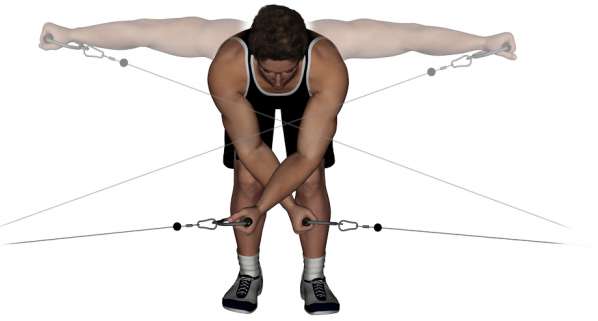
Movement (Execution)
Once you are stable, focus on controlled movement driven by the rear delts.
- Raise both arms out to the sides in a wide arc
- Lead the movement with your elbows, not your hands
- Keep your arms roughly parallel to the floor at the top
- Focus on squeezing the rear delts at peak contraction
- Pause briefly to improve control and activation
- Slowly return to the starting position under control
- Let your hands cross in front of your body at the bottom
In practice, this exercise works best when you prioritize control and consistency. The goal is to maintain constant tension on the rear delts rather than using excessive weight.
Video Demonstration
Watch the video below to see the proper setup, crossed grip position, and controlled arm path for the two-arm cable rear delt fly.

Muscles Worked in Two-Arm Cable Rear Delt Fly

The two-arm cable rear delt fly primarily targets the muscles responsible for shoulder horizontal abduction, while the cable setup ensures constant tension throughout the movement. In practice, several supporting muscles assist in stabilizing and controlling the motion.
- Posterior deltoids — responsible for shoulder horizontal abduction and the primary drivers of the movement.
- Rhomboids — responsible for scapular retraction and helping stabilize the shoulder blades during the lift.
- Middle trapezius — responsible for assisting in scapular retraction and maintaining proper shoulder positioning.
- Infraspinatus — part of the rotator cuff, responsible for external rotation and shoulder joint stability.
- Teres minor — works with the infraspinatus to stabilize the shoulder and assist in external rotation.
- Lower trapezius — helps maintain scapular stability and supports proper shoulder mechanics.
- Anterior deltoids (antagonist) — responsible for shoulder flexion, opposing the movement of the rear delts.
- Pectoralis major (antagonist) — responsible for horizontal adduction, acting opposite to the rear delt fly movement.
How the Two-Arm Cable Rear Delt Fly Works: Biomechanics & Mechanics
The two-arm cable rear delt fly is a bilateral cable isolation movement that trains shoulder horizontal abduction under constant tension. Because both arms move simultaneously and the cables pull from a fixed direction, the rear delts remain engaged throughout the entire range of motion. In practice, this creates a smooth and consistent resistance profile that is difficult to achieve with free weights.
Key Joint Actions
- Shoulder horizontal abduction — both arms move outward away from the midline, driven primarily by the posterior deltoids
- Controlled scapular retraction — the shoulder blades move slightly, but excessive retraction shifts the load to the upper back
- Minimal elbow movement — the elbow angle remains relatively fixed, keeping the focus on the shoulder joint
Role of Bilateral Movement
- Improves training efficiency — both sides are trained at the same time, allowing for higher training volume in less time
- Promotes symmetrical movement patterns — encourages coordinated activation of both rear delts
- Reduces mental load — easier to maintain rhythm compared to unilateral variations
Arm Path Mechanics
- The movement follows a wide arc — both arms move outward rather than straight back
- Leading with the elbows improves activation — helps keep tension on the rear delts
- Crossed start position increases range — beginning with crossed arms allows a greater stretch at the bottom
Resistance Profile
- Cable resistance provides constant tension — the rear delts remain loaded throughout the entire movement
- Effective stretch and contraction — tension is present in both the stretched and shortened positions
- Smooth force curve — resistance remains consistent across the range of motion
Stability and Control
- The torso must remain stable — any movement shifts the load away from the rear delts
- Core engagement supports posture — especially in the bent-over position
- Moderate stability demand — requires control, but less than unilateral variations
From a coaching perspective, the biggest advantage of this exercise is its combination of constant tension and bilateral efficiency. It allows you to accumulate quality volume while maintaining consistent rear delt activation throughout each repetition.
Technique Optimization Tips
The two-arm cable rear delt fly is highly effective, but only when performed with control and a proper arm path. Because both arms move simultaneously, small technical errors can quickly shift the load away from the rear delts. In practice, focusing on precision and consistency makes the biggest difference.
- Lead with your elbows. This keeps the emphasis on the rear delts rather than turning the movement into a row.
- Keep your arms slightly bent. A fixed elbow angle helps maintain constant tension and reduces joint stress.
- Maintain a stable torso. Avoid lifting or swinging your body during the movement.
- Pull outward, not backward. This ensures the rear delts remain the primary movers.
- Control the return phase. Letting the cables pull your arms back too quickly reduces time under tension.
- Keep your shoulders down. Prevent the upper traps from taking over by avoiding shrugging.
- Use moderate weight. This exercise is most effective when performed with strict form rather than heavy loading.
Technical Emphasis & Targeting Adjustments
Small adjustments in setup and execution can significantly change how the two-arm cable rear delt fly feels and which muscles take on the most work. Because both arms move simultaneously under constant tension, even subtle changes can shift the emphasis. In practice, these tweaks help you keep the focus on the rear delts and avoid unnecessary involvement of the traps or lats.
- Adjust your torso angle. A more horizontal torso increases rear delt involvement, while a more upright position shifts tension toward the traps.
- Control the direction of the pull. Pulling slightly downward can improve rear delt activation, while pulling too high increases upper trap involvement.
- Keep your shoulders depressed. This reduces trap dominance and helps isolate the posterior deltoids.
- Limit excessive scapular retraction. Pulling the shoulder blades too far together shifts the load to the rhomboids.
- Adjust your starting position. A deeper crossed-arm position increases stretch and improves the overall range of motion.
- Use a shorter range of motion if needed. Stopping before other muscles take over can maintain better rear delt tension.
- Focus on symmetry between both arms. Ensure both sides move evenly to maintain balanced activation.
The most effective way to use this exercise is to adjust your setup and arm path so the rear delts stay under tension, rather than letting the traps or upper back take over.
Two-Arm Cable Rear Delt Fly Benefits and Drawbacks
The two-arm cable rear delt fly is a highly effective exercise for building the rear delts with constant tension and efficient execution. In practice, it allows you to quickly accumulate quality volume, but it also comes with a few limitations compared to unilateral or machine variations.
Benefits
- Provides constant tension throughout the movement. The cable keeps the rear delts engaged from start to finish.
- More time-efficient than unilateral exercises. Both sides are trained simultaneously, allowing for higher training volume.
- Promotes symmetrical development. Bilateral movement encourages balanced activation of both rear delts.
- Allows a smooth and controlled movement path. The cable setup helps maintain consistent resistance and rhythm.
- Improves mind-muscle connection. Continuous tension makes it easier to feel the rear delts working.
Drawbacks
- Less effective for correcting imbalances. Both arms work together, making it harder to identify side-to-side differences.
- Requires proper setup. Incorrect positioning can reduce effectiveness or shift the load to other muscles.
- Moderate stability demands. Maintaining a stable torso requires control, especially with both arms moving.
- Limited loading potential. Works best with moderate weights rather than heavy loads.
- Cable availability may be limited. You need access to a cable crossover machine.
This exercise works best when combined with unilateral and machine variations, allowing you to balance efficiency, control, and overall rear delt development.
Two-Arm Cable Rear Delt Fly Variations
Although the two-arm cable rear delt fly is already a highly effective exercise, a few variations can change the feel of the movement and help you match it to your structure and training goals. In practice, rotating these options can improve activation and keep your rear delt training more productive.
🔹 Upright Two-Arm Cable Rear Delt Fly
Performed in a more upright position, this variation (reverse cable crossover) is easier to set up but typically targets the traps more and provides less rear delt isolation.
🔹 Chest-Supported Two-Arm Cable Rear Delt Fly
Using a bench for support reduces momentum and improves stability. As a result, this version is ideal for stricter execution.
🔹 Two-Arm Cable Rear Delt Fly with Pause
Adding a pause at peak contraction increases time under tension and improves mind-muscle connection.
🔹 Slow Tempo Two-Arm Cable Rear Delt Fly
Slowing down both phases of the movement improves control and keeps the rear delts under constant tension longer.
🔹 One-Arm Cable Rear Delt Fly
This unilateral variation allows greater focus on each side and helps correct muscular imbalances, making it a valuable complement to the two-arm version.
Replacement Exercises (Substitutes)
If the two-arm cable rear delt fly isn’t available or you want more variety, there are several effective alternatives for targeting the rear delts. In practice, combining different tools and setups can improve activation and lead to more balanced shoulder development.
- Head-supported dumbbell rear delt fly. Provides strict form and minimizes momentum for better isolation.
- Seated bent-over dumbbell rear delt fly. A stable free-weight option with controlled execution.
- Bent-over dumbbell rear delt fly (standing). Adds more coordination and overall control demands.
- Machine rear deltoid fly (reverse pec deck). A highly stable option that simplifies rear delt isolation.
- Incline bench rear delt raise. Offers support and helps maintain a consistent path of movement.
- Face pull. A versatile exercise that targets the rear delts along with the upper back and rotator cuff.
- Resistance band rear delt fly. A simple and effective option for home workouts or warm-ups.
Where This Exercise Fits in a Workout
The two-arm cable rear delt fly works best as an isolation exercise for your shoulders or upper body. Because it allows both arms to move simultaneously under constant tension, it’s ideal for accumulating volume efficiently while maintaining consistent rear delt activation. In practice, it fits perfectly into hypertrophy-focused sessions.
- After primary compound lifts. Use it after rows, pull-ups, or presses when transitioning into isolation work.
- As a volume-based rear delt exercise. Ideal for adding more total work without overcomplicating your training.
- In hypertrophy-focused sessions. Works best with moderate loads and controlled tempo.
- As a complement to unilateral work. Pair it with one-arm cable variations to balance efficiency and control.
- In supersets or finishers. Combine it with lateral raises or machine work to increase time under tension.
Sets & Reps Recommendations
The two-arm cable rear delt fly works best with moderate loads and controlled repetitions. Because both arms move simultaneously under constant tension, the goal is to accumulate quality volume rather than lift heavy weights. In practice, this makes it ideal for hypertrophy-focused training.
- Sets: 2–4 per workout
- Reps: 12–20 per set
- Tempo: Controlled lift with a slow and deliberate lowering phase
- Rest time: 45–75 seconds between sets
Additional Programming Tips
- Use a weight you can control on both sides. If one side starts to dominate, reduce the load.
- Keep tension throughout the set. Avoid letting the cables pull your arms back too quickly between reps.
- Focus on symmetrical movement. Both arms should move at the same speed and follow the same path.
- Pause briefly at peak contraction. This improves rear delt activation and control.
- Stop when the form breaks down. Quality reps are more important than quantity.
Two-Arm Cable Rear Delt Fly vs One-Arm Cable Rear Delt Fly
Both the two-arm and one-arm cable rear delt fly are highly effective exercises for targeting the posterior deltoids under constant tension. However, they differ in execution, control, and overall training purpose. In practice, the choice depends on whether your goal is efficiency or precision.
| Training Factor | Two-Arm Cable Rear Delt Fly | One-Arm Cable Rear Delt Fly |
|---|---|---|
| Exercise Type | Cable isolation (bilateral) | Cable isolation (unilateral) |
| Primary Focus | Rear delts (high isolation) | Rear delts (maximum isolation) |
| Stability Requirement | Moderate | Moderate to high |
| Ease of Execution | Easier to maintain rhythm | More technique-dependent |
| Mind-Muscle Connection | High | Very high |
| Coordination Demand | Moderate | Higher |
| Loading Potential | Moderate | Moderate |
| Time Efficiency | High (both sides at once) | Lower (one side at a time) |
| Imbalance Correction | Limited | Excellent |
| Best Use | Volume & efficiency | Precision & symmetry |
Conclusion: Both variations are valuable, but they serve different purposes. The two-arm cable rear delt fly is ideal for adding volume and training efficiently, while the one-arm version is better for improving control and correcting imbalances. In my experience, combining both leads to the best overall development of the rear delt.
Closing Thoughts
The two-arm cable rear delt fly is one of the most efficient exercises for building the rear delts while maintaining constant tension throughout the movement. Training both sides simultaneously allows you to accumulate quality volume without sacrificing control or consistency.
However, the effectiveness of this exercise depends on proper execution. If you focus on a clean arm path, controlled tempo, and stable torso position, you can keep the tension exactly where it should be—on the rear delts.
In my experience, this variation works best as a complement to unilateral and free-weight exercises. The two-arm version builds volume and efficiency, while other variations improve control and address imbalances. Together, they create a well-rounded approach to rear delt development.
What is the two-arm cable rear delt fly?
It’s a cable-based isolation exercise where both arms move outward to target the rear delts under constant tension.
Is the two-arm cable rear delt fly effective?
Yes. It provides consistent resistance throughout the movement, making it highly effective for rear delt activation.
How is it different from the one-arm version?
The two-arm version is more time-efficient, while the one-arm version offers better control and imbalance correction.
Should I pull backward or outward?
Outward. Pulling backward shifts the movement toward a row and reduces rear delt focus.
Why use cables instead of dumbbells?
Cables maintain tension even at the bottom of the movement, while dumbbells lose resistance in that position.
What’s the best torso angle for this exercise?
A torso close to parallel with the floor usually provides the best rear delt activation.
How do I avoid using my traps?
Keep your shoulders down and avoid shrugging during the movement.
Is this exercise good for beginners?
Yes. It’s relatively easy to learn and helps build proper rear delt activation.
What’s the biggest mistake people make?
Pulling the handles backward instead of outward, which turns the exercise into a row.
Can I build muscle with this exercise alone?
It’s effective, but the best results come when combined with other rear delt exercises.
