


Introduction
The head-supported dumbbell rear delt fly is one of the most effective exercises for isolating the rear delts while minimizing momentum and unwanted body movement. In practice, supporting your head on an incline bench immediately improves control and makes it much easier to keep the tension exactly where it should be—on the posterior deltoids.
This variation, also known as the head-supported rear delt raise, is performed by hinging forward and placing your forehead against the top of an incline bench. From this position, you raise the dumbbells out to the sides in a controlled arc. Because your head and torso are stabilized, you eliminate most of the common mistakes seen in standard bent-over raises.
One of the biggest advantages of this setup is reduced cheating. Unlike standing versions, where lifters often swing the weights or shift their torso, the head-supported position forces strict execution. As a result, you get cleaner reps, better muscle activation, and more consistent progress.
In my experience, this is one of the best rear delt exercises for lifters who struggle to maintain proper form with free weights. It’s also an excellent choice when you want to focus purely on isolation without lower-back fatigue or balance limitations.
In this guide, I’ll show you how to perform the head-supported dumbbell rear delt fly with perfect form, avoid common mistakes, and use it effectively in your training.
Other Names for the Head-Supported Dumbbell Rear Delt Fly
The head-supported dumbbell rear delt fly is known by several different names depending on coaching style and gym terminology. In practice, all of these refer to the same movement focused on strict rear delt isolation with added stability.
- Head-supported rear delt raise
- Incline head-supported rear delt fly
- Head-supported bent-over rear delt raise
- Incline bench rear delt fly (head-supported)
- Supported rear delt dumbbell fly
Required Equipment for the Head-Supported Dumbbell Rear Delt Fly
This exercise requires minimal equipment, but proper setup is important for maintaining stability and strict form. In practice, the head support is what makes this variation more controlled and effective than standard versions.
- Dumbbells – used to provide resistance throughout the movement
- Incline bench – set at an appropriate angle to support your head and maintain a stable torso position
Make sure the bench height and angle allow your torso to stay close to parallel with the floor, while your head remains comfortably supported.
How to Perform the Head-Supported Dumbbell Rear Delt Fly with Perfect Form
Proper setup is essential for this variation. The head support reduces momentum, so any positioning mistake becomes obvious. In practice, a clean setup makes the movement feel smooth and keeps the tension on the rear delts.
Starting Position (Setup)
Before you begin, adjust the bench and your body position carefully. This ensures better alignment and more consistent activation.
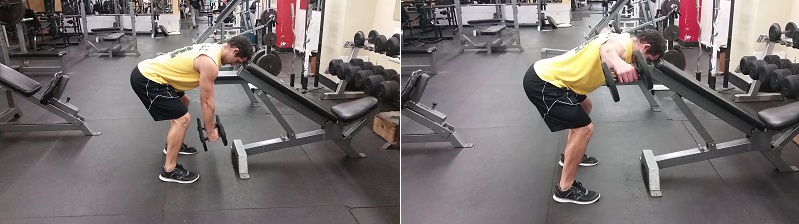
- Set an incline bench so the top edge supports your forehead
- Stand behind the bench and hinge forward at the hips
- Position your torso close to parallel with the floor
- Let your arms hang straight down under your shoulders
- Hold the dumbbells with a neutral grip (palms facing each other)
- Keep a slight bend in your elbows
- Engage your core and keep a neutral spine
- Maintain light contact between your forehead and the bench
- Keep your shoulders relaxed (not shrugged)
Movement (Execution)
Once you’re stable, focus on controlled movement driven by the rear delts.
- Raise your arms out to the sides in a wide arc
- Lead the movement with your elbows, not your hands
- Keep your arms roughly parallel to the floor at the top
- Squeeze your rear delts at peak contraction
- Pause briefly to improve control and activation
- Lower the dumbbells slowly back to the starting position
- Keep tension on the muscles without letting the weights fully rest
In practice, this variation forces strict form, so lighter weights and controlled repetitions will deliver the best results.
Video Demonstration
Watch the video below to see proper setup, head-support positioning, and a controlled arm path for the head-supported dumbbell rear delt fly.
Muscles Worked in Head-Supported Dumbbell Rear Delt Fly
The head-supported dumbbell rear delt fly primarily targets the muscles responsible for shoulder horizontal abduction, with the supported position helping eliminate momentum and improve isolation. In practice, this makes it one of the most effective dumbbell variations for maintaining strict rear delt activation.
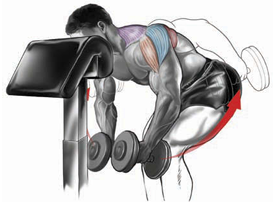
- Primary muscles: posterior deltoids
- Secondary muscles: rhomboids, middle trapezius, infraspinatus, teres minor
- Stabilizing muscles: lower trapezius, rotator cuff musculature
- Antagonist muscles: anterior deltoids, pectoralis major
In practice, the head support makes a noticeable difference in how clean the movement feels. When your head is stabilized, it becomes much easier to eliminate cheating and keep the tension directly on the rear delts throughout each repetition.
How the Head-Supported Dumbbell Rear Delt Fly Works: Biomechanics & Mechanics
The head-supported dumbbell rear delt fly is a free-weight isolation movement that trains shoulder horizontal abduction with minimal momentum. Because your head is stabilized against the bench, movement becomes much more precise. In practice, this allows you to keep more consistent tension on the rear delts.
Key Joint Actions
- Shoulder horizontal abduction – the arms move outward away from the midline, driven primarily by the posterior deltoids
- Controlled scapular retraction – the shoulder blades move slightly, but excessive retraction shifts the load to the upper back
- Minimal elbow movement – the elbow angle stays relatively fixed, keeping the focus on the shoulder joint
Role of Head Support
- Eliminates unwanted body movement – prevents swinging and torso extension
- Improves stability – makes the movement more controlled and repeatable
- Forces strict execution – reduces the ability to cheat with momentum
Arm Path Mechanics
- The movement follows a wide arc – the arms move outward rather than straight back
- Leading with the elbows improves activation – this keeps tension on the rear delts
- A consistent path maintains isolation – deviations shift load to other muscles
Resistance Profile
- Resistance is gravity-based – tension increases as the arms rise
- The movement is hardest near the top, where the rear delts are shortened
- Less tension at the bottom – compared to cable variations
Stability and Control
- The torso remains fixed – supported indirectly through head stabilization
- Core engagement supports alignment – even though the movement is more stable
- The exercise is more isolated than the standing versions, due to reduced balance demands
From a coaching perspective, the biggest advantage of this exercise is the strict control it enforces. When you remove momentum and stabilize the head, it becomes much easier to isolate the posterior deltoids and perform clean, repeatable repetitions.
Technique Optimization Tips
The head-supported dumbbell rear delt fly is all about precision. Because the setup limits cheating, even small technical errors can shift the load away from the rear delts. In practice, focusing on control and a clean arm path makes the biggest difference.
- Keep light, consistent contact with the bench. Your forehead should stay gently pressed against the pad without pushing into it.
- Lead with your elbows. This helps keep the emphasis on the rear delts rather than the upper back or arms.
- Avoid shrugging your shoulders. Keeping your shoulders down prevents the upper traps from taking over.
- Use a fixed elbow angle. A slight bend should remain constant throughout the movement.
- Control the lowering phase. Lowering the weights slowly helps maintain tension and improve muscle activation.
- Keep your torso completely still. The head support should eliminate any unnecessary movement.
- Choose lighter weights for better control. This variation works best with strict form rather than heavy loading.
Technical Emphasis & Targeting Adjustments
Small changes in setup and execution can significantly affect how the head-supported dumbbell rear delt fly feels and which muscles take on the most work. Because this variation limits momentum, even subtle adjustments make a noticeable difference. In practice, these tweaks help you keep tension on the rear delts and avoid shifting the load to the upper back.
- Adjust the bench angle slightly. A more horizontal torso usually increases rear delt involvement, while a steeper angle can bring more traps into play.
- Control the height of your arms. Lifting to shoulder level is usually enough; going higher often increases activation of the upper trapezius.
- Keep your shoulders depressed. This reduces upper-trap dominance and improves rear-delt isolation.
- Limit excessive scapular retraction. Pulling the shoulder blades too far together shifts the load to the rhomboids.
- Use a shorter range of motion if needed. Stopping just before other muscles take over can maintain better rear delt tension.
- Experiment with grip orientation. A pronated grip may increase rear delt involvement, while a neutral grip often feels more natural.
- Use lighter weights for precision. This variation is most effective when you prioritize control over load.
The most effective way to use this exercise is to adjust your setup and arm path so the rear delts stay under tension, rather than letting the traps or upper back take over.
Head-Supported Dumbbell Rear Delt Fly Benefits and Drawbacks
The head-supported dumbbell rear delt fly is one of the strictest rear delt isolation exercises you can perform. In practice, it removes most opportunities for cheating, which improves muscle activation—but it also limits how much weight you can use.
Benefits
- Maximizes rear delt isolation. Head support eliminates momentum and keeps the focus on the posterior deltoids.
- Reduces lower-back involvement. The supported position removes the need to stabilize the torso under load.
- Encourages strict form. It becomes much harder to cheat, which improves exercise quality.
- Improves mind-muscle connection. The controlled setup makes it easier to feel the rear delts working.
- Helps fix technique issues. Great for lifters who struggle with form in standing variations.
Drawbacks
- Limits loading potential. You will typically use lighter weights compared to unsupported variations.
- Less natural for some lifters. The head-supported position may feel awkward at first.
- Reduced range of motion in some setups. Bench height and positioning can slightly restrict movement.
- Less tension at the bottom. Like most dumbbell exercises, resistance is lower in the stretched position.
- Requires proper bench setup. Incorrect positioning can reduce effectiveness or comfort.
This exercise works best when combined with cable and machine variations, allowing you to benefit from strict isolation, constant tension, and progressive overload.
Head-Supported Dumbbell Rear Delt Fly Variations
Although the head-supported dumbbell rear delt fly is already a highly effective isolation exercise, a few variations can change the movement’s feel and help you tailor it to your structure and training goals. In practice, rotating these options can improve activation and keep your rear delt training more productive.
🔹 Pronated-Grip Head-Supported Dumbbell Rear Delt Fly
Using a pronated grip can shift more of the workload to the rear delts. However, some lifters may find this position less comfortable on the shoulders.
🔹 Supinated-Grip Head-Supported Dumbbell Rear Delt Fly
A supinated grip can slightly increase the involvement of the external rotators. As a result, it changes the feel of the exercise and may suit some shoulder structures better.
🔹 Head-Supported Dumbbell Rear Delt Fly with Pause
Adding a brief pause at the top increases time under tension and improves mind-muscle connection. Even a short hold can make the rear delts work much harder.
🔹 Slow Tempo Head-Supported Dumbbell Rear Delt Fly
Slowing down both the lifting and lowering phases improves control and keeps the rear delts under tension longer. Therefore, this variation works especially well for hypertrophy-focused training.
🔹 Seated Bent-Over Dumbbell Rear Delt Fly
This variation uses a similar setup but removes head support and places you in a seated position. As a result, it still offers good stability but allows slightly more freedom of movement compared to the head-supported version.
Replacement Exercises (Substitutes)
If the head-supported dumbbell rear delt fly doesn’t suit you, or you want more variety, there are several effective alternatives to target the rear delts. In practice, combining different tools and setups can improve activation and lead to more balanced shoulder development.
- Seated bent-over dumbbell rear delt fly. Offers good stability while allowing slightly more freedom of movement.
- Bent-over dumbbell rear delt fly (standing). A classic variation that adds more coordination and overall control demands.
- Reverse cable crossover. Provides constant tension and a smooth resistance profile throughout the movement.
- One-arm cable rear delt fly. Improves focus on each side and helps correct muscular imbalances.
- Two-arm cable rear delt fly. Allows simultaneous movement with consistent tension across both sides.
- Machine rear deltoid fly (reverse pec deck). A stable, beginner-friendly option for isolating the rear delts.
- Incline bench rear delt raise. Provides additional support and helps maintain a consistent arm path.
- Face pull. A versatile exercise that targets the rear delts along with the upper back and rotator cuff.
- Resistance band rear delt fly. A simple and effective option for home workouts or warm-ups.
Where This Exercise Fits in a Workout
The head-supported dumbbell rear delt fly works best as a strictly isolated movement in your shoulder or upper-body training. Because the setup minimizes momentum, you can focus on clean execution and consistent rear delt activation. In practice, this makes it ideal for controlled, higher-rep work.
- After primary compound lifts. Use it after rows, pull-ups, or presses when transitioning into isolation work.
- As a high-precision rear delt exercise. Ideal when your goal is strict form and targeted muscle activation.
- In hypertrophy-focused sessions. Works best with moderate loads and controlled tempo.
- As a technique refinement movement. Useful for improving form and eliminating bad habits from other variations.
- In finishers or supersets. Pair it with lateral raises or cable movements to increase volume and time under tension.
Sets & Reps Recommendations
The head-supported dumbbell rear delt fly works best with lighter loads and precise execution. Because this variation limits momentum, the focus should be on control rather than weight. In practice, rear delts respond very well to higher reps and strict form.
- Sets: 2–4 per workout
- Reps: 12–20 per set
- Tempo: Controlled lift with a slow and deliberate lowering phase
- Rest time: 45–75 seconds between sets
Additional Programming Tips
- Use lighter weights than usual. This variation is designed for control, not heavy loading.
- Keep tension throughout the set. Avoid letting the dumbbells fully rest at the bottom.
- Focus on clean, repeatable reps. Each repetition should follow the same path and tempo.
- Pause briefly at the top. This improves contraction and reinforces the mind-muscle connection.
- Stop when the form breaks down. Quality reps matter more than quantity.
Head-Supported Dumbbell Rear Delt Fly vs Seated Bent-Over Dumbbell Rear Delt Fly
Both the head-supported and seated bent-over dumbbell rear delt fly target the posterior deltoids using a similar movement pattern, but they differ in stability, control, and overall execution. In practice, the choice between them depends on how much support and strictness you need.
| Training Factor | Head-Supported Dumbbell Rear Delt Fly | Seated Bent-Over Dumbbell Rear Delt Fly |
|---|---|---|
| Exercise Type | Free-weight isolation | Free-weight isolation |
| Primary Focus | Rear delts (maximum isolation) | Rear delts (high isolation) |
| Stability Requirement | Very low | Low to moderate |
| Ease of Execution | Very controlled | Moderately controlled |
| Lower Back Involvement | Minimal | Minimal |
| Cheating Potential | Very low | Low |
| Mind-Muscle Connection | Very easy to achieve | Easy to achieve |
| Coordination Demand | Very low | Moderate |
| Loading Potential | Lower | Slightly higher |
| Best Use | Strict isolation & technique | Isolation with more freedom |
Conclusion: Both variations are highly effective, but they serve slightly different purposes. The head-supported version is ideal for strict isolation and eliminating cheating, while the seated version allows a bit more freedom and slightly heavier loading. In my experience, using both variations can significantly improve overall rear delt development.
Closing Thoughts
The head-supported dumbbell rear delt fly is one of the most effective exercises for achieving strict rear delt isolation. By removing momentum and stabilizing the head, this variation forces clean execution and makes it much easier to keep the tension exactly where it should be.
However, the key to getting results is not the exercise itself, but how you perform it. If you focus on controlled movement, proper arm path, and consistent technique, this exercise can significantly improve both the look and function of your shoulders.
In my experience, this is one of the best options for refining technique and improving mind-muscle connection. When combined with cable and machine variations, it becomes a powerful tool for building balanced, well-developed rear delts.
Is the head-supported rear delt fly better than regular bent-over raises?
For isolation, yes. The head-supported version removes momentum and makes it easier to keep strict form. However, regular bent-over raises may allow slightly heavier loading.
Why does head support improve rear delt activation?
Supporting your head stabilizes your entire upper body. As a result, your rear delts have to do the work instead of relying on momentum or body movement.
How much pressure should I apply with my head on the bench?
Only light contact is needed. Pressing too hard can create unnecessary tension in the neck and reduce overall movement quality.
Can this exercise replace cable rear delt movements?
Not completely. Dumbbells lack tension at the bottom, while cables provide constant resistance. In practice, combining both gives better results.
What bench angle works best for this exercise?
Most lifters benefit from a setup where the torso is close to parallel with the floor. This aligns the movement better with rear delt function.
Should I squeeze my shoulder blades at the top?
Only slightly. Excessive squeezing shifts the load to the rhomboids and traps. The focus should remain on the rear delts.
Why does this exercise feel harder than seated rear delt raises?
Because it removes momentum and limits compensation. Even with lighter weights, the increased control makes the movement more demanding.
Is this a good exercise for beginners?
Yes, especially for learning proper form. The head support helps beginners avoid common mistakes like swinging and poor posture.
How do I know if I’m using too much weight?
If you start lifting your torso, losing contact with the bench, or using momentum, the weight is too heavy.
What’s the biggest advantage of this variation over others?
The ability to perform strict, controlled reps. This makes it one of the best exercises for improving rear delt activation and technique.
