

Introduction
If your shoulders look flat from the side or disappear from the back, there’s a high chance your rear delts are underdeveloped. And you’re not alone — most lifters unknowingly neglect this part of the shoulder, focusing instead on pressing movements that mainly hit the front delts.
The result?
Poor shoulder balance, weaker posture, and a lack of that “3D shoulder look” that separates average physiques from impressive ones.
The problem is not just that people skip rear delt training — it’s that they train them incorrectly. Many so-called rear delt exercises end up targeting the upper back instead, meaning the rear delts never receive the stimulus they actually need to grow.
In this complete guide, you’ll discover the best rear delt exercises for building size, strength, and balanced shoulders. More importantly, you’ll learn how to perform them correctly, avoid common mistakes, and choose the right exercises based on your goals and equipment.
Whether you’re a beginner trying to feel your rear delts for the first time or an experienced lifter looking to refine your technique, this guide will help you train smarter — and finally build the shoulders you’ve been missing.
Rear Deltoid Anatomy: What You Need to Know
The rear deltoid (posterior deltoid) is one of the three heads of the deltoid muscle, located at the back of the shoulder. While the front delts are heavily involved in pressing movements, the rear delts play a completely different role—one that is often overlooked yet essential for balanced shoulder development.
From a functional standpoint, the rear delts are primarily responsible for shoulder horizontal abduction — moving your arms outward and away from your body. They also assist in external rotation and shoulder extension, especially during pulling movements.
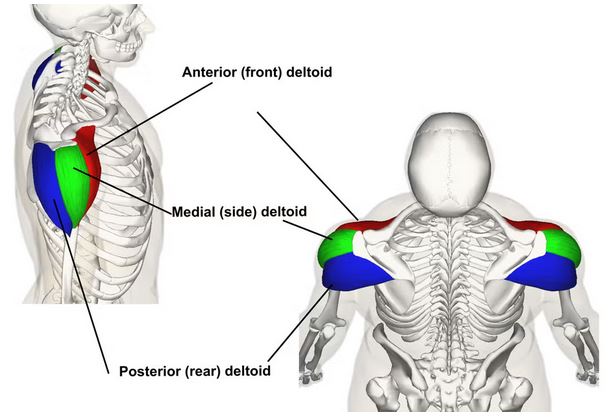
Because of these functions, the rear delts work closely with the upper back muscles, including the rhomboids and trapezius. This is exactly why many lifters struggle to isolate them — stronger muscles tend to take over if technique is not precise.
Another important point is the torso’s angle. Rear delts are best activated when your torso is positioned parallel or nearly parallel to the ground, aligning the direction of resistance with their primary function. This is why exercises like prone and bent-over variations are so effective.
In practice, understanding the anatomy of the rear delt is key to training them properly. If you don’t align your movement with their natural function, you’ll end up training the wrong muscles — no matter how hard you try.
What Makes a Great Rear Delt Exercise?
Not all “rear delt exercises” are created equal. In fact, many movements intended to target the rear delts end up working the upper back instead. The difference comes down to mechanics, execution, and how well the exercise aligns with the rear deltoid’s actual function.
A great rear delt exercise is not defined by how heavy you can lift—but by how effectively it places tension on the posterior deltoids throughout the movement.
Key Characteristics of an Effective Rear Delt Exercise
- Emphasizes shoulder horizontal abduction.
The arms should move outward to the sides, not straight backward. This is the primary function of the rear delts. - Minimizes upper back dominance.
Exercises that overly involve the rhomboids and traps reduce rear delt activation. - Provides a stable body position.
More stability means less cheating and better isolation (e.g., chest-supported or seated variations). - Allows controlled movement.
Rear delts respond best to strict form and slower tempo—not momentum. - Maintains consistent tension.
Exercises that maintain tension in the rear delts throughout most of the range of motion are more effective. - Matches proper torso angle.
Movements performed with the torso close to parallel to the floor better align with the rear delt’s function.
What Most People Get Wrong
One of the biggest mistakes lifters make is turning rear delt exercises into rows. The moment your elbows start moving backward instead of outward, the lats and upper back take over.
In practice, the best rear delt exercises are the ones that force you to stay honest. If you can’t cheat the movement, you’re much more likely to train the right muscle.
Classification of Rear Delt Exercises
Rear delt exercises can be grouped based on how they load the muscle, the equipment used, and the level of stability they provide. Understanding these categories will help you choose the right movements for your goals and build a more effective training program.
In practice, no single category is “the best.” The most effective approach is to combine different types of exercises to fully stimulate the rear delts from multiple angles.
1. Dumbbell Rear Delt Exercises
These are the most accessible and versatile options. They allow for a natural movement path and are excellent for building mind-muscle connection.
Examples:
- Bent-Over Dumbbell Lateral Raise (standing)
- Seated Bent-Over Dumbbell Lateral Raise
- Incline Dumbbell Rear Delt Fly
- Prone Dumbbell Rear Delt Fly
👉 Best for: control, technique, and isolation
2. Cable Rear Delt Exercises
Cable exercises provide constant tension throughout the movement, making them highly effective for hypertrophy and muscle activation.
Examples:
- Reverse Cable Crossover
- One-Arm Cable Rear Delt Fly
- Two-Arm Cable Rear Delt Fly
👉 Best for: consistent tension and smooth resistance
3. Machine-Based Rear Delt Exercises
Machines offer the highest level of stability, making them ideal for beginners or those who struggle with proper form.
Examples:
- Reverse Pec Deck Fly
👉 Best for: simplicity, stability, and ease of use
4. Hybrid Rear Delt Exercises
These movements combine elements of rows and flys, allowing for heavier loading while still targeting the rear delts.
Examples:
- Dumbbell Rear Delt Row
👉 Best for: strength and overload
5. Functional & Bodyweight-Friendly Options
These exercises are great for beginners, home workouts, or improving shoulder health and control.
Examples:
- Face Pull
- Resistance Band Rear Delt Fly
👉 Best for: accessibility, injury prevention, and activation
By combining exercises from each category, you ensure complete rear delt development—balancing isolation, load, and control.
Best Rear Delt Exercises Ranked (Top 12 for Shoulder Balance & Size)
Before diving into the list, it’s important to understand how these exercises were ranked.
This ranking is not random. It’s based on a combination of biomechanics, muscle activation, and real-world training effectiveness. In practice, the best rear delt exercises are not necessarily the most popular—but the ones that consistently deliver results when performed correctly.
Key Ranking Criteria
- Rear delt activation.
How effectively does the exercise target the posterior deltoids without excessive involvement of the upper back? - Ability to isolate the muscle.
Exercises that minimize cheating and force strict execution rank higher. - Resistance profile.
Movements that provide consistent tension throughout the range of motion are more effective for hypertrophy. - Stability and control.
More stable exercises allow better technique and muscle focus. - Ease of execution.
Exercises that are easier to learn and perform correctly rank higher, especially for most lifters. - Versatility and accessibility.
Movements that can be performed in most gyms (or even at home) have an advantage.
#1 Reverse Cable Crossover
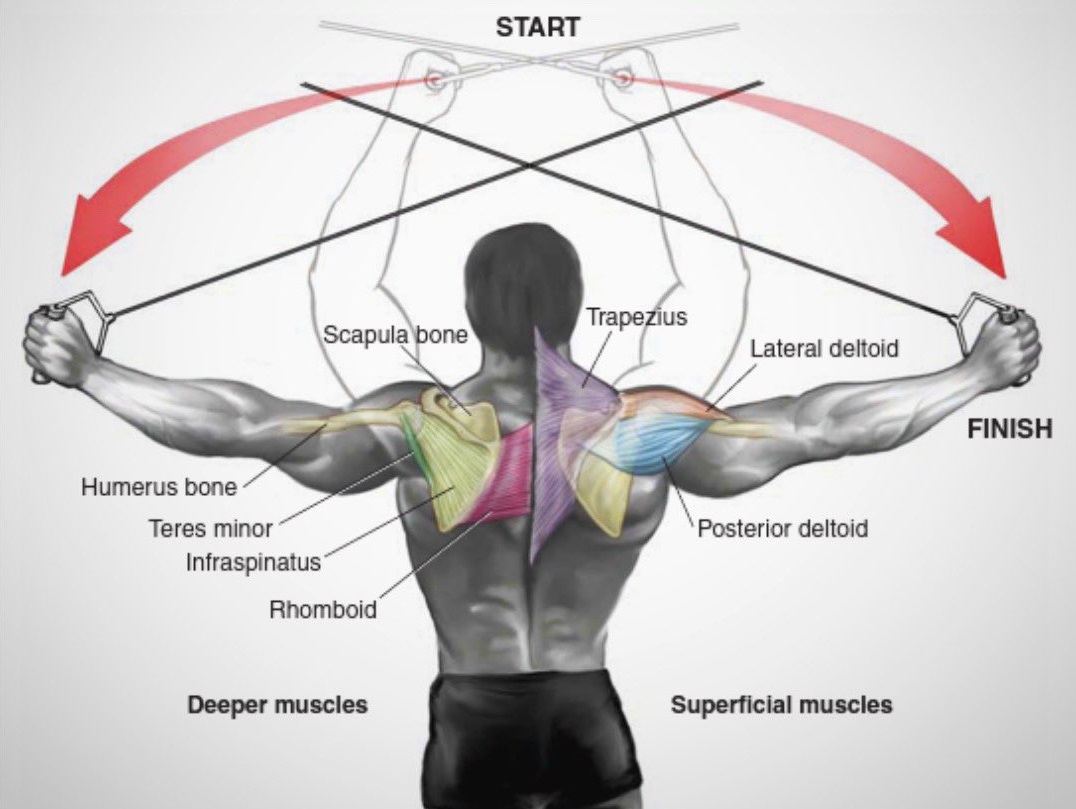
The reverse cable crossover is one of the most effective rear delt exercises because it provides constant tension throughout the entire movement. Unlike dumbbells, cables keep the rear delts engaged even in the stretched position, making it ideal for hypertrophy.
In practice, this is one of the best exercises for developing a strong mind-muscle connection and ensuring consistent rear delt activation.
To perform it, stand between two cable pulleys, grab the handles with crossed arms, and pull outward in a wide arc while keeping your torso stable.
- Best for: Maximum rear delt activation and constant tension
- Difficulty: Beginner to intermediate
- Type: Cable / Isolation
👉 Read full guide: Reverse Cable Crossover
#2 Reverse Pec Deck Fly
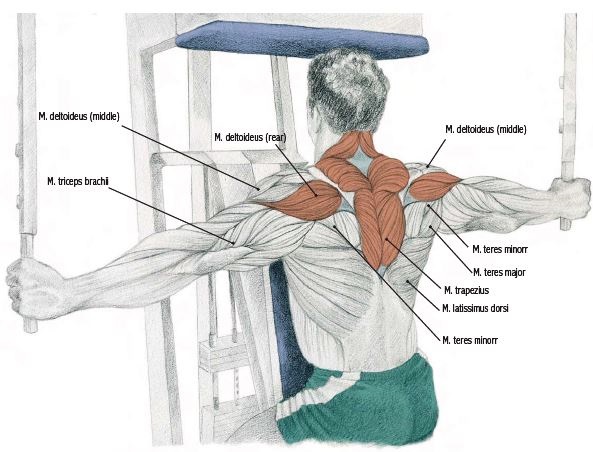
The reverse pec deck fly is one of the easiest and most reliable ways to isolate the rear delts. The machine setup removes most stability requirements, allowing you to focus purely on the target muscle.
This makes it especially effective for beginners or anyone struggling to feel their rear delts during free-weight movements.
Sit facing the machine pad, grab the handles, and pull your arms outward until they are in line with your shoulders while keeping your chest firmly against the support.
- Best for: Isolation and beginner-friendly execution
- Difficulty: Beginner
- Type: Machine / Isolation
👉 Read full guide: Reverse Pec Deck Fly
#3 Bent-Over Dumbbell Lateral Raise (Standing)
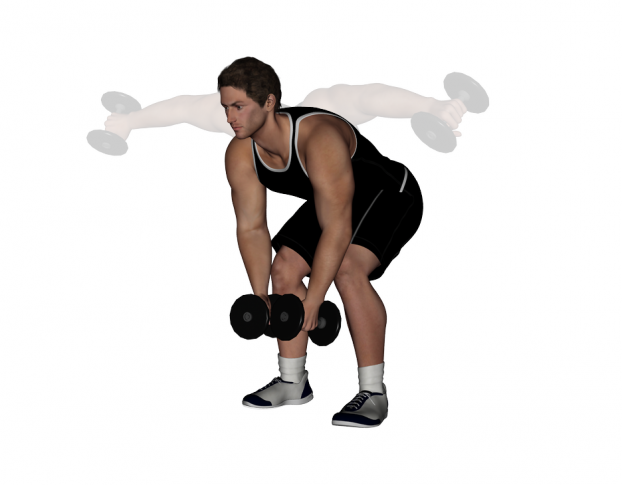
The bent-over dumbbell lateral raise is a classic rear delt exercise that requires control and proper positioning. When performed correctly, it effectively targets the posterior deltoids while also engaging the upper back.
However, because it requires stability, it’s easier to perform incorrectly compared to supported variations.
Bend at the hips with a flat back, let your arms hang down, and raise the dumbbells out to the sides while keeping your torso stable.
- Best for: Free-weight rear delt training
- Difficulty: Intermediate
- Type: Dumbbell / Isolation
👉 Read full guide: Bent-Over Dumbbell Lateral Raise (standing)
#4 Seated Bent-Over Dumbbell Lateral Raise
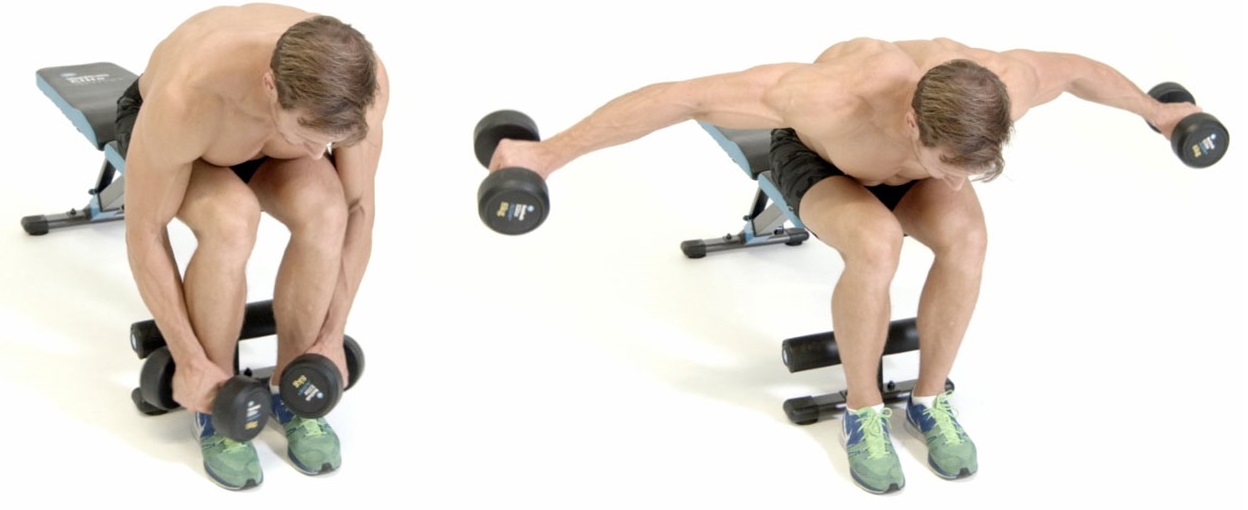
The seated version improves stability and reduces lower-back involvement compared to the standing variation. This allows for better control and more consistent rear delt activation.
In practice, this is a great progression for lifters who struggle with balance in the standing version.
Sit on a bench, lean forward with your chest close to your thighs, and lift the dumbbells out to the sides in a controlled arc.
- Best for: Stability and improved control
- Difficulty: Beginner to intermediate
- Type: Dumbbell / Isolation
👉 Read full guide: Seated Bent-Over Dumbbell Lateral Raise
#5 Incline Dumbbell Rear Delt Fly
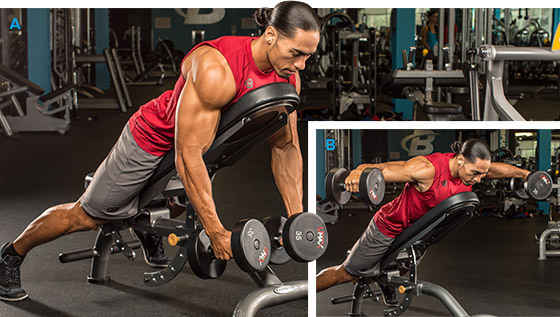
The incline dumbbell rear delt fly adds chest support, which helps reduce momentum and improve control. The slight incline angle makes the movement more comfortable while still effectively targeting the rear delts.
This variation is ideal for lifters who want a balance between isolation and a natural movement feel.
Lie chest-down on an incline bench and raise the dumbbells out to the sides while keeping your body fixed against the bench.
- Best for: Controlled rear delt training with added comfort
- Difficulty: Beginner to intermediate
- Type: Dumbbell / Isolation
👉 Read full guide: Incline Dumbbell Rear Delt Fly
#6 Prone Dumbbell Rear Delt Fly
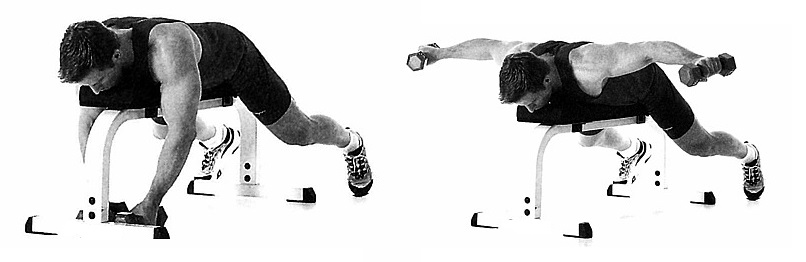
The prone dumbbell rear delt fly is one of the strictest and most isolated rear delt exercises. With the torso fully parallel to the floor, it places the rear delts in an optimal position for maximum activation.
In practice, this is one of the best movements for eliminating cheating and forcing proper technique.
Lie face down on a flat bench and lift the dumbbells outward in a wide arc while keeping your torso fully supported.
- Best for: Maximum isolation and strict form
- Difficulty: Intermediate
- Type: Dumbbell / Isolation
👉 Read full guide: Prone Dumbbell Rear Delt Fly
#7 One-Arm Cable Rear Delt Fly
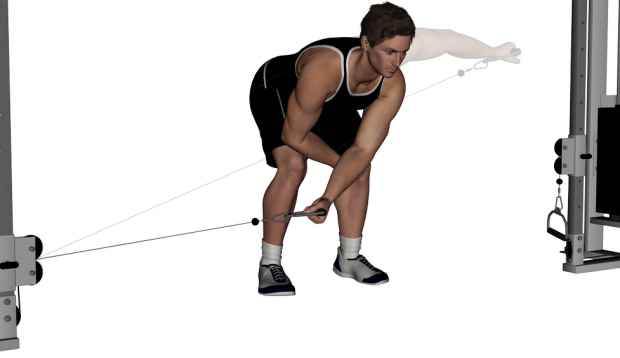
The one-arm cable rear delt fly is a unilateral exercise that allows you to focus on one side at a time. This improves control and helps correct muscle imbalances.
It also provides constant tension, making it highly effective for hypertrophy.
Stand next to a cable machine, grab the handle with the opposite hand, and pull your arm outward across your body while keeping your torso still.
- Best for: Fixing imbalances and improving control
- Difficulty: Intermediate
- Type: Cable / Isolation
👉 Read full guide: One-Arm Cable Rear Delt Fly
#8 Two-Arm Cable Rear Delt Fly
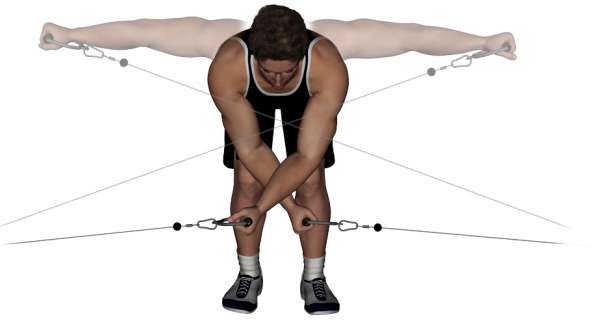
The two-arm cable rear delt fly is a bilateral version that allows efficient training of both sides at once. It combines the benefits of constant tension with a more time-efficient setup.
This makes it a great option for higher-volume training sessions.
Grab both cable handles with crossed arms and pull them outward simultaneously while maintaining a stable torso position.
- Best for: Efficient bilateral training
- Difficulty: Beginner to intermediate
- Type: Cable / Isolation
👉 Read full guide: Two-Arm Cable Rear Delt Fly
#9 Head-Supported Dumbbell Rear Delt Fly
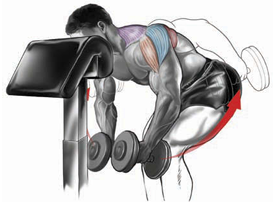
The head-supported rear delt fly reduces body movement and helps maintain a consistent torso position. This improves stability and makes it easier to keep tension on the rear delts.
In practice, it’s a great variation for refining technique and improving control.
To perform it, lean forward with your head supported on a bench or pad and raise the dumbbells out to the sides with controlled movement.
- Best for: Stability and strict execution
- Difficulty: Beginner to intermediate
- Type: Dumbbell / Isolation
👉 Read full guide: Head-Supported Dumbbell Rear Delt Fly
#10 Dumbbell Rear Delt Row
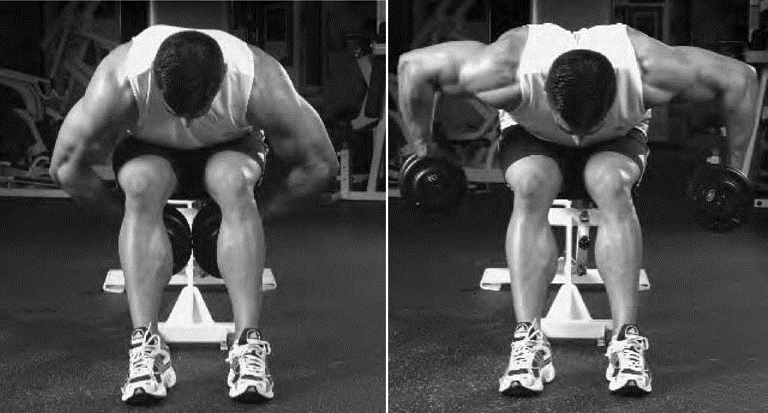
The dumbbell rear delt row is a hybrid movement that lets you use more weight than traditional fly variations do. By keeping your elbows bent and driving them outward, you shift the focus toward the rear delts while still engaging the upper back.
In practice, this is one of the best exercises for combining load and rear delt activation.
Lean forward with dumbbells in hand, keep your elbows bent, and lift them outward to the sides rather than pulling straight back.
- Best for: Heavier rear delt training
- Difficulty: Intermediate
- Type: Dumbbell / Hybrid
👉 Read full guide: Dumbbell Rear Delt Row
#11 Face Pull
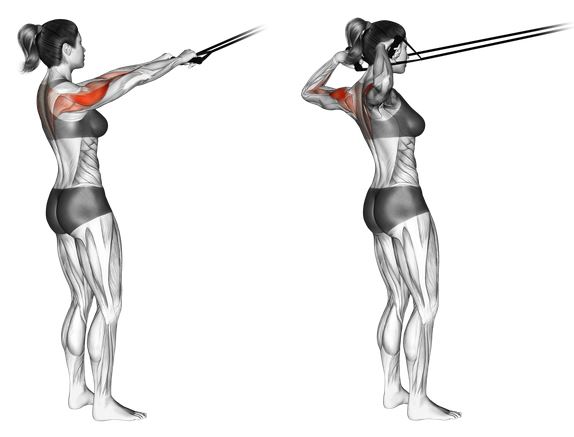
The face pull is a functional movement that targets the rear delts, upper back, and rotator cuff muscles. While it’s not a pure isolation exercise, it plays a crucial role in improving shoulder health and posture.
It’s especially valuable for balancing out pressing movements and preventing shoulder issues.
Pull the rope attachment toward your face while flaring your elbows outward and keeping your upper arms in line with your shoulders.
- Best for: Shoulder health and functional strength
- Difficulty: Beginner
- Type: Cable / Functional
👉 Read full guide: Face Pull
#12 Resistance Band Rear Delt Fly
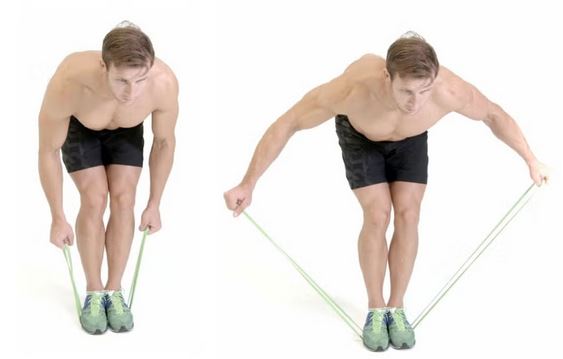
The resistance band rear delt fly is a simple and effective option for home workouts or warm-ups. It provides lighter resistance but still allows you to activate the rear delts and improve control.
In practice, it’s an excellent choice for beginners or as part of a pre-workout activation routine.
Hold a resistance band with both hands and pull it apart by moving your arms outward, maintaining tension throughout the movement.
- Best for: Beginners and home training
- Difficulty: Beginner
- Type: Resistance band / Isolation
👉 (No dedicated guide yet)
Best Rear Delt Exercises by Goal
Not all rear delt exercises serve the same purpose. Some are better for strict isolation, others allow heavier loading, while some are ideal for improving shoulder health. Choosing the right exercise depends on your specific goal.
In practice, the best results come from combining different types of movements rather than relying on a single type.
Best for Hypertrophy (Muscle Growth)
If your goal is to build bigger rear delts, you need exercises that provide consistent tension and controlled movement.
Top picks:
- Reverse Cable Crossover
- Two-Arm Cable Rear Delt Fly
- Incline Dumbbell Rear Delt Fly
- Prone Dumbbell Rear Delt Fly
These exercises keep the rear delts under tension for longer, which is key for hypertrophy.
Best for Strength & Load
If you want to use heavier weights and build strength, you need exercises that let you lift more without losing control.
Top picks:
- Dumbbell Rear Delt Row
- Bent-Over Dumbbell Lateral Raise (standing)
These movements allow slightly heavier loading while still targeting the rear delts.
Best for Isolation & Mind-Muscle Connection
If you struggle to feel your rear delts working, focus on exercises that minimize momentum and increase control.
Top picks:
- Reverse Pec Deck Fly
- Prone Dumbbell Rear Delt Fly
- Head-Supported Dumbbell Rear Delt Fly
These variations make it easier to isolate the rear delts and improve technique.
Best for Shoulder Health & Injury Prevention
Rear delt training is not just about aesthetics—it’s also crucial for maintaining healthy shoulders.
Top picks:
- Face Pull
- Resistance Band Rear Delt Fly
These exercises improve stability, posture, and rotator cuff function.
Best for Beginners
If you’re just starting out, you need exercises that are easy to learn and control.
Top picks:
- Reverse Pec Deck Fly
- Resistance Band Rear Delt Fly
- Two-Arm Cable Rear Delt Fly
These options reduce complexity and help build a foundation.
| Exercise | Isolation | Load Potential | Stability | Difficulty | Best Use |
|---|---|---|---|---|---|
| Reverse Cable Crossover | Very high | Moderate | High | Beginner–Intermediate | Hypertrophy, constant tension |
| Reverse Pec Deck Fly | Very high | Moderate | Very high | Beginner | Isolation, mind-muscle connection |
| Bent-Over Dumbbell Lateral Raise (standing) | High | Moderate | Moderate | Intermediate | Free-weight training |
| Seated Bent-Over Dumbbell Lateral Raise | High | Moderate | High | Beginner–Intermediate | Controlled execution |
| Incline Dumbbell Rear Delt Fly | Very high | Moderate | Very high | Beginner–Intermediate | Balanced isolation |
| Prone Dumbbell Rear Delt Fly | Maximum | Low–Moderate | Very high | Intermediate | Strict isolation |
| One-Arm Cable Rear Delt Fly | Very high | Moderate | High | Intermediate | Unilateral control |
| Two-Arm Cable Rear Delt Fly | Very high | Moderate | High | Beginner–Intermediate | Efficient volume |
| Head-Supported Dumbbell Rear Delt Fly | Very high | Low–Moderate | Very high | Beginner–Intermediate | Technique refinement |
| Dumbbell Rear Delt Row | Moderate–High | High | Moderate | Intermediate | Load & strength |
| Face Pull | Moderate | Moderate | High | Beginner | Shoulder health |
| Resistance Band Rear Delt Fly | Moderate | Low | High | Beginner | Activation, home training |
Rear Delts vs Upper Back: Why Most Lifters Get It Wrong
One of the biggest reasons rear delts remain underdeveloped is simple: most lifters don’t actually train them — they train their upper back instead.
At first glance, this makes sense. Rear delt exercises often involve pulling movements, and the rear delts work closely with muscles like the rhomboids and trapezius. The problem is that these muscles are usually stronger and more dominant, so they naturally take over if your technique isn’t precise.
The Core Difference
- Rear delts → move the arms outward (horizontal abduction)
- Upper back (rhomboids, traps) → pull the shoulder blades together (retraction)
👉 This difference is critical.
The moment your movement turns into pulling backward and squeezing your shoulder blades hard, you’ve shifted the load away from the rear delts and onto the upper back.
Why This Happens
- You use too much weight
- You focus on pulling back instead of out
- You overemphasize scapular retraction
- You let stronger muscles take over
In practice, this turns most “rear delt exercises” into poorly executed rows.
How to Fix It
- Think “outward,” not “backward.”
Your elbows should move to the sides, not behind your body. - Control the movement.
Slower reps help keep tension on the rear delts. - Limit excessive squeezing.
A slight contraction is enough—don’t overdo scapular retraction. - Use lighter weights.
This allows you to maintain proper form and muscle focus.
Why Most People Fail to Train Rear Delts Properly
Even when people include rear delt exercises in their workouts, they often fail to see real results. The issue is not a lack of effort—it’s a combination of poor exercise selection, incorrect technique, and misunderstanding how the rear delts actually function.
In practice, most lifters think they’re training their rear delts… but they’re not.
1. They Use Too Much Weight
This is the most common mistake.
Rear delt exercises are not meant to be heavy. When the weight is too heavy, the body compensates by using the upper back and momentum rather than the rear delts.
The result: less rear delt activation and slower progress.
2. They Turn Every Exercise into a Row
Instead of moving the arms outward, many lifters pull the weights backward. This shifts the emphasis to the lats, rhomboids, and traps, turning the movement into a completely different exercise.
If it feels like a row, it’s probably not targeting your rear delts properly.
3. They Lack Mind-Muscle Connection
Rear delts are harder to feel compared to larger muscle groups.
Without focus and control, it’s easy for stronger muscles to take over. This leads to ineffective reps—even if the exercise looks correct.
4. They Don’t Use the Right Angles
Rear delts work best when the torso is parallel or close to parallel to the floor.
If your torso is too upright, the movement changes, and the rear delts are no longer in an optimal position.
5. They Neglect Rear Delts Altogether
Many training programs focus heavily on pressing movements, which emphasize the front delts.
Over time, this creates muscle imbalances, poor posture, and underdeveloped rear delts.
Signs Your Rear Delts Are Underdeveloped
Rear delts are one of the most commonly neglected muscle groups—and in many cases, the imbalance is easy to spot once you know what to look for. The problem is that most lifters don’t realize their rear delts are lagging until it starts affecting both their physique and performance.
Here are the most common signs your rear delts are underdeveloped:
1. Your Shoulders Look Flat from the Side or Back
Well-developed shoulders should have a round, 3D appearance. If your shoulders look flat or lack depth, especially from the side or back, weak rear delts are often the reason.
2. Your Front Delts Dominate
If your shoulders look developed from the front but lack fullness from the back, it’s a clear sign of imbalance. This usually happens due to too much pressing and not enough targeted rear delt work.
3. You Feel Upper Back More Than Rear Delts
If, during “rear delt exercises,” you mainly feel your traps and rhomboids, it’s likely your rear delts are not properly activated or are too weak to contribute effectively.
4. Poor Posture (Rounded Shoulders)
Weak rear delts can contribute to forward-rounded shoulders, especially when combined with tight chest muscles and strong front delts.
5. Difficulty Controlling Rear Delt Movements
If you struggle to control the movement or feel the target muscle during rear delt exercises, it’s often a sign of poor development and a weak mind-muscle connection.
6. Limited Shoulder Stability
The rear delts help stabilize the shoulder joint. Weakness here can lead to reduced control and increased injury risk over time.
Sample Rear Delt Workouts
Do You Need to Train Rear Delts Separately?
This is one of the most common questions when it comes to shoulder training—and the short answer is: Yes, in most cases you should train rear delts separately.
However, “separately” does not mean you need an entire workout dedicated only to rear delts. It means you should include exercises that directly target the posterior deltoids as the primary movers, rather than relying on indirect work from rows, pull-ups, or other compound pulling movements, where the lats, rhomboids, and traps tend to dominate.
In practice, this simply means giving rear delts intentional attention within your existing training split—not isolating them into a separate training day.
At the same time, most training programs heavily emphasize pressing movements, which target the front delts.
Over time, this leads to:
- Overdeveloped front delts
- Underdeveloped rear delts
- Poor shoulder balance
- Increased risk of injury
The rear delts are best trained either as part of a shoulder workout (when following a muscle-group split) or on a pull day (as part of a push-pull-legs training split), where they complement back training. A typical pull day also includes biceps work, as both back and biceps are involved in pulling movements, making it a natural and efficient training combination.
Shoulder Day Workout
Pull Day Workout
Final Conclusion
Developing strong, well-defined rear delts is essential for achieving balanced shoulders, better posture, and a complete upper-body physique. While many lifters focus heavily on pressing and front delt work, true shoulder development comes from giving equal attention to all three heads—especially the often-neglected posterior deltoids.
As you’ve seen in this guide, the key is not just choosing the right exercises, but executing them correctly and applying them consistently. Rear delts respond best to controlled movements, moderate weights, and a clear focus on proper arm path—pulling outward rather than backward.
Whether you train them during a shoulder workout or on a pull day, what matters most is that you include direct rear delt work rather than relying solely on indirect stimulation from compound pulling exercises.
In practice, the most effective approach is simple:
- Train rear delts 2–3 times per week
- Combine isolation, load-based, and functional movements
- Prioritize form over weight
Do this consistently, and your rear delts will no longer be a weak point—but one of your strongest visual assets.
Train with intent—and your shoulders will show it.
