



Introduction
The dumbbell stiff-leg deadlift is one of the best free-weight exercises for building hamstring and posterior chain strength, as well as hip-hinge mechanics, with minimal equipment. By combining loaded stretch tension with controlled hip hinging, the exercise effectively targets the hamstrings, glutes, spinal erectors, and upper-back stabilizers simultaneously.
Compared to the barbell version, the dumbbell stiff-leg deadlift often feels more natural and easier to control because each arm moves independently and the load stays closer to the body. This makes it an excellent option for lifters learning hip-hinge mechanics or training in home gyms with limited equipment.
Like all stiff-leg deadlift variations, the movement primarily emphasizes the hamstrings through hip extension, with the knees remaining only slightly bent throughout the exercise. Because the hamstrings are placed under significant stretch tension during the lowering phase, the dumbbell stiff-leg deadlift can be extremely effective for hypertrophy and posterior-chain development when performed correctly.
Another major advantage of the exercise is its versatility. Whether performed with two dumbbells, one dumbbell, or even in unilateral variations, the movement develops not only hamstring strength but also balance, grip strength, trunk stability, and athletic movement control.
Required Equipment
To perform the dumbbell stiff-leg deadlift correctly, you need:
- One or two dumbbells
- Flat lifting surface
- Optional lifting straps for grip support
One of the biggest advantages of the dumbbell variation is accessibility. Unlike barbell setups that require racks, plates, and more space, dumbbells enable effective hamstring and posterior chain training with minimal equipment.
Using dumbbells also allows greater freedom of movement because each arm moves independently. Many lifters find this more comfortable for the shoulders, hips, and lower back while learning proper hip-hinge mechanics.
Other Names for the Dumbbell Stiff-Leg Deadlift
This exercise may also be referred to as:
- Dumbbell Straight-Leg Deadlift
- Dumbbell SLDL
- Dumbbell Straight-Leg Romanian Deadlift
- Dumbbell Hip Hinge Deadlift
- Dumbbell Hamstring Deadlift
Although terminology varies slightly, all versions involve a dumbbell-based hip hinge performed with minimal knee flexion to maximize hamstring loading and stretch tension.
How to Perform the Dumbbell Stiff-Leg Deadlift
Starting Position (Setup)
Proper setup is essential because the dumbbell stiff-leg deadlift places significant tension on the hamstrings and lower back throughout the movement.
- Stand upright with your feet hip-width apart.
- Hold the dumbbells in front of your thighs using an overhand grip.
- Keep the knees slightly bent but fixed throughout the exercise.
- Retract the shoulders slightly and brace the core.
- Maintain a neutral spine with a slight natural lower-back arch.
- Keep the dumbbells close to the body at all times.
The movement should begin from a stable standing position with the hips prepared to move backward rather than downward.

Execution (Movement Phase)
- Initiate the movement by pushing the hips backward.
- Lower the dumbbells slowly while maintaining a flat back.
- Continue descending until maximal hamstring stretch is reached without spinal rounding.
- Keep the knees in the same slightly bent position throughout the movement.
- Drive the hips forward to return to the starting position.
- Squeeze the hamstrings and glutes at the top without leaning back excessively.
The dumbbells should travel close to the legs during both the descent and ascent phases.

Technique Optimization Tips for the Dumbbell Stiff-Leg Deadlift
Because the exercise heavily loads the posterior chain in a stretched position, proper mechanics are critical for both safety and effectiveness.
- Push the hips backward rather than bending downward.
- Keep the dumbbells close to the body throughout the movement.
- Maintain a neutral spine at all times.
- Avoid excessive knee bending during the descent.
- Lower only as far as flexibility allows without rounding the back.
- Control the eccentric phase slowly.
- Keep the chest open and shoulders pulled back.
A highly effective cue is: “Reach the hips back while dragging the dumbbells down the legs.”
Mechanical Resistance Analysis
The dumbbell stiff-leg deadlift places heavy emphasis on the hamstrings because the knees remain relatively fixed while the hips move through a large range of motion. This creates substantial eccentric loading and stretch-mediated tension throughout the posterior chain.
Compared to machine-based hamstring curls, the exercise trains the hamstrings more functionally because the glutes, spinal erectors, upper back, and core stabilizers all contribute simultaneously to maintaining proper body position.
One advantage of dumbbells over barbells is that they allow slightly greater natural movement and may improve comfort for lifters with hip, shoulder, or mobility restrictions. The independent loading can also improve coordination and muscular balance while reducing some technical constraints associated with fixed barbell positioning.
Common Mistakes
Although the dumbbell stiff-leg deadlift is highly effective for hamstring development, poor technique can quickly shift stress away from the posterior chain and toward the lower back.
- Rounding the spine during the descent
- Allowing the dumbbells to drift away from the body
- Turning the movement into a squat
- Excessively bending the knees
- Lowering beyond available hamstring flexibility
- Jerking or bouncing the weight at the bottom
- Hyperextending the spine at the top
One of the most common mistakes is lowering the dumbbells too far, rather than focusing on maintaining proper spinal alignment and hamstring tension.
Muscles Involved in the Dumbbell Stiff-Leg Deadlift
The dumbbell stiff-leg deadlift trains far more than just the hamstrings because multiple muscle groups must work together to stabilize and move the body through the hip-hinge pattern.
MAIN MUSCLES:
SECONDARY MUSCLES:
Gluteus maximus, trapezius, upper back musculature
ASSISTING MUSCLES:
Forearms, core stabilizers, and adductors
ANTAGONISTS:
Dumbbell Stiff-Leg Deadlift Pros and Cons
The dumbbell stiff-leg deadlift is one of the best minimalist posterior-chain exercises because it combines loaded stretch tension, functional hip hinging, and relatively accessible equipment requirements.
Advantages
- Excellent hamstring stretch tension
The exercise places the hamstrings under heavy eccentric loading during the descent. - Minimal equipment required
Only dumbbells and open space are needed to perform the movement effectively. - More natural movement freedom than barbells
Independent dumbbell positioning often feels more comfortable for the shoulders and hips. - Strong posterior-chain development
The movement simultaneously trains the hamstrings, glutes, spinal erectors, and upper back stabilizers. - Useful for home workouts
Dumbbells make the exercise highly practical for home and garage-gym training.
Potential Drawbacks
Despite its benefits, the dumbbell stiff-leg deadlift also has limitations.
- High technical demand
Poor hip-hinge mechanics can quickly increase lower-back stress. - Grip strength may become limiting
The forearms often fatigue before the hamstrings during higher-repetition sets. - Not ideal for complete beginners
Many new lifters lack sufficient flexibility or body awareness for safe execution. - Limited maximal loading compared to barbells
Dumbbells eventually become harder to progress for advanced strength-focused training.
Many lifters actually learn proper hip-hinge mechanics faster with dumbbells than with a barbell because the independent loading feels more natural and less restrictive. Dumbbells also make it easier to maintain a close resistance path without fighting against fixed bar positioning.
As a coach working with athletes and general fitness clients, I often use dumbbell stiff-leg deadlifts as a progression toward heavier barbell hip-hinge movements because they develop hamstring awareness, posterior-chain control, and movement confidence extremely well.
Dumbbell Stiff-Leg Deadlift Variations
Small changes in setup, loading style, or stance width can significantly alter hamstring recruitment, stability demands, and the overall feel of the exercise. Strategically rotating variations may also help improve long-term development of the posterior chain.
Single-Leg Dumbbell Stiff-Leg Deadlift
The unilateral version increases balance demands, hip stability, and coordination while helping correct muscular imbalances between sides.
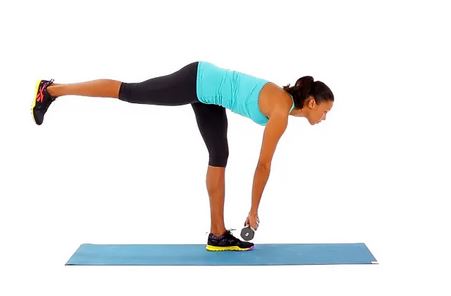
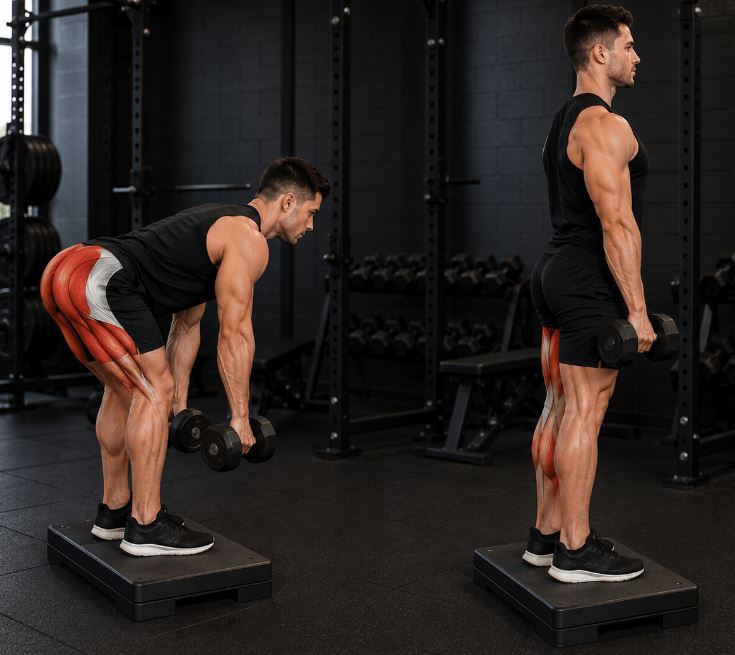
Deficit Dumbbell Stiff-Leg Deadlift
Standing on a small platform increases the range of motion and hamstring stretch tension. However, this variation also increases mobility demands and should only be used by experienced lifters with excellent technique.
Romanian Deadlift
The Romanian deadlift uses slightly more knee flexion and typically allows safer loading mechanics while still strongly emphasizing the hamstrings and glutes.

Kettlebell Stiff-Leg Deadlift
Kettlebells create a similar movement pattern but may feel more natural for some lifters due to their lower center of mass and neutral-grip positioning.

Smith Machine Stiff-Leg Deadlift
The Smith machine version provides additional stability and allows some lifters to focus more directly on hamstring tension without balance limitations.

Alternative Exercises for Hamstring Development
Although the dumbbell stiff-leg deadlift is highly effective for posterior-chain development, combining it with hip-dominant and knee-flexion exercises usually yields more comprehensive hamstring training.
Barbell Stiff-Leg Deadlift
The barbell version allows greater maximal loading and is often preferred for advanced strength-focused posterior-chain training.

Single-Leg Romanian Deadlift
The single-leg Romanian deadlift simultaneously improves hamstring strength, balance, hip stability, and unilateral posterior-chain control.

Lying Leg Curl
The lying leg curl isolates knee flexion and allows direct hamstring training with minimal spinal loading.

Nordic Hamstring Curl
The Nordic hamstring curl is one of the most demanding eccentric hamstring exercises and is widely used for athletic development and injury prevention.

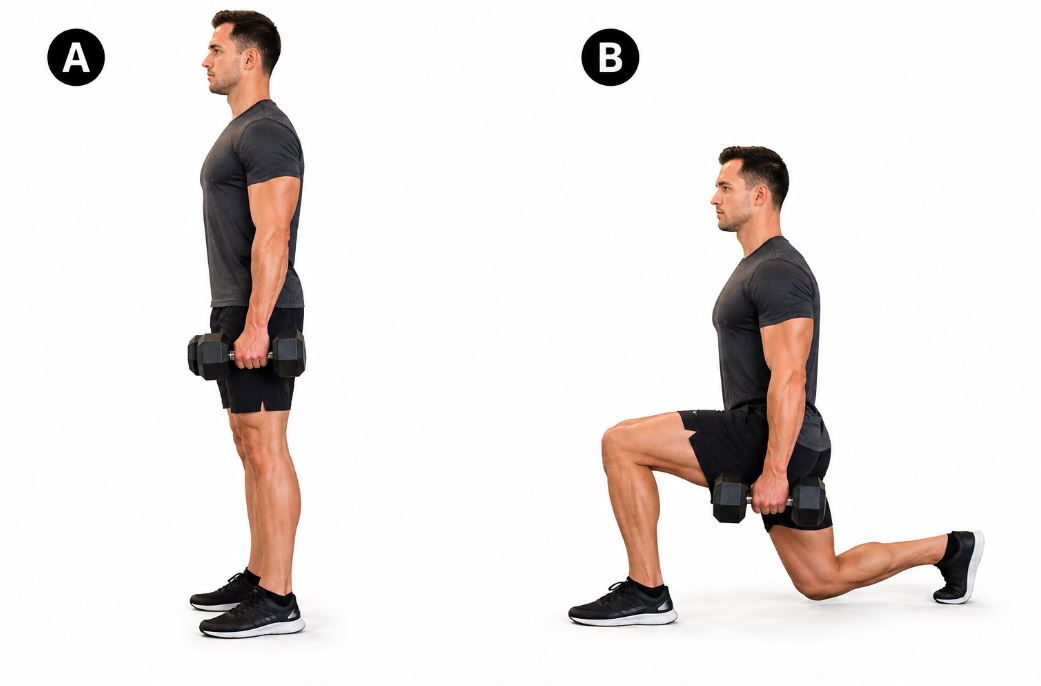
Reverse Lunge
Using a longer step length during reverse lunges increases hip hinging and posterior-chain involvement, placing greater emphasis on the hamstrings and glutes.
Dumbbell Stiff-Leg Deadlift vs Barbell Stiff-Leg Deadlift
Both exercises are excellent for hamstring and posterior chain development, but the type of loading changes movement mechanics, stability demands, and the overall feel of the exercise. Understanding these differences helps determine which variation best fits your training goals and experience level.
Conclusion: Both exercises are highly effective for hamstring and posterior-chain development. The dumbbell version offers greater movement freedom and accessibility, while the barbell version allows heavier loading and greater long-term strength progression.
Why Dumbbells Can Improve Hip-Hinge Mechanics
Many lifters learn hip-hinge mechanics more effectively with dumbbells because the load moves more naturally alongside the body. Unlike a fixed barbell, dumbbells allow slight adjustments in arm position, shoulder rotation, and hip movement throughout the exercise.
This added freedom often improves comfort for lifters with mobility restrictions or structural differences that make barbell positioning less natural. Dumbbells also encourage symmetrical movement because each side must stabilize independently rather than relying on a single connected bar.
For this reason, dumbbell stiff-leg deadlifts are frequently excellent teaching tools for developing posterior-chain awareness and proper hamstring loading before progressing to heavier barbell variations.
Final Thoughts
The dumbbell stiff-leg deadlift is one of the best minimalist posterior-chain exercises for building stronger hamstrings, glutes, and hip-hinge mechanics with minimal equipment.
When performed with strict spinal positioning, controlled eccentrics, and proper hip movement, the exercise provides exceptional stretch tension and hamstring activation while remaining highly practical for home gyms and general fitness training.
Why do dumbbell stiff-leg deadlifts often feel more natural than barbell versions?
Dumbbells allow each arm and shoulder to move independently, which reduces movement restrictions and often creates a more comfortable hip-hinge pattern. Many lifters also find it easier to keep the load close to the body with dumbbells.
Are dumbbell stiff-leg deadlifts effective enough for serious hamstring growth?
Absolutely. Although maximal loading potential is lower than with barbells, the exercise still creates excellent hamstring stretch tension and posterior-chain recruitment, especially when performed with controlled eccentrics and proper range of motion.
Why do forearms fatigue so quickly during dumbbell stiff-leg deadlifts?
Unlike barbells, dumbbells require each hand to stabilize independently throughout the movement. This increases grip demand significantly, especially during higher-repetition sets or slower eccentric tempos.
Should dumbbells touch the floor during stiff-leg deadlifts?
Usually no. The goal is maximizing hamstring tension while maintaining a neutral spine — not achieving maximum range of motion. For most lifters, lowering to mid-shin level is more than sufficient.
Can dumbbell stiff-leg deadlifts improve athletic performance?
Yes. The exercise strengthens the posterior chain, improves hip-hinge mechanics, and develops eccentric hamstring control — all important qualities for sprinting, jumping, deceleration, and directional changes.
Why do some people feel dumbbell stiff-leg deadlifts mostly in the glutes instead of the hamstrings?
This often depends on limb proportions, hip structure, stance width, and torso angle. Lifters with stronger hip-dominant mechanics may naturally recruit the glutes more heavily during hip-hinge movements.
Are dumbbell stiff-leg deadlifts safer for the lower back than barbell versions?
For many lifters, yes. The freer movement pattern and lighter loading potential often reduce technical stress on the spine. However, poor spinal positioning can still create lower-back strain regardless of equipment choice.
Is it better to use one dumbbell or two during stiff-leg deadlifts?
Using two dumbbells usually creates better loading symmetry and balance. Single-dumbbell variations can still be useful for beginners, home workouts, or unilateral stability challenges depending on the training goal.
