Close Menu
Bodybuilding Wizard

    Subscribe to Updates

    Join our mailing list to receive the latest updates from our team.

    Facebook X (Twitter) Instagram
    Trending
    • Does Soy Lower Testosterone or Increase Estrogen in Men? What the Science Says
    • Does Training Legs Really Boost Testosterone? What the Science Says
    • Does Sauna Really Boost Growth Hormone 16x? Myth vs. Science
    • Does Power Posing Really Boost Testosterone? Myth, Science & the Retraction
    • Does Ashwagandha Really Boost Testosterone and Lower Cortisol? Myth vs. Science
    • Progesterone and Exercise: How It Affects Training, Metabolism & the Menstrual Cycle
    • Estrogen and Exercise: How Estradiol Affects Muscle, Fat, Bone Health & Performance
    • Thyroid Hormones and Metabolism: T3, T4, Muscle Growth & Fat Loss Explained
    RSS Facebook X (Twitter) LinkedIn YouTube Pinterest Instagram
    Bodybuilding Wizard
    Subscribe Login
    • Home
    • Tools
      • Interactive Muscle Anatomy
      • Interactive Human Skeleton
      • Bodybuilding & Fitness Calculators
      • Dietary & Nutrition Calculators
      • Body Measurement Calculators
      • Fitness Tests
      • Bodybuilding Glossary
      • DIY Projects
    • Training
      • Weight training basics
      • Advanced bodybuilding
      • Strength training for women
      • Workout programs
      • Home weight training programs
      • Cardio workout
      • Exercise equipment
      • Weight training accessories
      • Weight lifting injuries
      • Weight training for sports
    • Exercises
      • Chest exercises
        • Middle chest exercises
        • Upper chest exercises
        • Lower chest exercises
      • Back exercises
        • Middle back (latissimus dorsi)
        • Upper back (trapezius)
        • Lower back (erector spinae)
      • Arm exercises
        • Bicep exercises
        • Tricep exercises
        • Forearm exercises
        • Grip-strengthening exercises
      • Shoulder exercises
        • Front deltoid
        • Side deltoid
        • Rear deltoid
        • Rotator Cuff
        • Scapular & Shoulder Stability
        • Neck strengthening exercises
      • Leg and glute exercises
        • Quadricep exercises
        • Hamstring exercises
        • Calf exercises
        • Glute & Hip exercises
        • Shin exercises
      • Abdominal exercises
        • Upper abdominal exercises
        • Lower abdominal exercise
        • Oblique exercises
      • Core exercises
      • Kettlebell exercises
      • Foam rolling & Stretching
      • Explosive (dynamic) lifts
    • Motivation
      • Greatest physiques
      • Motivation techniques & tips
      • Events and competitions
      • Latest fitness news
      • Videos
        • Funny gym reels
        • Motivational videos
        • Funny workout videos
      • Pictures
      • Quotes
      • Funny Fitness
      • Transformations
    • Diet
      • Nutrition Fundamentals
      • Diet Types & Strategies
      • Foods & Superfoods for Athletes
      • Muscle Building & Performance Nutrition
      • Weight Loss & Fat Management
      • Food Psychology & Myths
      • Recipes & Meal Ideas
    • Supplements
      • Supplements Review
      • Muscle Building Supplements
      • Anabolic Steroids
      • Fat Burners & Weight Loss
      • Pre-Workout & Energy Boosters
      • Recovery & Sleep Aids
      • Cognitive & Nootropic Support
      • General Supplement Advice
      • Health Supplements
        • Joint & Bone Support
        • Gut Health & Digestion
        • Vitamins & Minerals
        • Superfoods & Greens
      • Steroid Alternatives
    • Anatomy
      • Upper-Body Muscles
      • Lower-Body Muscles
      • Bones & Skeletal Anatomy
      • Muscle Growth & Genetics
      • Joints, Tendons & Connective Tissue
      • Hormones & Endocrine System
      • Physiology & Body Systems
      • Body Composition & Fat
      • General Anatomy & Basics
    • Health
    Bodybuilding Wizard
    You are at:Home»Anatomy»Muscle Growth & Genetics»Muscle Hyperplasia: Can Humans Really Grow New Muscle Fibers?
    Muscle Growth & Genetics

    Muscle Hyperplasia: Can Humans Really Grow New Muscle Fibers?

    No Comments10 Mins ReadkrunoslavBy krunoslavNovember 5, 2023Updated:August 6, 2026
    muscle hyperplasia
    Share
    Facebook Twitter Pinterest LinkedIn Email Tumblr WhatsApp Telegram
    Table of Contents
    • Introduction
    • What Is Muscle Hyperplasia?
    • Hyperplasia vs Hypertrophy
    • Does Muscle Hyperplasia Occur in Humans?
    • What Does Current Research Say?
    • Can Bodybuilding Cause Hyperplasia?
    • Can Steroids Cause Hyperplasia?
    • Satellite Cells and Hyperplasia
    • Why Hypertrophy Still Matters More
    • Common Myths About Muscle Hyperplasia
    • Conclusion

    Introduction

    You’ve probably heard some version of this claim: with enough training, your body doesn’t just grow the muscle fibers you already have — it creates entirely new ones. It’s a genuinely interesting idea, and it’s not pure myth; there’s real science behind it. The question is whether it actually happens in humans, and if it does, whether it matters for your training.

    💡

    QUICK ANSWER: Muscle hyperplasia — an increase in the actual number of muscle fibers — is well documented in animal studies but remains scientifically uncertain in humans. The best available evidence, including recent systematic reviews, has found no reliable evidence of meaningful fiber number increases in human resistance training studies. Even researchers who take the possibility seriously agree that if it occurs at all in humans, it contributes only a small fraction of total muscle growth compared to hypertrophy, which remains the dominant, well-established mechanism.

    What Is Muscle Hyperplasia?

    Muscle hyperplasia refers to an increase in the actual number of muscle fibers within a muscle, as opposed to an increase in the size of fibers that already exist. The theory is that under sufficiently intense mechanical stress, existing fibers might split, or new fibers might form from activated satellite cells, adding to the total fiber count rather than simply enlarging what’s already there.

    Hyperplasia vs Hypertrophy

    FeatureHypertrophyHyperplasia
    What happensExisting fibers get biggerNew fibers are formed
    Evidence in humansProven, extensively documentedUncertain, unresolved
    Evidence in animalsWell establishedWell established under specific conditions
    Role in muscle growthMain mechanismPossible minor role, at most
    Table 1. Hyperplasia vs Hypertrophy

    For the full picture of how hypertrophy actually works — the cellular mechanism, the types of hypertrophy, and how to train for it — see our complete guide to muscle hypertrophy. This guide focuses specifically on hyperplasia, the far less certain and far less understood half of that comparison.
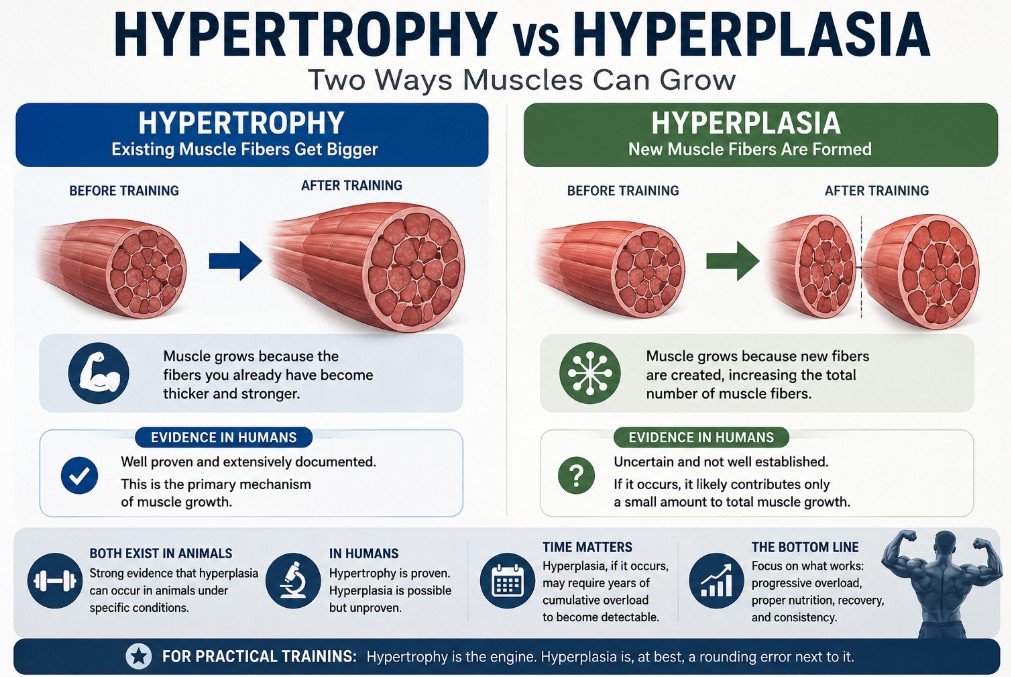
    Muscle hyperplasia infographic comparing muscle hyperplasia and muscle hypertrophy by showing new muscle fiber formation versus enlargement of existing muscle fibers

    Does Muscle Hyperplasia Occur in Humans?

    This is where the evidence gets genuinely interesting, and where it’s important to separate what’s been shown in animals from what’s actually been shown in people.

    Animal studies. The evidence here is comparatively strong. A meta-analysis of 17 animal studies using mechanical overload — chronic stretch, exercise, or surgical removal of synergist muscles — found statistically significant increases in muscle fiber number, averaging around 15%, across a range of species including quail and rodents. This is genuine, well-replicated evidence that hyperplasia can occur under experimental conditions that simply aren’t ethical or practical to reproduce in humans — extreme, sustained stretch protocols and surgical models that go well beyond anything a person would do in a gym.

    Human studies. The picture is far murkier. Much of the historical evidence comes from indirect methods — measuring whether a muscle’s total cross-sectional area grows faster than individual fiber size would predict, which is suggestive but not direct proof of new fiber formation. Direct fiber counting in humans requires invasive biopsy sampling, and biopsies only capture a small, localized sample of a muscle rather than the whole thing, making it genuinely difficult to detect a real change in total fiber number even if one occurred.

    Key Point: Hyperplasia has solid experimental support in animal models under conditions that don’t translate to normal human training. In humans, both the evidence and the measurement methods available remain far more limited and uncertain.

    What Does Current Research Say?

    The most useful recent evidence comes from a modern systematic review rather than any single older study. A comprehensive systematic review and meta-analysis specifically examining whether hyperplasia occurs in humans found no significant change in muscle fiber number following resistance training programs lasting up to six months. That’s a meaningfully stronger, more current conclusion than the frequently cited older single studies that first raised the possibility decades ago.

    Importantly, the researchers behind that review were careful not to overclaim a hard “no” either — they specifically noted that meaningful hyperplasia may be difficult to detect over relatively short training durations using current biopsy-based methodology. The honest scientific consensus right now is closer to “unproven and likely minor, if it happens at all” than either a confident yes or a confident no.
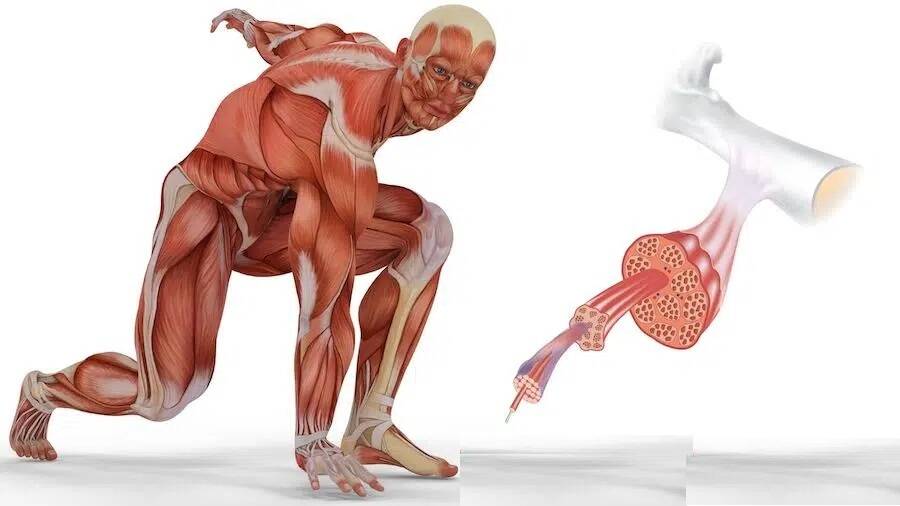
    muscle hyperplasia in humans

    Can Bodybuilding Cause Hyperplasia?

    Based on current evidence, not in any way that’s been reliably demonstrated. Bodybuilding-style resistance training produces enormous, well-documented increases in muscle size through hypertrophy — but the research specifically looking for fiber number increases in trained lifters has not found a consistent, meaningful effect. If hyperplasia contributes anything to a bodybuilder’s muscle size, current evidence suggests it’s a minor factor at most, not a distinct training outcome you can specifically chase or measure.

    Can Steroids Cause Hyperplasia?

    This is one of the more interesting corners of the research, and it’s genuinely more suggestive than the natural training evidence. A classic study comparing steroid-using and non-using strength athletes found significantly more myonuclei and central nuclei — a marker of newly formed muscle tissue — in the steroid-using group, alongside larger fiber size, and proposed that anabolic steroids enhance satellite cell activation enough to potentially contribute to new fiber formation. A more recent long-term study of steroid-using athletes similarly found elevated myonuclei counts and markers consistent with satellite cell activity, describing the findings as potentially indicative of muscle fiber hyperplasia.

    It’s worth being precise about what this does and doesn’t show: these are indirect markers (myonuclei counts, central nuclei, developmental protein expression) consistent with new fiber formation, not direct proof of it, and the study designs can’t fully rule out that steroid users were already genetically different in some way. But it’s a more consistent signal than anything found in natural training research, which makes some biological sense given how much more aggressively steroids drive satellite cell activity and protein synthesis than natural training alone can.

    Satellite Cells and Hyperplasia

    Every proposed mechanism for hyperplasia — natural or steroid-enhanced — ultimately runs through satellite cells, the muscle-specific stem cells responsible for donating myonuclei to growing fibers. The debate over whether apparent fiber “splitting” reflects genuine new fiber formation, versus satellite cells simply supporting more efficient growth of existing fibers, has never been fully resolved — and it’s a big part of why this topic remains scientifically unsettled rather than settled in either direction.

    Why Hypertrophy Still Matters More

    Even researchers who take hyperplasia seriously as a real, if unproven, phenomenon generally agree on one thing: if it occurs in humans at all, it accounts for a small fraction of total muscle growth — commonly estimated at somewhere around 5% or less — compared to hypertrophy, which is the overwhelming, well-established driver of muscle size increases. For virtually every practical training purpose, understanding and applying the principles that drive hypertrophy — progressive overload, mechanical tension, adequate protein and recovery — matters vastly more than anything related to hyperplasia.

    💪

    Coach’s Note: I get asked about hyperplasia more than almost any other “advanced” training topic, usually by someone hoping there’s a secret technique to unlock it. Here’s my honest take after years of watching what actually moves the needle for clients: even if hyperplasia turns out to be real in humans, it’s a rounding error next to hypertrophy. I’ve never programmed a single session around trying to trigger it, and neither should you. Master progressive overload, mechanical tension, and recovery first. That’s where essentially all of your results are actually coming from.

    Common Myths About Muscle Hyperplasia

    Myth: Chasing “the pump” creates new muscle fibers.

    Reality: The pump reflects temporary fluid and blood accumulation in muscle tissue. There’s no credible evidence connecting it to hyperplasia specifically.

    Myth: Steroids automatically create new muscle fibers for everyone who uses them.

    Reality: The evidence here is suggestive, not definitive — elevated myonuclei markers in steroid users are consistent with possible hyperplasia, but this hasn’t been proven as a universal or reliable effect.

    Myth: Bodybuilders have roughly double the muscle fibers of untrained people.

    Reality: There’s no reliable evidence supporting this. The overwhelming majority of the size difference between trained and untrained muscle comes from hypertrophy of existing fibers, not a dramatically higher fiber count.

    Conclusion

    New fibers might exist. New size definitely does.

    The evidence for hyperplasia in humans is genuinely uncertain, and even the researchers who take it seriously don’t think it explains much.

    Train for hypertrophy. It’s proven, it’s dominant, and it’s the mechanism that’s actually built every impressive physique you’ve ever seen.

    As with any actively debated area of exercise science, we’ll continue monitoring the research on human muscle hyperplasia and update this guide if meaningfully new evidence emerges.

    Key Takeaways
    • ✓ Muscle hyperplasia is an increase in the number of muscle fibers, distinct from hypertrophy, which increases the size of existing fibers.
    • ✓ Animal studies show clear evidence of hyperplasia under extreme, controlled experimental conditions not replicable in humans.
    • ✓ Recent systematic reviews of human resistance training found no significant change in muscle fiber number, though detecting it remains methodologically difficult.
    • ✓ Steroid use shows more suggestive (though still indirect) evidence of possible hyperplasia than natural training does.
    • ✓ Even if hyperplasia occurs in humans, current estimates suggest it contributes only a small fraction of total muscle growth compared to hypertrophy.
    Frequently Asked Questions About Muscle Hyperplasia
    What is muscle hyperplasia?

    Muscle hyperplasia is an increase in the actual number of muscle fibers within a muscle, as opposed to hypertrophy, which is an increase in the size of existing fibers.

    Can humans actually grow new muscle fibers?

    It remains scientifically uncertain. Animal studies show clear evidence of hyperplasia under specific experimental conditions, but recent systematic reviews of human resistance training studies have found no significant change in muscle fiber number.

    Does bodybuilding-style training cause hyperplasia?

    There’s no reliable evidence that natural bodybuilding training produces meaningful hyperplasia. Nearly all size gains from natural resistance training come from hypertrophy of existing fibers.

    Do anabolic steroids cause muscle fiber hyperplasia?

    Some studies of steroid-using athletes have found elevated myonuclei markers consistent with possible new fiber formation, which is more suggestive than the evidence in natural training. This remains an indirect finding, not definitive proof.

    If hyperplasia happens, how much does it contribute to muscle growth?

    Even researchers who consider hyperplasia plausible generally estimate it would account for a small fraction of total growth, commonly cited around 5% or less, with hypertrophy remaining the dominant mechanism by a wide margin.

    Why is muscle hyperplasia so hard to study in humans?

    Direct fiber counting requires invasive muscle biopsies, which only sample a small portion of a muscle rather than the whole thing, making it difficult to reliably detect a true change in total fiber number even if one occurred.

    References
    1. Kelley G. Mechanical overload and skeletal muscle fiber hyperplasia: a meta-analysis. Journal of Applied Physiology. 1996;81(4):1584–1588. PubMed
    2. A systematic review and meta-analysis examining if hyperplasia occurs in humans in response to resistance exercise. PubMed
    3. Kadi F, Eriksson A, Holmner S, Thornell LE. Effects of anabolic steroids on the muscle cells of strength-trained athletes. Medicine & Science in Sports & Exercise. 1999;31(11):1528–1534. PubMed
    4. Effects of Long Term Supplementation of Anabolic Androgen Steroids on Human Skeletal Muscle. PLOS ONE / PMC. PMC
    Share. Facebook Twitter Pinterest LinkedIn Tumblr Email WhatsApp
    krunoslav
    • X (Twitter)

    Hey! My name is Kruno, and I'm the owner and author of Bodybuilding Wizard. I am a licensed fitness trainer with a Ph.D. in kinesiology. Throughout my career, I have dedicated myself to helping individuals achieve their health and fitness goals through personalized training programs. In addition to my academic qualifications, I have completed various specialized courses, including certifications in nutrition and strength training, which have further enhanced my ability to provide comprehensive fitness guidance. I started this website back in late 2014, and it has been my pet project ever since. My goal is to help you learn proper weight training and nutrition principles so that you can get strong and build the physique of your dreams!

    Related Posts

    Anabolic Resistance: Why Muscle Growth Gets Harder With Age

    Do Men Build Muscle Faster Than Women? Sex Differences in Muscle Growth

    How Much Muscle Can You Build Naturally? Understanding Your Genetic Limits

    Leave A Reply Cancel Reply

    You must be logged in to post a comment.

    WE ARE SOCIAL
    • Facebook 3.6K
    • Twitter
    • YouTube 133
    • Instagram
    RECENT POSTS
    August 27, 2026

    Does Soy Lower Testosterone or Increase Estrogen in Men? What the Science Says

    August 26, 2026

    Does Training Legs Really Boost Testosterone? What the Science Says

    August 24, 2026

    Does Sauna Really Boost Growth Hormone 16x? Myth vs. Science

    August 24, 2026

    Does Power Posing Really Boost Testosterone? Myth, Science & the Retraction

    August 23, 2026

    Does Ashwagandha Really Boost Testosterone and Lower Cortisol? Myth vs. Science

    RECENT COMMENTS
    • Justin Dew on Designing your own home gym
    • krunoslav on Meet Your Muscles: How muscles are named?
    • Christina on Meet Your Muscles: How muscles are named?
    • igtropin on Stiff-Leg Deadlift: Proper Form, Muscles Worked & Hamstring Growth Guide
    • teragon labs on Barbell Back Squat: Proper Form, Benefits, Muscles Worked & Expert Tips
    LATEST GALLERIES

    Subscribe to Updates

    Join our mailing list to receive the latest updates from our team.

    ABOUT
    ABOUT

    We are a group of bodybuilding enthusiasts and this is our effort to have all the details about bodybuilding on a single website. We strive to educate and inform our visitors so that they can make the correct training, nutrition, and supplement decisions on their own. Bodybuilding Wizard will make your dream body your reality and take you to a whole new level!

    POPULAR POSTS
    April 2, 2014

    Lying Leg Curl: Complete Guide to Hamstring Isolation, Strength & Muscle Growth

    February 18, 2019

    Meet Your Muscles: How muscles are named?

    March 28, 2014

    Free weights: The main tool for building muscles

    BODYBUILDING WIZARD
    Bodybuilding Wizard Footer Logo
    Facebook X (Twitter) Instagram Pinterest YouTube
    • About
    • Authors
    • Editorial Policy
    • Write for us
    • Privacy
    • Contact
    • Terms of Use
    • Advertising
    • FAQ
    Copyright © 2014-2026 BodybuildingWizard. All rights reserved. Powered by WordPress. Made with love and lots of caffeine.

    Type above and press Enter to search. Press Esc to cancel.

    Sign In or Register

    Welcome Back!

    Login to your account below.

    Lost password?