



Introduction
The standing barbell calf raise is a classic free-weight exercise for building stronger, thicker, and more powerful calves. Unlike machine-based calf-raise variations, this exercise requires greater balance, postural control, and overall body stability while heavily loading the gastrocnemius during ankle plantarflexion.
Because the movement is performed with the knees relatively straight, the standing barbell calf raise primarily targets the gastrocnemius, with the soleus assisting throughout the exercise. The free-weight setup also increases the demands on stabilization across the feet, ankles, and torso, making the movement more technically demanding than many machine calf exercises.
When performed with a controlled tempo, full range of motion, and proper posture, the standing barbell calf raise can be highly effective for calf hypertrophy, lower-leg strength development, and improved overall calf definition, while also reinforcing balance and coordination under load.
Other Names for the Standing Barbell Calf Raise
Although the standing barbell calf raise is the most widely used name, some lifters and coaches may use slightly different terminology for this exercise.
- Barbell standing calf raise
- Standing barbell heel raise
- Free-weight standing calf raise
- Barbell calf raise
- Standing calf raise with barbell
Required Equipment
The standing barbell calf raise requires standard free-weight equipment and a stable, elevated surface to achieve full ankle range of motion.
- Barbell
- Weight plates
- Squat rack or power rack
- Calf block, weight plate, or step platform
- Flat training shoes or barefoot shoes for improved foot stability
- Optional safety bars for additional protection
How to Perform the Standing Barbell Calf Raise
Proper technique is extremely important during the standing barbell calf raise because the free-weight setup increases stability demands and spinal loading compared to machine-based calf exercises. Controlled repetitions and full ankle range of motion are essential for maximizing calf activation and reducing unnecessary momentum.
Starting Position
A stable setup helps maximize calf activation while improving posture and movement efficiency during the exercise.
- Position a barbell securely across the upper traps
- Stand upright with your feet approximately shoulder-width apart
- Place the balls of your feet on a calf block or elevated platform
- Allow your heels to hang slightly off the edge
- Maintain an upright torso and neutral spine
- Keep your knees relatively straight with a slight natural bend
- Brace your core and stabilize your posture
- Lower your heels slowly into a deep calf stretch
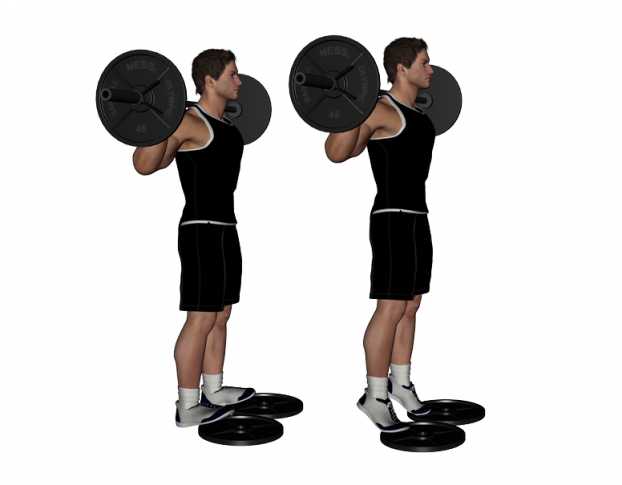
Execution (Action Phase)
The movement should occur almost entirely at the ankle joint.
- Push through the balls of your feet to raise your heels upward
- Contract the calf muscles as hard as possible at the top
- Pause briefly in the fully contracted position
- Lower your heels slowly under control
- Descend into a deep stretch at the bottom
- Repeat for the desired number of repetitions
Avoid leaning excessively forward or backward during the exercise. Controlled ankle movement and stable posture generally produce far better calf activation and exercise quality than bouncing or using excessive momentum.
Video Demonstration
Watching a proper demonstration helps lifters better understand posture control, foot positioning, and ankle mechanics during the standing barbell calf raise.
In the video below, notice how the torso remains upright and stable while the movement occurs almost entirely through ankle plantar flexion. Also, pay attention to the controlled lowering phase and the full stretch achieved at the bottom position.


One of the biggest advantages of the standing barbell calf raise is the ability to overload the calves using heavy free weights while still training balance, posture, and lower-leg stability. Many experienced lifters enjoy the more athletic and natural feel of free-weight calf training compared to machine-only variations.
However, a common myth is that free-weight calf raises are automatically superior to machine calf exercises. In reality, both approaches can build excellent calves when performed with full range of motion, controlled tempo, and proper progressive overload. Exercise quality matters far more than whether the resistance comes from a machine or a barbell.
Technique Optimization Tips
Small adjustments in setup and execution can significantly improve calf activation and overall training quality during the standing barbell calf raise.
- Use a full range of motion on every repetition
- Lower the heels slowly into a deep stretch
- Pause briefly at peak contraction
- Maintain an upright torso position
- Keep the knees relatively straight throughout the movement
- Perform the exercise with controlled tempo
- Push through the balls of the feet rather than the toes
- Avoid bouncing from the bottom position
Quick Form Checklist
Before starting each set, review these important technique cues.
- Balls of the feet positioned securely on the platform
- Heels allowed to move through a full stretch
- Upright torso and neutral spine maintained
- Stable balance and controlled posture
- Controlled lowering phase
- Strong calf contraction at the top
- No excessive bouncing or momentum
Technical Emphasis & Targeting Adjustments
Subtle changes in setup and execution can slightly alter muscular emphasis and overall training stimulus during the standing barbell calf raise.
- Straighter knees → greater gastrocnemius emphasis. Keeping the knees more extended places the gastrocnemius in a stronger mechanical position during ankle plantar flexion.
- Slower eccentric → improved hypertrophy stimulus. Lowering the heels slowly increases time under tension and may improve stretch-mediated calf growth.
- Pause at the bottom → increased loaded stretch. Briefly holding the stretched position increases tension on the calf muscles while improving ankle mobility control.
- Free-weight setup → greater stabilization demand. The barbell position requires greater posture control, balance, and lower-body stabilization than machine-based calf raises.
- Higher repetitions → greater muscular endurance stimulus. The calf muscles often respond well to moderate and high-repetition training because of their fatigue-resistant fiber composition.
- Neutral foot alignment → safer joint mechanics. Keeping the feet aligned naturally with the knees generally provides the most comfortable and biomechanically efficient ankle position.
Common Mistakes
Despite being a straightforward exercise, several technical mistakes can reduce calf activation and limit overall training effectiveness during the standing barbell calf raise.
- Using excessive weight with partial repetitions
- Bouncing aggressively out of the stretched position
- Performing the movement too quickly
- Leaning excessively forward or backward
- Failing to achieve full ankle range of motion
- Positioning too much of the foot on the platform
- Allowing the barbell to shift excessively during repetitions
- Bending the knees too much throughout the movement
Many lifters treat standing barbell calf raises like a “mini squat” and start using excessive body movement once the weight becomes heavy. In reality, the exercise should remain a controlled ankle-dominant movement where the calves perform the majority of the work.
Another common misconception is that heavier weight automatically produces better calf growth. In many cases, slower repetitions, full ankle range of motion, and deep stretching create far greater calf activation than simply loading the barbell as heavily as possible.
Mechanical Considerations
The standing barbell calf raise primarily trains the gastrocnemius through ankle plantarflexion while the body supports the external load in an upright standing position. Because the movement is performed with the knees relatively straight, the gastrocnemius remains in a strong mechanical position throughout the exercise.
Compared to machine-based calf raise variations, the standing barbell calf raise requires greater posture control, balance, and lower-body stabilization. The feet, ankles, and core musculature must work together to maintain stable positioning while the calves move through a loaded range of motion.
The free-weight setup may also provide a more athletic training feel for some lifters because the body must actively stabilize the resistance throughout the exercise. However, this increased demand for stabilization can also make it harder to isolate the calves completely compared to guided machine variations.
Muscles Worked in the Standing Barbell Calf Raise
The standing barbell calf raise primarily targets the muscles responsible for ankle plantar flexion and lower-leg force production. Because the movement is performed with relatively straight knees and external free-weight loading, the gastrocnemius becomes the dominant muscle involved in the exercise.
MAIN MUSCLES
SECONDARY MUSCLES
- Soleus
- Tibialis posterior
- Peroneus longus
- Peroneus brevis
- Flexor digitorum longus
ANTAGONISTS
- Tibialis anterior
- Extensor digitorum longus
Standing Barbell Calf Raise Pros and Cons
Like most free-weight exercises, the standing barbell calf raise offers several important advantages and limitations depending on your training goals, experience level, and available equipment.
Advantages
- Excellent free-weight calf overload. The exercise allows for significant external loading, promoting calf hypertrophy and strength development.
- Strong gastrocnemius emphasis. The relatively straight-knee setup places the gastrocnemius in an effective mechanical position during plantar flexion.
- Greater stabilization demands. The exercise challenges posture, balance, and lower-body coordination more than many machine calf raise variations.
- Minimal machine dependence. Only standard free-weight equipment is required.
- Athletic movement feel. Many lifters enjoy the more natural free-weight loading compared to guided machine exercises.
Potential Drawbacks
- Higher spinal loading. The barbell position places external load across the upper back and spine.
- More difficult to fully isolate the calves. Balance and posture demands may reduce the ability to isolate the calf compared to machine-based exercises.
- Requires proper rack setup and safety awareness. Performing the exercise outside a rack setup may increase unnecessary risk.
- Easy to misuse with excessive momentum. Many lifters shorten the range of motion or bounce excessively once heavier weights are introduced.
Standing Barbell Calf Raise Variations
Several variations of the standing barbell calf raise can slightly alter loading style, stability demands, or overall training stimulus while still emphasizing the calf muscles through ankle plantar flexion.
Smith Machine Standing Calf Raise
This variation uses a Smith machine instead of free weights, reducing stabilization demands while allowing heavier and more controlled calf loading.
Standing Dumbbell Calf Raise
Holding dumbbells at the sides provides a simpler free-weight variation with lower spinal loading and an easier setup than barbells.
Single-Leg Standing Dumbbell Calf Raise
This unilateral variation improves muscular symmetry, ankle stability, and lower-leg coordination by training one calf independently.
Machine Standing Calf Raise
Dedicated standing calf raise machines provide greater stability and isolation while minimizing balance demands during the exercise.
Paused Standing Barbell Calf Raise
This variation emphasizes longer pauses in both the stretched and contracted positions. The slower tempo increases time under tension and may enhance the hypertrophic stimulus for the calves.
Resistance Band Standing Calf Raise
Resistance bands provide a lightweight home-training option for calf endurance work and warm-ups.
Replacement Exercises (Substitutes) for the Standing Barbell Calf Raise
If barbells are unavailable or you want additional variation in your calf training, several exercises can provide a similar movement pattern while still effectively targeting the gastrocnemius and soleus muscles.
- Donkey calf raise. The bent-over torso position creates a unique loaded stretch and strong activation of the gastrocnemius.
- Hack Squat Calf Raise. Machine-based calf exercise performed on a hack squat machine.
- Leg press calf raise. This variation provides high loading potential and excellent calf stretching while placing minimal demands on stabilization.
- Rotary calf raise. The rotating platform creates smooth ankle mechanics and controlled calf tension throughout the movement.
- Seated calf raise. Although more soleus-focused, seated variations are excellent for complete lower-leg development.
Barbell calf raises are excellent for free-weight overload, but they are most effective when used within a complete calf-training system. Explore the best calf exercises for size, strength, and lower-leg performance.
If heavy calf training still is not producing results, read Why Your Calves Aren’t Growing: 10 Real Reasons & Proven Fixes.
Where This Exercise Fits in a Workout
Perform 3–5 sets of 10–20 repetitions.
Best programmed:
- During dedicated calf workouts
- At the end of lower-body training sessions
- During free-weight hypertrophy-focused training blocks
- As part of strength-oriented calf training routines
- In combination with seated calf raise variations for complete calf development
Standing Barbell Calf Raise vs Smith Machine Standing Calf Raise (Comparison Table)
| Criteria | Standing Barbell Calf Raise | Smith Machine Standing Calf Raise |
|---|---|---|
| Resistance Type | Free-weight | Guided machine |
| Stability Demand | Moderate | Low |
| Balance Requirement | Moderate | Minimal |
| Gastrocnemius Emphasis | High | High |
| Spinal Loading | Moderate to high | Moderate |
| Isolation Potential | Moderate | High |
| Coordination Demand | Higher | Lower |
| Best Use | Athletic free-weight calf training | Stable progressive overload |
The standing barbell calf raise provides a more natural free-weight loading environment while also increasing posture control, stabilization demands, and overall body coordination.
The Smith machine standing calf raise, however, provides greater stability during the exercise and often makes it easier to focus purely on calf contraction and progressive overload. Both exercises can be highly effective for calf hypertrophy when performed with a full range of motion and controlled tempo.
Final Thoughts
The standing barbell calf raise remains one of the classic free-weight exercises for building stronger, thicker, and more muscular calves. Its ability to combine heavy calf loading with posture control and stabilization demands gives the exercise a unique training feel compared with machine-based calf-raise variations.
When performed with strict technique, full ankle range of motion, and controlled tempo, the exercise can be highly effective for calf hypertrophy and lower-leg strength development. Like most calf exercises, long-term consistency, progressive overload, and exercise quality matter far more than simply loading the barbell as heavily as possible.
Why do some lifters prefer free-weight calf raises over machines?
Many lifters enjoy the more natural movement feel and increased stabilization demands of free-weight exercises. Standing barbell calf raises also require posture control, balance, and coordination, which can make the exercise feel more athletic compared to machine-only variations.
Is it safe to perform standing barbell calf raises outside a squat rack?
It is generally safer to perform the exercise inside a squat rack or power rack, especially when using heavier loads. Safety bars can provide protection if balance is lost or fatigue becomes excessive during the set.
Why do calves often respond well to both heavy and high-repetition training?
The calf muscles are heavily involved in everyday activities such as walking and standing, meaning they are highly fatigue-resistant. Because of this, many lifters respond well to combining heavier loading with higher repetition and endurance-focused training.
Should the heels touch the floor during standing barbell calf raises?
Ideally, the heels should descend into a deep controlled stretch below the forefoot level if ankle mobility and setup allow it. Full range of motion is usually far more effective than performing short partial repetitions.
Why do some lifters feel standing calf raises more in the feet than the calves?
This often occurs when force is pushed excessively through the toes instead of the balls of the feet. Poor ankle mobility or overly fast repetitions may also reduce proper calf tension.
Are standing barbell calf raises useful for athletes?
Yes. Strong calves contribute to force transfer, jumping, sprinting, acceleration, and lower-leg stiffness during athletic movement. However, athletes usually combine calf isolation work with more dynamic lower-body training methods.
Can standing barbell calf raises improve ankle stiffness and mobility?
Controlled repetitions through a full range of motion may help improve ankle mobility and tissue tolerance over time, especially when deep stretches are performed under control rather than with bouncing momentum.
Why do some people struggle to feel their calves working during calf raises?
Poor ankle mobility, limited range of motion, excessive weight, and fast repetitions often reduce calf activation. In many cases, lighter resistance with slower tempo and stronger peak contractions produces a much better mind-muscle connection.
