



Well-developed calves can completely transform the look of your lower body while also improving athletic performance, ankle stability, and overall movement efficiency. Strong calves play an important role in sprinting, jumping, walking, balance, and force transfer, yet calf training remains one of the most neglected areas in most workout programs.
As a coach working with lifters and athletes, I constantly see people rushing through a few quick calf raises at the end of leg day, only to wonder why their calves never seem to grow. In reality, calf development usually requires much more attention to exercise selection, range of motion, tempo, consistency, and training quality than most people realize.
Another major mistake is focusing only on one type of calf training. Effective lower-leg development requires targeting both the gastrocnemius and the soleus through a combination of standing exercises, seated variations, unilateral work, machine training, and free-weight movements. This is one reason some people build stronger, fuller calves much faster than others, despite using similar exercises.
The good news is that calves absolutely can improve when trained intelligently and consistently. While genetics does influence calf shape and muscle insertions, proper training still plays a massive role in how much size, strength, and definition you can develop over time.
In this guide, we’ll break down the best calf exercises for muscle growth, strength, endurance, and athletic performance. You’ll also learn the differences between standing and seated calf raises, common calf-training mistakes, and the most effective strategies for finally bringing up stubborn calves.
Quick Calf Anatomy
If you want to build bigger and more powerful calves, it helps to understand the two main muscles responsible for lower-leg development. One of the biggest reasons people struggle with calf growth is that they repeatedly perform the same exercise variations without understanding which muscles they are actually targeting.
The calves are primarily made up of the gastrocnemius and the soleus. Although both muscles contribute to ankle plantar flexion, they function slightly differently and respond best to different exercise positions.
While the variation between individuals is large, the average calf fiber type distribution in the general population is something like this:
- Gastrocnemius has about 55% type I fibers.
- Soleus has about 80% type I fibers.

Gastrocnemius Muscle
The gastrocnemius is the large visible calf muscle located on the back of the lower leg. This is the muscle that creates most of the upper calf size and the rounded shape people typically associate with impressive calves.
Because the gastrocnemius crosses both the knee and ankle joints, it becomes more active when the knees remain relatively straight during calf exercises. This is why standing calf raises tend to place greater emphasis on the gastrocnemius.
Exercises such as the standing machine calf raise, standing dumbbell calf raise, standing barbell calf raise, and donkey calf raise are all excellent choices for targeting the calf muscles.
The gastrocnemius also plays an important role in explosive athletic movements such as sprinting and jumping, making it highly important for both aesthetics and performance.
Soleus Muscle
The soleus sits underneath the gastrocnemius and is often overlooked in calf training programs. However, this muscle contributes significantly to overall calf thickness and lower-leg development.
Unlike the gastrocnemius, the soleus does not cross the knee joint. As a result, it becomes more active when the knees are bent during calf exercises. This is why seated calf raise variations are so effective for targeting the soleus.
Exercises such as the seated calf raise, seated dumbbell calf raise, seated barbell calf raise, and rotary calf raise place greater emphasis on the deeper calf muscles.
The soleus also plays a major role in walking, posture, endurance, and lower-leg stability because it remains active constantly throughout everyday movement.
Understanding the Different Types of Calf Exercises
Not all calf exercises train the lower leg in exactly the same way. The position of your knees, the type of resistance, the level of stability, and whether you train one leg or both legs at the same time can all change how the exercise feels and which part of the calf receives the most emphasis.
This is why a complete calf-training program should not rely on only one movement. A few rushed sets of standing calf raises may be better than nothing, but they rarely provide enough variety to fully develop both the gastrocnemius and the soleus.
A smarter approach is to organize calf exercises into several major categories. This makes it much easier to choose the right exercises for your goal, whether you want more size, better strength, improved ankle stability, or a more balanced lower-leg appearance.
Standing Calf Exercises (Gastrocnemius Emphasis)
Standing calf exercises are performed with the knees relatively straight, placing the gastrocnemius in a stronger mechanical position during ankle plantarflexion. Because the gastrocnemius crosses both the knee and ankle joints, keeping the legs extended increases its involvement throughout the movement.
These exercises are typically the foundation of most calf-training programs because they are highly effective for building visible calf size, upper calf fullness, and overall lower-leg power. Standing calf exercises also tend to carry over well into athletic activities such as sprinting, jumping, and explosive lower-body movement.
In most cases, standing calf exercises allow heavier loading than seated variations. This makes them excellent for progressive overload and long-term calf hypertrophy when performed with a full range of motion and controlled tempo.
Some of the best standing calf exercises include:
- Standing Machine Calf Raise
- Standing Barbell Calf Raise
- Standing Dumbbell Calf Raise
- Smith Machine Standing Calf Raise
- Donkey Calf Raise
- Leg Press Calf Raise
- Hack Squat Calf Raise
- Single-Leg Standing Dumbbell Calf Raise

Seated Calf Exercises (Soleus Emphasis)
Seated calf exercises are performed with the knees bent, which changes the mechanics of the movement and shifts more workload toward the soleus muscle. Because the gastrocnemius becomes mechanically shortened in a seated position, the soleus takes over a much larger role during ankle plantar flexion.
This is extremely important for complete calf development because the soleus contributes heavily to lower-leg thickness, muscular endurance, and overall calf density. Many lifters focus almost exclusively on standing calf raises and completely neglect seated calf work, which is one reason their calves often lack fullness from the side and rear.
Seated calf exercises also tend to work very well with slower tempo, controlled repetitions, deep stretching, and higher repetition ranges. Since the soleus is highly fatigue-resistant and active throughout daily movement, it often responds well to extended time under tension and consistent weekly training volume.
Some of the best seated calf exercises include:
- Seated Calf Raise
- Seated Dumbbell Calf Raise
- Seated Barbell Calf Raise

Free-Weight Calf Exercises
Free-weight calf exercises use external resistance, such as barbells or dumbbells, rather than machine-guided movement patterns. These variations generally require greater stabilization, balance, postural control, and overall body coordination than machine-based calf exercises.
One major advantage of free-weight calf training is that it often feels more natural and unrestricted. Many lifters prefer free weights because they allow greater freedom of movement and can be performed in a wider variety of gym or home workout settings.
Free-weight calf exercises can also improve:
- Ankle stability
- Lower-leg coordination
- Balance
- Unilateral strength
- Overall movement control
At the same time, they typically require a stricter technique because balance and posture become additional limiting factors during the exercise.
As a coach, I usually like to combine both free-weight and machine-based calf training in the same program. Machines are excellent for stable overload and isolation, while free weights often improve movement quality and coordination.
Some of the best free-weight calf exercises include:
- Standing Barbell Calf Raise
- Standing Dumbbell Calf Raise
- Seated Barbell Calf Raise
- Seated Dumbbell Calf Raise
- Single-Leg Standing Dumbbell Calf Raise
- Donkey Calf Raise (when using a weight belt loaded with plates)
Machine-Based Calf Exercises
Machine-based calf exercises are among the most effective for building bigger, stronger calves because they provide high stability and controlled resistance. Unlike many free-weight variations, machine exercises reduce balance and posture demands, allowing the calf muscles to become the primary limiting factor during the movement.
This added stability makes it easier to focus on:
- Deep stretching
- Controlled tempo
- Peak contraction
- Progressive overload
- Overall movement quality
Machine calf exercises are also excellent for training near muscular failure safely because the setup is generally more stable and predictable than free-weight movements.
Another major advantage is that machines often allow very consistent tension throughout the repetition, which can be extremely effective for hypertrophy-focused calf training.
As a coach, I frequently use machine-based calf exercises during hypertrophy-focused phases because they help lifters maintain strict technique while accumulating high-quality calf volume.
Some of the best machine-based calf exercises include:
- Standing Machine Calf Raise
- Leg Press Calf Raise
- Smith Machine Standing Calf Raise
- Rotary Calf Raise
- Hack Squat Calf Raise
Unilateral Calf Exercises
Unilateral calf exercises train one leg at a time instead of both legs simultaneously. These variations are extremely valuable for improving muscular balance, ankle stability, lower-leg coordination, and movement control.
Many lifters unknowingly develop calf strength imbalances over time, especially if they rely exclusively on bilateral machine exercises. Training one side independently helps identify and correct these asymmetries while also improving mind-muscle connection and overall movement awareness.
Unilateral calf work is particularly useful for:
- Athletes
- Runners
- Rehabilitation-focused training
- Balance improvement
- Ankle stabilization
Because only one leg is working at a time, these exercises usually create much higher stabilization demands throughout the foot and ankle complex. This can make even relatively light resistance feel surprisingly challenging when performed with strict control.
As a coach, I often include unilateral calf exercises alongside heavier bilateral movements to improve both aesthetics and athletic function. In many cases, single-leg calf work also helps expose weaknesses that bilateral exercises may hide.
Some of the best unilateral calf exercises include:
- Single-Leg Standing Dumbbell Calf Raise
- Single-Leg Bodyweight Calf Raise
It’s also important to understand that many bilateral calf exercises can easily be adapted into unilateral variations. In practice, a large number of machine-based and free-weight calf exercises can be performed one leg at a time to increase stabilization demands, improve mind-muscle connection, and help correct left-right strength imbalances.
For example, many lifters successfully perform single-leg variations on:
- Standing calf raise machines
- Leg press machines
- Hack squat machines
- Smith machines
simply by shifting the workload to one side at a time. This makes unilateral calf training far more versatile than many people realize.
Bodyweight Calf Exercises
Bodyweight calf exercises are often underestimated, but they can still be extremely effective for improving calf endurance, ankle stability, lower-leg coordination, and overall movement quality. These exercises are especially useful for beginners, home workouts, athletes, runners, and rehabilitation-focused training.
One major advantage of bodyweight calf training is accessibility. Since little or no equipment is required, these exercises can be performed almost anywhere while still providing meaningful lower-leg stimulation when proper technique and a full range of motion are used.
Bodyweight calf exercises also tend to place greater emphasis on:
- Balance
- Ankle control
- Movement awareness
- Foot stability
- Muscular endurance
When performed at a slower tempo, with pauses, and with higher repetitions, bodyweight calf raises can become surprisingly challenging despite the lack of external resistance.
As a coach, I often use bodyweight calf exercises:
- During warm-ups
- In athletic conditioning programs
- For ankle stability work
- In rehabilitation settings
- During high-repetition burnout sets
They also work very well for improving movement quality before progressing into heavier machine or free-weight calf training.
Some of the best bodyweight calf exercises include:
- Single-Leg Bodyweight Calf Raise
- Stair Calf Raise
- High-Rep Bodyweight Calf Raise
The 13 Best Calf Exercises
Now that we’ve covered the major categories of calf training, let’s look at the exercises themselves. Different calf raise variations create different training stimuli depending on factors such as knee position, stability, range of motion, loading potential, and overall movement mechanics.
As a coach, I rarely rely on just one calf exercise for long-term development. Combining standing, seated, machine-based, unilateral, and bodyweight variations usually produces far more complete results for both aesthetics and athletic performance.
Some exercises are better for:
- Heavy progressive overload
- Deep loaded stretching
- Soleus development
- Ankle stability
- Muscular endurance
- Athletic carryover
while others excel at creating controlled isolation and hypertrophy-focused tension.
Below are the best calf exercises for building bigger, stronger, and more powerful lower legs, along with explanations of what makes each movement effective and who benefits most from using it.
1. Standing Machine Calf Raise

The standing machine calf raise is one of the best overall exercises for building bigger and stronger calves. Because the knees remain relatively straight throughout the movement, this exercise places a strong emphasis on the gastrocnemius — the large visible calf muscle responsible for most of the upper calf size and shape.
One of the biggest advantages of the standing-machine calf raise is its stability. The machine-supported setup allows you to focus almost entirely on calf contraction, deep stretching, and controlled repetitions without worrying about balance or posture control. This makes it much easier to apply progressive overload safely while maintaining strict exercise technique.
As a coach, I’ve found that many lifters finally begin seeing calf growth once they stop rushing through sloppy partial reps and start performing standing calf raises with a full range of motion and proper tempo control. The deep stretch at the bottom of the movement is especially important for maximizing muscular tension and overall hypertrophy stimulus.
This exercise works extremely well for:
- Calf hypertrophy
- Progressive overload
- Heavy calf training
- Gastrocnemius development
- Athletic lower-leg strength
The standing machine calf raise is also highly versatile because it can be trained using:
- Heavier low-to-moderate reps
- Slow eccentrics
- Pause reps
- Higher-volume hypertrophy work
Depending on the machine design, many lifters can also easily perform unilateral standing calf raises by shifting the workload to one leg at a time.
➡️ Read the complete exercise guide here:
Standing Machine Calf Raise
2. Leg Press Calf Raise

The leg press calf raise is one of the most effective machine-based exercises for building stronger, thicker calves while minimizing demands on balance and stabilization. Because the upper body remains supported throughout the movement, the calves become the primary limiting factor, allowing you to focus heavily on muscular tension and controlled ankle movement.
One of the biggest advantages of the leg press calf raise is the ability to train the calves with relatively heavy resistance while still maintaining excellent stability and a full range of motion. Many lifters also find it easier to achieve a deeper stretch on the leg press than on traditional standing calf-raise machines.
As a coach, I often recommend the leg press calf raise to lifters who struggle with balance during standing variations or who want a highly stable environment for progressive overload and hypertrophy-focused calf training. The seated/reclined setup also reduces spinal loading, which can be helpful during high-volume lower-body training phases.
This exercise works especially well for:
- Calf hypertrophy
- Progressive overload
- Deep loaded stretching
- Controlled tempo training
- Gastrocnemius development
The leg press calf raise can also be performed using:
- Heavy low-to-moderate repetitions
- Slow eccentric repetitions
- Pause reps in the stretched position
- Higher-repetition burnout sets
- Unilateral single-leg variations
When performed with strict technique and full ankle range of motion, the leg press calf raise can become one of the most productive calf-building exercises in any training program.
➡️ Read the complete exercise guide here:
Leg Press Calf Raise
3. Smith Machine Standing Calf Raise

The Smith machine standing calf raise combines the benefits of heavy calf training with the added stability of a guided machine setup. Because the movement path is fixed, many lifters find it easier to focus entirely on calf contraction, range of motion, and controlled repetition quality without worrying as much about balance or posture control.
Like most standing calf variations, this exercise primarily targets the gastrocnemius because the knees remain relatively straight throughout the movement. The stable setup also makes it easier to train safely near muscular failure while maintaining strong calf tension from the stretched position through peak contraction.
As a coach, I often use the Smith machine standing calf raise during hypertrophy-focused training blocks because it works extremely well for slower tempo training, pause reps, and progressive overload. Many lifters also feel a stronger mind-muscle connection during Smith machine calf raises compared to free-weight versions.
This exercise works especially well for:
- Calf hypertrophy
- Controlled heavy loading
- Gastrocnemius development
- Tempo-focused training
- Stable progressive overload
The Smith machine setup also allows several useful training variations, including:
- Slow eccentric repetitions
- Pause reps at peak contraction
- Higher-repetition hypertrophy work
- Single-leg calf raises
- Stretch-emphasis calf training
One of the biggest mistakes people make on the Smith machine is loading too much weight and performing short, bouncing repetitions. In my experience, the calves respond much better when the movement is controlled, the heels fully descend into the stretch, and the contraction is held briefly at the top.
➡️ Read the complete exercise guide here:
Smith Machine Standing Calf Raise
4. Seated Calf Raise

The seated calf raise is one of the best exercises for directly targeting the soleus muscle, which lies underneath the gastrocnemius and contributes heavily to overall calf thickness and lower-leg density. Because the knees remain bent throughout the exercise, the gastrocnemius becomes mechanically shortened, forcing the soleus to handle a much larger portion of the workload.
Many lifters underestimate how important soleus development is for complete calf growth. In reality, calves often look much fuller and thicker once seated calf work is trained consistently alongside standing variations.
One of the biggest advantages of the seated calf raise is that it works extremely well with slower tempo, longer sets, and extended time under tension. Since the soleus is highly fatigue-resistant and is constantly active during walking and standing, it often responds very well to moderate and high repetition ranges.
As a coach, I frequently see lifters improve their stubborn calf development once they finally begin taking seated calf raises seriously, rather than focusing exclusively on standing movements.
This exercise works especially well for:
- Soleus development
- Overall calf thickness
- Muscular endurance
- Hypertrophy-focused calf training
- Higher-repetition calf work
The seated calf raise can also be trained using:
- Slow eccentric repetitions
- Pause reps in the stretched position
- High-volume hypertrophy sets
- Drop sets
- Extended time-under-tension methods
One common mistake is using excessive weight while shortening the movement range. The seated calf raise becomes far more effective when the heels fully descend into a deep stretch, and the contraction is controlled throughout the repetition.
➡️ Read the complete exercise guide here:
Seated Calf Raise
5. Rotary Calf Raise

The rotary calf raise is a machine-based calf exercise that uses a rotating platform or a pivoting movement path to create smooth, controlled ankle motion throughout the repetition. Unlike some traditional calf-raising machines, the rotary setup often provides very consistent resistance and a more natural-feeling movement pattern during plantarflexion.
Because the legs remain relatively extended during most rotary calf raise machines, the exercise places strong emphasis on the gastrocnemius while still involving the soleus to a lesser degree. The machine-supported setup also reduces balance demands, allowing lifters to focus heavily on muscular tension, stretching, and controlled repetition quality.
As a coach, I like rotary calf raises for lifters who prefer stable machine mechanics or who want a highly controlled hypertrophy-focused calf exercise without excessive spinal loading or posture demands.
This exercise works especially well for:
- Calf hypertrophy
- Controlled calf isolation
- Smooth ankle mechanics
- Tempo-focused training
- Gastrocnemius development
The rotary calf raise can also be performed using:
- Slow eccentric repetitions
- Pause reps at peak contraction
- Higher-repetition hypertrophy sets
- Stretch-emphasis training
- Controlled burnout sets
One of the biggest advantages of rotary calf raises is the ability to maintain consistent tension throughout the entire movement. When performed with a full range of motion and controlled tempo, the exercise can create an extremely strong calf contraction while minimizing unnecessary momentum.
➡️ Read the complete exercise guide here:
Rotary Calf Raise
6. Seated Dumbbell Calf Raise

The seated dumbbell calf raise is a simple but highly effective exercise for targeting the soleus muscle without requiring specialized gym equipment. By placing the dumbbells across the thighs while keeping the knees bent, the movement shifts more emphasis toward the deeper calf musculature responsible for lower-leg thickness and muscular endurance.
One of the biggest advantages of this exercise is accessibility. It can be performed almost anywhere with only a bench and a pair of dumbbells, making it an excellent option for home workouts, minimalist gym setups, or lifters without access to a seated calf raise machine.
Although the exercise may appear basic, it can become extremely challenging when performed with a full range of motion, slow eccentrics, and controlled peak contractions.
As a coach, I often recommend the seated dumbbell calf raise to beginners because it teaches proper calf raise mechanics while still providing an excellent hypertrophy stimulus for the soleus.
This exercise works especially well for:
- Soleus development
- Home calf workouts
- Lower-leg thickness
- Muscular endurance
- Controlled time under tension
The seated dumbbell calf raise can also be trained using:
- Higher-repetition hypertrophy sets
- Slow eccentric repetitions
- Pause reps at peak contraction
- Stretch-emphasis training
- Single-leg variations
One of the most common mistakes is allowing the dumbbells to bounce during the movement. The exercise becomes far more effective when the repetitions are controlled, and the heels fully descend into a deep calf stretch before driving upward into contraction.
➡️ Read the complete exercise guide here:
Seated Dumbbell Calf Raise
7. Donkey Calf Raise

The donkey calf raise is one of the most legendary old-school calf exercises in bodybuilding. Despite its unconventional appearance, it remains one of the most effective movements for creating a deep loaded stretch and intense gastrocnemius activation.
The bent-over torso position changes the mechanics of the exercise and often allows many lifters to achieve a stronger calf stretch compared to traditional upright standing calf raises. This is one reason why donkey calf raises became extremely popular among classic bodybuilders known for exceptional lower-leg development.
Unlike many modern machine variations, the donkey calf raise also creates a very unique training feel because the calves must work through a large range of motion while supporting the load from a forward-leaning body position.
As a coach, I’ve found that many lifters immediately notice a stronger calf contraction and stretch sensation when they first try properly performed donkey calf raises.
This exercise works especially well for:
- Gastrocnemius development
- Deep loaded stretching
- Calf hypertrophy
- Stretch-mediated tension
- Old-school bodybuilding calf training
The donkey calf raise can also be performed using:
- Partner resistance
- Machine-assisted setups
- Weight belt loading
- Slow eccentric repetitions
- Higher-repetition hypertrophy work
One of the biggest advantages of the donkey calf raise is the stretch position created at the bottom of the movement. When controlled properly, this exercise can generate extremely high muscular tension throughout the calves while still allowing a strong peak contraction at the top.
➡️ Read the complete exercise guide here:
Donkey Calf Raise
8. Single-Leg Standing Dumbbell Calf Raise

The single-leg standing dumbbell calf raise is an excellent unilateral exercise for improving calf strength, muscular symmetry, ankle stability, and lower-leg coordination. By training one leg at a time, the exercise forces each calf to work independently, which can help expose and correct strength imbalances that bilateral movements often hide.
Because the knee remains relatively straight during the movement, the exercise strongly emphasizes the gastrocnemius while also challenging the smaller stabilizing muscles around the ankle and foot.
One of the biggest advantages of unilateral calf training is the increased demand for stabilization. Even moderate resistance can feel extremely challenging when balance, coordination, and precise movement control are required.
As a coach, I frequently recommend single-leg calf work for athletes, runners, and lifters who want to improve ankle stability and overall lower-leg function, as well as calf hypertrophy.
This exercise works especially well for:
- Unilateral calf development
- Ankle stability
- Muscular symmetry
- Gastrocnemius hypertrophy
- Athletic lower-leg strength
The single-leg standing dumbbell calf raise can also be trained using:
- Slow eccentric repetitions
- Pause reps at peak contraction
- Higher-repetition endurance work
- Stretch-emphasis training
- Bodyweight-only variations
One common mistake is rushing the movement and using momentum to maintain balance. The exercise becomes far more effective when repetitions are controlled, and the calf does the majority of the work rather than relying on body sway or bouncing.
➡️ Read the complete exercise guide here:
Single-Leg Standing Dumbbell Calf Raise
9. Standing Barbell Calf Raise
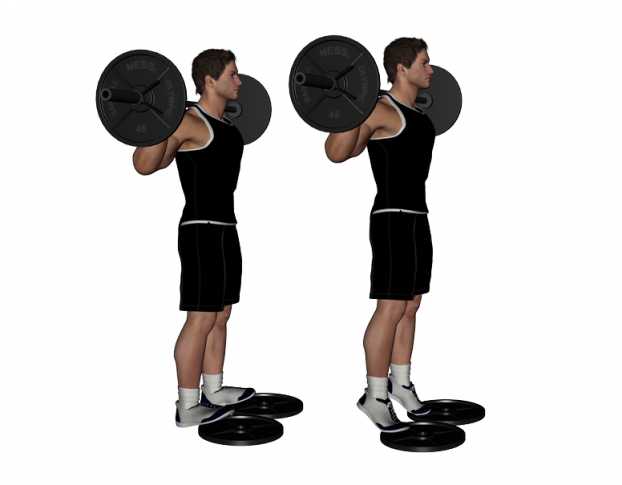
The standing barbell calf raise is a classic free-weight exercise for building stronger, more muscular calves with heavy external resistance. Because the load rests across the upper back similarly to a squat setup, this variation allows significant progressive overload while strongly emphasizing the gastrocnemius.
Unlike many machine-based calf exercises, the standing barbell calf raise also requires greater posture control and stabilization throughout the movement. This can help improve overall lower-body coordination while still placing heavy tension on the calf musculature.
One of the biggest advantages of this exercise is its simplicity. With only a barbell, weight plates, and an elevated surface, lifters can perform highly effective calf training without specialized machines.
As a coach, I usually recommend this exercise to intermediate and advanced lifters who already have solid balance, ankle mobility, and movement control. When performed with proper technique and a full range of motion, the standing barbell calf raise can be highly effective for long-term calf hypertrophy and strength gains.
This exercise works especially well for:
- Gastrocnemius development
- Heavy progressive overload
- Free-weight calf training
- Calf hypertrophy
- Athletic lower-leg strength
The standing barbell calf raise can also be trained using:
- Slow eccentric repetitions
- Pause reps at peak contraction
- Stretch-emphasis calf training
- Moderate-to-heavy hypertrophy sets
- Single-leg variations using lighter loads
One of the biggest mistakes in this exercise is allowing the range of motion to shorten as the weight increases. In my experience, calf growth improves much faster when movement remains controlled, and the heels fully descend into the stretch with every repetition.
➡️ Read the complete exercise guide here:
Standing Barbell Calf Raise
10. Bilateral Standing Dumbbell Calf Raise

The standing dumbbell calf raise is one of the most practical and versatile calf exercises for building stronger, more muscular lower legs with minimal equipment. By holding dumbbells at the sides of the body, lifters can train the calves through a natural movement pattern while still applying effective resistance and progressive overload.
Because the knees remain relatively straight throughout the exercise, the standing dumbbell calf raise primarily targets the gastrocnemius. At the same time, the free-weight setup also challenges balance, ankle stability, and lower-leg coordination more than many machine-based variations.
One major advantage of this exercise is accessibility. It works extremely well for:
- Home workouts
- Minimalist gym setups
- Travel training
- Beginners learning proper calf mechanics
As a coach, I often recommend standing dumbbell calf raises to lifters who want a simpler alternative to heavy machines while still developing strong calves through controlled full-range repetitions.
This exercise works especially well for:
- Gastrocnemius development
- Home calf workouts
- Free-weight calf training
- Calf hypertrophy
- Ankle stability and coordination
The standing dumbbell calf raise can also be trained using:
- Slow eccentric repetitions
- Pause reps at peak contraction
- Higher-repetition hypertrophy sets
- Stretch-emphasis training
- Single-leg variations
One of the biggest mistakes in this exercise is turning it into a bouncing movement rather than a controlled calf contraction. The exercise becomes far more effective when the heels fully lower into the stretch, and the repetition is performed smoothly without momentum.
➡️ Read the complete exercise guide here:
Standing Dumbbell Calf Raise
11. Seated Barbell Calf Raise

The seated barbell calf raise is an effective free-weight exercise for targeting the soleus while allowing heavier loading than many dumbbell-based seated variations. By placing the barbell across the thighs and keeping the knees bent throughout the movement, the exercise shifts more tension toward the deeper calf musculature responsible for overall lower-leg thickness and endurance.
One of the biggest advantages of the seated barbell calf raise is that it combines the benefits of seated soleus-focused training with the progressive overload potential of a barbell setup. This makes it an excellent option for lifters who want serious calf development without relying entirely on specialized gym machines.
Because the movement is relatively stable, it also works very well with controlled tempo, slow eccentrics, and extended time under tension.
As a coach, I often recommend seated barbell calf raises to intermediate lifters who already understand proper calf mechanics and want a heavier free-weight alternative to machine-based seated calf training.
This exercise works especially well for:
- Soleus development
- Overall calf thickness
- Free-weight calf training
- Hypertrophy-focused calf work
- Moderate-to-heavy seated calf loading
The seated barbell calf raise can also be trained using:
- Slow eccentric repetitions
- Pause reps at peak contraction
- Higher-repetition hypertrophy sets
- Stretch-emphasis training
- Extended time-under-tension methods
One common mistake is using excessive weight while allowing the movement range to shorten. The seated barbell calf raise becomes far more effective when the heels fully descend into the stretch, and the contraction remains controlled throughout the entire repetition.
➡️ Read the complete exercise guide here:
Seated Barbell Calf Raise
12. Single-Leg Bodyweight Calf Raise

The single-leg bodyweight calf raise is one of the simplest but most effective exercises for improving calf strength, ankle stability, muscular endurance, and lower-leg coordination without requiring any equipment. Training one leg at a time forces each calf to work independently while also increasing stabilization demands throughout the ankle and foot complex.
Although this exercise uses only bodyweight, it can become surprisingly challenging when performed with a full range of motion, a controlled tempo, and higher repetitions. The unilateral setup also makes it highly effective for identifying and correcting left-right strength imbalances.
Because the knee remains relatively straight during the movement, the exercise primarily emphasizes the gastrocnemius while also strongly involving the stabilizing musculature around the ankle.
As a coach, I frequently use single-leg bodyweight calf raises in:
- Beginner programs
- Athletic conditioning
- Ankle stability training
- Rehabilitation-focused workouts
- Home training routines
It is also an excellent starting point before progressing into heavier machine or free-weight calf exercises.
This exercise works especially well for:
- Ankle stability
- Muscular endurance
- Unilateral calf development
- Home calf workouts
- Athletic lower-leg function
The single-leg bodyweight calf raise can also be trained using:
- Slow eccentric repetitions
- Pause reps at peak contraction
- Higher-repetition endurance sets
- Stair or elevated-platform variations
- Tempo-focused calf training
One of the biggest mistakes with this exercise is rushing through the repetitions without controlling the stretch or contraction. Even without external resistance, strict execution and full ankle range of motion can create a highly effective calf-training stimulus.
➡️ Read the complete exercise guide here:
Single-Leg Bodyweight Calf Raise
13. Hack Squat Calf Raise

The hack squat calf raise is one of the most underrated machine-based exercises for building stronger and more muscular calves. By using the hack squat machine as a stable platform for ankle plantarflexion, lifters can focus heavily on calf contraction, deep stretching, and controlled movement mechanics without worrying much about balance or postural control.
Because the legs remain relatively straight during the exercise, the hack squat calf raise primarily targets the gastrocnemius while also engaging the soleus to a lesser degree. The machine-supported setup also makes it easier to safely use progressive overload and maintain strict repetition quality throughout the set.
One of the biggest advantages of the hack squat calf raise is the combination of:
- Stability
- Controlled movement
- Strong loading potential
- Deep range of motion
This makes the exercise highly effective for hypertrophy-focused calf training.
As a coach, I often recommend the hack squat calf raise to lifters who want a stable alternative to traditional standing calf raise machines while still training the calves with significant resistance and full ROM.
This exercise works especially well for:
- Gastrocnemius development
- Machine-based calf hypertrophy
- Controlled progressive overload
- Stretch-emphasis calf training
- Stable heavy calf work
The hack squat calf raise can also be trained using:
- Slow eccentric repetitions
- Pause reps at peak contraction
- Higher-repetition hypertrophy sets
- Single-leg variations
- Tempo-focused calf training
One common mistake is shortening the movement range, turning the exercise into a partial-pulse movement. In my experience, the hack squat calf raise becomes far more effective when the heels fully descend into the stretch, and the repetitions remain smooth and controlled throughout the set.
➡️ Read the complete exercise guide here:
Hack Squat Calf Raise
After breaking down each exercise individually, the comparison table below provides a quick overview of all 13 calf exercises, including their primary muscle emphasis, best use, and overall training style.
| Exercise | Primary Emphasis | Best For | Exercise Type |
|---|---|---|---|
| Standing Machine Calf Raise | Gastrocnemius | Heavy Hypertrophy & Progressive Overload | Machine-Based |
| Leg Press Calf Raise | Gastrocnemius | Stable Heavy Calf Training | Machine-Based |
| Smith Machine Standing Calf Raise | Gastrocnemius | Controlled Heavy Loading | Machine-Based |
| Seated Calf Raise | Soleus | Overall Calf Thickness | Machine-Based |
| Rotary Calf Raise | Gastrocnemius | Controlled Isolation & Tempo Work | Machine-Based |
| Seated Dumbbell Calf Raise | Soleus | Home Soleus Training | Free-Weight |
| Donkey Calf Raise | Gastrocnemius | Deep Loaded Stretch | Free-Weight / Manual Load |
| Single-Leg Standing Dumbbell Calf Raise | Gastrocnemius | Ankle Stability & Symmetry | Unilateral Free-Weight |
| Standing Barbell Calf Raise | Gastrocnemius | Heavy Free-Weight Overload | Free-Weight |
| Standing Dumbbell Calf Raise | Gastrocnemius | Home & Minimalist Training | Free-Weight |
| Seated Barbell Calf Raise | Soleus | Heavy Soleus Training | Free-Weight |
| Single-Leg Bodyweight Calf Raise | Gastrocnemius | Bodyweight Stability & Endurance | Bodyweight / Unilateral |
| Hack Squat Calf Raise | Gastrocnemius | Stable Heavy Hypertrophy Work | Machine-Based |
Standing vs Seated Calf Raises
One of the biggest mistakes in calf training is relying exclusively on either standing or seated calf raises while completely neglecting the other. Although both exercise categories train the calves through ankle plantar flexion, they do not emphasize the muscles in exactly the same way.
Standing calf raises are performed with relatively straight knees, which places the gastrocnemius in a stronger mechanical position. Because of this, standing variations are generally better for building visible upper calf size, explosive lower-leg strength, and overall calf power.
Exercises such as:
- Standing Machine Calf Raise
- Standing Barbell Calf Raise
- Leg Press Calf Raise
- Hack Squat Calf Raise
all place strong emphasis on the gastrocnemius.
Seated calf raises, on the other hand, are performed with bent knees. This shortens the gastrocnemius and shifts more tension toward the soleus muscle, which contributes heavily to lower-leg thickness and muscular endurance.
Exercises such as:
- Seated Calf Raise
- Seated Dumbbell Calf Raise
- Seated Barbell Calf Raise
are much more effective for directly targeting the soleus.
As a coach, I usually recommend combining both standing and seated calf exercises within the same training program. Lifters who train only standing variations often develop decent upper calf shape but still lack overall calf density and lower-leg fullness. Meanwhile, relying only on seated work may limit overall gastrocnemius development and athletic carryover.
For complete calf development, most lifters benefit from:
- 1–2 standing calf exercises
- 1 seated calf exercise
performed consistently throughout the week using full range of motion, controlled tempo, and progressive overload.
Why Your Calves Aren’t Growing
Many people train calves consistently for years without seeing noticeable results. While genetics do influence calf shape and muscle insertions, poor training quality is often a much bigger issue than most lifters realize.
As a coach, I’ve seen countless lifters dramatically improve calf development once they fix a few common training mistakes.
You’re Using Partial Reps
This is probably the biggest problem in calf training. Most people perform short bouncing repetitions instead of using full ankle range of motion. Effective calf raises should include a deep stretch at the bottom and a strong contraction at the top.
You’re Training Too Inconsistently
Calves usually respond much better to consistent weekly training than occasional burnout sets at the end of leg day. Since the calves are highly fatigue-resistant, they often benefit from being trained multiple times per week.
You’re Only Training the Gastrocnemius
Many lifters perform standing calf raises exclusively while completely neglecting seated calf work. This often leads to incomplete lower-leg development because the soleus contributes heavily to overall calf thickness.
You’re Using Too Much Weight
Ego lifting destroys calf exercise quality. Once the load becomes excessive, most lifters shorten the movement range and rely heavily on momentum. In many cases, slightly lighter weight with stricter execution produces far better calf growth.
You’re Rushing the Tempo
Fast bouncing repetitions reduce muscular tension and make the Achilles tendon do much of the work instead of the calves themselves. Controlled eccentrics and pauses usually create a much stronger hypertrophy stimulus.
You’re Expecting Fast Results
Calves often develop slower than muscles like the chest, shoulders, or arms. Successful calf training usually requires patience, consistency, progressive overload, and years of quality repetitions rather than searching for “secret” exercises or shortcuts.
If your calves still refuse to grow despite consistent training, exercise selection may only be part of the problem. For a much deeper breakdown of the most common calf-growth mistakes — along with practical, science-based solutions — check out our full guide: Why Your Calves Aren’t Growing: 10 Real Reasons & Proven Fixes.
Best Calf Workout for Size & Strength
Building bigger and stronger calves is not only about choosing the right exercises — it’s also about combining them intelligently within a structured training program. Effective calf workouts should include a balance of:
- Standing exercises
- Seated variations
- Controlled tempo
- Full range of motion
- Progressive overload
As a coach, I usually recommend training calves at least 2–3 times per week instead of relying on one rushed calf session after leg day. Because the calves are highly fatigue-resistant and active throughout daily movement, they often respond very well to slightly higher training frequency and consistent weekly volume.
Below are simple but highly effective calf workout examples for different training levels.
Beginner Calf Workout
This workout focuses on learning proper exercise technique, improving ankle mobility, and building a strong mind-muscle connection.
Workout
- Standing Dumbbell Calf Raise — 3 × 12–15
- Seated Dumbbell Calf Raise — 3 × 15–20
- Single-Leg Bodyweight Calf Raise — 2 × 20 per leg
Train this workout:
- 2x weekly
Focus on:
- Full ROM
- Controlled tempo
- Deep stretching
- Smooth repetitions
Intermediate Calf Workout
At the intermediate level, calves usually respond well to heavier loading combined with increased training volume and exercise variety.
Workout
- Standing Machine Calf Raise — 4 × 8–12
- Seated Calf Raise — 4 × 12–15
- Leg Press Calf Raise — 3 × 10–12
- Single-Leg Standing Dumbbell Calf Raise — 2 × 15 per leg
Train this workout:
- 2–3x weekly
Focus on:
- Progressive overload
- Slow eccentrics
- Pause reps
- Quality contractions
Advanced Calf Workout
Advanced calf training often requires higher weekly volume, stronger effort, and more variation in loading styles and repetition ranges.
Workout
- Standing Machine Calf Raise — 5 × 6–10
- Hack Squat Calf Raise — 4 × 10–12
- Seated Barbell Calf Raise — 4 × 15–20
- Rotary Calf Raise — 3 × 15–20
- Single-Leg Bodyweight Calf Raise — 2 × 25 per leg
Train this workout:
- 3–4x weekly
Focus on:
- Controlled eccentrics
- Stretch emphasis
- Progressive overload
- Long-term consistency
No matter your experience level, calf training works best when repetitions are controlled and performed through a full range of motion instead of rushing through short bouncing reps. Over time, consistent quality training almost always produces better results than constantly changing exercises or chasing extreme overload methods.
Final Thoughts
Building bigger and more powerful calves is rarely about finding one magical exercise. In most cases, successful calf development comes down to combining the right exercises with proper technique, full range of motion, progressive overload, and long-term consistency.
As a coach working with lifters and athletes, I’ve seen many people completely transform stubborn calves once they finally stop rushing through random calf raises and begin training the lower legs with real structure and intent. Small details such as slower tempo, deeper stretching, and consistent weekly volume often make a much bigger difference than constantly searching for “secret” training methods.
For complete lower-leg development, it’s important to include both:
- Standing calf exercises for the gastrocnemius
- Seated calf exercises for the soleus
while also using a combination of:
- Machine-based movements
- Free-weight exercises
- Unilateral variations
- Bodyweight training
Over time, this creates stronger, fuller, and more athletic calves while also improving ankle stability, movement efficiency, sprinting ability, and overall lower-body performance.
Most importantly, be patient. Calves are highly resilient muscles that often require more consistency and training quality than people expect. But when trained intelligently and consistently, they absolutely can grow.
