



Introduction
The single-leg bodyweight calf raise is a simple yet highly effective exercise for strengthening the calves, improving ankle stability, and developing lower-leg control, all without any equipment. Because the movement is performed on one leg at a time, the exercise also challenges balance, coordination, and unilateral strength throughout the foot and ankle complex.
Unlike heavily loaded machines or free-weight calf-raise variations, the single-leg bodyweight calf raise relies entirely on bodyweight resistance and controlled movement mechanics. This makes it an excellent option for beginners, home workouts, rehabilitation-focused training, runners, athletes, and anyone looking to improve calf function and lower-leg endurance.
When performed with full ankle range of motion and controlled tempo, the exercise can effectively target the gastrocnemius while also improving balance, foot stability, and mind-muscle connection. Despite its simplicity, the single-leg bodyweight calf raise can become surprisingly challenging when strict technique and higher repetitions are used.
Other Names for the Single-Leg Bodyweight Calf Raise
Although the single-leg bodyweight calf raise is the most descriptive name, some coaches and lifters may use slightly different terminology.
- Single-leg calf raise
- One-leg calf raise
- Single-leg heel raise
- Bodyweight calf raise
- Unilateral bodyweight calf raise
Required Equipment
One of the biggest advantages of the single-leg bodyweight calf raise is that it requires virtually no equipment and can be performed almost anywhere.
- Flat floor or stable surface
- Optional calf block or step platform
- Optional wall or rack support for balance assistance
- Flat training shoes or barefoot shoes for improved foot stability
- Optional staircase for increased ankle range of motion
How to Perform the Single-Leg Bodyweight Calf Raise
Proper technique is extremely important during the single-leg bodyweight calf raise because the unilateral setup increases the demands on balance and stabilization throughout the foot and ankle complex. Controlled repetitions and full ankle range of motion are essential for maximizing calf activation and improving lower-leg function.
Starting Position
A stable setup helps maximize calf activation while improving balance and movement control during the exercise.
- Stand upright on one foot
- Keep the nonworking leg slightly behind the body
- Position your foot flat on the floor or on an elevated platform
- Maintain an upright torso and neutral spine
- Keep the working knee relatively straight
- Use light balance support if needed
- Stabilize the ankle and foot before beginning the movement
- Lower the heel slightly into a calf stretch if using an elevated platform
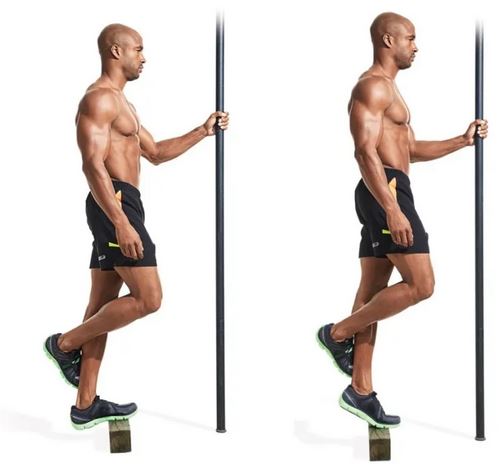
Execution (Action Phase)
The movement should occur almost entirely at the ankle joint.
- Push through the ball of the foot to raise the heel upward
- Contract the calf muscles as hard as possible at the top
- Pause briefly in the fully contracted position
- Lower the heel slowly under control
- Descend into a deep stretch if using a step platform
- Repeat for the desired number of repetitions before switching sides
Avoid excessive side-to-side shifting or using momentum to complete repetitions. Stable ankle mechanics and a controlled tempo generally produce far better calf activation and improved balance.
Video Demonstration
Watching a proper demonstration helps lifters better understand balance control, ankle mechanics, and movement tempo during the single-leg bodyweight calf raise.
In the video below, notice how the movement occurs almost entirely through ankle plantar flexion while the torso remains upright and stable. Also, pay attention to the controlled lowering phase and the balance demands created by the unilateral setup.

Many lifters underestimate bodyweight calf exercises because they are simple and require no equipment. However, when single-leg calf raises are performed with strict control, full range of motion, and higher repetitions, they can create a surprisingly strong calf-training stimulus while also improving ankle stability and lower-leg coordination.
A common misconception is that calf training only matters for bodybuilding aesthetics. In reality, stronger calves and better ankle control are extremely important for walking, running, jumping, balance, and overall lower-body function — especially as people age or become more physically active.
Technique Optimization Tips
Small adjustments in setup and execution can significantly improve calf activation and overall movement quality during the single-leg bodyweight calf raise.
- Use a full range of motion on every repetition
- Lower the heel slowly under control
- Pause briefly at peak contraction
- Maintain an upright torso position
- Keep the working knee relatively straight
- Perform the exercise with controlled tempo
- Push through the ball of the foot rather than the toes
- Avoid excessive body swaying or momentum
Quick Form Checklist
Before starting each set, review these important technique cues.
- Stable foot positioning maintained
- Upright torso and neutral spine maintained
- Controlled ankle movement throughout the exercise
- Strong calf contraction at the top
- Controlled lowering phase
- No excessive bouncing or momentum
- Balanced body positioning throughout repetitions
Technical Emphasis & Targeting Adjustments
Subtle changes in setup and execution can slightly alter muscular emphasis and overall training stimulus during the single-leg bodyweight calf raise.
- Straighter knee → greater gastrocnemius emphasis. Keeping the knee more extended places the gastrocnemius in a stronger mechanical position during plantar flexion.
- Slower eccentric → improved muscular control. Lowering the heel slowly increases time under tension and improves awareness of ankle stability.
- Pause at the top → stronger peak contraction. Briefly holding the fully contracted position may improve mind-muscle connection and calf recruitment.
- Elevated platform → greater range of motion. Using a step platform allows for a deeper calf stretch and increased demand on ankle mobility.
- Higher repetitions → greater endurance stimulus. Bodyweight calf raises often work best with moderate to high repetitions because of the calves’ fatigue-resistant nature.
- Unilateral setup → improved ankle stability. Training one side independently increases the demands on stabilization throughout the foot and ankle complex.
Common Mistakes
Despite being a simple exercise, several technical mistakes can reduce calf activation and limit overall training effectiveness during the single-leg bodyweight calf raise.
- Performing the movement too quickly
- Bouncing aggressively out of the stretched position
- Using very short partial repetitions
- Allowing excessive body swaying
- Failing to achieve full ankle range of motion
- Pushing excessively through the toes instead of the ball of the foot
- Losing balance repeatedly during the set
- Bending the working knee too much throughout the movement
If the exercise feels “too easy,” slow the repetitions down dramatically instead of immediately searching for added resistance. Controlled eccentrics, pauses, and full ankle range of motion can make bodyweight calf raises surprisingly challenging.
Another common misconception is that balance problems during single-leg calf raises are a sign of weakness alone. In many cases, reduced ankle stability, foot control, coordination, or limited movement awareness also contribute to instability during unilateral exercises.
Mechanical Considerations
The single-leg bodyweight calf raise primarily trains the gastrocnemius through ankle plantar flexion while also increasing stabilization demands throughout the foot and ankle complex. Because the exercise is performed unilaterally, many smaller stabilizing muscles must work continuously to maintain balance and body control.
Keeping the working knee relatively straight places the gastrocnemius in a stronger mechanical position during the movement. However, the soleus still contributes significantly throughout plantar flexion and lower-leg stabilization.
Compared to heavily loaded calf-raise variations, the bodyweight version places greater emphasis on movement quality, coordination, muscular endurance, and ankle control rather than on maximal overload. This makes the exercise especially valuable for beginners, rehabilitation-focused training, runners, and general lower-body function development.
Muscles Worked in the Single-Leg Bodyweight Calf Raise
The single-leg bodyweight calf raise primarily targets the muscles responsible for ankle plantar flexion, balance control, and lower-leg endurance. Because the movement is performed on one leg, several stabilizing muscles around the ankle and foot also contribute heavily throughout the exercise.
MAIN MUSCLES
SECONDARY MUSCLES
- Soleus
- Tibialis posterior
- Peroneus longus
- Peroneus brevis
- Flexor digitorum longus
ANTAGONISTS
- Tibialis anterior
- Extensor digitorum longus
Single-Leg Bodyweight Calf Raise Pros and Cons
Like most unilateral bodyweight exercises, the single-leg bodyweight calf raise offers several important advantages and limitations depending on your goals, training level, and workout environment.
Advantages
- Requires no equipment. The exercise can be performed almost anywhere using only body weight.
- Excellent for ankle stability and balance. The unilateral setup challenges foot control and lower-leg stabilization throughout the movement.
- Very beginner-friendly. The exercise is highly accessible and easy to scale for different fitness levels.
- Useful for rehabilitation and athletic training. Many runners, athletes, and rehabilitation programs use single-leg calf raises to improve lower-leg function and coordination.
- Strong mind-muscle connection potential. The slower bodyweight setup often improves movement awareness and calf control.
Potential Drawbacks
- Limited overload potential. Advanced lifters may eventually require additional resistance to maintain hypertrophy.
- Balance may initially limit performance. Beginners often struggle with stability and coordination during unilateral exercises.
- Higher repetitions are often necessary. Bodyweight resistance may require longer sets to create significant muscular fatigue.
- Easy to rush through repetitions. Many lifters perform the movement too quickly, rather than emphasizing controlled ankle mechanics.
Single-Leg Bodyweight Calf Raise Variations
Several variations of the single-leg bodyweight calf raise can slightly alter stability demands, range of motion, or overall training stimulus while still targeting the calf muscles through unilateral ankle plantar flexion.
Elevated Single-Leg Calf Raise
Performing the exercise on a step platform or staircase increases ankle range of motion and allows a deeper calf stretch during each repetition.
Supported Single-Leg Calf Raise
Using a wall, rack, or stable support surface reduces balance demands, allowing greater focus on calf contraction and ankle mechanics.
Paused Single-Leg Calf Raise
This variation emphasizes longer pauses in both the stretched and contracted positions. The slower tempo increases time under tension and improves movement control.
Tempo Single-Leg Calf Raise
Using slow eccentric lowering phases increases the demands on muscular endurance and improves awareness of ankle stability.
Bent-Knee Single-Leg Calf Raise
Slightly bending the working knee shifts more workload toward the soleus muscle instead of the gastrocnemius.
Weighted Single-Leg Calf Raise
Once bodyweight resistance becomes too easy, additional load can be added using dumbbells, kettlebells, weighted vests, or backpacks.
Replacement Exercises (Substitutes) for the Single-Leg Bodyweight Calf Raise
If you want additional variation in your calf training or need more external resistance, several exercises can provide a similar movement pattern while still effectively targeting the calf muscles.
- Single-leg standing dumbbell calf raise. This variation adds external load while maintaining unilateral balance and stabilization demands.
- Standing dumbbell calf raise. Bilateral dumbbell calf raises reduce balance demands while still providing effective free-weight calf training.
- Standing barbell calf raise. This variation allows heavier loading and greater potential for progressive overload.
- Machine standing calf raise. Dedicated calf raise machines provide greater stability and easier overload progression.
- Smith machine standing calf raise. The guided setup reduces stabilization demands while still allowing heavy calf loading.
- Seated calf raise. Seated variations emphasize the soleus more heavily because of the bent-knee position.
- Donkey calf raise. The bent-over torso position creates a unique loaded stretch and strong activation of the gastrocnemius.
Bodyweight calf raises are excellent for stability and endurance, but they can also support a larger calf-building plan. Explore our complete list of the best exercises for the calf muscles.
If your calves are not progressing, Why Your Calves Aren’t Growing: 10 Real Reasons & Proven Fixes covers the training mistakes that often limit results.
Where This Exercise Fits in a Workout
Perform 2–5 sets of 15–30 repetitions per leg.
Best programmed:
- During home workout routines
- At the end of lower-body training sessions
- During rehabilitation-focused training
- As part of ankle stability or athletic conditioning programs
- During warm-ups or calf activation work
Single-Leg Bodyweight Calf Raise vs Single-Leg Standing Dumbbell Calf Raise (Comparison Table)
| Criteria | Single-Leg Bodyweight Calf Raise | Single-Leg Standing Dumbbell Calf Raise |
|---|---|---|
| Resistance Type | Bodyweight | External free-weight |
| Stability Demand | High | High |
| Balance Requirement | High | High |
| Overload Potential | Limited | Moderate to high |
| Beginner Accessibility | Excellent | Good |
| Home Workout Friendly | Excellent | Excellent |
| Ankle Stability Focus | Very high | High |
| Best Use | Stability & endurance | Hypertrophy & strength |
The single-leg bodyweight calf raise is ideal for beginners, home workouts, rehabilitation programs, and improving ankle control without requiring any equipment.
The single-leg standing dumbbell calf raise, however, provides greater loading potential and may be more effective for long-term calf hypertrophy progression. Both exercises can be highly effective for lower-leg development when performed with a full range of motion and controlled tempo.
Final Thoughts
The single-leg bodyweight calf raise is one of the simplest yet most effective exercises for improving calf endurance, ankle stability, and lower-leg coordination. Its equipment-free setup makes it highly accessible for beginners, home workouts, athletes, and rehabilitation-focused training.
When performed with controlled tempo, full ankle range of motion, and proper balance control, the exercise can create a surprisingly effective calf-training stimulus while also improving overall lower-body function. Like many bodyweight exercises, movement quality and consistency are often far more important than complexity or external resistance.
Why do bodyweight calf raises sometimes feel harder than weighted calf raises?
Because the exercise is performed on one leg, the stabilizing muscles around the foot and ankle must work continuously to maintain balance and control. This added coordination demand can make the movement surprisingly challenging even without external resistance.
Is it normal to shake during single-leg calf raises?
Yes. Mild shaking is very common, especially for beginners or people with limited ankle stability and lower-leg coordination. In many cases, this improves gradually as balance and muscular control develop.
Can single-leg bodyweight calf raises help runners?
Absolutely. Stronger calves and better ankle control are important for running efficiency, foot stability, shock absorption, and lower-leg endurance. Many runners use single-leg calf raises as part of injury-prevention and conditioning programs.
Why do some people cramp during bodyweight calf raises?
Calf cramping may occur because of muscular fatigue, dehydration, poor ankle mobility, or excessive tension during balance-focused movements. Slowing the tempo down and improving movement control often helps reduce cramping.
Should calf raises be performed on a flat floor or a step platform?
Both options work well. Flat-floor calf raises are often easier for beginners, while elevated platforms allow greater ankle range of motion and a deeper loaded stretch.
Can bodyweight calf raises build muscle without added resistance?
Yes — especially for beginners. Higher repetitions, slower tempo, pauses, and full range of motion can create significant muscular fatigue and hypertrophy stimulus even without external weight.
Why are single-leg calf raises often used in rehabilitation programs?
The exercise allows controlled unilateral training with relatively low external stress while improving ankle stability, calf strength, balance, and lower-leg coordination progressively.
Are calves mainly endurance muscles?
The calves contain a relatively high percentage of fatigue-resistant muscle fibers because they work constantly during standing, walking, and movement. This is one reason why calves often respond well to higher training frequency and moderate-to-high repetition ranges.
