


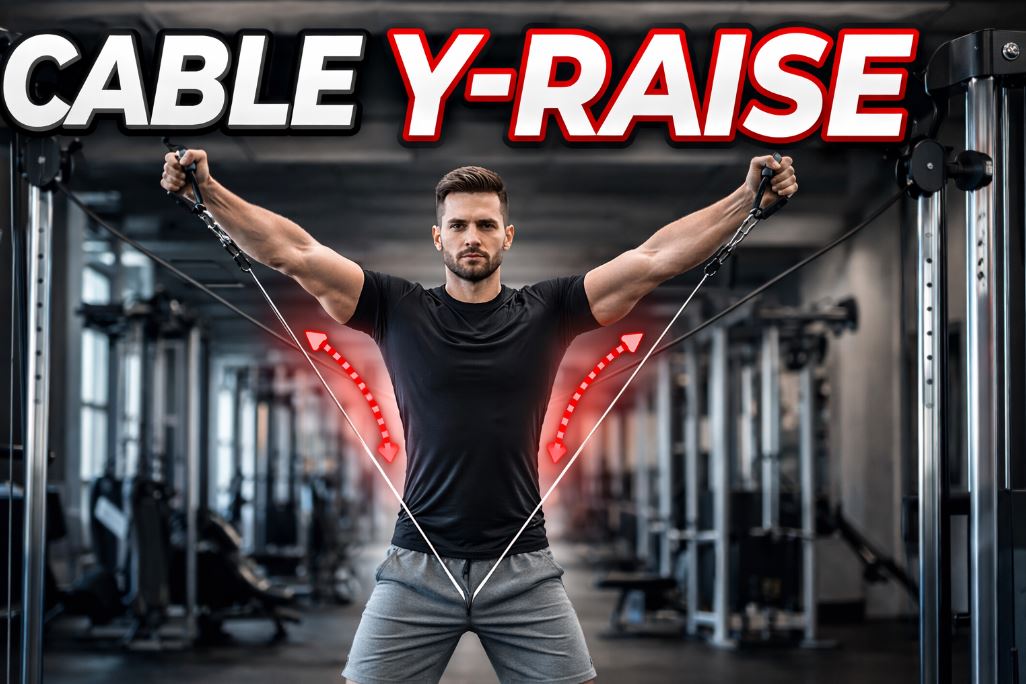
Why This Exercise Exists
The cable Y-raise is one of the most effective exercises for improving shoulder health, scapular control, and long-term overhead stability. While it may look simple and lightweight, this movement targets muscles that are often undertrained yet absolutely critical for pain-free shoulders—especially in lifters, athletes, and anyone performing overhead or pressing movements.
Originally popularized in rehabilitation, corrective exercise, and athletic preparation settings, the cable Y-raise focuses on strengthening the lower and upper trapezius and the rotator cuff while teaching the scapulae to move correctly on the rib cage. Unlike many traditional shoulder exercises that emphasize load over control, the cable Y-raise exists to restore balance, coordination, and stability within the shoulder complex.
Many shoulder issues don’t come from weak deltoids—but from poor scapular mechanics. This exercise addresses that root problem.
The cable Y-raise is not about lifting heavy weight—it’s about teaching the shoulder blades to move upward, backward, and rotate correctly under tension.
In my experience, athletes who consistently include this exercise tend to press better, feel stronger overhead, and experience far fewer shoulder aches over time.
It’s a small movement with a massive payoff—if done correctly and with control.
Equipment Needed
The cable Y-raise requires minimal equipment, but proper setup is crucial:
- Dual adjustable cable machine (or single cable with split handle setup)
- Lightweight plates (this is not a heavy lift)
- Single handles or D-handles
- Optional: incline bench (for chest-supported variation)
Step-by-Step Instructions for the Cable Y-Raise
A. Starting Position (Setup)
Proper setup is essential to ensure the correct muscles do the work.
- Set the cables at the lowest possible height.
- Attach a single handle to each cable.
- Stand between the cables, facing forward.
- Hold the handles with a neutral grip, arms slightly bent.
- Step back slightly to create light tension in the cables.
- Brace your core and keep your rib cage stacked over your pelvis.
- Set your shoulders down and back lightly—no shrugging yet.
Key cue: You should feel tension in the cables before the movement starts.
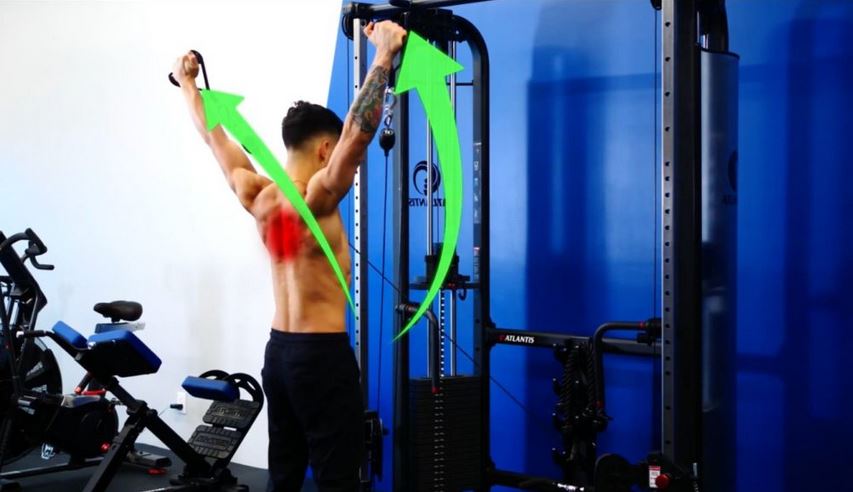
B. Movement (Execution)
This phase emphasizes controlled scapular motion rather than arm dominance.
- Inhale and brace your core.
- Raise both arms upward and outward in a “Y” pattern.
- Keep elbows softly bent and wrists neutral.
- Allow the shoulder blades to rotate upward and slightly retract.
- Lift until arms are roughly in line with your ears (or slightly below).
- Pause briefly at the top.
- Slowly lower the arms back to the starting position under control.
- Exhale as you return to the bottom.
Tempo recommendation:
Slow and controlled — 2–3 seconds up, 3–4 seconds down. No momentum.
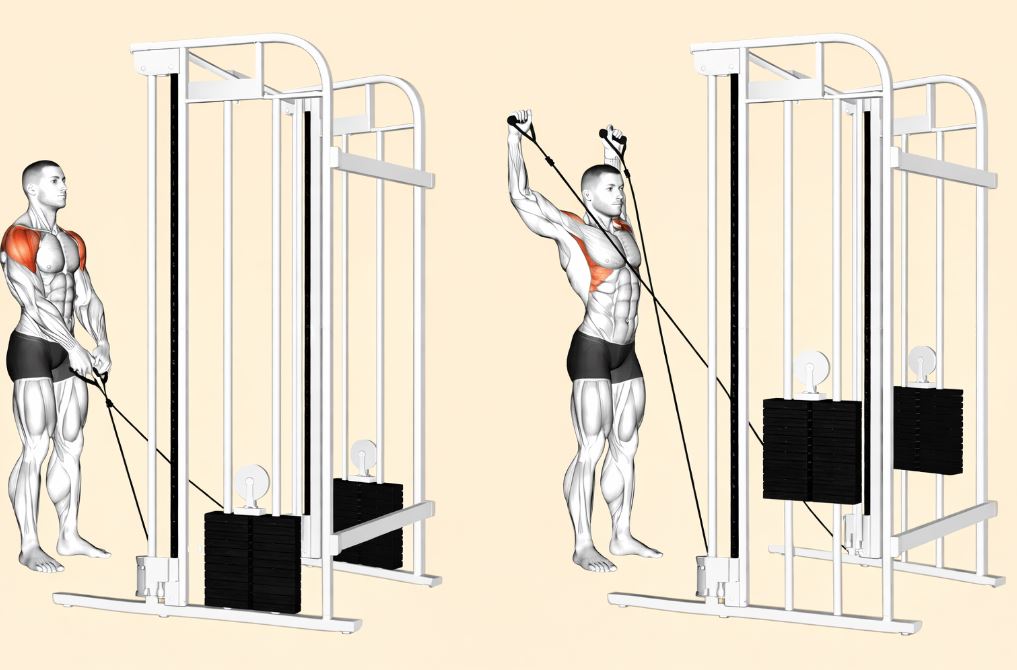
Cable Y-Raise – Proper Technique Demonstration
In the video below, you can see a clear demonstration of the Cable Y-Raise performed with proper setup and controlled execution. Pay close attention to the cable position in front of the body, the smooth “Y” movement pattern of the arms, and the coordinated upward rotation of the shoulder blades. This visual reference helps reinforce correct scapular mechanics, shoulder positioning, and tempo, making it especially useful for learning or refining technique.
Muscles Worked
Primary Muscles
Secondary Muscles
- Rotator cuff (especially supraspinatus)
- Rear deltoids
Stabilizers
- Serratus anterior
- Core musculature
- Deep scapular stabilizers
Common Mistakes
- Using too much weight: turns the exercise into a shrug or front raise.
- Bending the elbows excessively: shifts work away from the scapula.
- Overarching the lower back: compensation due to poor core control.
- Shrugging too early: upper traps dominate instead of coordinated movement.
- Rushing reps eliminates time under tension, where the benefit lives.
Performance Tips (Coach’s Cues)
- “Lift with your shoulder blades, not your hands.”
- “Think long arms, not heavy arms.”
- “Ribs down, neck long.”
- “Smooth up, slow down.”
- If you feel this mostly in your neck, you’re applying too much force.
Exercise Variations
1) Single-Arm Cable Y-Raise
Perform one arm at a time.
Why it works: Improves side-to-side scapular control and highlights asymmetries.
2) Chest-Supported Cable Y-Raise
Performed lying face-down on an incline bench.
Why it works: Removes lower-body compensation and isolates scapular motion.
3) Half-Kneeling Cable Y-Raise
One knee down, one foot forward.
Why it works: Adds core and pelvic control demands while maintaining shoulder focus.
4) Resistance Band Cable Y Raise
If a cable machine isn’t available—or if you simply want more flexibility in your training setup—the resistance band Y-raise is an excellent alternative to the cable version. When performed with proper control and setup, this variation delivers training benefits that are very similar.
Why it works: Resistance bands maintain constant tension throughout the range of motion, encouraging smooth, controlled scapular upward rotation and sustained activation of the lower traps and shoulder stabilizers without heavy loading.
5) Isometric Cable Y-Raise Hold
Pause 10–30 seconds at the top position.
Why it works: Builds endurance and positional awareness in stabilizing muscles.
6) Seated Cable Y-Raise
The seated cable Y-raise is a practical variation for individuals who prefer greater stability or want to remove lower-body involvement from the movement. Performing the exercise from a seated position allows you to focus entirely on shoulder and scapular mechanics without needing to manage balance or stance.
Why it works: Seating the body eliminates lower-body compensation and enhances positional stability.
Alternative / Replacement Exercises
If cable Y-raises are unavailable, consider:
- Dumbbell Y-raises (very light)
- Prone incline Y-raises
- Band Y-raises
- Scapular wall slides
- Face pulls with overhead finish
These can complement or temporarily replace cable work depending on equipment and goals.
Cable Y-Raise vs. Traditional Lateral Raise — Key Differences Explained
While both movements involve arm elevation, their intent and muscle emphasis differ fundamentally. The cable Y-raise prioritizes scapular movement quality, upward rotation, and shoulder stability. The lateral raise, on the other hand, focuses primarily on deltoid hypertrophy and shoulder width.
Choosing between them isn’t about which is “better,” but which problem you’re trying to solve.
| Criteria | Cable Y-Raise | Lateral Raise |
|---|---|---|
| Primary goal | Scapular control & stability | Deltoid hypertrophy |
| Load used | Very light | Moderate to heavy |
| Shoulder health focus | High | Moderate |
| Overhead carryover | Excellent | Limited |
| Rehab & prehab value | Excellent | Low |
| Technique sensitivity | High | Moderate |
| Beginner-friendly | Moderate | High |
Key Benefits of Doing the Cable Y-Raise
Improves scapular upward rotation
The Y-raise cable trains the shoulder blades to rotate smoothly upward as the arms elevate. This movement pattern is essential for pain-free overhead motion and is often deficient in people who press frequently or spend long hours in a seated posture.
Strengthens often-neglected lower traps
The lower trapezius plays a critical role in stabilizing the scapula and balancing the dominant upper traps. Cable Y-raises directly target this muscle, helping restore proper force distribution across the upper back and reducing excessive shrug-based compensation.
Enhances shoulder stability for pressing and overhead work
By reinforcing coordinated scapular movement under tension, the cable Y-raise improves joint control during pressing exercises, including overhead presses, bench variations, and Olympic lifts. This leads to smoother movement and better load tolerance.
Reduces risk of shoulder impingement
Poor scapular control is a common contributor to impingement symptoms. Cable Y-raises promote optimal spacing within the shoulder joint by encouraging upward rotation and posterior tilt of the scapula, which can reduce unnecessary joint compression over time.
Builds endurance in postural shoulder muscles
Unlike heavy lifts that emphasize peak force, the cable Y-raise develops endurance in the muscles responsible for maintaining shoulder position throughout training sessions. This endurance is crucial for preserving technique as fatigue sets in.
Excellent long-term joint health investment
While the exercise may not deliver immediate aesthetic rewards, its long-term payoff is substantial. Consistent inclusion of cable Y-raises helps maintain shoulder function, reduce chronic discomfort, and extend training longevity—especially for lifters and athletes with high overhead demands.
Who Should Use Cable Y-Raise?
- Lifters with shoulder discomfort during pressing
- Athletes in overhead or contact sports
- Individuals with poor posture or rounded shoulders
- Anyone prioritizing shoulder longevity
- Advanced trainees looking to bulletproof their shoulders
Who Should Be Cautious?
- Individuals with acute shoulder pain
- Those unable to control rib flare or lumbar extension
- Anyone loading the movement excessively
- People rushing through reps without control
When in doubt, reduce load and slow down.
Programming Insight (Short but Powerful)
Cable Y-raises work best 2–4 times per week as a warm-up, accessory, or finisher. Use 2–4 sets of 10–20 reps, or 20–40 seconds of time under tension. They pair extremely well with pressing days, pull days, and shoulder-focused sessions.
Placement: Warm-up, prehab block, or accessory after compound lifts.
Conclusion About Cable Y-Raise
The cable Y-raise is designed to address a problem many lifters ignore until it becomes painful: poor scapular control. By strengthening the muscles responsible for healthy shoulder movement, this exercise builds a foundation for stronger presses, safer overhead work, and long-term shoulder resilience. It won’t impress anyone with big numbers, but it will quietly improve everything else in your training.
If you care about shoulder health, this exercise isn’t optional—it’s essential.
Is the cable y-raise better than dumbbell y-raises for shoulder health?
The cable y-raise provides constant tension throughout the entire range of motion, which makes it especially effective for improving scapular control and lower trapezius activation compared to dumbbells, where tension drops at certain angles.
Should cable y-raises be performed with heavy or light weight?
Cable y-raises are most effective with light to moderate loads. Using excessive weight often shifts work away from the scapular stabilizers and increases upper trap dominance, reducing the corrective benefit of the exercise.
Can cable y-raises help improve posture?
Yes. By strengthening the lower traps and supporting proper upward scapular rotation, cable y-raises can contribute to better shoulder positioning and improved upper-body posture over time, especially in individuals with rounded shoulders.
Are cable y-raises suitable for beginners?
Cable y-raises can be beginner-friendly when performed with very light resistance and strict control. However, beginners should prioritize proper technique and slow tempo rather than range of motion or load progression.
How often should cable y-raises be programmed?
Cable y-raises are typically effective when programmed 2–4 times per week, either as part of a shoulder warm-up, corrective block, or accessory work focused on scapular stability and shoulder health.
Do cable y-raises carry over to pressing and pulling strength?
Indirectly, yes. While cable y-raises are not a primary strength builder, improved scapular stability and shoulder mechanics can enhance performance and longevity in pressing, pulling, and overhead movements.
