Close Menu
Bodybuilding Wizard

    Subscribe to Updates

    Join our mailing list to receive the latest updates from our team.

    Facebook X (Twitter) Instagram
    Trending
    • Does Soy Lower Testosterone or Increase Estrogen in Men? What the Science Says
    • Does Training Legs Really Boost Testosterone? What the Science Says
    • Does Sauna Really Boost Growth Hormone 16x? Myth vs. Science
    • Does Power Posing Really Boost Testosterone? Myth, Science & the Retraction
    • Does Ashwagandha Really Boost Testosterone and Lower Cortisol? Myth vs. Science
    • Progesterone and Exercise: How It Affects Training, Metabolism & the Menstrual Cycle
    • Estrogen and Exercise: How Estradiol Affects Muscle, Fat, Bone Health & Performance
    • Thyroid Hormones and Metabolism: T3, T4, Muscle Growth & Fat Loss Explained
    RSS Facebook X (Twitter) LinkedIn YouTube Pinterest Instagram
    Bodybuilding Wizard
    Subscribe Login
    • Home
    • Tools
      • Interactive Muscle Anatomy
      • Interactive Human Skeleton
      • Bodybuilding & Fitness Calculators
      • Dietary & Nutrition Calculators
      • Body Measurement Calculators
      • Fitness Tests
      • Bodybuilding Glossary
      • DIY Projects
    • Training
      • Weight training basics
      • Advanced bodybuilding
      • Strength training for women
      • Workout programs
      • Home weight training programs
      • Cardio workout
      • Exercise equipment
      • Weight training accessories
      • Weight lifting injuries
      • Weight training for sports
    • Exercises
      • Chest exercises
        • Middle chest exercises
        • Upper chest exercises
        • Lower chest exercises
      • Back exercises
        • Middle back (latissimus dorsi)
        • Upper back (trapezius)
        • Lower back (erector spinae)
      • Arm exercises
        • Bicep exercises
        • Tricep exercises
        • Forearm exercises
        • Grip-strengthening exercises
      • Shoulder exercises
        • Front deltoid
        • Side deltoid
        • Rear deltoid
        • Rotator Cuff
        • Scapular & Shoulder Stability
        • Neck strengthening exercises
      • Leg and glute exercises
        • Quadricep exercises
        • Hamstring exercises
        • Calf exercises
        • Glute & Hip exercises
        • Shin exercises
      • Abdominal exercises
        • Upper abdominal exercises
        • Lower abdominal exercise
        • Oblique exercises
      • Core exercises
      • Kettlebell exercises
      • Foam rolling & Stretching
      • Explosive (dynamic) lifts
    • Motivation
      • Greatest physiques
      • Motivation techniques & tips
      • Events and competitions
      • Latest fitness news
      • Videos
        • Funny gym reels
        • Motivational videos
        • Funny workout videos
      • Pictures
      • Quotes
      • Funny Fitness
      • Transformations
    • Diet
      • Nutrition Fundamentals
      • Diet Types & Strategies
      • Foods & Superfoods for Athletes
      • Muscle Building & Performance Nutrition
      • Weight Loss & Fat Management
      • Food Psychology & Myths
      • Recipes & Meal Ideas
    • Supplements
      • Supplements Review
      • Muscle Building Supplements
      • Anabolic Steroids
      • Fat Burners & Weight Loss
      • Pre-Workout & Energy Boosters
      • Recovery & Sleep Aids
      • Cognitive & Nootropic Support
      • General Supplement Advice
      • Health Supplements
        • Joint & Bone Support
        • Gut Health & Digestion
        • Vitamins & Minerals
        • Superfoods & Greens
      • Steroid Alternatives
    • Anatomy
      • Upper-Body Muscles
      • Lower-Body Muscles
      • Bones & Skeletal Anatomy
      • Muscle Growth & Genetics
      • Joints, Tendons & Connective Tissue
      • Hormones & Endocrine System
      • Physiology & Body Systems
      • Body Composition & Fat
      • General Anatomy & Basics
    • Health
    Bodybuilding Wizard
    You are at:Home»Training»Cardio workout»The Heart Rate Zones | How to Calculate Your Target Heart Rate Range?
    Calculate Your Target Heart Rate Range

    The Heart Rate Zones | How to Calculate Your Target Heart Rate Range?

    0
    By krunoslav on April 14, 2018 Cardio workout
    Share
    Facebook Twitter Pinterest LinkedIn Email Tumblr WhatsApp Telegram

    How to determine your target heart rate range?

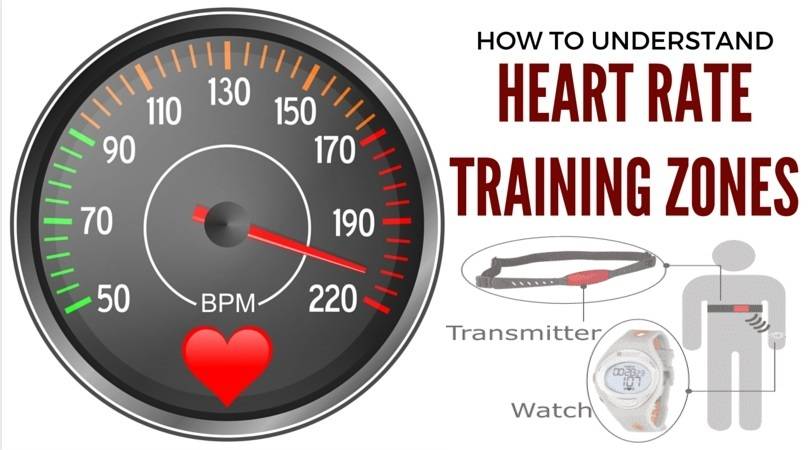
    In order to improve your cardiovascular system’s performance, you must first determine your target heart rate. Your target heart rate is the range where your body is able to most efficiently increase cardiovascular fitness. In this post you will find out what are the three heart rate zones and how to stay in right cardio zone during your training.

    What are the three heart rate zones?

    When you begin your exercise program, aim for the lower part of your target zone (60 percent). As you get into better shape, slowly build up to the higher part of your target zone (90 percent).

    There are three heart rate zones that focus on specific aspects of cardiovascular performance. These three zones are endurance (lower intense fat-loss zone), aerobic, and anaerobic. By targeting any one of these zones, you can control the benefits you get from cardiovascular exercise. The following table illustrates the range of these zones and their benefits.
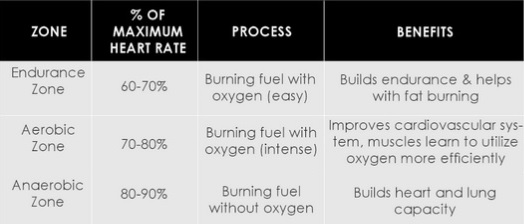
    heart rate zones: endurance, aerobic, anaerobic

    By varying the duration and intensity of a workout session, you can aim to achieve specific results. For example, to lose weight effectively, you should maintain an exercise program that focuses on endurance. This means engaging in low intensity exercise over long periods of time. However, the debate rages as to which is the best zone.

    Finding your target heart rate or training level

    Determine your maximum heart rate

    The first step in finding your target heart rate is to determine your maximum heart rate (MHR). Your maximum heart rate is a function of your age. In order to determine your maximum heart rate, enter your age into the equation below:

    220 – Age = Maximum Heart Rate

    For example, if you are forty-five years of age, your maximum heart rate will be 175 beats per minute (bpm). You never want to exceed this rate because it could put too much strain on your heart. As you get older, your MHR typically decreases.

    Multiply that number by the appropriate percentage to get your target heart rate

    A 45-year-old, for example, has an MHR of 175 (220 -45 = 176) beats per minute (bpm). If this person wants to train in the endurance zone (see the table above) he needs to multiply his MHR by 0.60 to get his lower level threshold, and multiply his MHR by 0.70 to get his upper level threshold. So, if you are 45 years old, your lower level threshold would be 175 x 0.60 = 105 beats per minute, and your upper level threshold would be 175 x 0.70 = 123 beats per minute. This would make your fat burning zone (endurance zone) 105 to 123 beats per minute.

    Once you have calculated your endurance (fat burning) zone, for example, be sure to adjust your intensity during exercise to stay within those upper and lower limits. Periodically check on your heart rate using one of the methods listed below.

    What is you want to train in the aerobic zone instead of the endurance zone? In that case you should multiply your MHR by 0.70 to get you lower level threshold, and multiply your MHR by 0.80 to get your upper level threshold. The following chart shows the range of target and maximum heart rates by age.
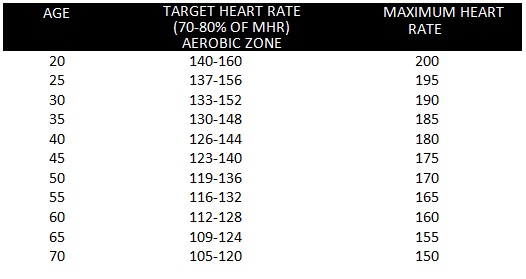
    target heart rate by age for the aerobic zoneHow can you tell how fast your heart is beating?

    Your heart should be beating within your target heart rate zone. If your heart is beating faster than your target heart rate, you are exercising too hard and should slow down. If your heart is beating slower than your target heart rate, you should exercise a little harder.

    To see if you are exercising within your target heart rate zone you have several options:

    (1) Manual pulse control

    You can measure your heart rate by feeling your pulse on your wrist or on your carotid artery on your neck. All you need is a wrist watch that shows seconds. Count your pulse for 10 seconds and multiply by 6. Now you have your heart-beats per minute. It’s only a slight inconvenience to stop and take your pulse.
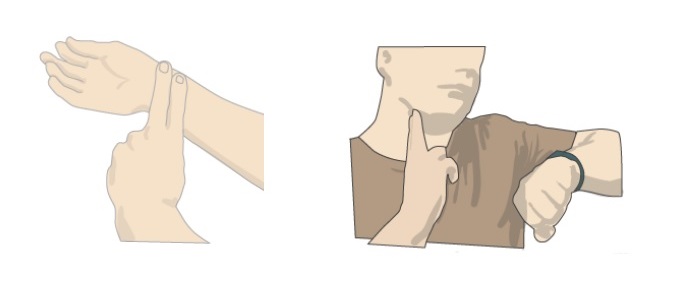
    measuring heart rate: wrist and neck

    (2) Heart rate monitor

    During aerobic exercise you may consider wearing a heart rate monitor to measure the intensity of your workout. This is the correct way to determine whether or not you’re working hard enough to reap cardiovascular benefits or too hard and need to slow down.

    To obtain the most accurate data, choose a model that has a chest-strap, which measures the heartbeats right at your heart. These impulses are transferred to your wrist-watch and are quite accurate. A popular manufacturer is POLAR. Pulse rate monitors are available in sporting goods stores starting at $70.00.
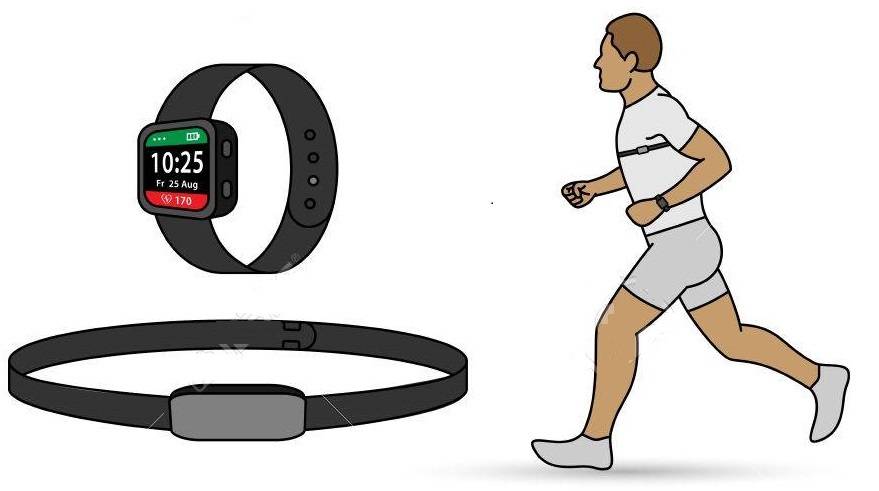
    chest-strap heart rate monitor

    (3) Alternative ways of measuring heart beats

    Can’t get it that way? Try the talk test. Research from the University of Wisconsin discovered that the point where it started to become difficult for subjects to talk corresponded to 75%-80%  of their MHR. Work out at an intensity just below the point where it starts to become difficult to talk and you’ll be burning body fat at a maximal rate.

    You don’t have to measure your heart rate every minute to figure out your intensity. Once you know the treadmill speed that gets your heart rate to the desired level, adjust the workout each minute by speed.

    Closing thoughts

    When prescribing cardiovascular exercise, the intensity (how hard the individual should exercise) should be carefully considered. Before agreeing the level of the exercise with an individual, it is useful to understand the benefits of exercising at different levels of intensity, otherwise known as the heart rate zones. In basic terms, each specific training zone is related to a heart-rate range in which certain benefits might be expected. The zones are not exact, but they are useful as a guide to cardiovascular training as the benefits relating to each zone are reasonably accurate. If your heart rate is above the target, work at a slower pace. If it’s below the target, increase the intensity of your workout. You should always stay within the upper and lower limits for you desired training zone.

    Share. Facebook Twitter Pinterest LinkedIn Tumblr Email WhatsApp
    krunoslav
    • X (Twitter)

    Hey! My name is Kruno, and I'm the owner and author of Bodybuilding Wizard. I am a licensed fitness trainer with a Ph.D. in kinesiology. Throughout my career, I have dedicated myself to helping individuals achieve their health and fitness goals through personalized training programs. In addition to my academic qualifications, I have completed various specialized courses, including certifications in nutrition and strength training, which have further enhanced my ability to provide comprehensive fitness guidance. I started this website back in late 2014, and it has been my pet project ever since. My goal is to help you learn proper weight training and nutrition principles so that you can get strong and build the physique of your dreams!

    Related Posts

    Best Cardio Exercises for Weight Loss: A Coach’s Complete Guide

    Fasted Cardio for Fat Loss: Does It Really Work or Is It Just a Myth?

    Maximum Heart Rate Calculator

    Leave A Reply Cancel Reply

    You must be logged in to post a comment.

    WE ARE SOCIAL
    • Facebook 3.6K
    • Twitter
    • YouTube 133
    • Instagram
    RECENT POSTS
    August 27, 2026

    Does Soy Lower Testosterone or Increase Estrogen in Men? What the Science Says

    August 26, 2026

    Does Training Legs Really Boost Testosterone? What the Science Says

    August 24, 2026

    Does Sauna Really Boost Growth Hormone 16x? Myth vs. Science

    August 24, 2026

    Does Power Posing Really Boost Testosterone? Myth, Science & the Retraction

    August 23, 2026

    Does Ashwagandha Really Boost Testosterone and Lower Cortisol? Myth vs. Science

    RECENT COMMENTS
    • Justin Dew on Designing your own home gym
    • krunoslav on Meet Your Muscles: How muscles are named?
    • Christina on Meet Your Muscles: How muscles are named?
    • igtropin on Stiff-Leg Deadlift: Proper Form, Muscles Worked & Hamstring Growth Guide
    • teragon labs on Barbell Back Squat: Proper Form, Benefits, Muscles Worked & Expert Tips
    LATEST GALLERIES

    Subscribe to Updates

    Join our mailing list to receive the latest updates from our team.

    ABOUT
    ABOUT

    We are a group of bodybuilding enthusiasts and this is our effort to have all the details about bodybuilding on a single website. We strive to educate and inform our visitors so that they can make the correct training, nutrition, and supplement decisions on their own. Bodybuilding Wizard will make your dream body your reality and take you to a whole new level!

    POPULAR POSTS
    April 2, 2014

    Lying Leg Curl: Complete Guide to Hamstring Isolation, Strength & Muscle Growth

    February 18, 2019

    Meet Your Muscles: How muscles are named?

    March 28, 2014

    Free weights: The main tool for building muscles

    BODYBUILDING WIZARD
    Bodybuilding Wizard Footer Logo
    Facebook X (Twitter) Instagram Pinterest YouTube
    • About
    • Authors
    • Editorial Policy
    • Write for us
    • Privacy
    • Contact
    • Terms of Use
    • Advertising
    • FAQ
    Copyright © 2014-2026 BodybuildingWizard. All rights reserved. Powered by WordPress. Made with love and lots of caffeine.

    Type above and press Enter to search. Press Esc to cancel.

    Sign In or Register

    Welcome Back!

    Login to your account below.

    Lost password?