

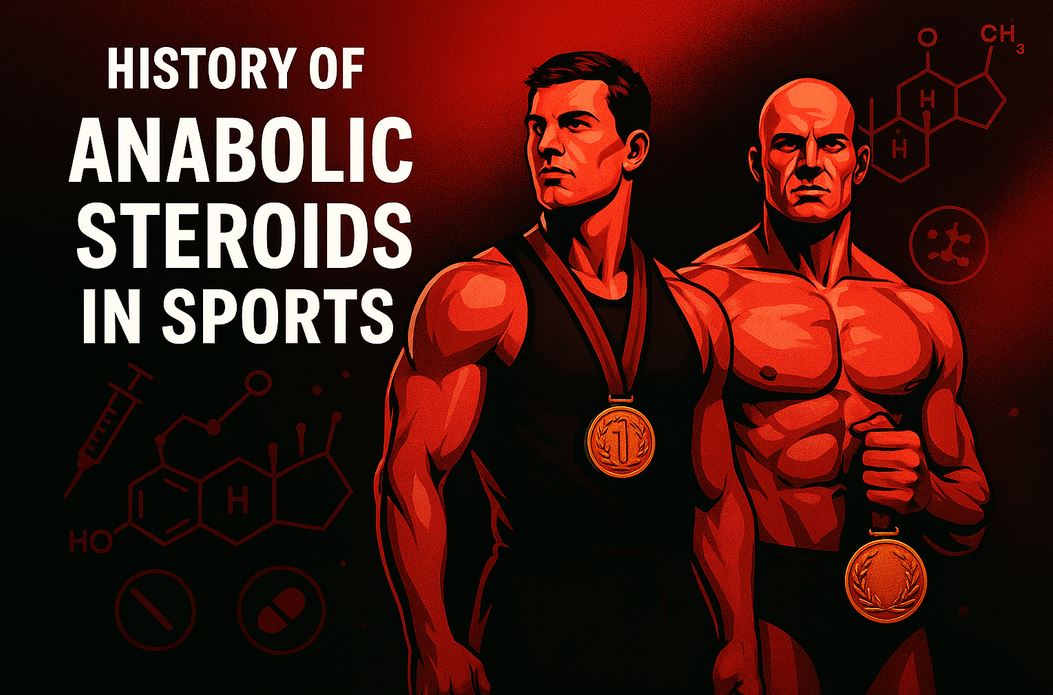
Anabolic steroids have become a symbol of both extraordinary human performance and ethical controversy in sports. From the early myths of warriors consuming animal organs to the state-sponsored doping programs of the Cold War, the history of anabolic steroid use is as complex as it is fascinating. This article explores the timeline, cultural impact, testing mechanisms, and major scandals that define the history of anabolic steroid use in sports.
📌 I. Ancient Roots: From Bull Testicles to Olympic Warriors
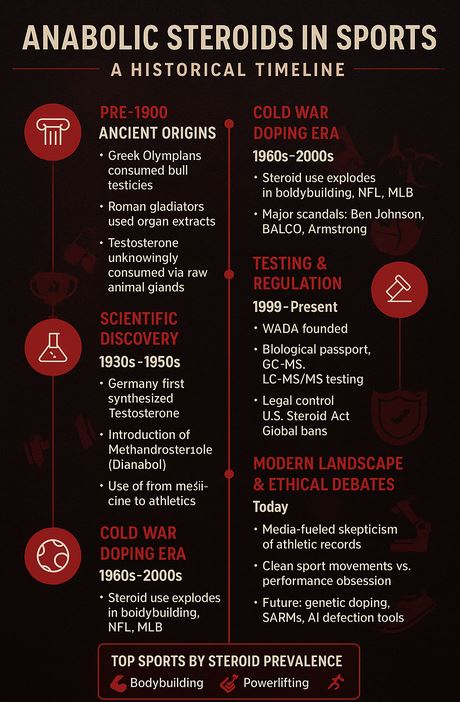
Long before synthetic compounds existed, ancient civilizations sought strength-enhancing substances. Historical texts suggest that Greek Olympians and Roman gladiators consumed animal testicles, particularly from bulls, believing they boosted courage and physical power. This idea wasn’t entirely unfounded: testicular tissue contains natural testosterone.
In China and India, traditional medicine systems also used organ extracts to increase vitality. While the biochemical mechanisms were unknown, the effects were observed empirically. This primitive form of androgen supplementation marks the beginning of what we now understand as anabolic enhancement.
📌 II. The Birth of Synthetic Anabolic Steroids (1930s–1950s)
The modern history of anabolic steroid use began in 1935 when German scientists first synthesized testosterone. In 1935, testosterone propionate became the first commercially available anabolic steroid. The aim was medical: to treat men with hypogonadism and muscle-wasting conditions.
Soon, researchers realized that modifying testosterone’s molecular structure could amplify its anabolic properties while reducing its androgenic (sex-related) effects.
This led to the development of Methandrostenolone (Dianabol) by Dr. John Ziegler and CIBA Pharmaceuticals in the 1950s. Originally intended for medical uses like muscle-wasting diseases and delayed puberty, steroids found a new audience: athletes looking for a competitive edge.
By the 1960s, Eastern Bloc nations like the Soviet Union and East Germany systematically administered anabolic steroids to athletes, turning performance enhancement into state-sponsored science.
📌 III. Rise of Steroid Use in Competitive Sports (1960s–1980s)
The 1960s to 1980s marked the golden age of anabolic steroid proliferation in sport. Athletes across disciplines began using steroids to improve performance, often encouraged or supervised by coaches and medical staff.
No program was more infamous than the East German Doping System, where teenage athletes were unknowingly given steroids like Oral Turinabol as part of state policy. Many went on to win Olympic medals while suffering severe health consequences later in life.
In the U.S., steroid use became commonplace in NFL locker rooms, college football, and especially in bodybuilding, which was glamorized by figures like Arnold Schwarzenegger, who later admitted to steroid use during competition years.
During this time, information about cycles, stacking, and post-cycle therapy spread through underground forums, gyms, and unregulated publications.
📌 IV. Steroid Use in the 1990s and 2000s: Mainstream Exposure and Legal Repercussions
After the 1980s, steroid use didn’t decline—it became more sophisticated and more visible. The 1990s and early 2000s saw anabolic steroids enter mainstream sports headlines, sparking intense debate across governments, health organizations, and media outlets.
During this period:
- Drug testing became more widespread, but athletes and coaches developed methods to evade detection.
- Media scrutiny intensified, especially in baseball and cycling, where record-breaking performances raised eyebrows.
- Legal responses emerged: In 1990, the U.S. Anabolic Steroid Control Act made unauthorized possession illegal, and further amendments followed in 2004.
This era marked the transition from hidden locker-room secrets to global headlines, congressional hearings, and public reckonings. The debate shifted from whether steroids were used to how widespread, harmful, and culturally accepted their use had become.
📌 V. Major Scandals That Shook the Sports World
Throughout the history of anabolic steroid use in competitive athletics, numerous high-profile scandals have not only rocked public trust but also fundamentally reshaped drug-testing protocols, media narratives, and the ethical frameworks surrounding elite sports.
🟠 Ben Johnson – The 1988 Seoul Olympics Shockwave
Canadian sprinter Ben Johnson set a blazing world record of 9.79 seconds in the men’s 100-meter final, defeating legendary American rival Carl Lewis. However, within 48 hours, he was stripped of his gold medal after testing positive for Stanozolol (Winstrol) — a synthetic anabolic steroid.
This scandal was a cultural earthquake: it marked the first time the global public saw concrete, undeniable evidence of elite doping on the Olympic stage. The fallout led to Canada’s Dubin Inquiry, which publicly exposed widespread doping in track and field and catalyzed reforms in anti-doping governance.
🟠 The BALCO Scandal – Science vs. Ethics (2003)
The Bay Area Laboratory Co-operative (BALCO) became infamous for distributing “The Clear” and “The Cream” — designer anabolic steroids and masking agents — to world-class athletes. The most high-profile names implicated included:
- ⚾ Barry Bonds (MLB home run king)
- 🏃♀️ Marion Jones (5-time Olympic medalist)
- 🏈 NFL players and track stars
The BALCO case revealed the depth of scientific sophistication used to circumvent existing drug tests. It exposed a disturbing pattern: performance enhancement was not an individual moral failing but an institutional strategy involving chemists, coaches, and handlers.
This led to congressional hearings, stricter drug testing protocols, and the permanent association of steroid use with betrayal and deceit in the public eye.
🟠 Lance Armstrong – A Culture of Concealment
Although Lance Armstrong’s doping regimen centered more on Erythropoietin (EPO) and blood transfusions than classic anabolic steroids, his story parallels steroid scandals in scale, deception, and cultural fallout. For over a decade, Armstrong maintained his innocence while winning 7 Tour de France titles.
The eventual revelation — enabled by testimony from teammates and USADA investigations — showed not just a single athlete cheating, but a coordinated, team-wide doping system supported by physicians, officials, and enablers.
Armstrong’s case reminded the world that elite athletic performance often walks a fine line between training and pharmacological engineering, regardless of substance type.
🟠 MLB’s Steroid Era – Home Runs on Hormones
From the late 1980s to the early 2000s, Major League Baseball witnessed a dramatic surge in offensive statistics. Fans were mesmerized by titanic home runs and record-breaking seasons from players like:
- Mark McGwire
- Sammy Sosa
- Jose Canseco
- Barry Bonds
This era created a financial boom in baseball, but at the cost of credibility. Canseco’s tell-all book “Juiced” and subsequent reports unveiled how widespread anabolic steroid use had become. The 2005 Congressional Hearings on Steroid Use in Baseball forced league officials to implement mandatory testing, suspensions, and public transparency.
The major doping scandals throughout the history of anabolic steroid use served as inflection points — waking up fans, regulators, and governments to the reality that the pursuit of victory often comes at the expense of ethics and health. They also underscore the constant evolution of performance-enhancing techniques — and the equally relentless evolution of detection and regulation.
📌 VI. The Birth of Drug Testing and Regulation
The response to rampant steroid use culminated in the creation of regulatory bodies and stricter policies:
- 1967: IOC introduces drug testing at the Olympics.
- 1999: Founding of the World Anti-Doping Agency (WADA), which standardized global testing protocols.
- Testing methods evolved from basic urine analysis to gas chromatography-mass spectrometry (GC-MS) and longitudinal athlete biological passports.
- Legal changes: The U.S. Anabolic Steroid Control Act (1990) classified anabolic steroids as Schedule III controlled substances, criminalizing non-prescribed possession and distribution.
These changes marked a turning point: steroid use was no longer just a performance issue—it became a legal and ethical one.
📌 VII. Sports Most Affected by Steroid Use
Certain sports have become synonymous with steroid controversies due to physical demands and media exposure:
- 💪 Bodybuilding: Virtually no top-level competitor avoids steroid use; entire categories like IFBB Pro have normalized performance enhancement.
- 🏀 Baseball: The 1990s home run boom revealed how steroids distorted competition.
- 🏋️ Powerlifting/Strongman: Maximal strength demands have made steroids common, with some federations explicitly non-tested.
- 🏃 Track & Field: Doping cases involving sprinters, hurdlers, and shot putters have been widespread.
- 🏈 American Football: Bulk and speed advantages from steroids remain desirable despite NFL testing.
Each of these sports saw not only physical transformations but also declines in public trust and athlete longevity.
📌 VIII. Ethical, Medical, and Cultural Implications
The history of anabolic steroid use raises difficult questions:
- Is it ethical to use substances that create uneven playing fields?
- What are the long-term medical risks of use, especially when started young?
- How does media glorification of extreme physiques drive young athletes toward PEDs?
While medical testosterone therapy has legitimate uses (e.g., for hypogonadism), the blurred line between therapeutic and enhancement use continues to fuel debate.
Culturally, the steroid era has shaped how we view records, champions, and the very definition of excellence.
📌 IX. The Future: New Drugs, Better Detection, and Evolving Norms
As technology advances, so do both doping techniques and detection methods:
- SARMs (Selective Androgen Receptor Modulators). A newer class of muscle-enhancing drugs that may eventually rival or replace steroids. Unlike traditional steroids, SARMs selectively target androgen receptors in muscle and bone tissue while minimizing interaction with other organs. This makes them theoretically safer, with fewer side effects related to the prostate, liver, or skin. SARMs are still under research and are not approved for human use by regulatory bodies like the FDA. Despite this, they have gained popularity in bodybuilding and athletics for their perceived benefits and oral availability.
- Genetic doping. CRISPR and epigenetic manipulation present new frontiers in PEDs. CRISPR is a gene-editing technology that allows scientists to alter DNA with high precision. In theory, it could be used to enhance muscle growth, stamina, or recovery by modifying genes responsible for these traits. Epigenetic manipulation, on the other hand, changes how genes are expressed without altering the genetic code itself. Both methods are difficult to detect with current testing and raise serious ethical concerns about fairness and long-term health effects.
- AI-driven analysis: Anti-doping agencies are integrating machine learning to flag biological anomalies.
On the social front, some argue for a rethinking of rules, either through regulated enhancement leagues or clearer therapeutic exemptions. What remains clear is that performance enhancement is evolving, not disappearing.
📌 X. Conclusion: The History of Anabolic Steroids
The history of anabolic steroid use in sports is more than a record of banned substances—it’s a reflection of human ambition, innovation, and the price paid for glory. From ancient rituals to designer steroids and AI detection, the pursuit of greatness continues to challenge what we consider fair, natural, and human. As testing improves and public awareness grows, so too does the need for honest conversations about limits, ethics, and the future of sport.
👉 Disclaimer
This article is for educational and informational purposes only. It does not endorse or encourage the use of anabolic steroids or any performance-enhancing substances. The use of such substances should always comply with local laws and professional medical advice.
✅ Key Takeaways: History of Anabolic Steroid Use in Sports
1️⃣ Ancient Origins: The use of testosterone-rich animal organs like bull testicles in ancient Greece and Rome marks the earliest form of performance enhancement.
2️⃣ Scientific Breakthroughs: The 1930s saw the isolation of testosterone, and the 1950s introduced synthetic anabolic steroids like Dianabol, originally for medical use.
3️⃣ Cold War Doping Programs: During the 1960s–1980s, nations like the Soviet Union and East Germany institutionalized steroid use for athletic dominance.
4️⃣ Mainstream Abuse: Steroid use surged across NFL, MLB, bodybuilding, and track & field in the 1970s–1990s, becoming widespread among professionals and amateurs.
5️⃣ Global Scandals: Events like Ben Johnson’s disqualification (1988), BALCO (2003), and the MLB Steroid Era exposed systemic abuse and shook public trust.
6️⃣ Legal and Ethical Shifts: Laws like the U.S. Anabolic Steroid Control Act (1990) and the formation of WADA (1999) transformed steroid use into a regulated and criminalized issue.
7️⃣ Evolving Detection Methods: Testing progressed from basic urine screens to advanced techniques like GC-MS and athlete biological passports.
8️⃣ Next-Gen PEDs: Genetic doping, CRISPR, SARMs, and epigenetic manipulation signal a future of more covert and complex enhancement strategies.
9️⃣ Cultural Debate: The history of anabolic steroid use continues to raise questions about fairness, health, consent, and the meaning of “natural” sport.
🔟 Still Relevant: Despite tighter regulations, steroids remain a critical issue in sports, with ongoing detection challenges and ethical debates.
What is the history of anabolic steroid use in sports?
Anabolic steroid use in sports dates back to the 1950s when testosterone derivatives were introduced to enhance muscle growth and recovery. The 1960s and 70s saw widespread use among Eastern Bloc athletes, leading to international scandals and regulation.
Did ancient athletes use natural testosterone sources?
Yes, historical records suggest that ancient Greek and Roman athletes consumed animal testicles, such as bull testicles, believing they could boost strength, vitality, and masculine energy—an early form of hormonal enhancement.
When did synthetic anabolic steroids become popular in sports?
Synthetic anabolic steroids became popular in the 1950s and 1960s, especially after the creation of Dianabol. They were initially used for medical purposes but soon adopted by athletes for performance enhancement.
What was the role of steroids during the Cold War era?
During the Cold War, countries like the Soviet Union and East Germany implemented systematic doping programs using anabolic steroids to dominate international competitions and promote political superiority.
What are the most famous steroid scandals in sports history?
Notable scandals include Ben Johnson’s disqualification at the 1988 Olympics, the BALCO affair in the early 2000s, and widespread steroid use in Major League Baseball during the 1990s and early 2000s.
How has steroid regulation evolved over time?
Steroid regulation began with Olympic drug testing in 1967, followed by laws like the U.S. Anabolic Steroid Control Act (1990). In 1999, WADA was formed to enforce global testing standards and deter doping in sports.
Which sports have the highest rates of anabolic steroid use?
Bodybuilding, powerlifting, baseball, football (NFL), and athletics (especially sprinting and throwing events) have historically shown the highest incidence of anabolic steroid use.
How do modern anti-doping tests detect anabolic steroids?
Modern tests use advanced methods such as gas chromatography-mass spectrometry (GC-MS) and longitudinal athlete biological passports to detect steroid metabolites even weeks or months after use.
What is genetic doping and how does it relate to steroids?
Genetic doping involves altering an athlete’s DNA or gene expression using methods like CRISPR or epigenetic reprogramming. It’s seen as the next frontier in performance enhancement, going beyond traditional steroid use.
Why is the history of anabolic steroid use still relevant today?
The history reveals the ongoing battle between performance enhancement and fair play. Despite stricter regulations, new drugs, evolving tactics, and ethical debates keep anabolic steroids a central topic in modern sports.
Do professional bodybuilders still use anabolic steroids today?
Yes, many professional bodybuilders continue to use anabolic steroids to achieve extreme levels of muscle mass and conditioning. While not officially endorsed, their usage is widespread in leagues where testing is minimal or nonexistent.
Are anabolic steroids common among female bodybuilders?
Yes, female bodybuilders in competitive divisions—especially in physique and bodybuilding classes—often use anabolic steroids to enhance muscle growth, strength, and leanness, although the side effects can be more pronounced in women.
Is it legal for Mr. Olympia competitors to use anabolic steroids?
While anabolic steroids are controlled substances in most countries, the IFBB Pro League does not conduct drug testing for the Mr. Olympia contest. Therefore, while legal use depends on jurisdiction, steroid use is unofficially tolerated in this event.
What are the health risks of long-term anabolic steroid use in bodybuilding?
Long-term anabolic steroid use can lead to serious health risks such as liver damage, cardiovascular disease, hormonal imbalances, infertility, and psychological effects like aggression and mood swings.
How do professional bodybuilders avoid testing positive for steroids?
Many professional bodybuilders compete in untested federations or use sophisticated steroid cycles, timing, and masking agents to avoid detection. Natural federations test rigorously, but many top-level events do not test for steroids.
📚 References & Further Reading
- Haupt, H. A., & Rovere, G. D. (1984). Anabolic steroids: a review of the literature. The American Journal of Sports Medicine, 12(6), 469–484. 👉 https://pubmed.ncbi.nlm.nih.gov/6391415/
- Kicman, A. T. (2008). Pharmacology of anabolic steroids. British Journal of Pharmacology, 154(3), 502–521. 👉 https://www.ncbi.nlm.nih.gov/pmc/articles/PMC2439524/
- Yesalis, C. E., & Bahrke, M. S. (2002). History of doping in sport. International Sports Studies, 24(1), 42–76. (Also covered in the book: Anabolic Steroids in Sport and Exercise, 2nd Ed., Human Kinetics)
- World Anti-Doping Agency (WADA). Science & Medicine Resources. 👉 https://www.wada-ama.org/en/what-we-do/science-medicine
- Hartgens, F., & Kuipers, H. (2004). Effects of androgenic-anabolic steroids in athletes. Sports Medicine, 34(8), 513–554. 👉 https://pubmed.ncbi.nlm.nih.gov/15248788/
- National Institute on Drug Abuse (NIDA). What is the history of anabolic steroid use? 👉 https://nida.nih.gov/publications/research-reports/steroids-anabolic/history-use
- Todd, T. (1987). Anabolic steroids: The gremlins of sport. Journal of Sport History, 14(1), 87–107. Full PDF available at university databases or JSTOR.
