


Most people train calves regularly but completely ignore the muscles on the front of the lower leg. That imbalance is far more common than people realize, especially in gym lifters, runners, and athletes who spend years strengthening the posterior chain while neglecting ankle dorsiflexion strength.
One of the best ways to directly strengthen the tibialis anterior with smooth, adjustable resistance is the cable tibialis raise (cable toe raises).
Unlike some bodyweight shin exercises, cable resistance creates continuous tension throughout the movement. This often leads to better muscular control, easier progression, and more consistent resistance across the entire range of motion.
As a coach, I especially like this variation for intermediate and advanced trainees because the cable setup allows very precise loading while maintaining smooth movement mechanics.
What Is the Cable Tibialis Raise?
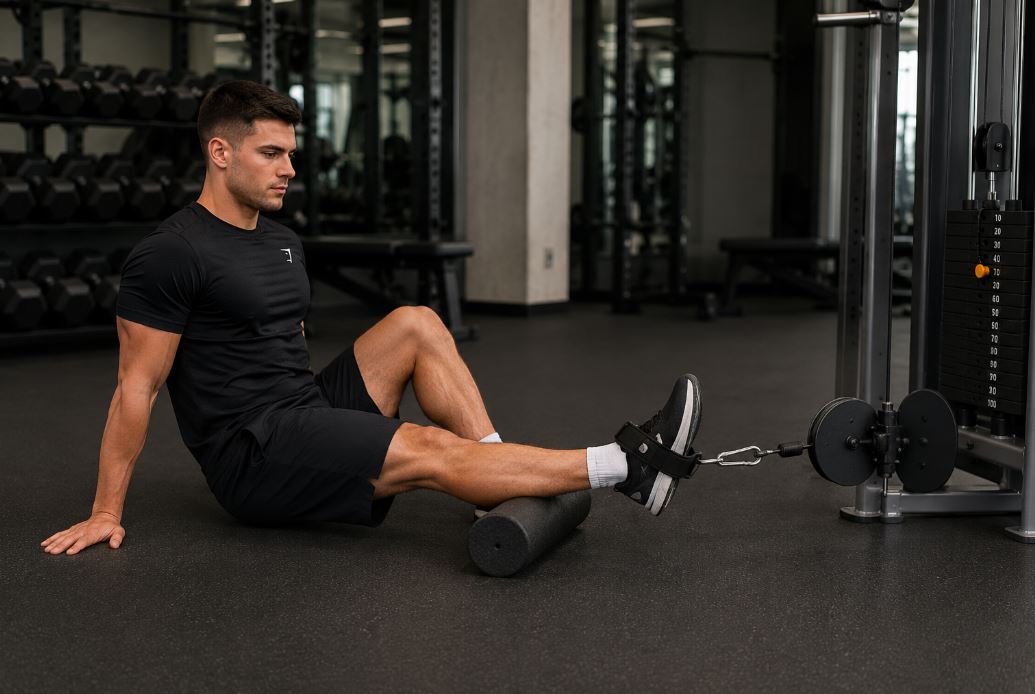
The cable tibialis raise is an ankle dorsiflexion exercise performed using a low cable pulley and ankle attachment.
The movement involves pulling the foot upward toward the shin against cable resistance. This directly targets the tibialis anterior — the primary muscle responsible for dorsiflexion.
Unlike resistance bands, the cable machine provides:
- Continuous tension
- Adjustable loading
- Smooth resistance
- Better progression control
This exercise may be performed:
- Seated
- Standing
- One leg at a time
The unilateral setup is one of the biggest advantages of cable tibialis raises.
Benefits of Cable Tibialis Raises
Continuous Resistance Through the Entire Movement
One major advantage of cable training is that tension remains more consistent throughout the exercise.
As a coach, I often notice that people achieve better tibialis activation with cables than with some free-weight or band variations.
Easy Progressive Overload
The cable machine allows very small resistance adjustments.
That makes progression:
- More measurable
- Easier to control
- Safer for beginners
Excellent for Unilateral Training
Because the movement is commonly performed one leg at a time, it becomes easier to:
- Correct imbalances
- Improve ankle control
- Focus on weaker sides
Smooth and Joint-Friendly Movement
Cable resistance tends to feel smoother than some heavier-loaded tibialis variations.
This often makes the exercise more comfortable for people who dislike abrupt changes in resistance.
Great for Athletes and Runners
The tibialis anterior plays an important role in:
- Running mechanics
- Foot control
- Deceleration
- Ankle stabilization
Strengthening these muscles may help improve lower-leg balance and athletic control.
Muscles Worked
Primary Muscle Worked
Secondary Muscles Involved
- Extensor hallucis longus
- Extensor digitorum longus
- Foot stabilizers
- Ankle stabilizers
The tibialis anterior remains the dominant muscle throughout the movement.
How to Perform the Cable Tibialis Raise Properly
The setup is slightly more technical than some bodyweight variations, but once adjusted correctly, the exercise feels very natural.
Step 1 — Attach the Ankle Strap
Set the cable pulley to the lowest position.
Attach an ankle strap securely around the foot or ankle, depending on your setup.
Make sure:
- The strap feels secure
- The cable pulls smoothly
- The resistance line matches the movement direction
Step 2 — Position Yourself Properly
You may perform the exercise:
- Seated on a bench
- Sitting on the floor
- Standing facing the cable machine
Most people initially find the seated variation easiest to control.

Step 3 — Pull the Toes Toward the Shin
Slowly dorsiflex the ankle by pulling the foot upward.
Focus on:
- Smooth movement
- Full dorsiflexion
- Controlled tempo
Pause briefly at the top position.
Can you really remember the last time you intentionally trained this movement pattern? Most people cannot, which is exactly why shin strength is often so underdeveloped.
Step 4 — Lower Slowly
Return to the starting position under control.
Avoid:
- Sudden dropping
- Momentum
- Jerky movement
The lowering phase helps maintain muscular tension.
Common Mistakes
Using Too Much Weight
The tibialis anterior is smaller and weaker than most people expect.
Going too heavy usually creates:
- Compensations
- Reduced range of motion
- Poor control
Moving Too Fast
Fast reps often reduce actual tibialis engagement.
Controlled repetitions usually work much better.
Incomplete Dorsiflexion
Some people barely move through the available range.
Try to maximize controlled dorsiflexion without sacrificing form.
Letting the Knee Compensate
The movement should primarily come from the ankle, not excessive knee movement.
Coach’s Tips for Better Tibialis Activation
Start With Moderate Resistance
You do not need a massive weight to challenge the tibialis anterior effectively.
Often:
- Lighter weight
- Cleaner execution
- Better control
produces superior results.
Use Controlled Eccentrics
Slower lowering phases often improve:
- Muscular tension
- Control
- Movement quality
Train Both Sides Equally
Unilateral cable work makes it easier to identify left-to-right imbalances.
Do not ignore weaker sides.
Combine Cable Work With Other Tibialis Variations
Cable tibialis raises work extremely well alongside:
- Heel walks
- Wall tibialis raises
- Tib bar raises
- Resistance band work
Different resistance profiles may help create more complete lower-leg development.
Best Rep Range & Programming
Cable tibialis raises respond very well to moderate repetitions and controlled tempo.
Recommended Rep Range
- Beginners: 12–15 reps
- General strength: 10–15 reps
- Endurance-focused: 15–25 reps
Recommended Sets
- 2–4 sets
Weekly Frequency
- 2–4 sessions weekly
The tibialis anterior generally tolerates moderate training frequency quite well.
Cable Tibialis Raise Variations
Seated Cable Tibialis Raise (Bilateral)
The most stable and beginner-friendly option. Perform the exercise with both feet simultaneously.

Standing Cable Tibialis Raise
Adds more balance and stabilization demands.
Single-Leg Cable Tibialis Raise
Excellent for correcting asymmetries and improving unilateral ankle control.
Slow Tempo Cable Tibialis Raise
Use slower eccentrics for increased time under tension.
Alternative Exercises (Substitutes)
- Tib Bar Raise
- Heel Walk Exercise
- Weight Plate Toe Raise
- Single-Leg Wall Tibialis Raise
- Standing Tibialis Raise
- Wall Tibialis Raise
- Resistance Band Tibialis Raise
- Seated Dumbbell Tibialis Raise
- DARD Tibialis Raise
If you want a complete breakdown of the best shin exercises for stronger tibialis anterior muscles, ankle stability, and better lower-leg performance, explore our full guide to the best tibialis anterior exercises.
Final Thoughts
The cable tibialis raise is one of the best machine-based exercises for directly strengthening the tibialis anterior with smooth, adjustable resistance. The ability to train one leg at a time while maintaining continuous tension makes this variation especially useful for athletes, runners, and lifters seeking stronger lower legs and better ankle control.
As a coach, I think cable tibialis raises are among the most underrated lower-body exercises in commercial gyms. Most people walk past cable stations every day without realizing they could use them to strengthen a muscle group they have probably neglected for years.
Frequently Asked Questions
Is a cable tibialis raise better than a resistance band tibialis raise?
The cable version usually provides smoother and more consistent resistance, while resistance bands are easier to use at home or when traveling. Both are useful, but cables offer better load control in a gym setting.
Where should the cable attachment sit for this exercise?
The attachment should be secure enough to pull the foot upward without slipping. Many lifters use an ankle cuff around the midfoot or a foot strap designed for dorsiflexion exercises.
Can cable tibialis raises help correct left-to-right imbalances?
Yes. Because the exercise is usually performed one leg at a time, it makes it easier to identify and strengthen a weaker side without the stronger leg compensating.
Should cable tibialis raises feel harder at the top?
They often feel most challenging near the top because the tibialis anterior is fully shortened and working hard to complete dorsiflexion against cable resistance.
Can beginners do cable tibialis raises?
Yes, but beginners should start with very light weight and focus on learning the movement first. The cable setup can feel awkward at first if you have never trained ankle dorsiflexion directly.
Are cable tibialis raises useful for ankle rehab?
They can be useful in some rehab-style programs, but anyone recovering from an ankle injury should follow guidance from a qualified healthcare professional before adding loaded dorsiflexion work.
Why does my foot rotate during cable tibialis raises?
Foot rotation usually means the resistance line is not aligned well or the ankle stabilizers are struggling to control the movement. Reduce the weight and adjust your body position so the cable pulls straight through the foot.
Can cable tibialis raises improve running downhill?
They may help because downhill running places extra eccentric demand on the lower legs and ankle control. Stronger dorsiflexors can support better foot positioning and control during descents.
Should I train cable tibialis raises with shoes or barefoot?
Shoes usually make the cable attachment more comfortable and secure. Barefoot training may improve foot awareness, but it can also make the strap less comfortable depending on the setup.
Can cable tibialis raises replace calf training?
No. Cable tibialis raises train the front of the lower leg, while calf exercises train the back of the lower leg. For balanced development, both sides should be trained.
