



Most people spend years training their calves while completely ignoring the muscles on the front of the lower leg. Then one day they start experiencing shin discomfort, ankle instability, or lower-leg fatigue during running — and suddenly those neglected muscles become very important.
Can you really remember the last time you directly trained your tibialis anterior?
The wall tibialis raise has become one of the most popular exercises for strengthening the shin muscles because it is simple, effective, and requires almost no equipment. All you need is a wall and your body weight.
As a coach, I especially like this exercise for beginners, runners, athletes, and anyone trying to improve lower-leg balance without complicated gym machines or setups.
What Is the Wall Tibialis Raise?
The wall tibialis raise is a bodyweight ankle dorsiflexion exercise that primarily targets the tibialis anterior muscle on the front of the shin.
The exercise is performed by leaning against a wall while repeatedly lifting the toes toward the shins.
This movement is known as ankle dorsiflexion.
Unlike calf raises, which strengthen the back of the lower leg, wall tibialis raises focus on the often-neglected muscles responsible for:
- Pulling the foot upward
- Controlling foot placement
- Supporting ankle stability
- Assisting with walking and running mechanics
Because the exercise uses body weight and a wall for support, it is accessible to nearly everyone.
Benefits of Wall Tibialis Raises
Strengthens the Tibialis Anterior
The main benefit is direct strengthening of the shin muscles.
Most gym programs completely neglect this area, which may eventually contribute to muscular imbalance between the calves and the tibialis anterior.
May Help Reduce Shin Splint Risk
Weak tibialis anterior muscles are commonly associated with excessive lower-leg stress during repetitive activities like running.
Strengthening these muscles may help improve lower-leg resilience and force absorption.
Improves Ankle Stability
The tibialis anterior helps stabilize the ankle during walking, sprinting, jumping, and landing movements.
Stronger shin muscles often contribute to better movement control.
Requires No Equipment
One of the biggest advantages of wall tibialis raises is accessibility.
No:
- Machines
- Resistance bands
- Dumbbells
- Gym membership
All you need is a wall and enough space to stand comfortably.
Beginner-Friendly
The exercise is easy to learn and easy to scale.
Even complete beginners can usually perform wall tibialis raises safely within minutes.
How to Perform the Wall Tibialis Raise Properly
The movement itself is simple, but a proper setup makes a major difference.
Step 1 — Stand With Your Back Against a Wall
Lean your upper back against a wall for support.
Position your feet roughly:
- 12–24 inches away from the wall
- Hip-width apart
Your knees should remain slightly bent throughout the exercise.
Step 2 — Keep Your Heels on the Floor
Your heels should stay planted firmly on the ground during the entire set.
The movement comes from the ankle joint — not from lifting the heels.
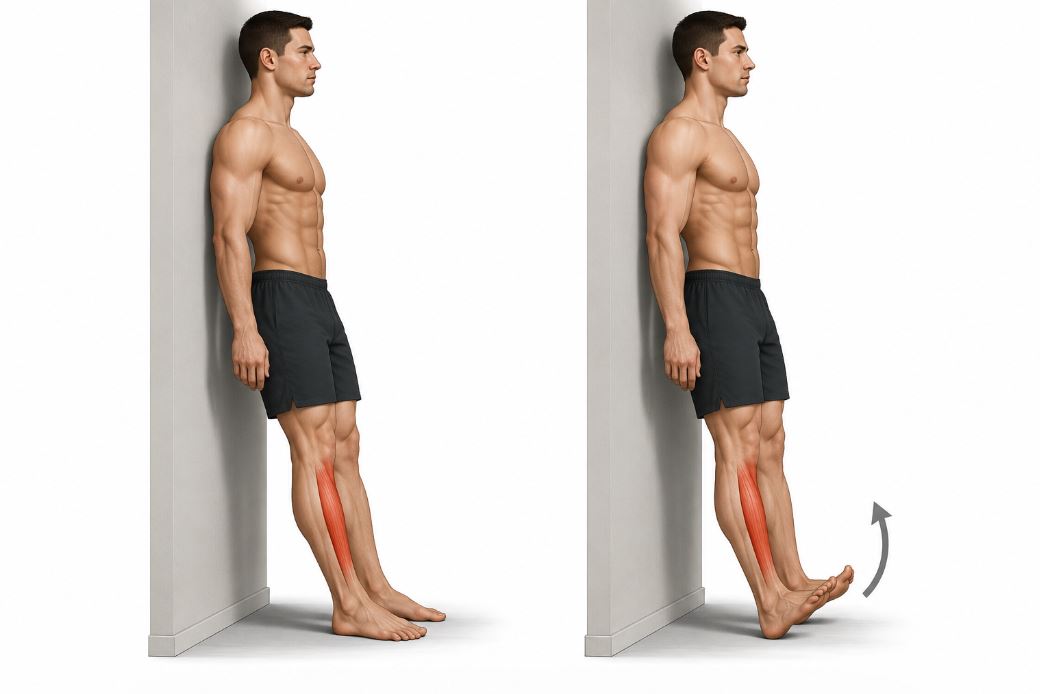
Step 3 — Lift Your Toes Toward Your Shins
Slowly raise the front of your feet upward as high as possible.
Think about pulling your toes toward your knees.
Pause briefly at the top position and squeeze the tibialis anterior.
As a coach, I often tell people not to rush this part. The stronger contraction usually comes from slower, more controlled repetitions.
Step 4 — Lower Under Control
Slowly return your feet to the starting position.
Do not simply drop the toes back down.
Controlled eccentrics help keep tension on the shin muscles longer.
Common Mistakes
Standing Too Close to the Wall
If your feet are too close to the wall, the exercise becomes much easier, and the tibialis anterior receives less tension.
Moving farther away generally increases difficulty.
Using Momentum
Swinging the feet rapidly reduces muscular tension.
Control the movement instead of bouncing through repetitions.
Lifting the Heels
The heels should remain planted throughout the exercise.
If the heels rise, the calves begin taking over more of the movement.
Rushing the Eccentric Phase
Many people focus only on lifting the toes upward.
However, slowly lowering the feet is equally important for proper tibialis anterior activation.
Coach’s Tips for Better Tibialis Activation
Start With Higher Reps
The tibialis anterior often responds well to moderate- or high-repetition training.
A good starting point is:
- 15–25 repetitions
- Controlled tempo
- Full range of motion
Don’t Underestimate This Exercise
The movement may look easy initially, but the burn builds quickly when performed correctly.
Many people are surprised by how fast their shin muscles fatigue.
Move Your Feet Farther Forward for More Difficulty
One of the easiest progression methods is simply increasing the distance between your feet and the wall.
More forward lean usually means:
- Greater resistance
- More shin muscle activation
- Higher difficulty
Focus on the Top Contraction
Try pausing for 1–2 seconds at the top of each repetition.
This often significantly improves tibialis anterior engagement.
Muscles Worked
Primary Muscle Worked
Secondary Muscles Involved
- Extensor hallucis longus
- Extensor digitorum longus
- Ankle stabilizers
The tibialis anterior remains the dominant muscle throughout the exercise.
Best Rep Range & Programming
Because the wall tibialis raise is a bodyweight movement, higher repetitions are usually more effective.
Recommended Rep Range
- Beginners: 12–15 reps
- General strength/endurance: 15–25 reps
- Advanced burn sets: 25–40 reps
Recommended Sets
- 2–4 sets
Training Frequency
- 2–5 times weekly
The tibialis anterior generally recovers more quickly than larger muscle groups.
Wall Tibialis Raise Variations
Single-Leg Wall Tibialis Raise
Perform the movement one leg at a time for greater unilateral challenge and muscular balance.
Weighted Wall Tibialis Raise
Advanced trainees may hold a dumbbell or wear a weighted vest for additional resistance.
Slow Eccentric Wall Tibialis Raise
Increase the lowering phase to 3–5 seconds to create greater time under tension.
Paused Wall Tibialis Raise
Pause for several seconds at the top position to improve muscular control and the quality of the contraction.
Who Should Do Wall Tibialis Raises?
This exercise can benefit many different populations.
Runners
Runners repeatedly stress the lower legs with every stride. Stronger shin muscles may help improve movement efficiency and muscular endurance.
Athletes
Sports involving sprinting, jumping, and rapid direction changes depend heavily on ankle control and lower-leg stability.
Beginners
Because the exercise requires no equipment and minimal coordination, it is excellent for beginners.
People Prone to Shin Discomfort
Strengthening the tibialis anterior may help improve lower-leg resilience and muscular balance.
Lifters With Overdeveloped Calves
Many gym-goers train calves heavily while neglecting the opposite side of the lower leg.
Wall tibialis raises help address this imbalance.
Replacement Exercises (Substitutes)
- Standing Tibialis Raise
- Resistance Band Tibialis Raise
- Weight Plate Toe Raise
- Tib Bar Raise
- Cable Tibialis Raise
- Heel Walk Exercise
- Single-Leg Wall Tibialis Raise
- Seated Dumbbell Tibialis Raise
- DARD Tibialis Raise
If you want to build stronger shin muscles and improve ankle stability, check out our complete guide to the best tibialis anterior exercises for every training level.
Final Thoughts
The wall tibialis raise is one of the simplest and most effective exercises for strengthening the tibialis anterior. It requires no equipment, minimal setup, and can be performed almost anywhere.
As a coach, I often recommend this exercise to people who completely neglect shin training yet still wonder why their lower legs fatigue quickly during running or other athletic activities.
The truth is simple: strong calves alone are not enough. The muscles on the front of the lower leg also play a major role in ankle stability, lower-leg balance, and movement control.
And the best part? You can start improving all of that with nothing more than a wall and a few controlled sets several times per week.
Frequently Asked Questions
What is a wall tibialis raise?
The wall tibialis raise is a bodyweight exercise that strengthens the tibialis anterior, the muscle on the front of the shin. It is performed by leaning against a wall and lifting the toes toward the shins while keeping the heels on the floor.
What muscles do wall tibialis raises work?
Wall tibialis raises primarily work the tibialis anterior. They also involve the toe extensors and smaller ankle stabilizers that help control dorsiflexion.
Are wall tibialis raises good for shin splints?
Wall tibialis raises may help strengthen the shin muscles and improve lower-leg resilience, which can support shin splint prevention. However, shin splints can have several causes, so training volume, footwear, running surface, and recovery also matter.
How often should I do wall tibialis raises?
Most people can perform wall tibialis raises 2–5 times per week. Beginners should start with 2–3 sets and gradually increase volume as the shin muscles adapt.
How many reps should I do for wall tibialis raises?
A good starting range is 12–25 controlled repetitions per set. More advanced trainees may use higher-rep sets of 25–40 repetitions for endurance and a stronger burn.
Why do my shins burn during wall tibialis raises?
A burning sensation is common because the tibialis anterior is often undertrained. The burn usually increases when you use slow repetitions, pause at the top, and keep constant tension on the shin muscles.
How do I make wall tibialis raises harder?
You can make wall tibialis raises harder by moving your feet farther away from the wall, using slower eccentrics, pausing at the top, performing single-leg reps, or adding external resistance.
Should wall tibialis raises be done before or after calf raises?
For most people, wall tibialis raises work best after calf raises or near the end of a lower-body workout. This helps train the front of the lower leg without interfering with larger strength exercises.
