



The tibialis anterior has become one of the most discussed lower-leg muscles in modern athletic training, largely because more coaches and athletes are finally realizing how important shin strength really is for performance, ankle stability, and overall lower-leg balance.
And when people talk about serious tibialis training today, one exercise usually comes up very quickly: the tib bar raise.
Unlike simple bodyweight tibialis exercises, the tib bar raise allows progressive overload in a much more practical and measurable way. That makes it especially useful for athletes, runners, and lifters who want to strengthen the shin muscles beyond beginner-level training.
As a coach, I like tib bar raises because they combine direct tibialis isolation with scalable resistance. In other words, they allow you to train the shin muscles more like you would train any other muscle group in the gym.
What Is the Tib Bar Raise?
The tib bar raise is a weighted ankle dorsiflexion exercise performed using a specialized piece of equipment called a tib bar.
The tib bar attaches weight plates to the feet, creating resistance during ankle dorsiflexion — the movement where the toes move upward toward the shin.
Unlike bodyweight tibialis raises, the tib bar allows:
- Progressive overload
- Heavier resistance
- More measurable progression
- Greater long-term strength development
The exercise primarily targets the tibialis anterior, but it also challenges several smaller muscles involved in ankle and foot stabilization.
Benefits of Tib Bar Raises
Allows Progressive Overload
One of the biggest limitations of bodyweight tibialis exercises is the lack of resistance progression.
Eventually:
- Higher reps become inefficient
- Muscular endurance becomes the limiting factor
- Loading progression becomes difficult
The tib bar solves this problem by allowing direct external loading.
Builds Stronger Tibialis Anterior Muscles
The exercise places the tibialis anterior under significant tension throughout the range of ankle dorsiflexion.
This may help improve:
- Shin strength
- Lower-leg muscular balance
- Dorsiflexion strength
- Ankle control
Useful for Athletes and Runners
Athletes often place enormous repetitive stress on the lower legs.
As a coach, I frequently see runners and field-sport athletes neglect shin strength entirely while overemphasizing calves, quads, and hamstrings.
Tib bar raises help address this imbalance.
More Efficient Than Extremely High-Rep Bodyweight Work
Instead of performing endless bodyweight repetitions, the tib bar lets you create meaningful resistance at lower rep ranges.
This often makes training more time-efficient.
Excellent for Long-Term Tibialis Development
If someone wants serious shin muscle development rather than simple activation work, weighted progression usually becomes necessary at some point.
That is where the tib bar becomes extremely useful.
How to Perform the Tib Bar Raise Properly
Although the movement itself is simple, proper setup matters.
Step 1 — Secure the Tib Bar
Attach the tib bar firmly to the feet in accordance with the equipment design.
Ensure:
- The device feels stable
- The weight is balanced evenly
- The feet are secured properly
Start light when learning the movement.
Step 2 — Sit on a Bench or Stable Surface
Sit upright with:
- Knees bent
- Feet elevated slightly off the floor
- Lower legs relaxed
Allow the tib bar and weight plates to hang naturally.
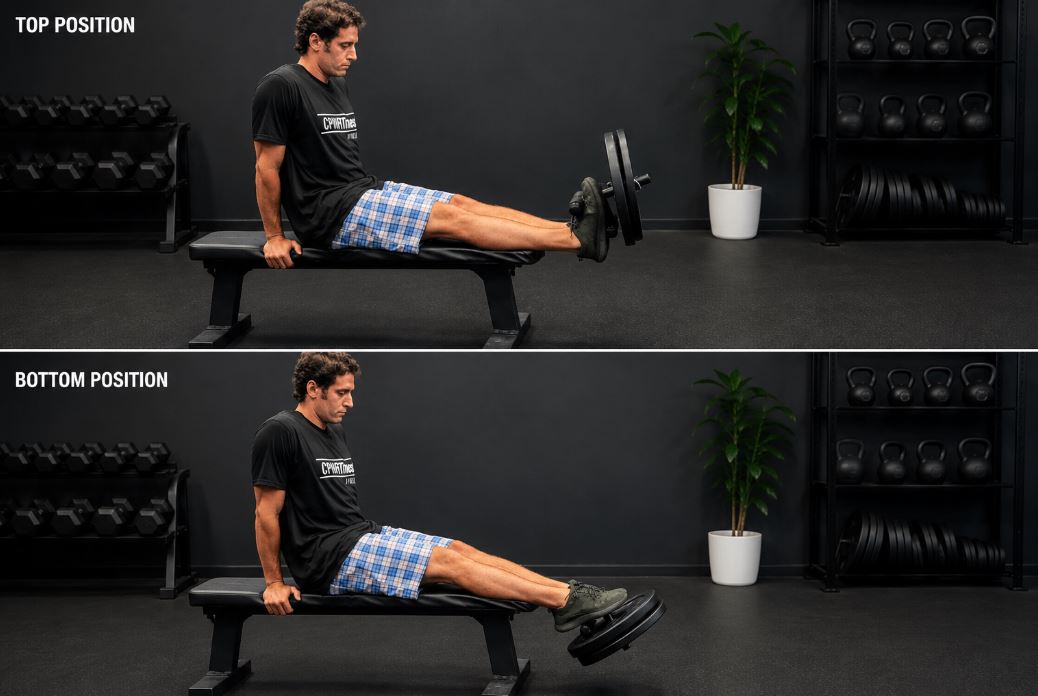
Step 3 — Dorsiflex the Ankles
Slowly pull the toes upward toward the shins.
Focus on:
- Controlled movement
- Smooth dorsiflexion
- Strong tibialis contraction
Pause briefly at the top position.
As a coach, I often remind people not to yank the weight upward aggressively. Controlled reps usually produce much better shin activation.
Step 4 — Lower Under Control
Slowly lower the feet back to the starting position.
Do not simply let gravity drop the weight.
The eccentric phase helps maintain continuous muscular tension.
Common Mistakes
Using Too Much Weight Too Early
The tibialis anterior is usually much weaker than people expect.
Going too heavy immediately often leads to:
- Poor control
- Excessive momentum
- Shortened range of motion
Swinging the Weight
Momentum reduces direct tension on the tibialis anterior.
Keep the movement smooth and controlled instead.
Incomplete Range of Motion
Many people only move through partial dorsiflexion.
Try to achieve a full controlled contraction whenever possible.
Rushing the Eccentric
The lowering phase matters.
Controlled eccentrics generally produce greater muscular tension and better movement quality.
Coach’s Tips for Better Tibialis Activation
Start Lighter Than You Think
Most people initially overestimate how much weight the tibialis anterior can handle.
Even small loads often feel surprisingly challenging.
Prioritize Control Over Load
The goal is not simply to move the weight.
The goal is to maintain:
- Clean dorsiflexion
- Controlled tempo
- Strong shin contraction
Use Full Range of Motion
Partial reps usually reduce exercise effectiveness.
Try to maximize dorsiflexion without compensating through momentum.
Train the Tibialis Consistently
Like calves, the tibialis anterior often responds well to relatively frequent training.
2–4 weekly sessions usually work very well.
Muscles Worked
Primary Muscle Worked
Secondary Muscles Involved
- Extensor hallucis longus
- Extensor digitorum longus
- Foot stabilizers
- Ankle stabilizers
The tibialis anterior remains the dominant muscle responsible for dorsiflexion throughout the movement.
Best Rep Range & Programming
Unlike some bodyweight tibialis exercises, tib bar raises work very well with moderate resistance.
Recommended Rep Range
- Beginners: 12–15 reps
- General strength: 10–15 reps
- Endurance-focused: 15–25 reps
Recommended Sets
- 2–4 sets
Training Frequency
- 2–4 sessions weekly
Because the tibialis anterior is relatively small, recovery is usually manageable with proper loading.
Tib Bar Raise Variations
Single-Leg Tib Bar Raise
Perform the movement one leg at a time for greater unilateral focus.
Slow Eccentric Tib Bar Raise
Use a 3–5 second lowering phase to increase time under tension.
Alternating Tib Bar Raise
Alternate left and right repetitions to challenge coordination and control.
High-Rep Tib Bar Burnout
Use lighter weights and higher repetitions for metabolic stress and endurance work.
Who Should Do Tib Bar Raises?
This exercise may be especially useful for:
- Athletes
- Runners
- Sprinters
- Lifters
- People seeking stronger shin muscles
- Individuals wanting better ankle stability
- Advanced trainees wanting progressive tibialis overload
It is especially useful once basic bodyweight tibialis exercises become too easy.
Alternative Exercises (Substitutes)
- Weight Plate Toe Raise
- Cable Tibialis Raise
- Wall Tibialis Raise
- Standing Tibialis Raise
- Resistance Band Tibialis Raise
- Single-Leg Wall Tibialis Raise
- Heel Walk Exercise
- Seated Dumbbell Tibialis Raise
- DARD Tibialis Raise
To explore more of the best shin exercises for building stronger tibialis anterior muscles and improving lower-leg durability, read our complete guide to the best anterior shin exercises.
Final Thoughts
The tib bar raise is one of the best exercises for progressively strengthening the tibialis anterior with measurable resistance. Unlike many bodyweight shin exercises, it allows consistent loading progression and more advanced long-term tibialis training.
As a coach, I think the biggest mistake people make in shin training is waiting until discomfort appears before they take lower-leg balance seriously. Strong calves matter, but strong shin muscles matter too.
And honestly, once people try properly loaded tib bar raises for the first time, they usually discover very quickly just how undertrained their tibialis anterior muscles really are.
Frequently Asked Questions
Is a tib bar better than resistance bands for tibialis training?
For progressive overload and long-term strength development, the tib bar is usually more effective because resistance can be increased more precisely. Resistance bands are still useful for beginners, warm-ups, and travel workouts.
Can tib bar raises help improve sprinting performance?
Stronger tibialis anterior muscles may help improve ankle stiffness, foot control, and lower-leg stability during sprinting mechanics, although sprint performance depends on many additional factors as well.
Why do tib bar raises feel harder than regular tibialis raises?
The tib bar adds direct external loading to ankle dorsiflexion, which creates significantly more tension on the tibialis anterior compared to simple bodyweight variations.
Should I use heavy or light weight for tib bar raises?
Most people respond best to controlled moderate loading rather than maximal weight. The tibialis anterior is a relatively small muscle, so quality movement usually matters more than heavy resistance.
Can tib bar raises improve jumping and landing mechanics?
Potentially, yes. The tibialis anterior contributes to ankle control and foot positioning during athletic movements, which may support better landing stability and movement efficiency.
Are tib bar raises useful for bodybuilders?
Yes. While often associated with athletic performance, tib bar raises may also help improve lower-leg muscular balance and create more complete lower-leg development alongside calf training.
How long does it take to notice progress from tib bar training?
Many people notice improved shin endurance and stronger contractions within several weeks of consistent training. Visible muscular development usually takes longer and depends on overall training volume and recovery.
Can beginners use a tib bar safely?
Yes, but beginners should start with very light weight and controlled repetitions. The tibialis anterior fatigues quickly when isolated, and excessive loading too early often leads to poor technique.
