


Most people spend years training calves while completely ignoring the muscles on the front of the lower leg. Over time, that imbalance can become significant — especially for runners, athletes, and gym lifters who constantly load the posterior chain but rarely directly train ankle dorsiflexion.
That is where the weight plate toe raise becomes extremely useful.
This simple exercise targets the tibialis anterior using nothing more than a weight plate and a bench or seated position. Unlike more advanced setups like tib bars or cable machines, this variation is accessible, inexpensive, and surprisingly effective.
As a coach, I like this exercise because it shows you do not need fancy equipment to properly train the shin muscles. In fact, many people are shocked by how difficult a relatively lightweight plate can feel once the tibialis anterior is isolated directly.
What Is the Weight Plate Toe Raise?
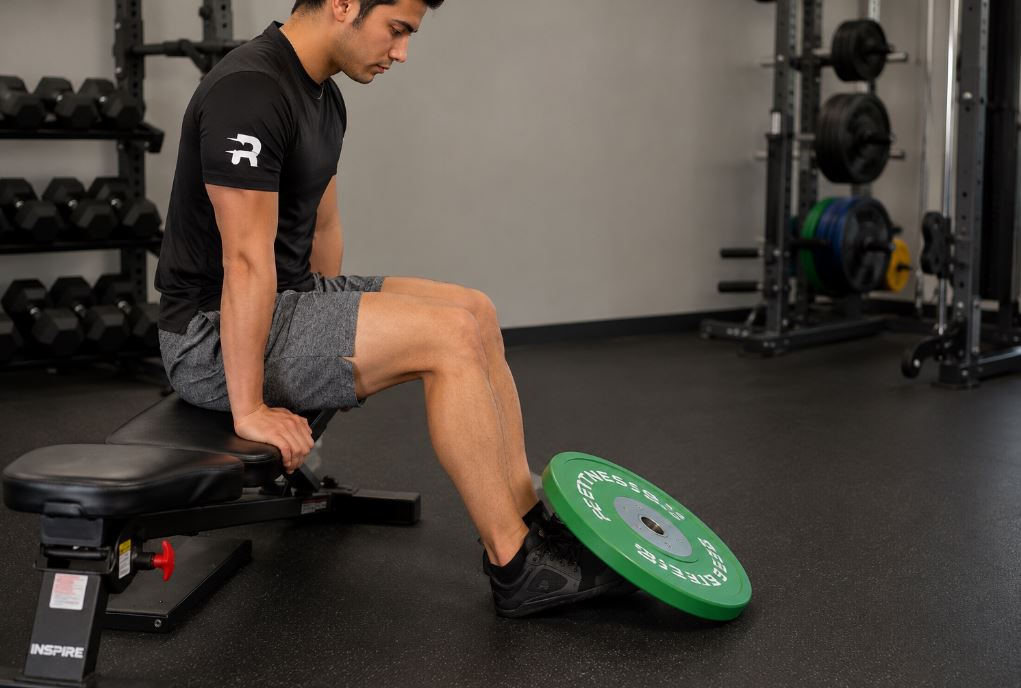
The weight plate toe raise is a seated ankle dorsiflexion exercise performed by attaching or balancing a weight plate on the feet while lifting the toes upward toward the shins.
The movement directly trains:
- Tibialis anterior
- Dorsiflexion strength
- Lower-leg muscular balance
Unlike bodyweight tibialis exercises, adding a plate creates external resistance, allowing progressive overload and stronger muscular contractions.
This exercise is sometimes also called:
- Weight plate tibialis raise
- Weighted toe raise
- Plate shin raise
Benefits of Weight Plate Toe Raises
Simple Yet Extremely Effective
One of the biggest advantages of this exercise is simplicity.
You only need:
- A weight plate
- A seated setup
- Controlled ankle movement
Despite the minimal setup, the exercise can create serious tibialis fatigue.
Great for Home Gyms
Not everyone owns:
- A tib bar
- Cable machine
- Specialized lower-leg equipment
A weight plate toe raise solves that problem very easily.
Helps Strengthen the Tibialis Anterior
The tibialis anterior is the primary muscle responsible for dorsiflexion.
Strengthening this muscle may help improve:
- Shin strength
- Ankle control
- Lower-leg balance
- Foot stability
Allows Progressive Overload
Unlike basic bodyweight shin exercises, the weight plate variation allows you to gradually increase resistance.
This makes long-term progression easier.
Excellent Transition Into Advanced Tibialis Training
As a coach, I often see this exercise work very well as a bridge between:
- Beginner bodyweight work, and
- Heavier tib bar training
It introduces external loading without requiring advanced equipment.
Muscles Worked
Primary Muscle Worked
Secondary Muscles Involved
- Extensor hallucis longus
- Extensor digitorum longus
- Foot stabilizers
- Ankle stabilizers
The tibialis anterior remains the dominant muscle throughout the movement.
How to Perform the Weight Plate Toe Raise Properly
Although the exercise looks simple, proper execution is key to effective shin activation.
Step 1 — Sit on a Bench or Stable Surface
Sit upright on a bench or sturdy surface with:
- Legs extended slightly
- Heels supported
- Feet free to move upward
Your lower legs should remain relaxed.
Step 2 — Position the Weight Plate
Place or secure a lightweight plate across the top portion of the feet.
Start lighter than you think you need.
The tibialis anterior fatigues quickly when isolated.

Step 3 — Lift the Toes Upward
Slowly dorsiflex the ankles by pulling the toes upward toward the shins.
Focus on:
- Controlled movement
- Full dorsiflexion
- Smooth tempo
Pause briefly at the top.
Can you really remember the last time you trained this movement directly? Most people cannot — which is exactly why shin muscles are often underdeveloped.
Step 4 — Lower Slowly
Return to the starting position under control.
Do not allow:
- The weight plate to drop suddenly
- Momentum to take over
- Partial repetitions
Controlled eccentrics help maintain muscular tension.
Common Mistakes
Using Too Much Weight
Many people dramatically overestimate tibialis strength.
Excessive loading often causes:
- Poor range of motion
- Jerky movement
- Compensation patterns
Moving Too Fast
Fast repetitions usually reduce actual muscular tension.
Controlled reps work much better.
Incomplete Range of Motion
Partial dorsiflexion limits exercise effectiveness.
Try to maximize controlled ankle movement.
Allowing Momentum to Take Over
Swinging the feet upward reduces direct engagement of the tibialis.
Keep the movement smooth and controlled.
Coach’s Tips for Better Tibialis Activation
Start With Very Light Weight
Even small plates may feel surprisingly difficult.
The goal is quality contraction, not ego lifting.
Focus on the Top Contraction
The peak dorsiflexion position is where many people feel the strongest tibialis activation.
Pause briefly there.
Use Slow Eccentrics
Slower lowering phases often improve:
- Control
- Time under tension
- Muscle awareness
Combine This Exercise With Other Shin Exercises
Weight plate toe raises work very well alongside:
- Wall tibialis raises
- Heel walks
- Tib bar raises
- Cable tibialis raises
- Resistance band tibialis raises
Different resistance profiles may improve overall lower-leg development.
Best Rep Range & Programming
The tibialis anterior usually responds very well to moderate-to-high repetitions.
Recommended Rep Range
- Beginners: 12–15 reps
- General strength: 10–20 reps
- Endurance-focused: 20–30 reps
Recommended Sets
- 2–4 sets
Weekly Frequency
- 2–4 sessions weekly
Because the tibialis anterior is relatively small, recovery is usually manageable with reasonable loading.
Weight Plate Toe Raise Variations
Single-Leg Weight Plate Toe Raise
Train one side at a time for greater unilateral focus.
High-Rep Toe Raise Burnout
Use lighter weights for extended sets and metabolic fatigue.
Slow Tempo Weight Plate Toe Raise
Increase time under tension using slower eccentrics.
Alternating Toe Raises
Alternate left and right repetitions for improved control and coordination.
Alternative Exercises (Substitutes)
- Standing Tibialis Raise
- Cable Tibialis Raise
- Resistance Band Tibialis Raise
- Single-Leg Wall Tibialis Raise
- Wall Tibialis Raise
- Heel Walk Exercise
- Seated Dumbbell Tibialis Raise
- Tib Bar Raise
- DARD Tibialis Raise
If you want a complete overview of the best shin exercises for building stronger tibialis anterior muscles, improving ankle stability, and developing balanced lower legs, make sure to explore our full guide to the best tibialis anterior exercises.
Final Thoughts
The weight plate toe raise is one of the simplest yet most effective exercises for strengthening the tibialis anterior without specialized equipment. It provides direct resistance, scalable progression, and excellent accessibility for both gym and home training.
As a coach, I think many people overlook how important balanced lower-leg development really is. Strong calves are valuable, but if the muscles on the front of the lower leg remain weak, overall ankle balance and lower-leg function may still suffer.
And honestly, once people try properly controlled weighted toe raises for the first time, they usually realize very quickly that their shin muscles are far weaker than they expected.
Frequently Asked Questions
Should the weight plate touch the floor during the exercise?
Ideally, the plate should remain under muscular control throughout the movement. Light contact with the floor is not a major problem, but completely unloading the resistance reduces tension on the tibialis anterior.
Can weight plate toe raises improve ankle stiffness for sports?
They may help improve active ankle control and lower-leg stiffness, which can contribute to better movement efficiency during sprinting, jumping, and rapid directional changes.
Why do weighted toe raises create such an intense burn?
The tibialis anterior is often undertrained in most workout programs. Once isolated directly under resistance, the muscle tends to fatigue quickly and produce a strong burning sensation.
Are weight plate toe raises useful for people who sit a lot?
Potentially, yes. Long periods of sitting may reduce lower-leg activity and ankle movement variability. Direct dorsiflexion training can help reintroduce controlled ankle activation.
Should the knees stay straight or bent during the exercise?
Slight knee bend is usually more comfortable for most people, but both positions can work. The key is maintaining controlled ankle dorsiflexion rather than excessive leg movement.
Can weight plate toe raises help improve walking mechanics?
Stronger dorsiflexors may improve foot clearance and ankle control during walking, especially during the swing phase when the foot moves forward.
What happens if the weight plate slides during the exercise?
If the plate shifts excessively, the movement becomes harder to control and may reduce exercise quality. Using shoes with stable surfaces or adjusting plate placement often helps.
Are weight plate toe raises safer than tib bar raises for beginners?
Many beginners find weight plate toe raises easier to learn because the setup is simpler and lighter loads are easier to manage compared to heavier tib bar loading.
Can this exercise help improve foot awareness?
Yes. Controlled dorsiflexion training often improves awareness of foot positioning, ankle movement, and lower-leg muscular engagement.
Do weight plate toe raises need to be trained heavy?
Not necessarily. The tibialis anterior often responds very well to moderate resistance, controlled tempo, and higher-quality repetitions rather than maximal loading.
