



Most people never realize how uneven their lower-leg strength actually is until they start training one side at a time. Bilateral shin exercises can hide muscular imbalances for years because the stronger side often compensates for the weaker one without you even noticing.
That is exactly why the single-leg wall tibialis raise is such a valuable variation.
By training one leg at a time, this exercise increases the demand on the tibialis anterior while also improving ankle control, stability, and unilateral lower-leg strength. Compared to standard wall tibialis raises, the single-leg version poses a noticeably greater challenge, even without external weight.
As a coach, I often use unilateral tibialis exercises to expose left-to-right weaknesses that would otherwise remain hidden during bilateral movements.
What Is the Single-Leg Wall Tibialis Raise?
The single-leg wall tibialis raise is a unilateral ankle dorsiflexion exercise performed while leaning against a wall.
The movement involves:
- Keeping one foot elevated
- Supporting the body with the opposite leg
- Pulling the working foot upward toward the shin
The exercise primarily targets the tibialis anterior while also increasing the demands on stabilization compared to bilateral tibialis raises.
Because only one leg works at a time, the movement:
- Increases relative loading
- Improves unilateral control
- Challenges ankle stability
- Helps identify muscular imbalances
Benefits of Single-Leg Wall Tibialis Raises
Improves Unilateral Lower-Leg Strength
Training one side at a time helps ensure both lower legs develop more evenly.
This is especially important for:
- Runners
- Athletes
- Lifters
- Individuals recovering from asymmetries
Greater Tibialis Activation
Because one leg handles the full workload, the tibialis anterior often works significantly harder compared to bilateral wall tibialis raises.
Many people immediately notice a stronger contraction and burn.
Challenges Stability and Control
The unilateral setup increases demands on:
- Foot stability
- Ankle control
- Balance
- Coordination
This creates additional athletic carryover.
Requires No Equipment
One of the biggest advantages of this exercise is simplicity.
You only need:
- A wall
- Bodyweight
- Enough space to lean comfortably
Helps Expose Left-to-Right Imbalances
As a coach, I often see one shin muscle fatigue much faster than the other during unilateral work.
Without single-leg exercises, these imbalances may remain hidden for years.
Muscles Worked
Primary Muscle Worked
Secondary Muscles Involved
- Extensor hallucis longus
- Extensor digitorum longus
- Foot stabilizers
- Ankle stabilizers
Because the exercise is unilateral, stabilization demands are usually higher than in bilateral versions.
How to Perform the Single-Leg Wall Tibialis Raise Properly
The setup is similar to a regular wall tibialis raise, but one leg performs all the work.
Step 1 — Lean Against a Wall
Stand with your back against a wall and position your feet slightly forward.
Your body should lean backward comfortably while the heels remain planted on the floor.
Step 2 — Lift One Foot Slightly Off the Ground
Choose one leg as the working side.
The opposite foot should remain elevated slightly so it does not assist during the movement.
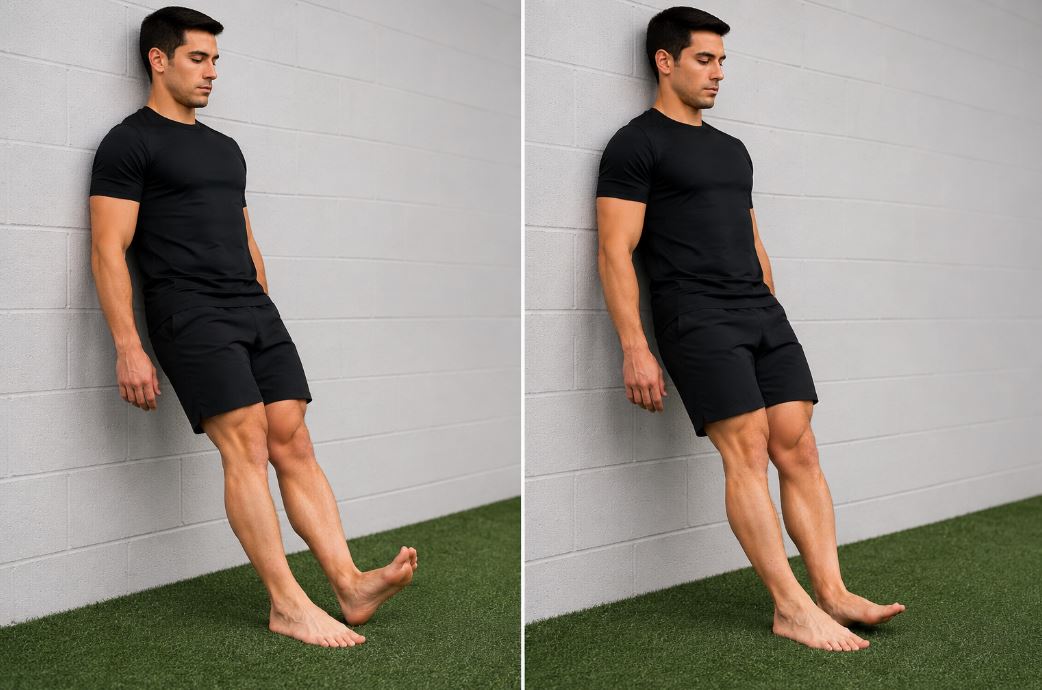
Step 3 — Pull the Toes Toward the Shin
Slowly dorsiflex the working ankle by lifting the front of the foot upward.
Focus on:
- Full dorsiflexion
- Controlled movement
- Smooth tempo
Pause briefly at the top position.
Can you really remember the last time you trained your shin muscles one side at a time? Most people cannot — which is why unilateral weaknesses often go unnoticed.
Step 4 — Lower Under Control
Slowly return the foot toward the starting position.
Do not:
- Bounce
- Rush
- Use momentum
Controlled eccentrics usually improve muscular tension and ankle control.
Common Mistakes
Using Momentum
Fast bouncing reps reduce direct tibialis activation.
Controlled movement works much better.
Letting the Nonworking Leg Assist
The elevated foot should not help during the movement.
Keep all tension on the working side.
Incomplete Range of Motion
Many people fail to dorsiflex the ankle fully.
Try to achieve a strong top contraction during every repetition.
Standing Too Upright
If the body angle is too vertical, resistance decreases significantly.
A slight backward lean helps maintain tension.
Coach’s Tips for Better Tibialis Activation
Focus on Symmetry
Do not rush through the stronger side while struggling through the weaker side.
Unilateral work should expose — not hide — asymmetries.
Use Controlled Tempo
The tibialis anterior usually responds very well to:
- Slower eccentrics
- Pauses
- Controlled contractions
Start With Lower Repetitions
Single-leg tibialis raises are often harder than people expect.
Even 10–15 controlled reps may feel challenging initially.
Combine Unilateral and Bilateral Work
Single-leg work pairs very well with:
- Wall tibialis raises
- Tib bar raises
- Cable tibialis raises
- Heel walks
Different variations create different stability and loading demands.
Best Rep Range & Programming
Because unilateral work increases relative intensity, slightly lower rep ranges often work well.
Recommended Rep Range
- Beginners: 8–12 reps
- General training: 10–15 reps
- Endurance-focused: 15–20 reps
Recommended Sets
- 2–4 sets per leg
Weekly Frequency
- 2–4 sessions weekly
The tibialis anterior generally recovers well with moderate loading.
Single-Leg Wall Tibialis Raise Variations
Slow Eccentric Single-Leg Raise
Use a slower lowering phase for increased time under tension.
Paused Single-Leg Raise
Hold the top contraction for 1–3 seconds.
Alternating Single-Leg Raises
Alternate sides continuously to create a smoother training flow.
Weighted Single-Leg Tibialis Raise
Advanced trainees may eventually add external resistance.
Replacement Exercises (Substitutes)
- Single-Leg Wall Tibialis Raise
- Wall Tibialis Raise
- Resistance Band Tibialis Raise
- Heel Walk Exercise
- Tib Bar Raise
- Cable Tibialis Raise
- Standing Tibialis Raise
- Seated Dumbbell Tibialis Raise
- DARD Tibialis Raise
If you are looking for the best shin exercises for building stronger tibialis anterior muscles and improving ankle control, make sure to read our complete guide to the best tibialis anterior exercises.
Final Thoughts
The single-leg wall tibialis raise is one of the best bodyweight exercises for improving unilateral shin strength, ankle control, and lower-leg muscular balance. Because the movement isolates one side at a time, it can expose weaknesses and stability limitations that bilateral exercises often hide.
As a coach, I think unilateral lower-leg training is something many athletes completely overlook. Yet in real-world movement, running, jumping, sprinting, and cutting rarely happen perfectly symmetrically.
And honestly, once people try single-leg tibialis work for the first time, they are often surprised by how quickly one side starts fatiguing compared to the other.
Frequently Asked Questions
Why does one leg feel significantly weaker during single-leg tibialis raises?
Most people naturally develop side-to-side strength differences from daily movement patterns, sports, posture habits, or previous injuries. Unilateral tibialis work often exposes these imbalances very quickly.
Can single-leg wall tibialis raises improve balance?
Yes. Because only one leg supports the movement, the exercise increases demands on ankle stability, foot control, and lower-leg coordination.
Should the nonworking leg stay completely relaxed?
The elevated leg should remain relaxed enough that it does not assist the movement, but you still want overall body tension and posture control throughout the exercise.
Why do my toes cramp during this exercise?
Toe cramping is common when the smaller foot muscles are weak or fatigued. Reducing volume temporarily and improving foot mobility may help.
Can single-leg tibialis raises help with athletic deceleration?
Potentially, yes. Stronger dorsiflexors may improve ankle control during stopping, landing, and directional changes commonly seen in sports.
Should I train both sides equally even if one side is weaker?
Usually yes, but some people benefit from adding a small amount of extra volume to the weaker side. The goal is gradual balance, not aggressive correction.
Are barefoot single-leg wall tibialis raises better than using shoes?
Both options can work. Barefoot training may improve foot awareness, while shoes may provide more comfort and stability depending on the surface.
Can this exercise be used as part of a warm-up?
Yes. Light sets of single-leg tibialis raises can help increase ankle activation and prepare the lower legs before running, jumping, sprinting, or lower-body strength training.
