


Most people never directly train the muscles on the front of the lower leg. Instead, nearly all the attention goes toward calf raises, squats, and other larger lower-body movements. But what happens when the tibialis anterior becomes weak compared to the calves?
Over time, this imbalance may contribute to:
- Shin discomfort
- Poor ankle stability
- Lower-leg fatigue
- Reduced running efficiency
- Increased stress around the ankle joint
Can you really remember the last time you intentionally trained your shin muscles?
The seated dumbbell tibialis raise is one of the easiest and most accessible weighted exercises for strengthening the tibialis anterior. It requires minimal equipment, works well in almost any gym setting, and allows gradual progression over time.
As a coach, I especially like this exercise for people who want more resistance than bodyweight tibialis raises but do not have access to specialized equipment like a tib bar or DARD machine.
What Is the Seated Dumbbell Tibialis Raise?
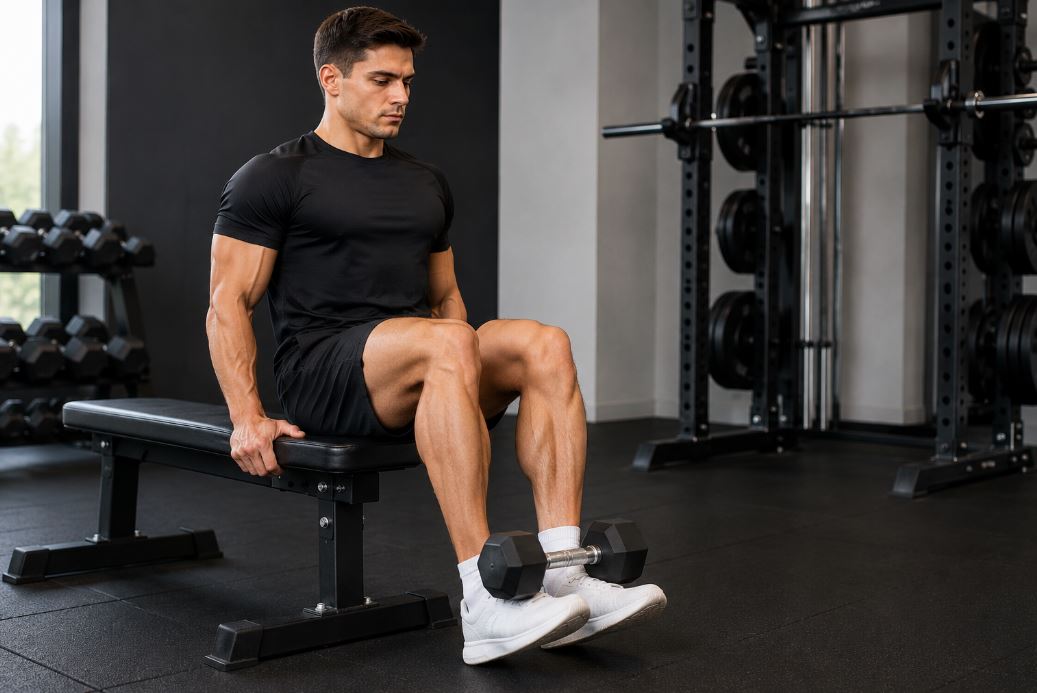
The seated dumbbell tibialis raise is an ankle dorsiflexion exercise performed while sitting on a bench with a dumbbell positioned across the feet.
The primary goal is to strengthen the tibialis anterior — the muscle responsible for pulling the foot upward toward the shin.
This movement is known as dorsiflexion.
Unlike bodyweight wall tibialis raises, the seated dumbbell version allows external loading, making it easier to progressively overload the shin muscles.
The exercise is simple but surprisingly effective when performed with:
- Controlled tempo
- Full range of motion
- Proper ankle movement
Benefits of Seated Dumbbell Tibialis Raises
Direct Tibialis Anterior Strengthening
The exercise isolates the tibialis anterior more directly than many traditional lower-body exercises.
This can help improve lower-leg muscular balance and overall shin strength.
Easy Progressive Overload
One major advantage of the dumbbell version is the ability to gradually increase resistance over time.
Even small increases in weight can significantly challenge the tibialis anterior.
Beginner-Friendly Setup
The exercise does not require complicated machines or advanced equipment.
All you need is:
- Bench
- Dumbbell
- Basic setup space
Useful for Athletes and Runners
The tibialis anterior plays an important role during:
- Running
- Sprinting
- Jumping
- Foot control
- Ankle stabilization
Stronger shin muscles may help improve lower-leg endurance and movement efficiency.
Better Lower-Leg Balance
Many people overtrain calves while completely neglecting the front side of the lower leg.
This exercise helps create more balanced lower-leg development.
How to Perform the Seated Dumbbell Tibialis Raise Properly
The setup is simple, but positioning matters.
Step 1 — Sit on a Bench
Sit upright on a bench or chair high enough so your feet can move freely.
Keep:
- Your torso upright
- Knees bent roughly 90 degrees
- Feet flat initially
Step 2 — Position the Dumbbell
Place one side of the dumbbell securely across the top of your feet.
Some people prefer:
- Holding the dumbbell manually
- Using both feet together
- Training one leg at a time
As a coach, I usually recommend starting with lighter dumbbells because the tibialis anterior fatigues quickly when isolated properly.
Step 3 — Lift the Toes Toward the Shins
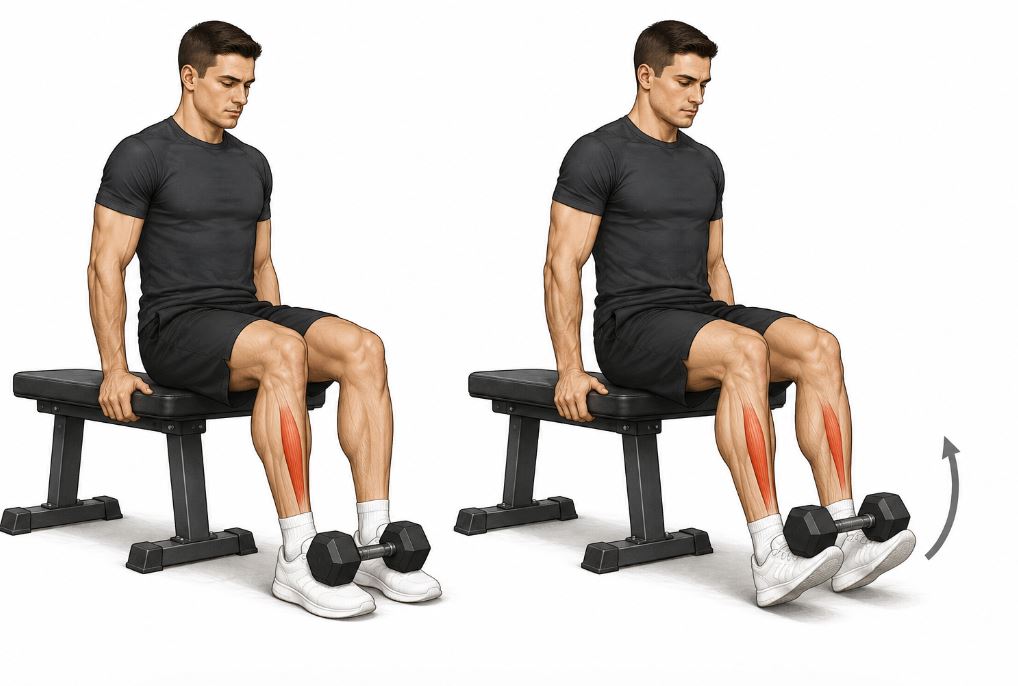
Slowly dorsiflex your ankles by lifting the front of the feet upward.
Think about pulling your toes toward your knees.
Pause briefly at the top position and squeeze the shin muscles.
Avoid:
- Swinging the feet
- Jerking the movement
- Using momentum
Step 4 — Lower the Weight Slowly
Slowly return to the starting position under control.
Do not simply let gravity drop the weight.
The lowering phase is extremely important for maintaining tension on the tibialis anterior.
Common Mistakes
Using Too Much Weight
This is one of the most common errors.
The tibialis anterior is relatively small, and excessive loading usually destroys proper movement quality.
Rushing the Repetitions
Fast repetitions reduce muscular tension and often shift stress away from the target muscles.
Controlled reps work much better.
Incomplete Range of Motion
Many people only move their feet slightly.
Try to fully dorsiflex the ankles for better tibialis activation.
Letting the Dumbbell Shift Excessively
The dumbbell should remain stable during the set.
Too much movement often disrupts exercise mechanics.
Coach’s Tips for Better Tibialis Activation
Slow Down the Eccentric
One of the best ways to increase difficulty without adding weight is to slow the lowering phase.
Try:
- 1 second up
- 1 second squeeze
- 3 seconds down
Don’t Chase Heavy Weight Too Quickly
The goal is not ego lifting.
Strict form and muscular control matter far more here than large dumbbells.
Pause at the Top
A brief pause at peak dorsiflexion often significantly improves muscle recruitment.
Train Tibialis Raises After Calves
I usually recommend placing tibialis work after calf exercises or near the end of lower-body training sessions.
This helps maintain balanced lower-leg development.
Muscles Worked
Primary Muscle Worked
Secondary Muscles Involved
- Extensor hallucis longus
- Extensor digitorum longus
- Ankle stabilizers
The tibialis anterior remains the dominant muscle throughout the movement.
Best Rep Range & Programming
The tibialis anterior generally responds very well to moderate- to high-rep training.
Recommended Rep Range
- 12–20 reps
Recommended Sets
- 2–4 sets
Training Frequency
- 2–4 sessions weekly
Because the muscle recovers relatively quickly, higher frequency is often well tolerated.
Seated Dumbbell Tibialis Raise Variations
Single-Leg Dumbbell Tibialis Raise
Train one leg at a time to improve unilateral balance and muscular symmetry.
Double Dumbbell Tibialis Raise
Use separate dumbbells on each foot for more balanced resistance.
Slow Eccentric Tibialis Raise
Increase the lowering phase to create more time under tension.
Paused Tibialis Raise
Pause for 2–3 seconds at the top position for greater contraction quality.
Who Should Do This Exercise?
This exercise may benefit:
- Runners
- Sprinters
- Jump athletes
- Soccer players
- Lifters with weak lower legs
- People seeking better ankle stability
- Individuals wanting more balanced lower-leg development
It is also a practical option for home gym users.
Replacement Exercises (Substitutes)
- Heel Walk Exercise
- Cable Tibialis Raise
- Wall Tibialis Raise
- Single-Leg Wall Tibialis Raise
- Resistance Band Tibialis Raise
- Standing Tibialis Raise
- Weight Plate Toe Raise
- Tib Bar Raise
- DARD Tibialis Raise
For a complete overview of the best shin exercises for strengthening the tibialis anterior and improving lower-leg endurance, explore our full guide to the best anterior shin exercises.
Final Thoughts
The seated dumbbell tibialis raise is one of the most practical and accessible weighted exercises for strengthening the tibialis anterior. It requires minimal equipment, allows progressive overload, and can be adjusted for nearly any experience level.
As a coach, I think exercises like this are often overlooked simply because the shin muscles are not as visually impressive as larger muscle groups. But strong tibialis anterior muscles play an important role in ankle stability, lower-leg balance, and the quality of athletic movement.
And honestly, most people only realize how weak their shin muscles are once they actually start training them properly.
Frequently Asked Questions
Can weak tibialis anterior muscles affect squat or deadlift performance?
Indirectly, yes. Weak shin muscles may contribute to reduced ankle stability and poorer lower-leg control, which can affect balance and positioning during compound lower-body exercises.
Is it normal to feel cramps in the shin muscles during tibialis raises?
Yes. Because the tibialis anterior is often undertrained, cramping or intense fatigue can occur when first introducing direct shin training. Starting with lighter resistance and slower reps usually helps.
Should I train the tibialis anterior barefoot or with shoes?
Both options can work. Training barefoot may improve foot awareness and ankle control, while shoes can provide more comfort and stability when using heavier dumbbells.
Can seated dumbbell tibialis raises improve ankle mobility?
They may help improve active ankle dorsiflexion control and strength, especially when performed through a full range of motion with controlled tempo.
Why does the tibialis anterior fatigue so quickly?
The tibialis anterior is a relatively small muscle that most people rarely train directly. Once isolated properly, it often reaches muscular fatigue much faster than larger lower-body muscle groups.
Can tibialis training help with overall lower-leg aesthetics?
Yes. Developing the tibialis anterior may create a more balanced lower-leg appearance by adding muscular development to the front side of the shin area rather than focusing only on the calves.
