Close Menu
Bodybuilding Wizard

    Subscribe to Updates

    Join our mailing list to receive the latest updates from our team.

    Facebook X (Twitter) Instagram
    Trending
    • Does Soy Lower Testosterone or Increase Estrogen in Men? What the Science Says
    • Does Training Legs Really Boost Testosterone? What the Science Says
    • Does Sauna Really Boost Growth Hormone 16x? Myth vs. Science
    • Does Power Posing Really Boost Testosterone? Myth, Science & the Retraction
    • Does Ashwagandha Really Boost Testosterone and Lower Cortisol? Myth vs. Science
    • Progesterone and Exercise: How It Affects Training, Metabolism & the Menstrual Cycle
    • Estrogen and Exercise: How Estradiol Affects Muscle, Fat, Bone Health & Performance
    • Thyroid Hormones and Metabolism: T3, T4, Muscle Growth & Fat Loss Explained
    RSS Facebook X (Twitter) LinkedIn YouTube Pinterest Instagram
    Bodybuilding Wizard
    Subscribe Login
    • Home
    • Tools
      • Interactive Muscle Anatomy
      • Interactive Human Skeleton
      • Bodybuilding & Fitness Calculators
      • Dietary & Nutrition Calculators
      • Body Measurement Calculators
      • Fitness Tests
      • Bodybuilding Glossary
      • DIY Projects
    • Training
      • Weight training basics
      • Advanced bodybuilding
      • Strength training for women
      • Workout programs
      • Home weight training programs
      • Cardio workout
      • Exercise equipment
      • Weight training accessories
      • Weight lifting injuries
      • Weight training for sports
    • Exercises
      • Chest exercises
        • Middle chest exercises
        • Upper chest exercises
        • Lower chest exercises
      • Back exercises
        • Middle back (latissimus dorsi)
        • Upper back (trapezius)
        • Lower back (erector spinae)
      • Arm exercises
        • Bicep exercises
        • Tricep exercises
        • Forearm exercises
        • Grip-strengthening exercises
      • Shoulder exercises
        • Front deltoid
        • Side deltoid
        • Rear deltoid
        • Rotator Cuff
        • Scapular & Shoulder Stability
        • Neck strengthening exercises
      • Leg and glute exercises
        • Quadricep exercises
        • Hamstring exercises
        • Calf exercises
        • Glute & Hip exercises
        • Shin exercises
      • Abdominal exercises
        • Upper abdominal exercises
        • Lower abdominal exercise
        • Oblique exercises
      • Core exercises
      • Kettlebell exercises
      • Foam rolling & Stretching
      • Explosive (dynamic) lifts
    • Motivation
      • Greatest physiques
      • Motivation techniques & tips
      • Events and competitions
      • Latest fitness news
      • Videos
        • Funny gym reels
        • Motivational videos
        • Funny workout videos
      • Pictures
      • Quotes
      • Funny Fitness
      • Transformations
    • Diet
      • Nutrition Fundamentals
      • Diet Types & Strategies
      • Foods & Superfoods for Athletes
      • Muscle Building & Performance Nutrition
      • Weight Loss & Fat Management
      • Food Psychology & Myths
      • Recipes & Meal Ideas
    • Supplements
      • Supplements Review
      • Muscle Building Supplements
      • Anabolic Steroids
      • Fat Burners & Weight Loss
      • Pre-Workout & Energy Boosters
      • Recovery & Sleep Aids
      • Cognitive & Nootropic Support
      • General Supplement Advice
      • Health Supplements
        • Joint & Bone Support
        • Gut Health & Digestion
        • Vitamins & Minerals
        • Superfoods & Greens
      • Steroid Alternatives
    • Anatomy
      • Upper-Body Muscles
      • Lower-Body Muscles
      • Bones & Skeletal Anatomy
      • Muscle Growth & Genetics
      • Joints, Tendons & Connective Tissue
      • Hormones & Endocrine System
      • Physiology & Body Systems
      • Body Composition & Fat
      • General Anatomy & Basics
    • Health
    Bodybuilding Wizard
    You are at:Home»Anatomy»Lower-Body Muscles»Meet the Muscles that Help Push
    muscles that help push
    Lower-Body Muscles

    Meet the Muscles that Help Push

    No Comments6 Mins ReadkrunoslavBy krunoslavAugust 9, 2021Updated:November 24, 2025
    Share
    Facebook Twitter Pinterest LinkedIn Email Tumblr WhatsApp Telegram

    Do you know what are the major muscles that help push, pull, or swing? If not sure, this article is the right place to start. Here we’ll examine all the muscles that help in generating pushing movement. Maybe you’re already asking yourself why this is relevant to know. Well, here’s why! The mission of the push, pull, swing concept is to ensure that you engage all of your muscles, not just the ones that look good in a mirror, during your workouts. Furthermore, for a successful strength training you need to incorporate an equal number of pushing and pulling movements to obtain and keep muscular balance.

    We can divide all major muscles in our body in a simple and very understandable way according to the function they perform:

    • Pushing muscles. Muscles that help generate pushing movement. When you perform push exercises, you carry out movements in which you push the weight or resistance away from your body (during the concentric portion of the movement).
    • Pulling muscles. Muscles in the human body that help generate pulling movement. When you perform pull exercises, you carry out movement in which the muscle pulls weight toward the body during the concentric portion of the movement and then lengthens as the weight moves away from the body during the eccentric portion of the exercise.
    • Muscles that help push and pull at the same time.
    • Swinging muscles. These muscles assist and support in moving your torso through various planes of motion. For example, bending your body from side to side, twisting right and left, lowering and rising your torso, etc.

    Major pushing muscles in the human body

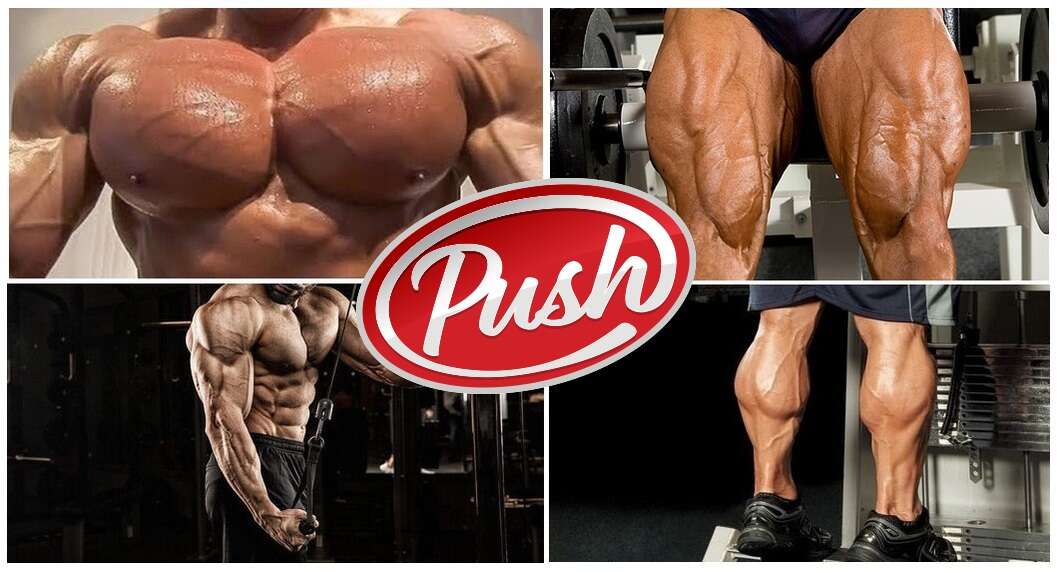
    Here you will find a brief description of all the major muscles in the human body that help generate pushing movements. Muscles that help push are the following: pectorals, triceps, quadriceps, and calves. Yes, you have noticed well. Shoulders are not classified in this category despite the fact that you push the weight away from your body when you do barbell or shoulder presses. Pushing exercises include push-ups, bench presses, back squats, triceps overhead presses, forward lunges, calf raises, and countless other exercises.

    Chest (Pectorals)

    You actually have two separate groups of muscles that make up your chest. The larger of the two is the pectoralis major, the top layer that lies closest to your skin. The fibers of this muscle originate at three locations: your collarbone, your breastbone, and your ribs just below your breastbone. From there, the fibers stretch across both sides of your chest in a fan shape, starting wide at the center of your body and tapering together at the sides of your body to attach to the top of your humerus (upper arm bone).

    The smaller of the two muscle groups is the pectoralis minor, which rests underneath your pectoralis major. This thinner, more triangular muscle starts at your third, fourth, and fifth ribs and attaches near your shoulder joint.

    HOW THEY WORK: Together, both muscles are responsible for moving your upper arms toward the center of your body and assist with drawing your shoulders forward. Whenever you either push a weight above your chest or push your body away from a stationary object (like the floor, when performing a pushup), your pectorals shorten in order to pull your arms across your chest and bring them together.

    Triceps Brachii

    Located along the backs of your upper arms, your triceps are composed of three separate muscles, or heads: the lateral head, the medial head, and the long head. The three heads each start at one of two locations—your upper arm bone or your shoulder blade – then come together at your forearm, attaching to a tendon that connects to your elbow bone.

    HOW THEY WORK: All three heads work together to extend your elbows. This is what you’re doing every time you straighten your arm from a bent position. This happens whenever you push a weight over your head or above your chest, for example. However, your triceps brachii also help out with other jobs. Foe example, they are stabilizing your shoulder joints during certain pushing movements and aiding your upper back muscles with arm adduction (which happens when you bring your arms down and back toward your body).

    Quadriceps

    Your quads – the muscles that rest along the fronts of your thighs – divide into four separate heads: the vastus intermedius, the rectus femoris, the vastus lateralis, and the vastus medialis. The vastus intermedius attaches to and covers much of the front and sides of your femur (your thighbone) but is not visible, as it lies below the rectus femoris. The rectus femoris starts at your pelvis and runs down your thigh in front of the vastus intermedius. The vastus lateralis and medialis begin at the back of your femur laterally and medially, respectively. All four quadricep muscles run down your thigh and converge at the patellar tendon, which attaches along the upper part of your tibia (shinbone).

    HOW THEY WORK: Your quadriceps are mainly responsible for extending your knees (straightening your legs). However, they also help to support and stabilize your knee joints, particularly the inner and outer sides. Because many of the pushing exercises that target your quadriceps also involve your lower legs. your quads often work in unison with your calves.

    Calf muscles (calves)

    Along the backs of your lower legs are two sets of muscle groups: the gastrocnemius and the soleus. The gastrocnemius (the larger of the two) is the one you can see. The soleus is hidden underneath the gastrocnemius and attaches just below your knee and at your Achilles tendon. Together, both sets of muscles combine to form the diamond-shaped muscle that extends from the back of your knee to your ankle.

    HOW THEY WORK: The gastrocnemius’s job is to flex your foot, which is what you do whenever you elevate your heels. The soleus does the exact same thing, but only when your knees are bent.

    Closing thoughts: Muscles that help push 

    Muscles in the human body that help perform pushing movements are: chest (pectorals), triceps brachii, quadriceps, and calves. In a resistance training routine, it’s important to balance pushing and pulling exercises. Whether a plan works your entire body or focuses on specific body parts, incorporating push and pull exercises is crucial to overall strength, muscular development, and muscular balance.

    Share. Facebook Twitter Pinterest LinkedIn Tumblr Email WhatsApp
    krunoslav
    • X (Twitter)

    Hey! My name is Kruno, and I'm the owner and author of Bodybuilding Wizard. I am a licensed fitness trainer with a Ph.D. in kinesiology. Throughout my career, I have dedicated myself to helping individuals achieve their health and fitness goals through personalized training programs. In addition to my academic qualifications, I have completed various specialized courses, including certifications in nutrition and strength training, which have further enhanced my ability to provide comprehensive fitness guidance. I started this website back in late 2014, and it has been my pet project ever since. My goal is to help you learn proper weight training and nutrition principles so that you can get strong and build the physique of your dreams!

    Related Posts

    Major Upper Body Muscles: Complete Anatomy Guide

    The Anatomy of Biceps Femoris: The Only Hamstring with Two Heads

    The Anatomy of Semimembranosus: The Broadest of the Three Hamstring Muscles

    Leave A Reply Cancel Reply

    You must be logged in to post a comment.

    WE ARE SOCIAL
    • Facebook 3.6K
    • Twitter
    • YouTube 133
    • Instagram
    RECENT POSTS
    August 27, 2026

    Does Soy Lower Testosterone or Increase Estrogen in Men? What the Science Says

    August 26, 2026

    Does Training Legs Really Boost Testosterone? What the Science Says

    August 24, 2026

    Does Sauna Really Boost Growth Hormone 16x? Myth vs. Science

    August 24, 2026

    Does Power Posing Really Boost Testosterone? Myth, Science & the Retraction

    August 23, 2026

    Does Ashwagandha Really Boost Testosterone and Lower Cortisol? Myth vs. Science

    RECENT COMMENTS
    • Justin Dew on Designing your own home gym
    • krunoslav on Meet Your Muscles: How muscles are named?
    • Christina on Meet Your Muscles: How muscles are named?
    • igtropin on Stiff-Leg Deadlift: Proper Form, Muscles Worked & Hamstring Growth Guide
    • teragon labs on Barbell Back Squat: Proper Form, Benefits, Muscles Worked & Expert Tips
    LATEST GALLERIES

    Subscribe to Updates

    Join our mailing list to receive the latest updates from our team.

    ABOUT
    ABOUT

    We are a group of bodybuilding enthusiasts and this is our effort to have all the details about bodybuilding on a single website. We strive to educate and inform our visitors so that they can make the correct training, nutrition, and supplement decisions on their own. Bodybuilding Wizard will make your dream body your reality and take you to a whole new level!

    POPULAR POSTS
    April 2, 2014

    Lying Leg Curl: Complete Guide to Hamstring Isolation, Strength & Muscle Growth

    February 18, 2019

    Meet Your Muscles: How muscles are named?

    March 28, 2014

    Free weights: The main tool for building muscles

    BODYBUILDING WIZARD
    Bodybuilding Wizard Footer Logo
    Facebook X (Twitter) Instagram Pinterest YouTube
    • About
    • Authors
    • Editorial Policy
    • Write for us
    • Privacy
    • Contact
    • Terms of Use
    • Advertising
    • FAQ
    Copyright © 2014-2026 BodybuildingWizard. All rights reserved. Powered by WordPress. Made with love and lots of caffeine.

    Type above and press Enter to search. Press Esc to cancel.

    Sign In or Register

    Welcome Back!

    Login to your account below.

    Lost password?